 plumi
What happens to products at the end of their useful life?: OCR GCSE Combined Science B questions
Every OCR GCSE Combined Science B exam question on C4.4 What happens to products at the end of their useful life?, 2018–2025, with its mark scheme and examiner’s report.
Paper
All papers
Exam
All years
Calculations
Q8(c)
The whole paper ↗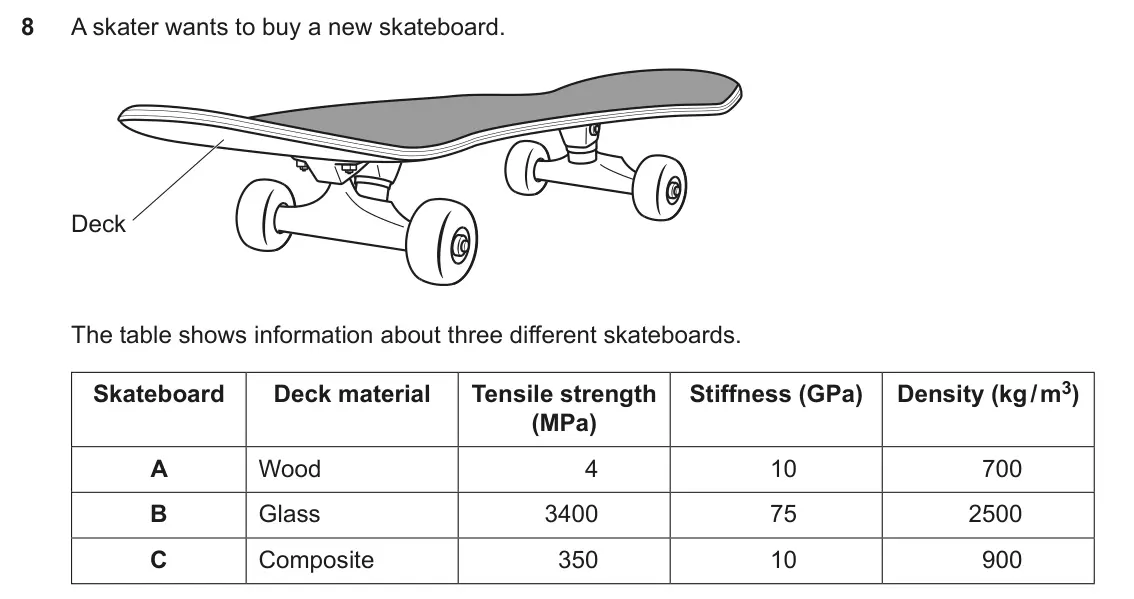
Q8(c)(i)
The whole paper ↗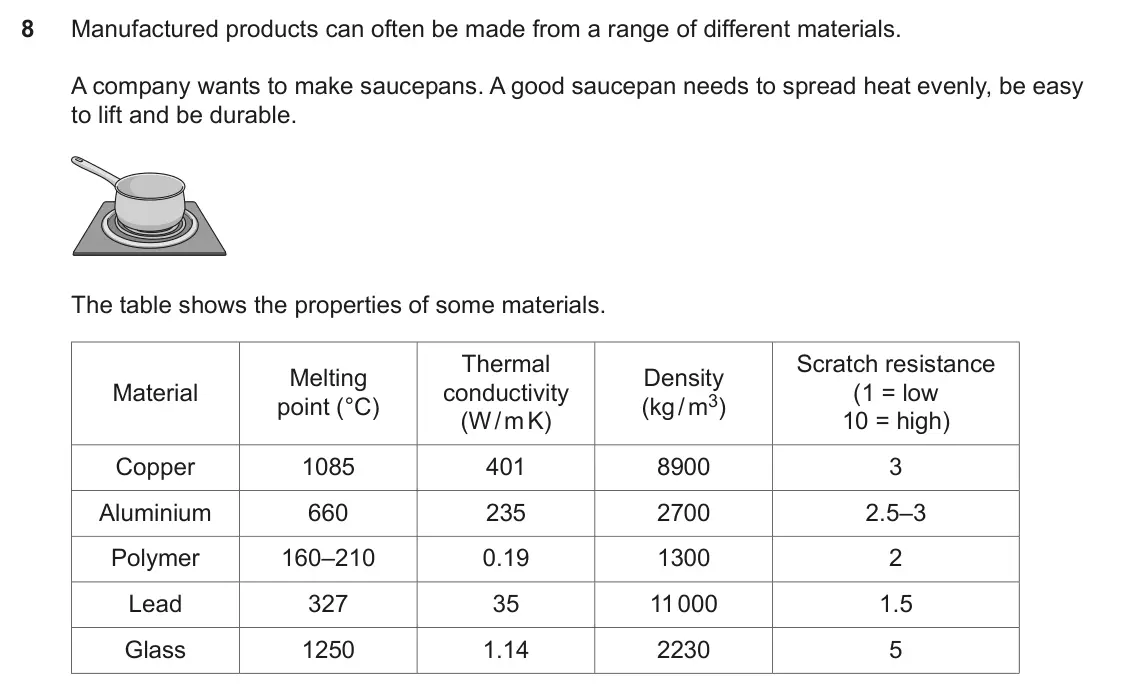
Q8(c)(ii)
The whole paper ↗Q5(a)
The whole paper ↗Q2(a)(i)
The whole paper ↗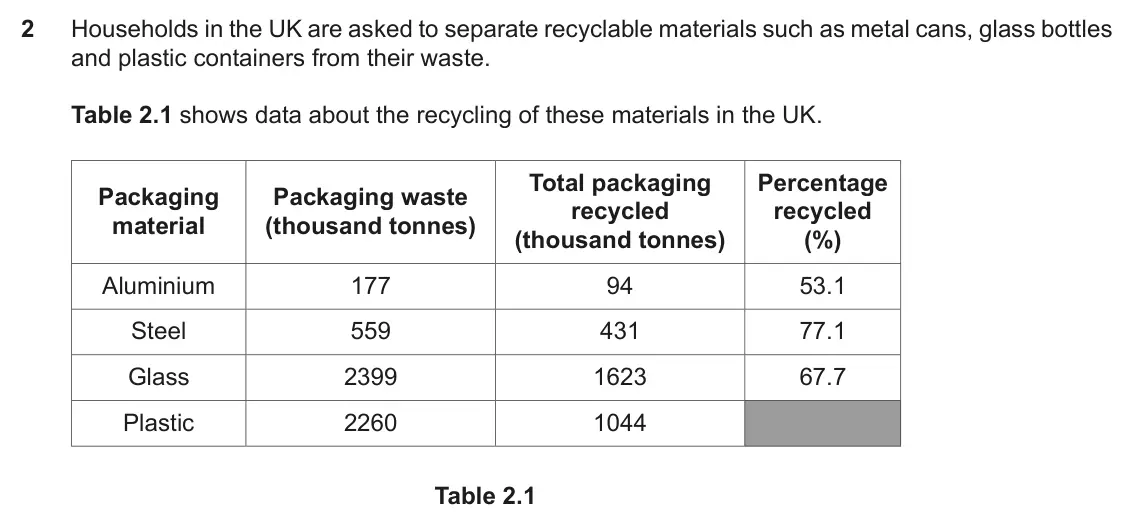
Q2(a)(ii)
The whole paper ↗Q2(b)(i)
The whole paper ↗Q2(b)(ii)
The whole paper ↗Q2(b)(iii)
The whole paper ↗Q4(a)
The whole paper ↗
Q4(b)(i)
The whole paper ↗Q4(b)(ii)
The whole paper ↗Q4(b)(iii)
The whole paper ↗Q4(b)(iv)
The whole paper ↗Q4(c)(i)
The whole paper ↗Q4(c)(ii)
The whole paper ↗Q3(c)
The whole paper ↗Q5(a)(i)
The whole paper ↗
Q5(a)(ii)
The whole paper ↗
All 26 questions on What happens to products at the end of their useful life?, as a list
- June 2025, Combined Science Paper 4 Foundation, Q8(c) (1 mark): The skater decides to recycle the old skateboard so that it does not take up space in landfill. State one other factor that should also be considered when dispo
- June 2023, Chemistry Paper 6 Higher, Q8(c)(i) (2 marks): One of the things considered during the manufacturing stage of the process is the use of the raw materials. Describe two other resources which should be conside
- June 2023, Chemistry Paper 6 Higher, Q8(c)(ii) (1 mark): Describe one other stage of a product’s lifetime which should be considered in a life-cycle assessment. [1]
- June 2023, Combined Science Paper 8 Higher, Q5(a) (6 marks): (a)* A supermarket wants to buy new shopping bags for their customers. They look at some data comparing the global warming potential (GWP) of different bags. GW
- November 2021, Combined Science Paper 4 Foundation, Q2(a)(i) (1 mark): Which packaging material produces the highest amount of packaging waste? Use data from Table 2.1. Put a ring around the correct answer. Aluminium Glass Plastic
- November 2021, Combined Science Paper 4 Foundation, Q2(a)(ii) (3 marks): Calculate the percentage of plastic recycled. Use data from Table 2.1. Use the equation: percentage recycled = total packaging recycled × 100 packaging waste Gi
- November 2021, Combined Science Paper 4 Foundation, Q2(b)(i) (2 marks): Which packaging material has the UK been most successful in recycling? Use data from Table 2.2 to explain your answer. [2]
- November 2021, Combined Science Paper 4 Foundation, Q2(b)(ii) (1 mark): Household waste for recycling is sent to a sorting centre. Steel contains iron. Suggest how the sorting centre could separate the steel cans from the aluminium
- November 2021, Combined Science Paper 4 Foundation, Q2(b)(iii) (2 marks): Producing glass from recycled materials uses less energy than producing glass from new resources. Name two other factors that would be important when deciding t
- November 2021, Combined Science Paper 8 Higher, Q7 (6 marks): 7* Beth is looking at a life-cycle assessment diagram for a plastic bottle made from the polymer HDPE. The energy used in the life-cycle of one plastic bottle i
- November 2020, Chemistry Paper 2 Foundation, Q4(a) (2 marks): Which two statements explain why plants are more sustainable raw materials than crude oil? Tick (3) two boxes. Crude oil is finite. Crude oil is found undergrou
- November 2020, Chemistry Paper 2 Foundation, Q4(b)(i) (2 marks): What should be considered when completing a life-cycle assessment for both polyester shirts and cotton shirts? Tick (3) two boxes. The amount that workers are p
- November 2020, Chemistry Paper 2 Foundation, Q4(b)(ii) (2 marks): Calculate the difference in the total energy used for the production of the two fabrics from raw materials. Use data from the table. Difference in total energy
- November 2020, Chemistry Paper 2 Foundation, Q4(b)(iii) (2 marks): Give two advantages to the environment of making polyester fabric rather than cotton fabric. Use data from the table to support your answers. 1. 2. [2]
- November 2020, Chemistry Paper 2 Foundation, Q4(b)(iv) (1 mark): Give one disadvantage to the environment of making polyester fabric rather than cotton fabric. Use data from the table to support your answer. [1]
- November 2020, Chemistry Paper 2 Foundation, Q4(c)(i) (2 marks): There are many different methods of disposing of shirts at the end of their life-cycle. The table gives some information about disposal by burning. Suggest two
- November 2020, Chemistry Paper 2 Foundation, Q4(c)(ii) (1 mark): When shirts are disposed of by burning, energy is released. Suggest one use for this energy. [1]
- November 2020, Combined Science Paper 4 Foundation, Q3(c) (2 marks): Suggest which material costs the least to recycle. Use data from Table 3.1 to explain your answer. [2]
- June 2018, Combined Science Paper 4 Foundation, Q5(a)(i) (1 mark): Which statement about the behaviour of polymers in seawater is correct? Tick (✓) one box. HDPE waste would float in seawater, but LDPE would sink. PET waste wou
- June 2018, Combined Science Paper 4 Foundation, Q5(a)(ii) (2 marks): A study identified the types of plastic litter in samples of seawater. Some of the results are shown in Table 5.2. Type of plastic litter Amount of plastic litt
- June 2018, Combined Science Paper 4 Foundation, Q5(a)(iii) (2 marks): The samples of plastic litter were analysed and the type of polymer was identified. The main types of polymer found are shown in the pie chart. acrylic polyuret
- June 2018, Combined Science Paper 4 Foundation, Q5(b) (4 marks): PET is the main type of polymer used for manufacturing plastic drinks’ bottles. Describe one of the processes for recycling PET from drinks’ bottles. [4]
- June 2018, Combined Science Paper 4 Foundation, Q5(c)(i) (2 marks): The scientists think that the bacterium may be useful in the recycling of PET. Suggest two ways in which the bacterium might improve recycling. 1 2 [2]
- June 2018, Combined Science Paper 8 Higher, Q4(a)(i) (3 marks): Which statements about the Life Cycle Assessment for PET bottles are true, and which are false? Put a tick (✓) in one box in each row. True False (✓) (✓) Coal,
- June 2018, Combined Science Paper 8 Higher, Q4(a)(ii) (4 marks): Describe one of the processes used to recycle PET drinks bottles. [4]
- June 2018, Combined Science Paper 8 Higher, Q4(b)(i) (1 mark): Suggest one way in which the bacterium might improve recycling. [1]
Questions, mark schemes and examiner’s reports are © OCR, from their published past papers. Plumi isn’t affiliated with any exam board. Want whole papers? Full past papers.
Rather write your answers by hand on iPad? Plumi marks them against the same mark schemes.