 plumi
What does the Periodic Table tell us about elements?: OCR GCSE Combined Science B questions
Every OCR GCSE Combined Science B exam question on C2.2 What does the Periodic Table tell us about elements?, 2018–2025, with its mark scheme and examiner’s report.
Paper
All papers
Exam
All years
Calculations
Q3(a)
The whole paper ↗
Q3(b)
The whole paper ↗Q6(a)(i)
The whole paper ↗
Q6(a)(ii)
The whole paper ↗Q6(a)(iii)
The whole paper ↗Q6(c)(i)
The whole paper ↗Q6(c)(ii)
The whole paper ↗Q1(a)(i)
The whole paper ↗Q8(d)
The whole paper ↗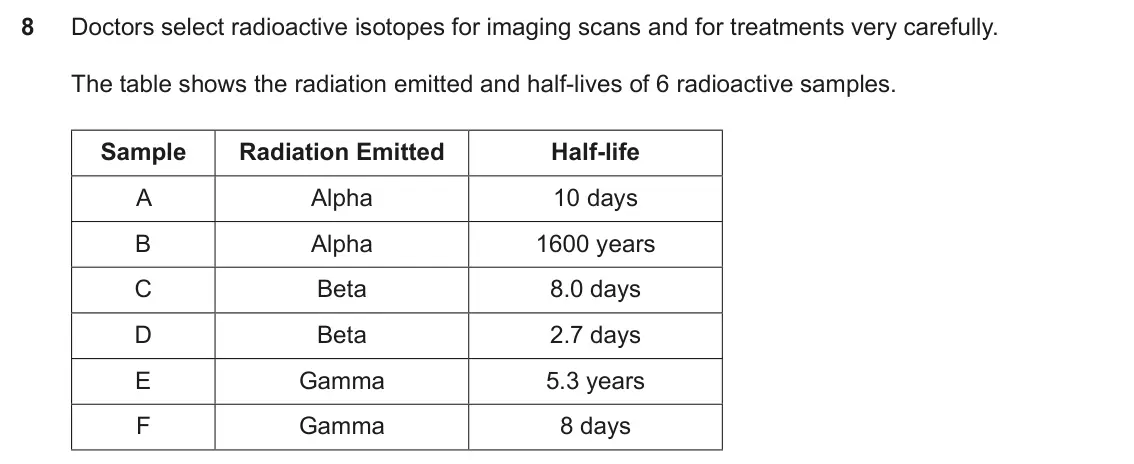
Q8(e)
The whole paper ↗Q3(d)
The whole paper ↗
Q1(d)
The whole paper ↗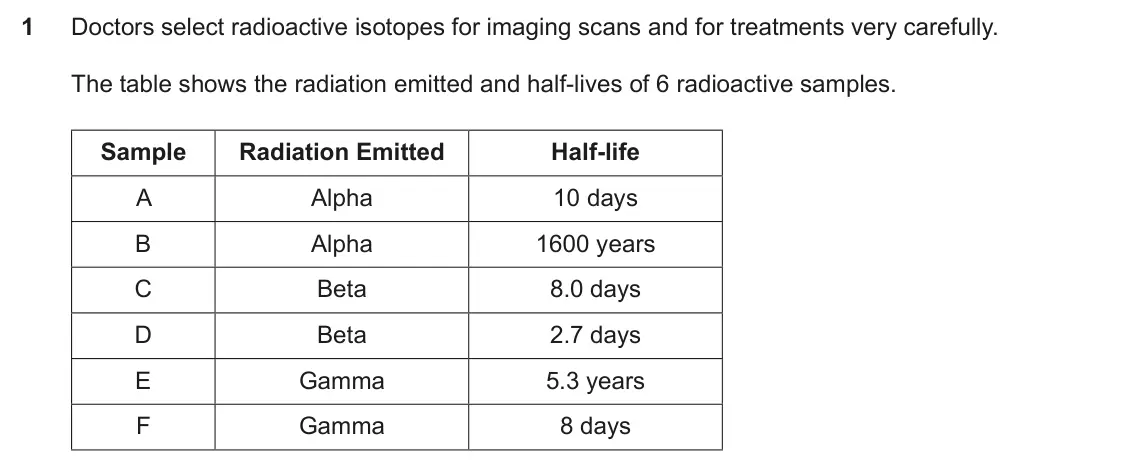
Q1(e)
The whole paper ↗Q1(a)
The whole paper ↗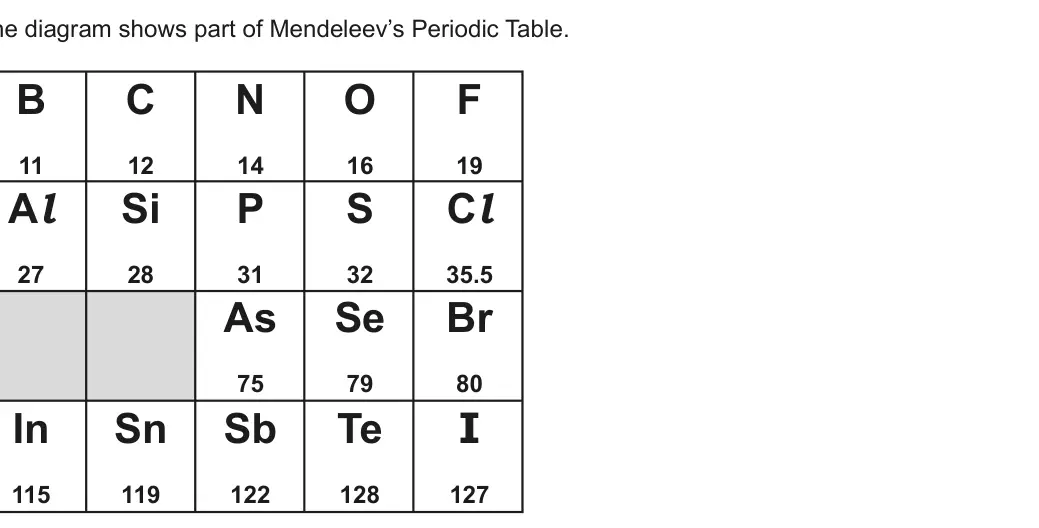
Q1(b)(i)
The whole paper ↗Q1(b)(ii)
The whole paper ↗Q1(c)
The whole paper ↗Q1(d)(ii)
The whole paper ↗Q4(b)
The whole paper ↗
Q4(c)
The whole paper ↗
All 67 questions on What does the Periodic Table tell us about elements?, as a list
- June 2025, Chemistry Paper 2 Foundation, Q3(a) (2 marks): Draw lines to connect each element with its colour at room temperature. Element Colour at room temperature Chlorine Grey Bromine Brown-red Iodine Yellow-green [
- June 2025, Chemistry Paper 2 Foundation, Q3(b) (2 marks): The table shows some properties of different halogens. Formula Boiling Reaction with hydrogen point (°C) Fluorine F2 –188 Explodes when cold and in the absence
- June 2025, Chemistry Paper 6 Higher, Q6(a)(i) (3 marks): Explain why the halogens all form molecules containing two identical atoms. Use ideas about electrons and bonding. [3]
- June 2025, Chemistry Paper 6 Higher, Q6(a)(ii) (1 mark): Predict the reaction of bromine with hydrogen. [1]
- June 2025, Chemistry Paper 6 Higher, Q6(a)(iii) (3 marks): Explain the trend in boiling points shown in the table. Use ideas about energy and forces. [3]
- June 2025, Chemistry Paper 6 Higher, Q6(c)(i) (3 marks): In the reaction, chlorine reacts with iodide ions to form chloride ions and iodine. Write the balanced ionic equation for the reaction. Include state symbols. [
- June 2025, Chemistry Paper 6 Higher, Q6(c)(ii) (2 marks): The table shows what happens when some halogens are added to aqueous solutions of metal halides. Complete the table. Use the Data Sheet. Halogen Metal halide Re
- June 2024, Chemistry Paper 2 Foundation, Q1(a)(i) (5 marks): Complete Table 1.1. Use the Data Sheet. [5]
- June 2024, Combined Science Paper 4 Foundation, Q8(d) (2 marks): How many outer shell electrons does each radium-226 atom have? Explain your answer. Use the Data and Equation Sheet. Number of outer-shell electrons Explanation
- June 2024, Combined Science Paper 4 Foundation, Q8(e) (1 mark): Another of the radioactive isotopes in the table is iodine-131. Which element will most readily react with iodine-131 to form a salt? Tick (✓) one box. Copper G
- June 2024, Chemistry Paper 6 Higher, Q3(d) (2 marks): The properties of elements depend on the electron arrangements of their atoms. The electron arrangement of magnesium is 2.8.2. The electron arrangement of fluor
- June 2024, Combined Science Paper 8 Higher, Q1(d) (2 marks): How many outer shell electrons does each radium-226 atom have? Explain your answer. Use the Data and Equation Sheet. Number of outer-shell electrons Explanation
- June 2024, Combined Science Paper 8 Higher, Q1(e) (1 mark): Another of the radioactive isotopes in the table is iodine-131. Which element will most readily react with iodine-131 to form a salt? Tick (✓) one box. Copper G
- June 2023, Chemistry Paper 2 Foundation, Q1(a) (1 mark): Give the symbols of the two elements shown in the diagram which are not in order of atomic mass. and [1]
- June 2023, Chemistry Paper 2 Foundation, Q1(b)(i) (2 marks): Name the two elements that had not been discovered when Mendeleev wrote his Periodic Table. Use the diagram and the Data Sheet. and [2]
- June 2023, Chemistry Paper 2 Foundation, Q1(b)(ii) (1 mark): Describe how the discovery of new elements supported Mendeleev’s decision to leave gaps. [1]
- June 2023, Chemistry Paper 2 Foundation, Q1(c) (2 marks): The table shows the atomic number and electron arrangement of some of the elements in Group 1 of the modern Periodic Table. Element Atomic number Electron arran
- June 2023, Chemistry Paper 2 Foundation, Q1(d)(ii) (2 marks): Describe an experiment to show that the reactivity of the Group 1 elements increases down the group. [2]
- June 2023, Chemistry Paper 2 Foundation, Q4(b) (1 mark): The halogens all react with iron wool. The reactivity of the halogens decreases down Group 17(7). The table shows the reactions when iron wool is put into jars
- June 2023, Chemistry Paper 2 Foundation, Q4(c) (2 marks): Aqueous solutions of the halogens react with aqueous solutions of less reactive halides. Alex plans an experiment to find the order of reactivity of some haloge
- June 2023, Chemistry Paper 6 Higher, Q5(c)(i) (1 mark): Why are Group 0 elements very unreactive? [1]
- June 2023, Chemistry Paper 6 Higher, Q5(c)(ii) (2 marks): Give two physical properties of Group 0 elements. 1 2 [2]
- June 2023, Chemistry Paper 6 Higher, Q5(d)(i) (1 mark): Complete the symbol equation for the reaction of sodium with water. sodium + water sodium hydroxide + hydrogen 2 + 2 2NaOH + [1]
- June 2023, Chemistry Paper 6 Higher, Q5(d)(ii) (2 marks): Complete the table by predicting the observations for the reaction of rubidium with water. Formula of Element Observations hydroxide Fizzes steadily; slowly bec
- June 2022, Chemistry Paper 2 Foundation, Q4(a) (3 marks): Complete the table to describe the difference in the properties of metals and non-metals. Use words from the list. dull high low shiny Property Metals Non-metal
- June 2022, Chemistry Paper 2 Foundation, Q4(c)(i) (2 marks): Complete the table to show the position of these two elements in the Periodic Table. Use the Data Sheet. Period Group Sodium Oxygen [2]
- June 2022, Chemistry Paper 2 Foundation, Q7(a)(i) (1 mark): Name the most reactive member of Group 17(7). [1]
- June 2022, Chemistry Paper 2 Foundation, Q7(a)(ii) (1 mark): Name one member of Group 17(7) that is not shown in Table 7.1. [1]
- June 2022, Chemistry Paper 2 Foundation, Q7(a)(iii) (3 marks): Predict the state and colour at 20 °C, the reaction with iron wool and the product of the reaction for the element identified in (ii). State and colour at 20 °C
- June 2022, Chemistry Paper 6 Higher, Q3(a) (1 mark): Describe one other property, not shown in Table 3.1, which is different for metals and non-metals. [1]
- November 2021, Chemistry Paper 2 Foundation, Q1(a)(i) (1 mark): What information did Mendeleev use to help him decide the order of the elements? Tick (✓) one box. Alphabetical order Colour Date discovered Relative atomic mas
- November 2021, Chemistry Paper 2 Foundation, Q1(a)(ii) (1 mark): Mendeleev left gaps in the table. Give one reason why he needed to leave gaps. [1]
- November 2021, Chemistry Paper 2 Foundation, Q1(b)(i) (2 marks): Fig. 1.1 shows the electron arrangement in a lithium atom. Li Fig. 1.1 Draw lines to connect each statement about the number and arrangement of electrons in a l
- November 2021, Chemistry Paper 2 Foundation, Q1(b)(ii) (2 marks): The properties of an element depend on the arrangement of electrons in its atoms. Lithium and fluorine have different arrangements of electrons, and different p
- November 2021, Combined Science Paper 4 Foundation, Q7(a) (2 marks): Krypton is a Group 0 element. Which two statements are properties of krypton? Tick (✓) two boxes. It forms positive ions when reacting. It is a gas at room temp
- November 2021, Combined Science Paper 4 Foundation, Q7(b) (2 marks): The table shows some properties of the Group 1 elements. Complete the table by predicting the reaction of caesium with water, and the melting point of rubidium.
- November 2021, Combined Science Paper 4 Foundation, Q7(e) (1 mark): Which scientist developed the Periodic Table? Tick (✓) one box. Dalton Thomson Mendeleev Rutherford [1]
- November 2021, Chemistry Paper 6 Higher, Q3(a)(i) (1 mark): How did leaving these gaps help him to arrange the other elements into groups? Use ideas about properties of elements in your answer. [1]
- November 2021, Chemistry Paper 6 Higher, Q3(a)(ii) (2 marks): How did the work of later scientists show that he was correct to leave gaps? [2]
- November 2021, Chemistry Paper 6 Higher, Q3(a)(iii) (1 mark): What is unusual about the positions of Te and I? [1]
- November 2021, Chemistry Paper 6 Higher, Q3(b)(i) (3 marks): Fig. 4.1 shows the arrangement of electrons in lithium and fluorine. Li F Lithium Fluorine Fig. 4.1 How does the arrangement of electrons in lithium relate to i
- November 2021, Chemistry Paper 6 Higher, Q7 (6 marks): 7* Layla investigates the trend in reactivity of the Group 7 elements, using these solutions: Chlorine water Potassium chloride Iodine water Potassium iodide Br
- November 2021, Combined Science Paper 8 Higher, Q5(b) (2 marks): Give one property of Group 1 elements and one property of Group 7 elements. Property of Group 1 elements Property of Group 7 elements [2]
- November 2020, Chemistry Paper 2 Foundation, Q1(a)(ii) (2 marks): The Periodic Table shows information about atoms of sulfur. What is the group number and period number for sulfur? Use the Data Sheet. Group number = Period num
- November 2020, Chemistry Paper 2 Foundation, Q9(b)(i) (2 marks): Magnesium is a metal and phosphorus is a non-metal. They have different electron arrangements. Electron arrangement Magnesium 2.8.2 Phosphorus 2.8.5 How do the
- November 2020, Chemistry Paper 2 Foundation, Q9(b)(ii) (1 mark): The electron arrangement of argon is 2.8.8. What does this tell you about the reactivity of argon? [1]
- November 2020, Chemistry Paper 6 Higher, Q2(b)(i) (2 marks): Magnesium is a metal and phosphorus is a non-metal. They have different electron arrangements. Electron arrangement Magnesium 2.8.2 Phosphorus 2.8.5 How do the
- November 2020, Chemistry Paper 6 Higher, Q2(b)(ii) (1 mark): The electron arrangement of argon is 2.8.8. What does this tell you about the reactivity of argon? [1]
- November 2020, Combined Science Paper 8 Higher, Q4(b)(i) (1 mark): Predict the reaction of strontium with water. [1]
- November 2020, Combined Science Paper 8 Higher, Q4(b)(ii) (6 marks): (ii)* Table 4.2 shows the melting point of some Group 2 oxides. Oxide Melting point (°C) Magnesium oxide 2852 Calcium oxide 2572 Strontium oxide 2531 Barium oxi
- June 2019, Chemistry Paper 2 Foundation, Q1(a) (2 marks): Which of the following statements about the atoms of all group 1 elements are true and which are false? Tick (3) one box in each row. Statement True False They
- June 2019, Chemistry Paper 2 Foundation, Q1(b) (2 marks): The elements on the left of the periodic table are all metals. Which two statements about atoms of these elements are true? Tick (3) two boxes. They have a smal
- June 2019, Chemistry Paper 2 Foundation, Q1(c)(i) (2 marks): How do the observations show the trend in reactivity going down Group 1 of the Periodic Table? [2]
- June 2019, Chemistry Paper 2 Foundation, Q1(c)(ii) (2 marks): All the metals fizz when added to water and the universal indicator turns blue. Draw lines to connect each observation with the product that causes it. Observat
- June 2019, Chemistry Paper 6 Higher, Q5(a) (2 marks): Give one similarity and one difference in the way that the electron arrangement of Lithium is the same as the electron arrangements of other atoms in Group 1 of
- June 2019, Chemistry Paper 6 Higher, Q5(b) (2 marks): Explain why elements on the left of the Periodic Table are metals. [2]
- June 2019, Chemistry Paper 6 Higher, Q5(c)(i) (2 marks): Name the two products of the reaction between lithium and water. and [2]
- June 2019, Chemistry Paper 6 Higher, Q5(c)(ii) (2 marks): What two changes will Beth see when these products form? 1. 2. [2]
- June 2019, Chemistry Paper 6 Higher, Q5(c)(iii) (2 marks): Beth repeats her experiment with sodium and then potassium. She uses fresh water and indicator each time. How will the observations from her experiments show th
- June 2018, Chemistry Paper 2 Foundation, Q1(a) (2 marks): Mendeleev developed the first Periodic Table. He looked for patterns in the properties of elements. He discovered that by putting the elements in order of their
- June 2018, Chemistry Paper 2 Foundation, Q1(b) (5 marks): The modern Periodic Table puts elements in order of their atomic number. Table 1.1 shows some information about fluorine and sodium. Use the Periodic Table to h
- June 2018, Chemistry Paper 2 Foundation, Q9(a) (3 marks): Each element has a different state and colour at room temperature. Draw lines to connect each element with its correct state and colour at room temperature. Sta
- June 2018, Chemistry Paper 2 Foundation, Q9(b)(i) (1 mark): Describe the trend in reactivity of the Group 7 elements with hydrogen. [1]
- June 2018, Chemistry Paper 2 Foundation, Q9(b)(ii) (2 marks): A mixture of chlorine and hydrogen explodes when a small spark is added. Does this fit the trend of the reactivity of the other Group 7 elements with hydrogen?
- June 2018, Chemistry Paper 6 Higher, Q1(a) (3 marks): Each element has a different state and colour at room temperature. Draw lines to connect each element with its correct state and colour at room temperature. Sta
- June 2018, Chemistry Paper 6 Higher, Q1(b)(i) (1 mark): Describe the trend in reactivity of the Group 7 elements with hydrogen. [1]
- June 2018, Chemistry Paper 6 Higher, Q1(b)(ii) (2 marks): A mixture of chlorine and hydrogen explodes when a small spark is added. Does this fit the trend of the reactivity of the other Group 7 elements with hydrogen?
Questions, mark schemes and examiner’s reports are © OCR, from their published past papers. Plumi isn’t affiliated with any exam board. Want whole papers? Full past papers.
Rather write your answers by hand on iPad? Plumi marks them against the same mark schemes.