 plumi
What determines the current in an electric circuit?: OCR GCSE Combined Science B questions
Every OCR GCSE Combined Science B exam question on P3.1 What determines the current in an electric circuit?, 2018–2025, with its mark scheme and examiner’s report.
Paper
All papers
Exam
All years
Calculations
Q6(a)
The whole paper ↗
Q6(b)(i)
The whole paper ↗Q6(b)(ii)
The whole paper ↗Q6(b)(iii)
The whole paper ↗Q7(a)
The whole paper ↗
Q7(b)(i)
The whole paper ↗Q7(b)(ii)
The whole paper ↗Q6(a)
The whole paper ↗Q9(a)
The whole paper ↗Q9(b)(i)
The whole paper ↗Q9(b)(ii)
The whole paper ↗Q9(b)(iii)
The whole paper ↗Q7(c)
The whole paper ↗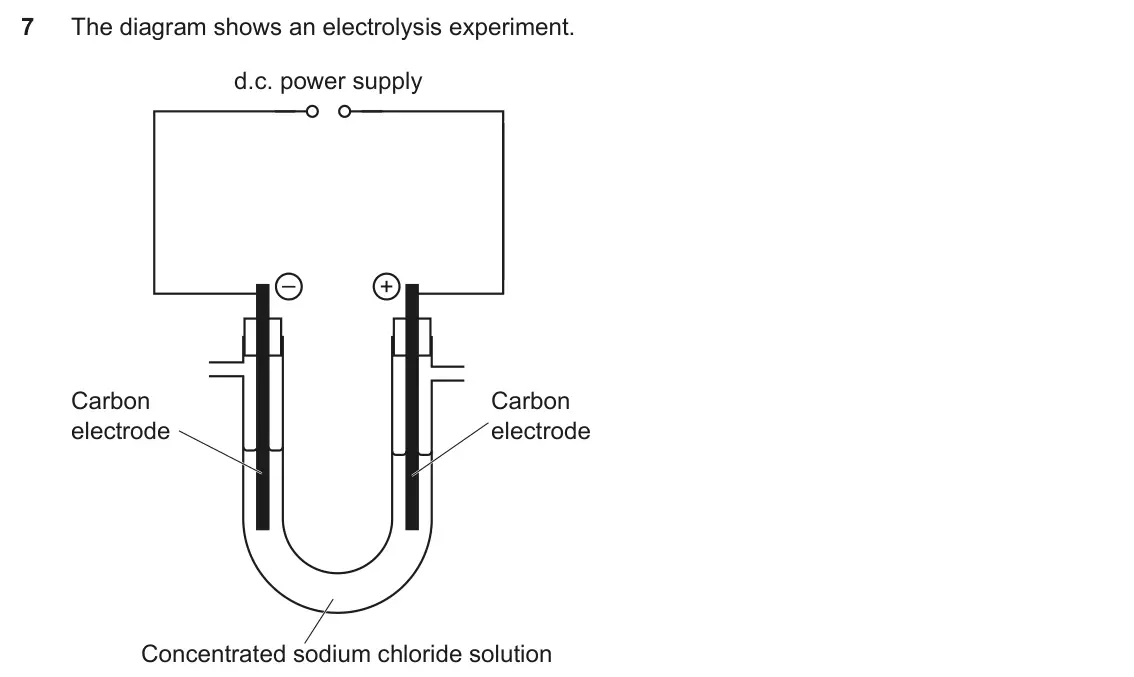
Q7(d)(i)
The whole paper ↗Q7(d)(ii)
The whole paper ↗Q8(a)
The whole paper ↗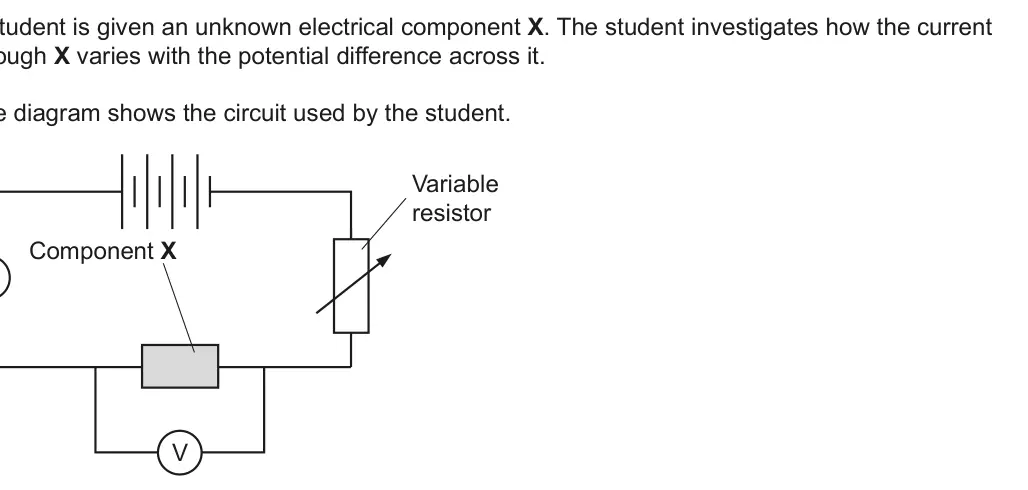
Q8(b)(i)
The whole paper ↗Q8(b)(ii)
The whole paper ↗Q8(c)
The whole paper ↗Q1(a)
The whole paper ↗
All 82 questions on What determines the current in an electric circuit?, as a list
- June 2025, Physics Paper 3 Foundation, Q6(a) (2 marks): Component 1 is used to measure the potential difference across the filament lamp. Component 2 is used to change the potential difference across the filament lam
- June 2025, Physics Paper 3 Foundation, Q6(b)(i) (1 mark): Use the graph to find the current in the filament lamp when the potential difference across it is 2.4 V. Current = A [1]
- June 2025, Physics Paper 3 Foundation, Q6(b)(ii) (2 marks): Calculate the resistance of the filament lamp when the potential difference across it is 2.4 V. Use the equation: resistance = potential difference current Use
- June 2025, Physics Paper 3 Foundation, Q6(b)(iii) (2 marks): Explain the relationship between current and potential difference shown on the graph. [2]
- June 2025, Physics Paper 7 Higher, Q7(a) (3 marks): Draw a circuit that Sara can use to measure the resistance of different lengths of wire. Include a voltmeter and an ammeter in the circuit. [3]
- June 2025, Physics Paper 7 Higher, Q7(b)(i) (1 mark): Draw a line of best fit on the graph. [1]
- June 2025, Physics Paper 7 Higher, Q7(b)(ii) (3 marks): For a length of wire of 50 cm, the resistance is 2.2 Ohms. Calculate the length of wire that would have a resistance of 20 Ohms. Length = cm [3]
- June 2024, Physics Paper 3 Foundation, Q6(a) (3 marks): A physical quantity is something that can be measured and given a value. Complete the table by writing in the unit for each physical quantity. Quantity Unit Ele
- June 2024, Physics Paper 3 Foundation, Q9(a) (4 marks): Electric circuits are represented by symbols. Draw lines to connect each symbol to its name and its use. Symbol Name Use Allows current to Diode flow in one dir
- June 2024, Physics Paper 3 Foundation, Q9(b)(i) (2 marks): Describe how the current in the filament lamp changes as the potential difference across it increases from 0 V to 4 V. [2]
- June 2024, Physics Paper 3 Foundation, Q9(b)(ii) (4 marks): Calculate the resistance of the filament lamp when the potential difference across it is 2.2 V. Use the graph and the Equation Sheet. Resistance = Ω [4]
- June 2024, Physics Paper 3 Foundation, Q9(b)(iii) (3 marks): The diagram shows part of the circuit that a student uses to obtain these results. Complete the circuit diagram by adding a variable resistor, voltmeter and an
- June 2024, Combined Science Paper 4 Foundation, Q7(c) (3 marks): The current in the circuit is 0.01 A. Calculate the charge that flows in the circuit in 15 minutes. Use the equation: charge = current × time Charge = C [3]
- June 2024, Combined Science Paper 4 Foundation, Q7(d)(i) (1 mark): Name a component that can be used to vary the current. [1]
- June 2024, Combined Science Paper 4 Foundation, Q7(d)(ii) (1 mark): Name a component that can be used to measure the current. [1]
- June 2024, Physics Paper 7 Higher, Q8(a) (2 marks): Explain the effect of the student changing the resistance of the variable resistor. [2]
- June 2024, Physics Paper 7 Higher, Q8(b)(i) (2 marks): Sketch the graph of current against potential difference for these results. 30 20 Current (mA) 10 0 0 0.5 1.0 1.5 2.0 2.5 Potential difference (V) [2]
- June 2024, Physics Paper 7 Higher, Q8(b)(ii) (1 mark): Suggest what component X is. [1]
- June 2024, Physics Paper 7 Higher, Q8(c) (3 marks): Calculate the charge that flows through component X in 300 seconds when the potential difference across it is 1.5 V. Use the equation: charge = current × time C
- June 2023, Physics Paper 3 Foundation, Q1(a) (1 mark): What is the correct circuit symbol for a filament lamp? Put a ring around the correct option. [1]
- June 2023, Physics Paper 3 Foundation, Q1(b) (3 marks): The torch is not working. Ling makes this circuit to test components. Ammeter Crocodile clip A B Crocodile clip Battery Complete the sentences to explain how th
- June 2023, Physics Paper 3 Foundation, Q1(d) (2 marks): The current through the filament lamp is 0.5 A. Calculate the charge that flows through the lamp in 30 s. Use the equation: charge = current × time Charge = C [
- June 2023, Physics Paper 3 Foundation, Q4(a)(i) (2 marks): Calculate the potential difference across the lamp. Use the equation: potential difference = current × resistance Potential difference = V [2]
- June 2023, Combined Science Paper 4 Foundation, Q9(a) (1 mark): Complete the circuit diagram by: • adding a cell • adding the equipment needed to measure the potential difference and current. Crocodile clip Wire being tested
- June 2023, Combined Science Paper 4 Foundation, Q9(b) (2 marks): The length of the wire used in the experiment is 90 cm. The current is 0.16 A and the potential difference is 1.5 V. Calculate the resistance of the wire. Use t
- June 2023, Combined Science Paper 4 Foundation, Q9(c) (2 marks): The student predicts that the longer the wire is the greater the resistance will be. Describe how the student can extend their investigation to test their predi
- June 2023, Physics Paper 7 Higher, Q3(b) (2 marks): Suggest how Ben could find out how the current in a filament lamp affects the brightness of a filament lamp. [2]
- June 2023, Physics Paper 7 Higher, Q7(a)(i) (4 marks): Calculate the time for 30 C of charge to flow through the fan motor. Use the Equation Sheet. Time = s [4]
- June 2023, Physics Paper 7 Higher, Q7(a)(ii) (2 marks): Define current. [2]
- June 2023, Combined Science Paper 8 Higher, Q2(a) (1 mark): Complete the circuit diagram by: • adding a cell • adding the equipment needed to measure the potential difference and current. Crocodile clip Wire being tested
- June 2023, Combined Science Paper 8 Higher, Q2(b) (2 marks): The length of the wire used in the experiment is 90 cm. The current is 0.16 A and the potential difference is 1.5 V. Calculate the resistance of the wire. Use t
- June 2023, Combined Science Paper 8 Higher, Q2(c) (2 marks): The student predicts that the longer the wire is the greater the resistance will be. Describe how the student can extend their investigation to test their predi
- June 2023, Combined Science Paper 8 Higher, Q3(d) (2 marks): 57 C of charge flows through the solenoid in 30 seconds. Calculate the current flowing through the solenoid. Use the equation: charge = current × time Current =
- June 2022, Physics Paper 3 Foundation, Q5(a) (3 marks): A constant current of 1.1 A flows through the battery when the crane is switched on. Calculate the charge that flows through the battery in 2 minutes. Use the e
- June 2022, Physics Paper 3 Foundation, Q7(a) (1 mark): What is component X? Tick (3) one box. Diode Light dependent resistor Thermistor Variable resistor [1]
- June 2022, Physics Paper 3 Foundation, Q7(b) (1 mark): Suggest how Beth can change the circuit so that the potential difference across component X can be varied. [1]
- June 2022, Physics Paper 3 Foundation, Q7(c) (4 marks): Beth changes her circuit and records the results shown in the table. Potential difference (V) Current (A) 0.10 0.01 0.30 0.03 0.50 0.05 0.67 0.07 0.81 0.09 0.89
- June 2022, Combined Science Paper 4 Foundation, Q3(c)(i) (2 marks): In a circuit, you can measure current, potential difference and resistance. Draw one line from each circuit measurement to the unit it is measured in. Measureme
- June 2022, Combined Science Paper 4 Foundation, Q3(c)(ii) (2 marks): Mia’s circuit contains a 3.0 V battery and has a total resistance of 24 Ω. Calculate the current. Use the equation: current (A) = potential difference (V) ÷ res
- June 2022, Physics Paper 7 Higher, Q4(b) (2 marks): Ali wants to determine the resistance of resistor X. X Fig. 4.1 Complete the circuit diagram in Fig. 4.1 to allow Ali to determine the resistance of resistor X.
- June 2022, Physics Paper 7 Higher, Q4(c)(i) (3 marks): Explain why the resistance of Y is smaller than the resistance of X. [3]
- June 2022, Physics Paper 7 Higher, Q4(c)(ii) (5 marks): The potential difference across Y is 12 V. Calculate the resistance of Y. Use the equation: potential difference = current × resistance Give your answer to 2 si
- June 2022, Combined Science Paper 8 Higher, Q5(a)(i) (3 marks): Draw lines to connect each electrical component to its correct symbol. Electrical Component Symbol Diode Light dependent resistor (LDR) Thermistor Variable resi
- June 2022, Combined Science Paper 8 Higher, Q5(a)(ii) (2 marks): Sarah is planning to make a series circuit to investigate the effect of changing the temperature of a thermistor on the current and potential difference in the
- June 2022, Combined Science Paper 8 Higher, Q5(a)(iii) (3 marks): Plot Sarah’s results from the table and draw a line of best fit. The first two have been plotted for you. 12 11 10 9 8 7 Current (mA) 6 5 4 3 2 1 0 0 1 2 3 4 5
- June 2022, Combined Science Paper 8 Higher, Q5(b) (1 mark): Sarah repeated the experiment at different temperatures. She heated the thermistor in a water bath to increase the temperature. Which of these graphs shows how
- November 2021, Physics Paper 3 Foundation, Q2(b)(i) (2 marks): Calculate the resistance of the coil of insulated wire. Use the equation: resistance = potential difference ÷ current Resistance = Ω [2]
- November 2021, Physics Paper 3 Foundation, Q2(b)(ii) (2 marks): The current passes through the coil for 30 s. Calculate the charge that flows through the coil. Use the equation: charge = current × time Charge = C [2]
- November 2021, Physics Paper 3 Foundation, Q4(b)(i) (1 mark): Complete the circuit diagram in Fig. 4.3 by adding a variable resistor. [1]
- November 2021, Physics Paper 7 Higher, Q4(a) (4 marks): Draw a circuit diagram in the box that can be used for this experiment. [4]
- November 2021, Physics Paper 7 Higher, Q4(b) (3 marks): Describe a method Ben can use to collect the data for his investigation. [3]
- November 2021, Physics Paper 7 Higher, Q4(c) (4 marks): Ben plots a graph of his results, as shown. 1.5 1.0 I (A) 0.5 0 0 1 2 3 4 5 6 7 8 V (V) Explain what the graph shows about the resistance of the thermistor as t
- November 2020, Physics Paper 3 Foundation, Q2(a) (2 marks): Complete the table by filling in the blank spaces. One has been done for you. Circuit component Name of circuit component battery A V [2]
- November 2020, Physics Paper 3 Foundation, Q2(b)(i) (2 marks): Draw a series circuit diagram with one bulb that Ben can use to start his investigation. Use all of the circuit components from the table. [2]
- November 2020, Physics Paper 3 Foundation, Q12(a)(i) (1 mark): Complete the graph in Fig. 12.1 by plotting the remaining two points from the table. [1]
- November 2020, Physics Paper 3 Foundation, Q12(a)(ii) (1 mark): Draw a line of best fit on the graph in Fig. 12.1. [1]
- November 2020, Physics Paper 3 Foundation, Q12(a)(iii) (1 mark): Describe the relationship between current and potential difference for component A. [1]
- November 2020, Physics Paper 3 Foundation, Q12(a)(iv) (1 mark): Suggest what component A could be. [1]
- November 2020, Physics Paper 3 Foundation, Q12(a)(v) (4 marks): Calculate the resistance of component A when the potential difference across it is 2.0 V. Use data from the graph in Fig. 12.1. Use the equation: potential diff
- November 2020, Physics Paper 3 Foundation, Q12(b)(i) (1 mark): Describe what happens to the current as the potential difference changes for component B. [1]
- November 2020, Physics Paper 3 Foundation, Q12(b)(ii) (1 mark): Suggest what component B can be used for in a circuit. [1]
- November 2020, Combined Science Paper 4 Foundation, Q5(a)(i) (3 marks): Complete the circuit diagram to show how Beth can investigate the resistance of a wire inside a section of an electric car track. Ruler Crocodile clips Electric
- November 2020, Combined Science Paper 4 Foundation, Q5(a)(ii) (2 marks): Beth calculates the resistance of different lengths of the section of track, and her results are shown in the table. Length of section Resistance of track (cm)
- November 2020, Combined Science Paper 4 Foundation, Q5(a)(iii) (2 marks): Calculate the current in the circuit when there is a potential difference of 3.0 V across 50 cm of track. Use the equation: potential difference = current × res
- November 2020, Combined Science Paper 4 Foundation, Q5(b) (2 marks): Beth makes three changes to the investigation to improve it. Draw lines to connect each change in the investigation with its correct improvement. Change in inve
- November 2020, Physics Paper 7 Higher, Q2(a)(i) (1 mark): Complete the graph in Fig. 2.1 by plotting the remaining two points from the table. [1]
- November 2020, Physics Paper 7 Higher, Q2(a)(ii) (1 mark): Draw a line of best fit on the graph in Fig. 2.1. [1]
- November 2020, Physics Paper 7 Higher, Q2(a)(iii) (1 mark): Describe the relationship between current and potential difference for component A. [1]
- November 2020, Physics Paper 7 Higher, Q2(a)(iv) (1 mark): Suggest what component A could be. [1]
- November 2020, Physics Paper 7 Higher, Q2(a)(v) (4 marks): Calculate the resistance of component A when the potential difference across it is 2.0 V. Use data from the graph in Fig. 2.1. Use the equation: potential diffe
- November 2020, Physics Paper 7 Higher, Q2(b)(i) (1 mark): Describe what happens to the current as the potential difference changes for component B. [1]
- November 2020, Physics Paper 7 Higher, Q2(b)(ii) (1 mark): Suggest what component B can be used for in a circuit. [1]
- November 2020, Combined Science Paper 8 Higher, Q3(a) (3 marks): Layla is investigating two fixed resistors. She sets up an electrical circuit with a 9 V battery to calculate the resistance of each resistor separately. Draw a
- November 2020, Combined Science Paper 8 Higher, Q3(d) (3 marks): Layla replaces the old motor in a 12V electric toy car with a new motor, as shown in the diagram. She also has access to four different resistors, 109, 12S, 168
- June 2019, Physics Paper 3 Foundation, Q2(a) (1 mark): What is an electric current? [1]
- June 2019, Physics Paper 3 Foundation, Q2(b) (2 marks): Complete these sentences about current in a wire. Use words from the list. You may use each word once, more than once, or not at all. battery complete circuit d
- June 2019, Physics Paper 3 Foundation, Q2(c) (2 marks): The current in the wire is 0.4 A. Calculate the electric charge that passes a given point in 30 s. Use the equation: charge = current × time Charge = C [2]
- June 2018, Physics Paper 3 Foundation, Q4(b) (3 marks): The statements below about the circuit in Fig. 4.1 are either true or false. Put a tick (✓) in the correct box after each statement. True False If the current c
- June 2018, Physics Paper 7 Higher, Q3(a) (5 marks): When the switch, S, is closed the current in the heating element is 14 A. Calculate the resistance of the heating element. Give your answer to 2 decimal places.
- June 2018, Physics Paper 7 Higher, Q3(b) (4 marks): The statements below about the circuit in Fig. 3.1 are either true or false. Put a tick (✓) in the correct box after each statement. True False If the current c
- June 2018, Combined Science Paper 8 Higher, Q6(a)(i) (2 marks): Draw a suitable circuit diagram for the experiment. [2] The results of Amir’s experiment are shown in Table 6.1. Temperature (°C) Resistance (kΩ) 0 27.7 10 18.1
- June 2018, Combined Science Paper 8 Higher, Q6(a)(ii) (2 marks): Complete the graph by plotting the results from Table 6.1 and draw a line of best fit. Some have been plotted for you. 30 25 20 resistance 15 (kΩ) 10 5 0 10 20
Questions, mark schemes and examiner’s reports are © OCR, from their published past papers. Plumi isn’t affiliated with any exam board. Want whole papers? Full past papers.
Rather write your answers by hand on iPad? Plumi marks them against the same mark schemes.