 plumi
How does energy transform matter?: OCR GCSE Combined Science B questions
Every OCR GCSE Combined Science B exam question on P6.1 How does energy transform matter?, 2018–2025, with its mark scheme and examiner’s report.
Paper
All papers
Exam
All years
Calculations
Q5(c)(i)
The whole paper ↗
Q5(c)(ii)
The whole paper ↗Q8(a)(i)
The whole paper ↗
Q8(a)(ii)
The whole paper ↗Q8(a)(iii)
The whole paper ↗Q8(a)(iv)
The whole paper ↗Q8(b)
The whole paper ↗Q10(a)
The whole paper ↗
Q10(b)
The whole paper ↗Q10(c)(i)
The whole paper ↗Q10(c)(ii)
The whole paper ↗Q4(c)(i)
The whole paper ↗
Q6(a)
The whole paper ↗Q7(a)(i)
The whole paper ↗Q7(a)(ii)
The whole paper ↗Q7(a)
The whole paper ↗
Q7(b)(i)
The whole paper ↗Q7(b)(iii)
The whole paper ↗Q7(c)
The whole paper ↗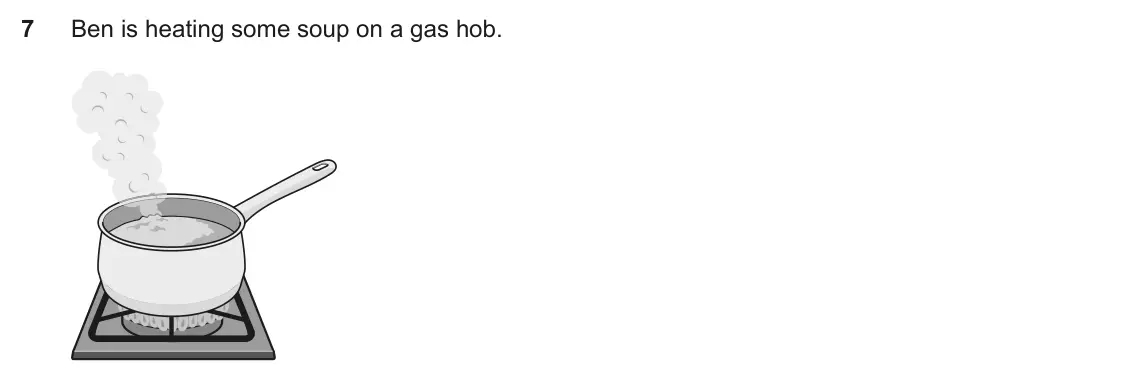
Q6(a)
The whole paper ↗
All 65 questions on How does energy transform matter?, as a list
- June 2025, Physics Paper 3 Foundation, Q5(c)(i) (3 marks): Calculate the power of the electric heater. Use the equation: energy transferred = power × time Power = W [3]
- June 2025, Physics Paper 3 Foundation, Q5(c)(ii) (3 marks): Calculate the specific latent heat of vaporisation of water. energy transferred to water Use the equation: specific latent heat of vaporisation = mass of water
- June 2025, Physics Paper 3 Foundation, Q8(a)(i) (2 marks): Calculate the volume of the stone, using Fig. 8.1. Volume = cm3 [2]
- June 2025, Physics Paper 3 Foundation, Q8(a)(ii) (1 mark): What type of error does the balance show in Fig. 8.1? Tick (✓) one box. Random error Recording error Systematic error [1]
- June 2025, Physics Paper 3 Foundation, Q8(a)(iii) (1 mark): Calculate the mass of the stone. Mass = g [1]
- June 2025, Physics Paper 3 Foundation, Q8(a)(iv) (4 marks): Calculate the density of the stone. Use your answers from (a)(i) and (a)(iii) and the Equation Sheet. Give your answer to 2 significant figures. Density = g / c
- June 2025, Physics Paper 3 Foundation, Q8(b) (4 marks): Explain two changes that Ryan can make to improve their experiment. 1 2 [4]
- June 2025, Physics Paper 7 Higher, Q10(a) (4 marks): Hiro uses a 100 cm3 measuring cylinder and a balance that can measure up to 100.00 g to find the density of the rock. The diagram shows the steps followed by Hi
- June 2025, Physics Paper 7 Higher, Q10(b) (4 marks): Hiro does another experiment to find the specific heat capacity of a different sample of the same rock. This is the method: 1. Measure the mass of the rock 2. H
- June 2025, Physics Paper 7 Higher, Q10(c)(i) (1 mark): Suggest why Hiro cannot be certain that the rock is granite. Use information from the table. [1]
- June 2025, Physics Paper 7 Higher, Q10(c)(ii) (2 marks): Describe how Hiro can change each of the experimental methods in (a) and (b) to be more certain that the rock is granite. [2]
- June 2024, Physics Paper 3 Foundation, Q4(c)(i) (3 marks): Calculate the increase in the internal energy store of the water over 6 hours. Use the Equation Sheet. Specific heat capacity of water = 4200 J / kg / °C Increa
- June 2024, Physics Paper 3 Foundation, Q6(a) (3 marks): A physical quantity is something that can be measured and given a value. Complete the table by writing in the unit for each physical quantity. Quantity Unit Ele
- June 2024, Physics Paper 3 Foundation, Q7(a)(i) (1 mark): Use Fig. 7.1. Mass = g [1]
- June 2024, Physics Paper 3 Foundation, Q7(a)(ii) (2 marks): Calculate the density of the liquid. Use the equation: density = mass volume Density = g / cm3 [2]
- June 2024, Physics Paper 7 Higher, Q7(a) (2 marks): Draw lines to connect each term with its correct definition. Term Definition Thermal energy required to change the state of 1 kg of a substance at constant temp
- June 2024, Physics Paper 7 Higher, Q7(b)(i) (4 marks): The mass of the water is 20 g. The density of the water at point A is 1 g / cm3. Calculate the change in density of the water between A and B. Use the graph and
- June 2024, Physics Paper 7 Higher, Q7(b)(iii) (3 marks): Explain what happens to the density between points B and C on the graph. You do not need to calculate the density. [3]
- June 2023, Physics Paper 3 Foundation, Q7(c) (4 marks): When energy is transferred to the soup, the internal energy of the soup increases. Calculate the energy transferred to the soup when the temperature is increase
- June 2023, Physics Paper 7 Higher, Q6(a) (4 marks): Mia has a sample of the syrup from Fig. 6.1. She needs to determine the density of the syrup. She collects the equipment shown in Fig. 6.2. Fig. 6.2 Electronic
- June 2023, Physics Paper 7 Higher, Q6(b)(i) (4 marks): Calculate the density of the block. Density = g / cm3 [4]
- June 2023, Physics Paper 7 Higher, Q6(b)(ii) (1 mark): Fig. 6.4 shows 4 diagrams, A, B, C, and D. These diagrams show what happens to blocks of different densities that are dropped into the tube. Fig. 6.4 A B Tube T
- June 2023, Physics Paper 7 Higher, Q6(b)(iii) (1 mark): Suggest why the block moves to this position. [1]
- June 2022, Physics Paper 3 Foundation, Q8(b)(ii) (2 marks): What is the change in temperature over the first 4 minutes? Change in temperature = °C [2]
- June 2022, Physics Paper 3 Foundation, Q8(c) (2 marks): The mass of the chocolate is 0.15 kg. The specific heat capacity of chocolate is 1600 J / kg °C. Calculate the change in the internal energy of the chocolate in
- June 2022, Physics Paper 7 Higher, Q6(b)(i) (4 marks): Calculate the weight of this volume of water. Use the equation: density = mass ÷ volume Density of water = 1000 kg / m3 Gravitational field strength = 10 N / kg
- June 2022, Physics Paper 7 Higher, Q8(c)(i) (4 marks): 1.7 MJ of energy is transferred from the mass of oxygen gas to reduce the temperature of the oxygen to its boiling point. Calculate the mass of the oxygen gas.
- June 2022, Physics Paper 7 Higher, Q8(c)(ii) (3 marks): The mass of oxygen gas calculated in (c)(i) is at its boiling point. Calculate the energy that must be transferred from the mass of oxygen gas to liquify it. Us
- November 2021, Physics Paper 3 Foundation, Q6(a)(i) (1 mark): Calculate the volume of the cube. Volume = cm3 [1]
- November 2021, Physics Paper 3 Foundation, Q6(a)(ii) (2 marks): The mass of the cube is 513 g. Calculate the density of the cube. Use the equation: density = mass ÷ volume Density = g/cm3 [2]
- November 2021, Physics Paper 7 Higher, Q10(a) (4 marks): The heater transfers 189 000 J to heat the tank and the air. Calculate the specific heat capacity of the air. Specific heat capacity of aluminium = 900 J/kg °C
- November 2020, Physics Paper 3 Foundation, Q10(a) (2 marks): Explain what is incorrect about Amir’s statement. 1. 2. [2]
- November 2020, Physics Paper 3 Foundation, Q10(b)(i) (1 mark): What is the correct equation to calculate density? Put a ring around the correct answer. mass volume density = mass × volume density = volume density = mass [1]
- November 2020, Physics Paper 3 Foundation, Q10(b)(ii) (3 marks): A 90 cm3 scoop of ice cream has a mass of 66 g. Calculate the density of the ice cream. Give your answer to 2 significant figures. Density = g / cm3 [3]
- November 2020, Physics Paper 3 Foundation, Q10(c) (1 mark): The specific heat capacity of ice cream is 2740 J / kg °C. Four students are trying to define specific heat capacity. Alex Jane It is the increase in internal I
- November 2020, Physics Paper 3 Foundation, Q10(d) (1 mark): Amir wants to calculate the energy transferred to a 0.4 kg tub of melted ice cream as it warms up from 4 °C to room temperature, 20 °C. He uses data from the ta
- November 2020, Physics Paper 3 Foundation, Q10(e) (3 marks): Calculate the energy needed to change 0.4 kg of solid, frozen ice cream at –6 °C into 0.4 kg of liquid, melted ice cream at –6 °C. Use data from the table. Use
- November 2020, Physics Paper 7 Higher, Q4(a) (1 mark): Complete the statement about density. Tick (3) one box. The density of a material is equivalent to: the mass per 1 kg of the material. the mass per 1 m3 of the
- November 2020, Physics Paper 7 Higher, Q4(b) (1 mark): Amaya makes a prediction. I predict that as the relative atomic mass of metals increases, the density will also increase. She plots a graph of density against r
- November 2020, Physics Paper 7 Higher, Q4(c) (3 marks): Amaya concludes from her graph that the density of metals increases as the relative atomic mass of the metals increases. The table shows the relative atomic mas
- November 2020, Physics Paper 7 Higher, Q10(a)(i) (1 mark): Describe the effect on the milk. Use ideas about energy stores in your answer. [1]
- November 2020, Physics Paper 7 Higher, Q10(a)(ii) (1 mark): Nina heats 560 g of water, using the same method that Jack uses for heating the milk. Why does the temperature of the milk increase more quickly than the temper
- November 2020, Physics Paper 7 Higher, Q10(b)(i) (3 marks): Calculate the energy needed to turn all the water to steam once it is boiling. Specific latent heat of water = 2.23 × 10⁶ J kg–1 Give your answer to 3 significa
- November 2020, Physics Paper 7 Higher, Q10(b)(ii) (3 marks): The time taken for all the water to turn to steam is 7 minutes. Calculate the power of the heater used. Use the equation: energy transferred = power × time Powe
- June 2019, Physics Paper 3 Foundation, Q10(c) (2 marks): Calculate the energy needed to melt the 50 g of ice. The specific latent heat of ice = 334 J/g Energy = J [2]
- June 2019, Physics Paper 3 Foundation, Q12(a) (3 marks): Explain how they can safely use the apparatus, to take measurements, and to determine the specific heat capacity of the oil. [3]
- June 2019, Physics Paper 3 Foundation, Q12(b) (2 marks): Alex and Ben repeat their experiment 3 times. Their results are shown in Table 12.1. Specific heat Experiment 1 Experiment 2 Experiment 3 capacity of oil 1.94 2
- June 2019, Physics Paper 3 Foundation, Q12(c) (3 marks): Table 12.2 shows accurate values for the specific heat capacities of the oil and water. Liquid Specific heat capacity (kJ/kg °C) oil 1.7 water 4.2 Table 12.2 Co
- June 2019, Combined Science Paper 4 Foundation, Q1(a)(ii) (1 mark): The coin floats because it is less dense than the mercury. Which is the correct equation for calculating density? Tick (✓) one box. density = weight ÷ volume de
- June 2019, Combined Science Paper 4 Foundation, Q1(b) (2 marks): Eureka cans are used to measure the volume of odd‑shaped objects. Fig. 1.2 shows the apparatus that can be used to find the volume of the coin in Fig 1.1. Eurek
- June 2019, Physics Paper 7 Higher, Q2(a) (3 marks): Explain how they can safely use the apparatus, to take measurements, and to determine the specific heat capacity of the oil. [3]
- June 2019, Physics Paper 7 Higher, Q2(b) (2 marks): Alex and Ben repeat their experiment 3 times. Their results are shown in Table 2.1. Specific heat Experiment 1 Experiment 2 Experiment 3 capacity of oil 1.94 2.
- June 2019, Physics Paper 7 Higher, Q2(c) (3 marks): Table 2.2 shows accurate values for the specific heat capacities of the oil and water. Liquid Specific heat capacity (kJ/kg °C) oil 1.7 water 4.2 Table 2.2 Comp
- June 2019, Physics Paper 7 Higher, Q11(b) (3 marks): Describe how the energy transfers involved help to cool the building at night. [3]
- June 2019, Physics Paper 7 Higher, Q11(c)(i) (2 marks): The ideal building temperature is 22 °C. Which PCM, A or B, is more suitable for cooling the building? Justify your answer. [2]
- June 2019, Physics Paper 7 Higher, Q11(c)(ii) (5 marks): Calculate the specific latent heat of PCM B. Specific latent heat = J/kg [5]
- June 2018, Physics Paper 3 Foundation, Q6(a)(i) (1 mark): What other equipment does she need to measure the volume of the stone? [1]
- June 2018, Physics Paper 3 Foundation, Q6(a)(ii) (2 marks): State two steps Mia must follow when using the can to get an accurate measurement of the volume of the stone. 1 2 [2]
- June 2018, Physics Paper 3 Foundation, Q6(b) (1 mark): Complete this sentence to define density. Density is [1]
- June 2018, Physics Paper 3 Foundation, Q6(c)(i) (2 marks): Mia repeats the volume measurement five times. These are her results. Measurements 1 2 3 4 5 44.5 Volume of the 43.0 44.5 43.0 45.0 stone (cm3) Calculate the me
- June 2018, Physics Paper 3 Foundation, Q6(c)(ii) (3 marks): Calculate the density of Mia’s 220.0 g stone. Use your answer to part (c)(i). Density = g / cm3 [3]
- June 2018, Physics Paper 3 Foundation, Q6(d)(i) (1 mark): Which of the materials in Table 6.1 could Mia’s stone be made of? Tick (✓) one box. Chalk Sandstone Granite Malachite Haematite [1]
- June 2018, Physics Paper 3 Foundation, Q6(d)(ii) (3 marks): Mia discusses her experiment with Sundip. Mia Measuring the density is a useful way to identify any type of rock. Sundip I don’t think you can identify rocks by
- June 2018, Combined Science Paper 4 Foundation, Q3(d) (2 marks): The ethanol concentration of beer can be found by measuring its density. Describe how to measure the density of a liquid. [2]
- June 2018, Physics Paper 7 Higher, Q8(a) (4 marks): Calculate the mass of gas in the can in Fig. 8.1. The density of the gas is 7.1 × 10⁻³ g / cm3. Use the equation: volume of a cylinder = π × (radius)2 × height
Questions, mark schemes and examiner’s reports are © OCR, from their published past papers. Plumi isn’t affiliated with any exam board. Want whole papers? Full past papers.
Rather write your answers by hand on iPad? Plumi marks them against the same mark schemes.