 plumi
What does the Periodic Table tell us about the elements?: OCR GCSE Chemistry B questions
Every OCR GCSE Chemistry B exam question on C2.2 What does the Periodic Table tell us about the elements?, 2018–2025, with its mark scheme and examiner’s report.
Paper
All papers
Exam
All years
Calculations
Q3(a)
The whole paper ↗
Q3(b)(i)
The whole paper ↗Q3(b)(ii)
The whole paper ↗Q3(c)(i)
The whole paper ↗Q3(c)(ii)
The whole paper ↗Q8(a)
The whole paper ↗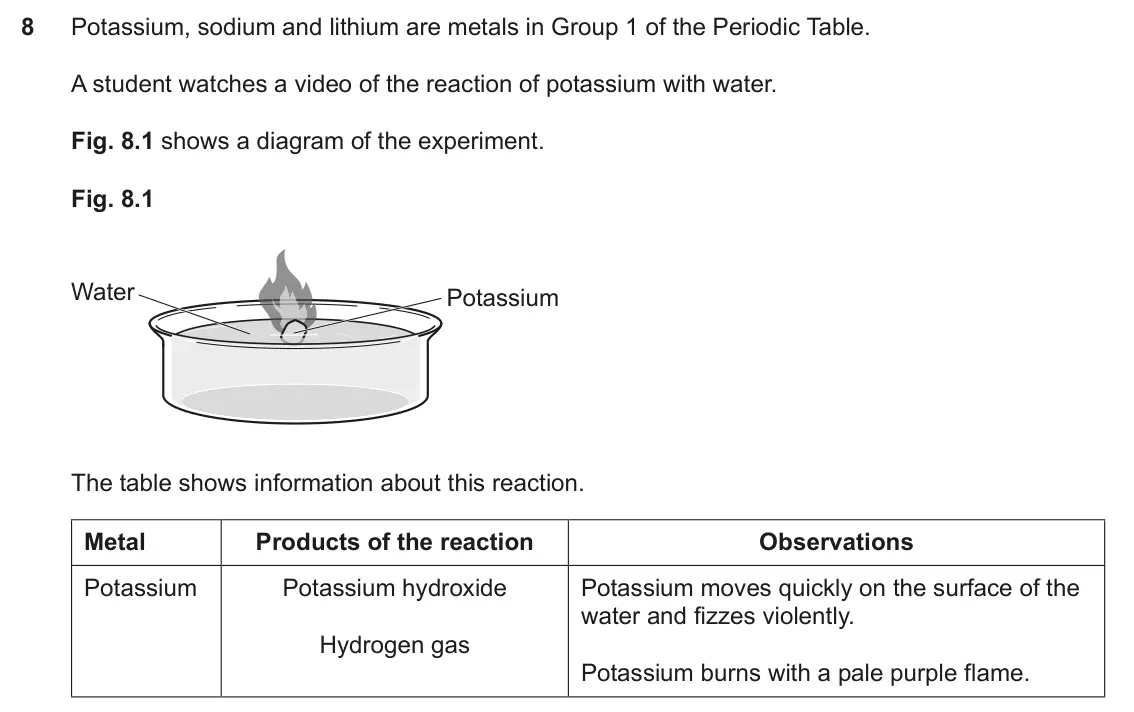
Q8(b)(i)
The whole paper ↗Q8(b)(ii)
The whole paper ↗Q5(a)(i)
The whole paper ↗
Q5(a)(ii)
The whole paper ↗Q5(a)(iii)
The whole paper ↗Q5(b)
The whole paper ↗Q5(c)(i)
The whole paper ↗Q5(c)(ii)
The whole paper ↗Q1(a)
The whole paper ↗
Q1(b)(i)
The whole paper ↗Q1(b)(ii)
The whole paper ↗Q2(a)(i)
The whole paper ↗
Q2(a)(ii)
The whole paper ↗Q2(b)
The whole paper ↗
All 105 questions on What does the Periodic Table tell us about the elements?, as a list
- June 2025, Paper 1 Foundation, Q3(a) (3 marks): Table 3.1 shows information about some Group 7 elements. Table 3.1 State at room Colour at room Colour in the Element Formula temperature and temperature and ga
- June 2025, Paper 1 Foundation, Q3(b)(i) (2 marks): Plot the boiling point data from Table 3.2 on the graph. The boiling point of fluorine has been done for you. [2]
- June 2025, Paper 1 Foundation, Q3(b)(ii) (1 mark): Find whether iodine is a solid, liquid or gas at 100 °C. Tick (✓) one box. Solid Liquid Gas [1]
- June 2025, Paper 1 Foundation, Q3(c)(i) (1 mark): Which of these is a product of the reaction? Tick (✓) one box. Bromine Chlorine Potassium [1]
- June 2025, Paper 1 Foundation, Q3(c)(ii) (1 mark): What is the name for this type of reaction? Tick (✓) one box. Combustion Displacement Neutralisation Titration [1]
- June 2025, Paper 2 Foundation, Q8(a) (3 marks): The student then watches a video of the reaction of sodium with water. Predict the products of the reaction of sodium with water and describe the observations y
- June 2025, Paper 2 Foundation, Q8(b)(i) (2 marks): Lithium and fluorine belong to different groups of the Periodic Table. Explain how the arrangement of electrons in lithium and fluorine is related to their grou
- June 2025, Paper 2 Foundation, Q8(b)(ii) (1 mark): Explain how Fig. 8.2 shows that lithium and fluorine are in the same period of the Periodic Table. [1]
- June 2025, Paper 3 Higher, Q5(a)(i) (1 mark): Which statement about Group 1 metals is true? Tick (✓) one box. Group 1 metals are hard. Potassium is the most reactive Group 1 metal. Reactivity increases down
- June 2025, Paper 3 Higher, Q5(a)(ii) (2 marks): Sodium is a Group 1 metal. Sodium reacts with water, moist air and chlorine. Draw lines to connect each reaction with its correct observation. Reaction Observat
- June 2025, Paper 3 Higher, Q5(a)(iii) (1 mark): Caesium reacts with water to make hydrogen and one other product. Complete the word equation for the reaction. caesium + water hydrogen + [1]
- June 2025, Paper 3 Higher, Q5(b) (3 marks): The table shows information about some Group 7 elements. Element Melting point (°C) Boiling point (°C) State at room temperature Fluorine –220 –188 Gas Chlorine
- June 2025, Paper 3 Higher, Q5(c)(i) (2 marks): Describe an experiment to show that this statement is true. Include in your answer: • the names and physical state of each reactant • the observation you expect
- June 2025, Paper 3 Higher, Q5(c)(ii) (1 mark): Aqueous chlorine is corrosive. State one safety precaution that can be taken when handling aqueous chlorine. [1]
- June 2025, Paper 4 Higher, Q1(a) (3 marks): The student then watches a video of the reaction of sodium with water. Predict the products of the reaction of sodium with water and describe the observations y
- June 2025, Paper 4 Higher, Q1(b)(i) (2 marks): Lithium and fluorine belong to different groups of the Periodic Table. Explain how the arrangement of electrons in lithium and fluorine is related to their grou
- June 2025, Paper 4 Higher, Q1(b)(ii) (1 mark): Explain how Fig. 1.2 shows that lithium and fluorine are in the same period of the Periodic Table. [1]
- June 2024, Paper 1 Foundation, Q2(a)(i) (1 mark): Describe one physical property of lithium. [1]
- June 2024, Paper 1 Foundation, Q2(a)(ii) (2 marks): Complete the diagram to show the arrangement of electrons in an atom of lithium. Use the Periodic Table. Li [2]
- June 2024, Paper 1 Foundation, Q2(b) (4 marks): Lithium reacts with water to form an alkaline solution and hydrogen gas. Complete the word equation and balanced symbol equation for the reaction. Include state
- June 2024, Paper 1 Foundation, Q11(b) (2 marks): How does the arrangement of electrons in atoms of sodium and chlorine relate to their group and period in the Periodic Table? [2]
- June 2024, Paper 2 Foundation, Q1(d)(ii) (1 mark): The student uses the table to decide A is a metal atom. The student is correct. How does the student know? Tick (3) one box. Atom A has one electron in the oute
- June 2024, Paper 3 Higher, Q2(b) (2 marks): How does the arrangement of electrons in atoms of sodium and chlorine relate to their group and period in the Periodic Table? [2]
- June 2024, Paper 3 Higher, Q12(a) (2 marks): The table shows the properties of three Group 7(17) elements at room temperature and pressure. Complete the table. State at room Element Colour temperature Chlo
- June 2024, Paper 3 Higher, Q12(b)(i) (3 marks): Explain what the student observes when the reaction takes place. [3]
- June 2024, Paper 3 Higher, Q12(b)(ii) (1 mark): Write an ionic equation for the reaction. Use the symbol equation to help you. [1]
- June 2024, Paper 4 Higher, Q3(c)(i) (2 marks): Identify whether each element is a metal or a non-metal. Put one tick (3) in each row. Element Metal Non-metal A B C [2]
- June 2024, Paper 4 Higher, Q3(c)(ii) (1 mark): Use ideas about electron arrangement to explain how you decided if each element was a metal or a non-metal. [1]
- June 2023, Paper 1 Foundation, Q9(a) (1 mark): Argon is unreactive because it is in Group 0 of the Periodic Table. State one other property of argon. [1]
- June 2023, Paper 1 Foundation, Q9(c)(i) (2 marks): Which statements about X are true, and which are false? Tick (3) one box in each row. True False X is a metal. X is in the first period of the Periodic Table. X
- June 2023, Paper 1 Foundation, Q9(c)(ii) (1 mark): Name one element that is more reactive than element X. [1]
- June 2023, Paper 2 Foundation, Q2(a)(ii) (1 mark): Which formula contains an atom of a Group 17 (7) element? [1]
- June 2023, Paper 3 Higher, Q1(a) (1 mark): Argon is unreactive because it is in Group 0 of the Periodic Table. State one other property of argon. [1]
- June 2023, Paper 3 Higher, Q1(c)(i) (2 marks): Which statements about X are true, and which are false? Tick (3) one box in each row. True False X is a metal. X is in the first period of the Periodic Table. X
- June 2023, Paper 3 Higher, Q1(c)(ii) (1 mark): Name one element that is more reactive than element X. [1]
- June 2022, Paper 1 Foundation, Q2(a) (2 marks): Complete the sentence to describe how Mendeleev placed elements in the Periodic Table. Use words from the list. atomic colour molecular properties size Mendelee
- June 2022, Paper 1 Foundation, Q2(b)(i) (1 mark): Which two elements in Table 2.1 are metals? and [1]
- June 2022, Paper 1 Foundation, Q2(b)(ii) (1 mark): Which column in Table 2.1 did you use to work out your answer to (b)(i)? [1]
- June 2022, Paper 1 Foundation, Q2(b)(iii) (1 mark): The elements in Table 2.1 are all solids at room temperature (25 °C). How does the data in the table show that this is true? [1]
- June 2022, Paper 1 Foundation, Q2(c)(i) (2 marks): Draw lines to connect each halogen with its correct appearance at room temperature (25 °C). Halogen Appearance Grey solid Chlorine Purple gas Iodine Green gas B
- June 2022, Paper 1 Foundation, Q2(c)(ii) (1 mark): Sodium iodide solution reacts with chlorine. Complete the word equation for this reaction. sodium iodide + chlorine iodine + [1]
- June 2022, Paper 3 Higher, Q5(a) (1 mark): Which property shows iodine is a non-metal? Tick (✓) one box. It is a shiny grey solid. It does not conduct electricity. It is unreactive. Its density is higher
- June 2022, Paper 3 Higher, Q5(c)(i) (1 mark): What would you see when this reaction happens? [1]
- June 2022, Paper 3 Higher, Q5(c)(ii) (1 mark): What information does this reaction show about the reactivity of the halogens? [1]
- November 2021, Paper 1 Foundation, Q1(a) (1 mark): State the Group number of lithium, sodium and potassium in the modern Periodic Table. Group number [1]
- November 2021, Paper 1 Foundation, Q1(b) (2 marks): Which statements about lithium, sodium and potassium are true and which are false? Tick (3) one box in each row. Statement True False They all react with water.
- November 2021, Paper 1 Foundation, Q1(c)(i) (1 mark): The elements nitrogen, phosphorus and arsenic have similar properties. Complete Table 1.2 by adding the symbols for these three elements. Element Symbol Relativ
- November 2021, Paper 1 Foundation, Q1(c)(ii) (2 marks): Dobereiner called his sets of three elements ‘triads’. He had this idea: ‘The relative atomic mass of element 2 is approximately equal to the mean of the other
- November 2021, Paper 1 Foundation, Q1(d) (2 marks): Mendeleev arranged the elements in order of their relative atomic masses. Mendeleev’s work was peer reviewed. Describe the peer review process. [2]
- November 2021, Paper 1 Foundation, Q8(c)(i) (1 mark): State the colour of the solution at the end of the experiment. [1]
- November 2021, Paper 1 Foundation, Q8(c)(ii) (1 mark): What causes the colour change? [1]
- November 2021, Paper 1 Foundation, Q8(d) (1 mark): Potassium reacts with chlorine. Sodium also reacts with chlorine. Is the reaction of sodium with chlorine faster or slower than the reaction of potassium with c
- November 2021, Paper 1 Foundation, Q8(f) (2 marks): The element astatine, At, is below iodine in Group 7 of the Periodic Table. Which two properties of astatine are correct? Tick (3) two boxes. It reacts with Na+
- November 2021, Paper 2 Foundation, Q2(a)(i) (1 mark): What is the name of the salt that forms when lithium reacts with chlorine? [1]
- November 2021, Paper 2 Foundation, Q2(a)(ii) (1 mark): How would Layla's observations be different when she uses lithium? Put a ring around the correct answer. Reaction is slower Reaction is faster Reaction takes sa
- November 2021, Paper 2 Foundation, Q2(a)(iii) (1 mark): Give one reason for your answer to (a)(ii). [1]
- November 2021, Paper 2 Foundation, Q2(b) (3 marks): Layla does experiments with other Group 1 and Group 7 elements. Complete the table of information about each element. Solid, liquid or gas at Colour at room Ele
- November 2021, Paper 2 Foundation, Q8(a) (1 mark): Lithium (Li), sodium (Na) and potassium (K) are in Group 1 of the Periodic Table. How does the atomic radius change down Group 1? Use the graph. [1]
- November 2021, Paper 2 Foundation, Q8(b)(i) (1 mark): Give the symbols of the two elements which have the smallest atoms. Use the graph. and [1]
- November 2021, Paper 2 Foundation, Q8(b)(ii) (1 mark): Which group of the Periodic Table do the elements in (b)(i) belong to? Use the Data Sheet. Group [1]
- November 2021, Paper 2 Foundation, Q8(c) (2 marks): Which statements in the table are true and which are false? Tick one box (✓) in each row. Use the graph. True False Statement (✓) (✓) Potassium (K) is the large
- November 2021, Paper 2 Foundation, Q8(d)(i) (3 marks): The diagram shows the radius of his model of a lithium atom. Radius = 68 cm Model of a lithium (Li) atom Kai makes a model of a sodium (Na) atom to the same sca
- November 2021, Paper 2 Foundation, Q8(d)(ii) (1 mark): Kai makes his lithium model red to match the flame test colour of lithium. What colour should he make his sodium model? [1]
- November 2021, Paper 3 Higher, Q1(b) (2 marks): James has a solution of chlorine in water. He tests the solution with blue litmus paper. State two colour changes that James will see. 1 2 [2]
- November 2021, Paper 3 Higher, Q1(c)(i) (1 mark): State the colour of the solution at the end of the experiment. [1]
- November 2021, Paper 3 Higher, Q1(c)(ii) (1 mark): What causes the colour change? [1]
- November 2021, Paper 3 Higher, Q1(d) (1 mark): Potassium reacts with chlorine. Sodium also reacts with chlorine. Is the reaction of sodium with chlorine faster or slower than the reaction of potassium with c
- November 2021, Paper 3 Higher, Q1(f) (2 marks): The element astatine, At, is below iodine in Group 7 of the Periodic Table. Which two properties of astatine are correct? Tick (✓) two boxes. It reacts with Na+
- November 2021, Paper 3 Higher, Q4(a)(ii) (2 marks): Potassium is more reactive with water than sodium and lithium. State two observations that would prove this. 1 2 [2]
- November 2021, Paper 3 Higher, Q4(b) (1 mark): Which property is used to arrange the elements in the modern Periodic Table? Tick (✓) one box. Atomic number Mass number Neutron number Relative atomic mass [1]
- November 2021, Paper 3 Higher, Q4(c) (2 marks): Dobereiner called his sets of three elements, ‘triads’. He had this idea: ‘The relative atomic mass of the middle element is approximately equal to the mean of
- November 2021, Paper 4 Higher, Q1(a) (1 mark): Lithium (Li), sodium (Na) and potassium (K) are in Group 1 of the Periodic Table. How does the atomic radius change down Group 1? Use the graph. [1]
- November 2021, Paper 4 Higher, Q1(b)(i) (1 mark): Give the symbols of the two elements which have the smallest atoms. Use the graph. and [1]
- November 2021, Paper 4 Higher, Q1(b)(ii) (1 mark): Which group of the Periodic Table do the elements in (b)(i) belong to? Use the Data Sheet. Group [1]
- November 2021, Paper 4 Higher, Q1(c) (2 marks): Which statements in the table are true and which are false? Tick one box (✓) in each row. Use the graph. True False Statement (✓) (✓) Potassium (K) is the large
- November 2021, Paper 4 Higher, Q1(d)(i) (3 marks): The diagram shows the radius of his model of a lithium atom. Radius = 68 cm Model of a lithium (Li) atom Kai makes a model of a sodium (Na) atom to the same sca
- November 2021, Paper 4 Higher, Q4(a) (3 marks): Complete the table of information about the reactions between Group 1 and Group 7 elements. Colour of Group 7 Group 1 Group 7 element gas before the Name of pro
- November 2021, Paper 4 Higher, Q4(b) (3 marks): Which of the reactions from the table do you expect to be the fastest? Explain your choice. Reaction between and Explanation [3]
- November 2020, Paper 1 Foundation, Q5(a)(i) (2 marks): Lithium is in Group 1. Chlorine and bromine are in Group 17. Draw lines to connect each element with one correct property. Element Property Conducts electricity
- November 2020, Paper 1 Foundation, Q5(a)(iii) (1 mark): Jack reacts lithium with chlorine. He then reacts lithium with bromine. Describe how the rates of these two reactions are different. [1]
- November 2020, Paper 3 Higher, Q10(d)(i) (2 marks): Nina wants to use a displacement reaction to show chlorine is more reactive than bromine. Describe what Nina needs to do and what she will see. Nina needs to Ni
- November 2020, Paper 3 Higher, Q10(d)(ii) (2 marks): Nina has to be careful when using chlorine in her experiments. State one precaution she must take and why the precaution is needed. Precaution Why the precautio
- June 2019, Paper 1 Foundation, Q5(b) (1 mark): When Mendeleev made his Periodic Table, he left a gap below aluminium. Later gallium was discovered and put into this gap. Give one reason why gallium fitted in
- June 2019, Paper 1 Foundation, Q5(e) (2 marks): Mendeleev put potassium and sodium in the same group because they both react with water. Ali’s teacher puts a piece of sodium into water. The teacher then puts
- June 2019, Paper 2 Foundation, Q4(c) (1 mark): Explain why the solution turns brown. [1]
- June 2019, Paper 2 Foundation, Q4(d) (3 marks): Complete the sentences about this reaction by putting a ring around one word in each line. The temperature increase shows that the reaction is endothermic / exo
- June 2019, Paper 2 Foundation, Q9 (6 marks): 9* Mia is a teacher. She does a demonstration to show the reactions of the metals in Group 1 with water. She wants to show the trend in reactivity for potassium
- June 2019, Paper 3 Higher, Q5(a) (2 marks): Mendeleev left a gap below aluminium. Later gallium was discovered and fitted this gap. Give two reasons why gallium fitted this gap. 1 2 [2]
- June 2019, Paper 3 Higher, Q5(b) (1 mark): When Mendeleev made his Periodic Table he also put some elements ‘out of order’. Which later discovery proved that he was right to do this? Tick (3) one box. Mo
- June 2019, Paper 3 Higher, Q9(c)(i) (1 mark): What colour does she see if the water contains dissolved chlorine? [1]
- June 2019, Paper 3 Higher, Q9(c)(ii) (2 marks): Write an ionic equation for this reaction. [2]
- June 2019, Paper 4 Higher, Q8 (6 marks): 8* Mia wants to investigate the trend in reactivity for Group 7 elements. She adds chlorine water to a solution of potassium bromide. chlorine water thermometer
- June 2018, Paper 1 Foundation, Q4(a) (3 marks): Complete Table 4.1 by filling in the missing information. Chlorine Bromine Iodine Appearance and state at room temperature and yellow-green gas grey solid press
- June 2018, Paper 1 Foundation, Q4(b)(i) (2 marks): Complete word and chemical equations for the reaction that happens. chlorine + potassium bromide + bromine Cl2 + 2 2KCl + Br2 [2]
- June 2018, Paper 1 Foundation, Q4(b)(ii) (1 mark): Use the equations in (b)(i) to explain why the solution turns brown. [1]
- June 2018, Paper 1 Foundation, Q5(a) (1 mark): Which element in Table 5.1 is a metal? Explain your answer. Element Explanation [1]
- June 2018, Paper 1 Foundation, Q5(b) (1 mark): Which element in Table 5.1 is a liquid at 500 °C? [1]
- June 2018, Paper 1 Foundation, Q5(c) (2 marks): Which element in Table 5.1 has an atom with eight electrons in its outer shell? Explain your answer. Element Explanation [2]
- June 2018, Paper 2 Foundation, Q11(a) (1 mark): Some of Mendeleev’s groups contain similar elements to groups in the modern Periodic Table. Which group in Mendeleev’s table contains the elements now found in
- June 2018, Paper 2 Foundation, Q11(b) (1 mark): None of the elements from Group 18 of the modern Periodic Table are shown on Mendeleev’s table. Suggest a reason why. [1]
- June 2018, Paper 3 Higher, Q5(a) (3 marks): Ling reacts some chlorine solution with a solution of potassium bromide. The solution turns brown. Explain why. Include an ionic equation in your answer. [3]
- June 2018, Paper 3 Higher, Q5(b) (1 mark): Ling sees that the element astatine, At, is below iodine in Group 7. She makes some predictions about astatine. Which predictions about astatine are correct? Ti
- June 2018, Paper 4 Higher, Q2(a) (1 mark): Some of Mendeleev’s groups contain similar elements to groups in the modern Periodic Table. Which group in Mendeleev’s table contains the elements now found in
- June 2018, Paper 4 Higher, Q2(b) (1 mark): None of the elements from Group 18 of the modern Periodic Table are shown on Mendeleev’s table. Suggest a reason why. [1]
- June 2018, Paper 4 Higher, Q4(b)(ii) (1 mark): Explain how you can tell from the diagrams that element X and element Y are in the same group of the Periodic Table. [1]
Questions, mark schemes and examiner’s reports are © OCR, from their published past papers. Plumi isn’t affiliated with any exam board. Want whole papers? Every OCR GCSE Chemistry B paper.
Rather write your answers by hand on iPad? Plumi marks them against the same mark schemes.