 plumi
How do metals and non-metals combine to form compounds?: OCR GCSE Chemistry B questions
Every OCR GCSE Chemistry B exam question on C2.3 How do metals and non-metals combine to form compounds?, 2018–2025, with its mark scheme and examiner’s report.
Paper
All papers
Exam
All years
Calculations
Q8(b)(iii)
The whole paper ↗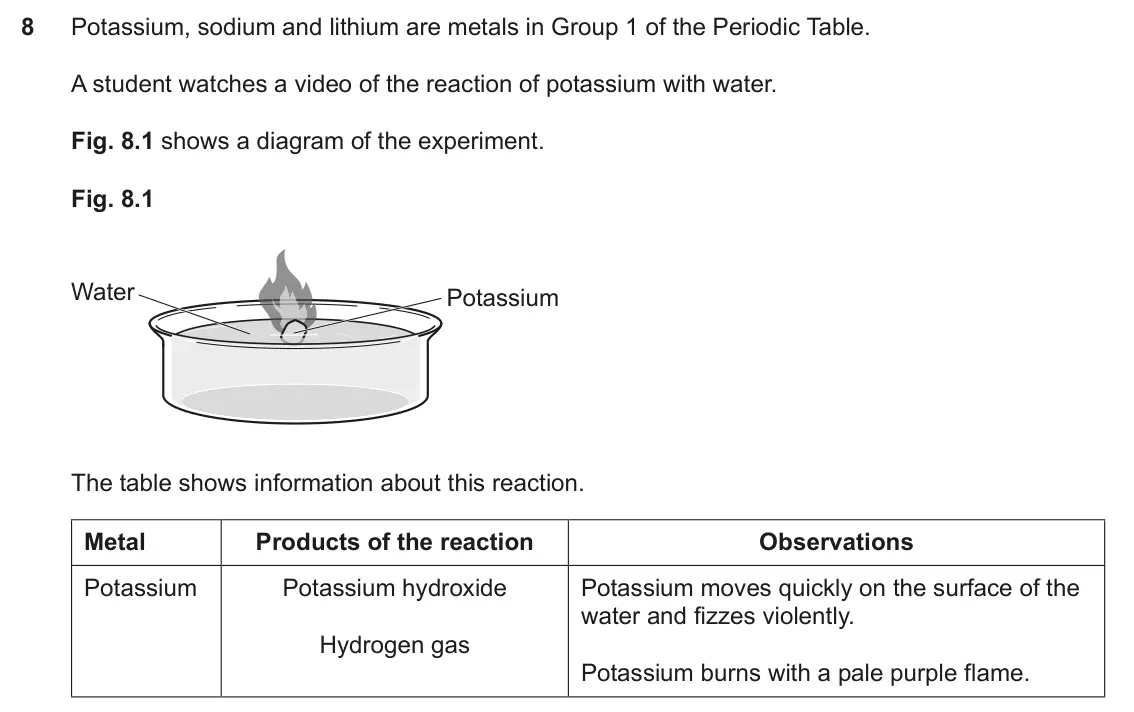
Q8(b)(iv)
The whole paper ↗Q4(a)(i)
The whole paper ↗
Q4(a)(ii)
The whole paper ↗Q4(a)(iii)
The whole paper ↗Q4(b)
The whole paper ↗Q1(b)(iii)
The whole paper ↗
Q1(b)(iv)
The whole paper ↗Q11(a)(i)
The whole paper ↗
Q11(a)(ii)
The whole paper ↗Q11(a)(iii)
The whole paper ↗Q2(a)(i)
The whole paper ↗
Q2(a)(ii)
The whole paper ↗Q2(a)(iii)
The whole paper ↗Q9(b)
The whole paper ↗
Q1(b)
The whole paper ↗
Q9(a)
The whole paper ↗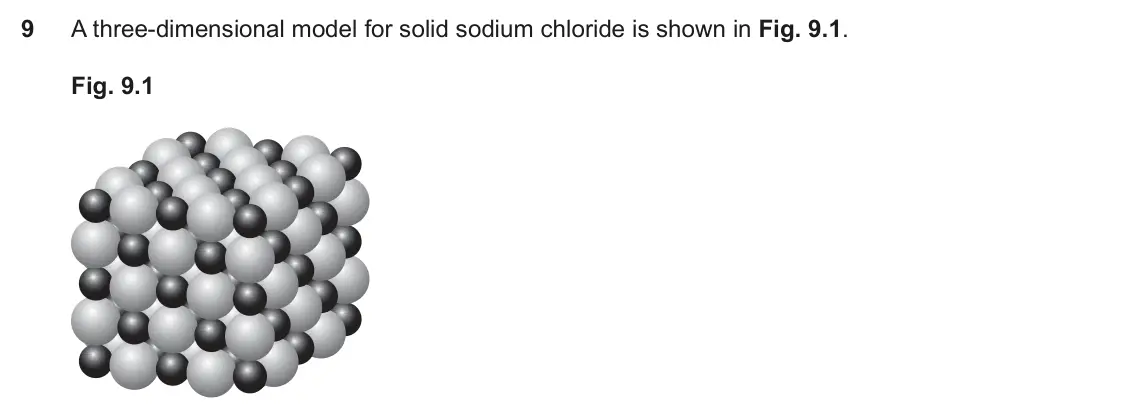
Q9(b)
The whole paper ↗Q1(c)(ii)
The whole paper ↗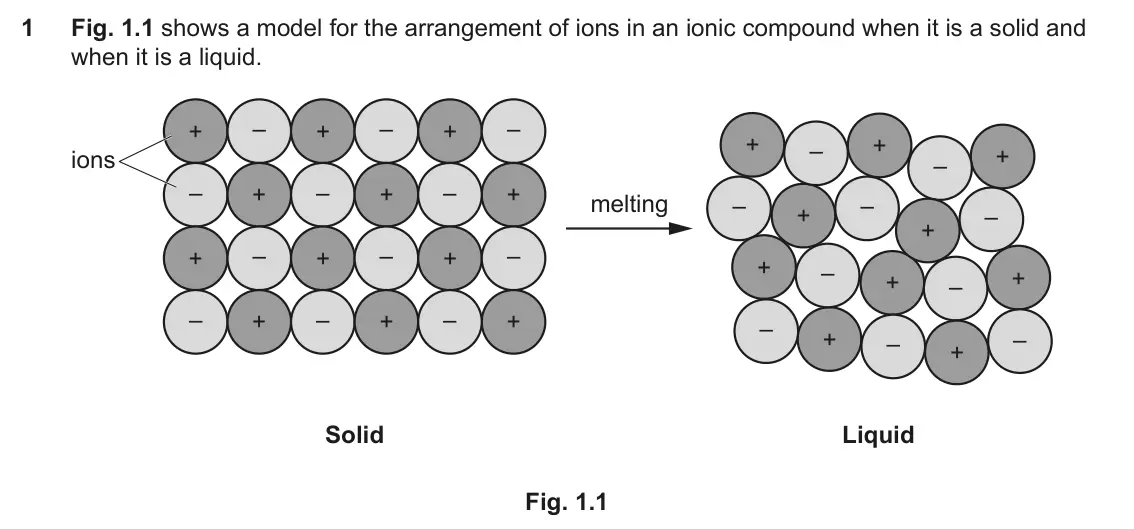
Q8(b)
The whole paper ↗
All 45 questions on How do metals and non-metals combine to form compounds?, as a list
- June 2025, Paper 2 Foundation, Q8(b)(iii) (3 marks): Lithium fluoride is an ionic compound that has lithium ions and fluoride ions. Fig. 8.3 shows a dot and cross diagram of these ions. The diagram is not complete
- June 2025, Paper 2 Foundation, Q8(b)(iv) (1 mark): Which statement gives a correct limitation of using a complete dot and cross diagram to represent ionic bonding? Tick (✓) one box. It does not show that the ion
- June 2025, Paper 3 Higher, Q4(a)(i) (2 marks): Complete the diagram by writing the correct charge onto each ion. [2]
- June 2025, Paper 3 Higher, Q4(a)(ii) (1 mark): State one limitation of the model of potassium bromide shown in the diagram. [1]
- June 2025, Paper 3 Higher, Q4(a)(iii) (3 marks): Which statements about the bonds in potassium bromide are true and which are false? Tick (✓) one box in each row. True False A bromine atom gains an electron to
- June 2025, Paper 3 Higher, Q4(b) (2 marks): The properties of potassium bromide can be explained in terms of the behaviour of its ions. Draw lines to connect each property with its correct explanation. Pr
- June 2025, Paper 4 Higher, Q1(b)(iii) (3 marks): Lithium fluoride is an ionic compound that has lithium ions and fluoride ions. Fig. 1.3 shows a dot and cross diagram of these ions. The diagram is not complete
- June 2025, Paper 4 Higher, Q1(b)(iv) (1 mark): Which statement gives a correct limitation of using a complete dot and cross diagram to represent ionic bonding? Tick (✓) one box. It does not show that the ion
- June 2024, Paper 1 Foundation, Q11(a)(i) (2 marks): Describe the attraction between ions in sodium chloride. [2]
- June 2024, Paper 1 Foundation, Q11(a)(ii) (2 marks): Which two statements about the limitations of the models in Fig. 11.1 are true? Tick (✓) two boxes. Model A does not show the relative sizes of the ions. Model
- June 2024, Paper 1 Foundation, Q11(a)(iii) (2 marks): Fig. 11.2 shows the dot and cross diagram for sodium chloride. Complete Fig. 11.2 to show the structure and charge of the chloride ion. Fig. 11.2 + Na Cl Na Cl
- June 2024, Paper 3 Higher, Q2(a)(i) (2 marks): Describe the attraction between ions in sodium chloride. [2]
- June 2024, Paper 3 Higher, Q2(a)(ii) (2 marks): Which two statements about the limitations of the models in Fig. 2.1 are true? Tick (✓) two boxes. Model A does not show the relative sizes of the ions. Model C
- June 2024, Paper 3 Higher, Q2(a)(iii) (2 marks): Fig. 2.2 shows the dot and cross diagram for sodium chloride. Complete Fig. 2.2 to show the structure and charge of the chloride ion. Fig. 2.2 + Na Cl Na Cl Sod
- June 2023, Paper 1 Foundation, Q9(b) (2 marks): Chlorine is very reactive. Argon is unreactive. Explain how the reactivity of these two elements are related to the arrangement of electrons in their atoms. [2]
- June 2023, Paper 3 Higher, Q1(b) (2 marks): Chlorine is very reactive. Argon is unreactive. Explain how the reactivity of these two elements are related to the arrangement of electrons in their atoms. [2]
- June 2023, Paper 4 Higher, Q9(a) (2 marks): Draw a two-dimensional diagram to show the arrangement of ions in sodium chloride. Use these symbols. Cl− Na+ Show at least eight ions. [2]
- June 2023, Paper 4 Higher, Q9(b) (2 marks): Explain why the model shown in Fig. 9.1 cannot be used to show the arrangement of ions in calcium chloride, CaCl 2. [2]
- June 2022, Paper 2 Foundation, Q1(c)(ii) (2 marks): Use ideas about electrons to explain why sodium atoms form an ion with a +1 charge. [2]
- June 2022, Paper 3 Higher, Q8(b) (2 marks): Magnesium sulfide, MgS is an ionic compound which contains the ions Mg2+ and S2–. Explain why magnesium sulfide has a high melting point. [2]
- June 2022, Paper 3 Higher, Q8(c) (2 marks): Complete Fig. 8.1 to show the ‘dot and cross’ diagrams for an Mg2+ ion and an S2– ion. Show all the electrons. 2+ 2– Mg S Fig. 8.1 [2]
- June 2022, Paper 4 Higher, Q6(b) (3 marks): Sodium atoms form sodium ions with a single positive charge. Neon atoms do not form ions. Use ideas about electrons to explain these statements. [3]
- June 2022, Paper 4 Higher, Q6(c) (6 marks): Fig. 6.1 shows the particle model for solids, liquids and gases. inelastic spheres melting boiling Solid Liquid Gas Fig. 6.1 (c)* Sodium chloride contains sodiu
- June 2022, Paper 4 Higher, Q8(b)(iii) (1 mark): A fuel cell filled with potassium hydroxide solution works better than a fuel cell filled with pure water. One reason it works better is because potassium hydro
- November 2021, Paper 1 Foundation, Q8(e) (1 mark): Calcium also reacts with chlorine. Calcium forms Ca2+ ions and chlorine forms Cl – ions. What is the correct formula of calcium chloride? Put a ring around the
- November 2021, Paper 2 Foundation, Q2(c)(ii) (2 marks): Chlorine forms chloride ions, Cl–. Complete the sentence to explain why chloride ions have a charge of –1. Use the words. You can use each word once, more than
- November 2021, Paper 3 Higher, Q1(e) (1 mark): Calcium also reacts with chlorine. Calcium forms Ca2+ ions and chlorine forms Cl– ions. What is the correct formula of calcium chloride? Put a ring around the c
- November 2021, Paper 3 Higher, Q3(a) (1 mark): Iron oxide, Fe2O3, contains O2– ions. What other ion does iron oxide, Fe2O3, contain? [1]
- November 2020, Paper 1 Foundation, Q8(f)(i) (2 marks): Fig. 8.1 shows the ‘dot and cross’ diagrams for a magnesium (Mg) atom and an oxygen (O) atom. Atoms Mg O Fig. 8.1 Complete Fig. 8.2 to show the ‘dot and cross’
- November 2020, Paper 2 Foundation, Q5(a) (6 marks): Magnesium oxide has ionic bonding. When ionic bonds form, electrons pass from one atom to another to form ions. The diagrams show the arrangement of electrons i
- November 2020, Paper 3 Higher, Q11(d) (2 marks): Magnesium oxide (MgO) is formed in Method 1. Complete Fig. 11.2 to show the ‘dot and cross’ diagrams for an Mg2+ ion and an O2– ion. Show all the electrons. 2+
- November 2020, Paper 4 Higher, Q5(a) (6 marks): Sodium oxide, Na2O and magnesium oxide, MgO, are both oxides with ionic bonds. When ionic bonds form, electrons pass from one atom to another to form ions. Fig.
- November 2020, Paper 4 Higher, Q5(b) (2 marks): Sodium oxide and magnesium oxide are both ionic compounds. Which statements about both sodium oxide and magnesium oxide are correct? Tick (3) two boxes. Their b
- November 2020, Paper 4 Higher, Q7(a)(i) (2 marks): Give two reasons why Fig. 7.1 is a better representation for the ions in solid ammonium nitrate, NH4NO3, than the ions in solid calcium nitrate, Ca(NO3)2. 1. 2.
- November 2020, Paper 4 Higher, Q7(a)(ii) (2 marks): In Fig. 7.1 the ions are shown far larger than they actually are. Suggest two other reasons why Fig. 7.1 does not accurately represent a solid ionic compound. 1
- June 2019, Paper 1 Foundation, Q5(c) (1 mark): When gallium reacts it loses three electrons. Which ion is formed? Put a ring around the correct answer. Ga Ga+ Ga2+ Ga3+ Ga− Ga2− Ga3− [1]
- June 2019, Paper 1 Foundation, Q5(d) (2 marks): Ionic compounds have high melting points. Which two statements explain this? Tick (3) two boxes. There are strong attractions between the ions. Shared electron
- June 2019, Paper 3 Higher, Q5(c) (3 marks): Gallium forms an oxide, Ga2O3. Draw a ‘dot and cross’ diagram for the ions in Ga2O3. Show outer electron shells only. [3]
- June 2018, Paper 1 Foundation, Q5(d) (1 mark): Element T in Table 5.1 reacts with a metal to make a compound. What type of structure does this compound have? Tick (3) one box. Giant covalent Giant ionic Simp
- June 2018, Paper 1 Foundation, Q11(d)(i) (1 mark): CeO2 contains O2– ions. What is the charge on the cerium ion? Put a ring around the correct answer. 1+ 2+ 3+ 4+ 5+ 6+ [1]
- June 2018, Paper 1 Foundation, Q13(d) (2 marks): Magnesium oxide, MgO, is an ionic compound. Draw a ‘dot and cross’ diagram for the ions in magnesium oxide. Show the outer electron shells only. [2]
- June 2018, Paper 2 Foundation, Q1(b) (2 marks): Explain why diamond and graphite are elements, but carbon dioxide is a compound. [2]
- June 2018, Paper 2 Foundation, Q5(b)(ii) (1 mark): What is the formula of a fluoride ion? Put a ring around the correct answer. F F– F2 F+ [1]
- June 2018, Paper 3 Higher, Q2(d) (2 marks): Magnesium oxide, MgO, is an ionic compound. Draw a ‘dot and cross’ diagram for the ions in magnesium oxide. Show the outer electron shells only. [2]
- June 2018, Paper 3 Higher, Q6(c) (1 mark): CeO2 contains O2– ions. Explain how the formula shows that Ce is present as Ce4+ ions. [1]
Questions, mark schemes and examiner’s reports are © OCR, from their published past papers. Plumi isn’t affiliated with any exam board. Want whole papers? Every OCR GCSE Chemistry B paper.
Rather write your answers by hand on iPad? Plumi marks them against the same mark schemes.