 plumi
What is the genome and what does it do?: OCR GCSE Biology B questions
Every OCR GCSE Biology B exam question on B1.1 What is the genome and what does it do?, 2018–2025, with its mark scheme and examiner’s report.
Paper
All papers
Exam
All years
Calculations
Q2(a)
The whole paper ↗Q2(b)
The whole paper ↗Q2(c)
The whole paper ↗Q3(a)(i)
The whole paper ↗
Q3(b)
The whole paper ↗Q4(a)
The whole paper ↗
Q4(b)
The whole paper ↗Q4(c)
The whole paper ↗Q8(a)
The whole paper ↗
Q9(c)(i)
The whole paper ↗
Q9(c)(ii)
The whole paper ↗Q9(c)(iii)
The whole paper ↗Q4(a)
The whole paper ↗
Q4(b)
The whole paper ↗Q4(c)(i)
The whole paper ↗Q8(c)(i)
The whole paper ↗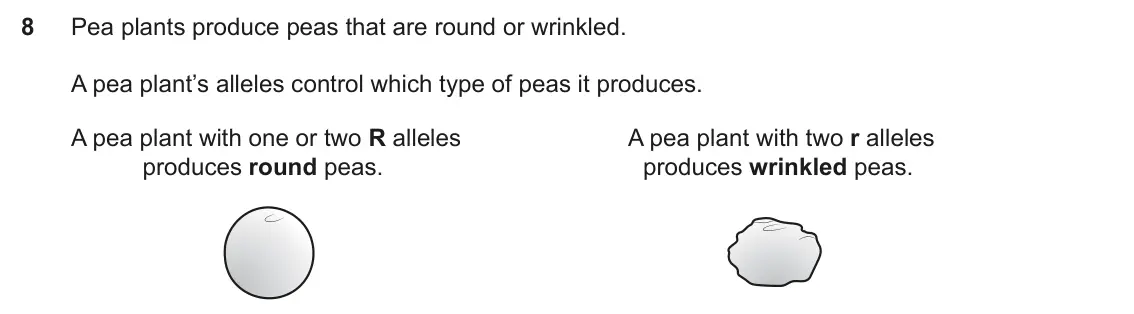
Q8(c)(iii)
The whole paper ↗Q1(b)
The whole paper ↗Q1(c)
The whole paper ↗Q5(d)
The whole paper ↗
All 95 questions on What is the genome and what does it do?, as a list
- June 2025, Paper 2 Foundation, Q2(a) (2 marks): Put these three structures in order of size, from the largest to the smallest. Chromosome Gene Nucleotide Largest Smallest [2]
- June 2025, Paper 2 Foundation, Q2(b) (1 mark): Which statement describes the genome? Tick (3) one box. A section of DNA that stores the instructions to make a protein. All the physical features of an organis
- June 2025, Paper 2 Foundation, Q2(c) (3 marks): Draw lines to connect each description with the correct number. Description Number 1 The number of bases in each nucleotide. 2 The number of different nucleotid
- June 2025, Paper 2 Foundation, Q3(a)(i) (1 mark): Classify the organism that the cell in Fig. 3.1 has come from. Tick (3) one box. Animal Bacterium Plant [1]
- June 2025, Paper 2 Foundation, Q3(b) (2 marks): Fig. 3.2 is a diagram of a different cell. Fig. 3.2 Plasmid Cell wall Cytoplasm Cell membrane DNA State two reasons why the cell in Fig. 3.2 would be classified
- June 2025, Paper 2 Foundation, Q4(a) (2 marks): Fig. 4.1 shows a light microscope. Fig. 4.1 A Clip B Coarse focus C D Fine focus Write the correct letter, A, B, C or D, next to each part. Eyepiece lens Light
- June 2025, Paper 2 Foundation, Q4(b) (3 marks): Complete the method to describe how to set up the light microscope to observe stomata on a slide. Use words from the list. eyepiece light objective slide stage
- June 2025, Paper 2 Foundation, Q4(c) (1 mark): Why is it important to look from the side in step 2 of the method? [1]
- June 2025, Paper 3 Higher, Q8(a) (1 mark): What is a gene? [1]
- June 2025, Paper 3 Higher, Q9(c)(i) (3 marks): Complete the sentences to describe how a mutation in a gene can change the activity of an enzyme. Use words from the list. active site amino acids bases protein
- June 2025, Paper 3 Higher, Q9(c)(ii) (1 mark): A mutation can also happen in non-coding DNA. What is non-coding DNA? Tick (✓) one box. DNA that does not cause a genetic disorder. DNA that does not store inst
- June 2025, Paper 3 Higher, Q9(c)(iii) (2 marks): Describe how a mutation in non-coding DNA can affect an organism’s phenotype. [2]
- June 2025, Paper 4 Higher, Q4(a) (2 marks): Fig. 4.1 shows a light microscope. Fig. 4.1 X Y Stage Coarse focus Light Fine focus Identify parts X and Y. Part X Part Y [2]
- June 2025, Paper 4 Higher, Q4(b) (2 marks): Statements A to D describe steps for setting up the microscope to view a piece of leaf on a slide. The statements are not in the correct order. A Place the slid
- June 2025, Paper 4 Higher, Q4(c)(i) (1 mark): Calculate the magnification of the image shown in Fig. 4.2. Use the equation: magnification = image length (mm) actual length (mm) Magnification = × [1]
- June 2025, Paper 4 Higher, Q8(c)(i) (3 marks): They discovered that the R allele is used to make an enzyme called SBE1. Complete the sentences to explain how this happens. Use words from the list. amino acid
- June 2025, Paper 4 Higher, Q8(c)(iii) (3 marks): The scientists also discovered that: • the r allele has an extra section of DNA inserted into it • the version of the SBE1 enzyme made from the r allele does no
- June 2024, Paper 1 Foundation, Q1(b) (1 mark): Which structure is the smallest? Tick (✓) one box. Cell Nucleus Organ Tissue [1]
- June 2024, Paper 1 Foundation, Q1(c) (1 mark): Which structure is the smallest? Tick (✓) one box. Cell Chromosome Gene Nucleus [1]
- June 2024, Paper 1 Foundation, Q5(d) (2 marks): The diagram shows the structure of DNA. A What are the two components of the part labelled A on the diagram? 1 2 [2]
- June 2024, Paper 2 Foundation, Q1(a) (2 marks): Here is a diagram of three cells. Cell A Cell B Cell C Mitochondria Cell wall Nucleus Loop of DNA containing DNA in the cytoplasm Which cell is a bacteria cell?
- June 2024, Paper 2 Foundation, Q1(b) (4 marks): Light microscopes can be used to observe bacteria. Here is a labelled diagram of a light microscope: Eyepiece lens Objective lens Stage Focus Light Complete the
- June 2024, Paper 2 Foundation, Q5(b)(i) (1 mark): Which statement explains what a gene is? Tick (✓) one box. A characteristic of an organism. A section of DNA that contains instructions. Part of a cell that con
- June 2024, Paper 2 Foundation, Q5(b)(ii) (1 mark): Cells need genes to make which substances? Put a ring around the correct answer. carbohydrates fats mineral ions proteins [1]
- June 2023, Paper 1 Foundation, Q1(a) (4 marks): Write these structures in order of size. Cell Chromosome Gene Nucleotide Nucleus Smallest Largest [4]
- June 2023, Paper 1 Foundation, Q1(b) (2 marks): The table shows the number of chromosomes that different animals have in each body cell. Animal Number of chromosomes in each body cell Earthworm 36 Giant panda
- June 2023, Paper 2 Foundation, Q2(b)(ii) (2 marks): The student’s body cells also need amino acids. Explain what the student’s body cells make using amino acids and how their genome is involved. [2]
- June 2023, Paper 2 Foundation, Q2(b)(iii) (1 mark): Where is the genome stored in the student’s cells? [1]
- June 2023, Paper 2 Foundation, Q2(b)(iv) (1 mark): The genome is made of DNA. Complete the sentence to describe the structure of DNA. Put a ring around each correct option. DNA is a polymer made from two / four
- June 2023, Paper 2 Foundation, Q6(b)(i) (3 marks): Statements A to E describe steps the scientist uses to look at the slide under the microscope. They are not in the correct order. A Place the slide on the stage
- June 2023, Paper 2 Foundation, Q6(b)(ii) (2 marks): Suggest two ways the scientist can work safely when using the microscope. 1 2 [2]
- June 2023, Paper 2 Foundation, Q6(c)(ii) (1 mark): To get the image in Fig. 6.3 the scientist used an eyepiece lens with a magnification of ×10, and an objective lens with a magnification of ×40. Describe how to
- June 2023, Paper 3 Higher, Q3(e) (3 marks): Identify three similarities between a cholera cell and a eukaryotic cell. 1 2 3 [3]
- June 2023, Paper 4 Higher, Q1(b)(i) (3 marks): Statements A to E describe steps the scientist uses to look at the slide under the microscope. They are not in the correct order. A Place the slide on the stage
- June 2023, Paper 4 Higher, Q1(b)(ii) (2 marks): Suggest two ways the scientist can work safely when using the microscope. 1 2 [2]
- June 2023, Paper 4 Higher, Q1(c)(ii) (1 mark): To get the image in Fig. 1.3 the scientist used an eyepiece lens with a magnification of ×10, and an objective lens with a magnification of ×40. Describe how to
- June 2023, Paper 4 Higher, Q6(a)(i) (2 marks): Describe what the fungi’s genome is and where it is stored. [2]
- June 2023, Paper 4 Higher, Q6(a)(ii) (4 marks): Explain how the genome is used to make proteins. [4]
- June 2022, Paper 1 Foundation, Q1 (4 marks): Complete the sentences about DNA and the production of proteins in cells. Put a ring around each correct answer. The shape of DNA is called a double helix / nuc
- June 2022, Paper 1 Foundation, Q7(a) (2 marks): The image Anika can see under the microscope is blurry. Describe how she should change the microscope to get a better image. [2]
- June 2022, Paper 1 Foundation, Q7(c) (1 mark): Where is the genetic material in a bacterial cell found? [1]
- June 2022, Paper 1 Foundation, Q9(a) (4 marks): Draw lines to connect each genetic term to its definition. Genetic term Definition Alleles A different version of a gene The two copies of a gene in a pair of C
- June 2022, Paper 3 Higher, Q5(a) (5 marks): Complete the sentences to explain how individuals in the same family can have different phenotypes. Use words from the list. alleles chromosomes DNA gene genomi
- June 2022, Paper 3 Higher, Q5(b) (2 marks): Genes code for proteins that are made by cells. Put sentences A–D in the correct order to describe protein synthesis. A mRNA leaves the nucleus. B mRNA enters t
- June 2022, Paper 4 Higher, Q3(c) (1 mark): The diagram shows a cell from a Gentoo penguin. Cytoplasm Nucleus Cell membrane DNA Mitochondria The presence of mitochondria shows that this is a eukaryotic ce
- June 2022, Paper 4 Higher, Q3(d) (1 mark): If a cell contains a vacuole, this suggests it could be a plant cell. State one other structure that suggests a cell is a plant cell. [1]
- June 2022, Paper 4 Higher, Q4(c)(i) (2 marks): Explain what a plasmid is. [2]
- June 2022, Paper 4 Higher, Q4(c)(ii) (2 marks): Explain how receiving a plasmid causes a bacterium to become resistant to an antibiotic. [2]
- June 2022, Paper 4 Higher, Q7(b)(i) (3 marks): Describe how the person’s cells will use the influenza mRNA to make influenza protein. [3]
- November 2021, Paper 2 Foundation, Q7(a) (3 marks): Explain how the genetic material is stored in an animal cell and how it is used to control what happens in the cell. [3]
- November 2021, Paper 2 Foundation, Q7(b) (2 marks): Give two ways in which the genetic material is stored in a prokaryotic cell such as a bacterium. 1. 2. [2]
- November 2021, Paper 2 Foundation, Q7(c)(iii) (3 marks): Even though scientists found her complete genome, they cannot be sure that she looked exactly like the image. Her genome is not the only factor that would have
- November 2021, Paper 2 Foundation, Q7(c)(iv) (1 mark): How many of our features are affected by both our genome and our environment? Tick (✓) one box. All of our features A small number of our features Most of our f
- November 2021, Paper 3 Higher, Q5(a) (2 marks): Explain the difference in how DNA is stored in these two types of cells. [2]
- November 2021, Paper 3 Higher, Q5(b)(i) (3 marks): Describe the structure of DNA. [3]
- November 2021, Paper 4 Higher, Q4(c) (4 marks): Explain why scientists cannot be sure exactly what she looked like, even though they found her complete genome. In your answer, include examples of other things
- November 2021, Paper 4 Higher, Q4(d) (2 marks): The scientists investigated all parts of her genome, including her non-coding DNA. Complete the sentences to explain why investigating her non-coding DNA helped
- November 2020, Paper 1 Foundation, Q1(c) (2 marks): Cells contain many organelles. Complete the sentences about organelles and their functions. Use words from the list. You can use each word once, more than once,
- November 2020, Paper 1 Foundation, Q2(b) (1 mark): What word is used to describe the physical features observed as a result of genes? Put a ring around the correct answer. allele environment phenotype [1]
- November 2020, Paper 1 Foundation, Q2(c)(i) (1 mark): Which statement defines the term genome? Tick (✓) one box. The chromosomes inherited from the mother The DNA found in the sperm cell The entire genetic material
- November 2020, Paper 1 Foundation, Q2(c)(ii) (1 mark): Where is DNA stored in an animal cell? Tick (✓) one box. Chloroplast Cytoplasm Nucleus [1]
- November 2020, Paper 1 Foundation, Q9(b) (3 marks): Sarah's teacher tells her she can observe these structures using a light microscope. Complete the sentences to describe how to use a light microscope. Use words
- November 2020, Paper 2 Foundation, Q1(a) (2 marks): Which two words describe the shape of a DNA molecule? Tick (✓) two boxes. Double Genome Single Helix Triple Nucleus [2]
- November 2020, Paper 2 Foundation, Q1(b) (1 mark): DNA is made from nucleotides. Each nucleotide is made from a common sugar, a phosphate group and one other part. What is the name of the other part? [1]
- November 2020, Paper 2 Foundation, Q1(c) (4 marks): Put the structures in the correct order of size, from the largest to the smallest. cell chromosome gene nucleotide nucleus largest smallest [4]
- November 2020, Paper 2 Foundation, Q1(d) (1 mark): Ali has made this diagram of a bacterium. Nucleus -Cytoplasm DNA - Plasmid There is a mistake in Ali's diagram. Identify one mistake in Ali's diagram of a bacte
- November 2020, Paper 2 Foundation, Q5(c)(i) (4 marks): Sarah puts a slide with a sample of the microorganisms on the microscope stage. She plans to use the microscope's mirror to reflect direct sunlight through the
- November 2020, Paper 2 Foundation, Q5(e) (2 marks): In Sarah's light microscope: The magnification of the eyepiece lens is x10. The magnification of the most powerful objective lens is x40. Was the image in Fig.
- November 2020, Paper 3 Higher, Q11(a) (2 marks): Compare the structure of mRNA to the structure of DNA. [2]
- November 2020, Paper 3 Higher, Q11(b) (3 marks): Genetic variants can be found in both coding and non-coding DNA. Complete the sentences to describe the effect of genetic variants in non-coding DNA. Use words
- November 2020, Paper 3 Higher, Q12(b)(i) (1 mark): XMEN syndrome is caused by a gene mutation. What is a gene mutation? [1]
- November 2020, Paper 4 Higher, Q5(d)(i) (3 marks): Explain how the drug prevents the brain damage caused by Huntington’s disease. [3]
- November 2020, Paper 4 Higher, Q5(d)(ii) (2 marks): The drug is injected into the patient’s blood. Give two reasons why the drug must be able to move through cell membranes but does not need to enter the cell nuc
- June 2019, Paper 1 Foundation, Q1(a) (1 mark): Draw an arrow on the diagram to show where the student should place the slide. [1]
- June 2019, Paper 1 Foundation, Q1(b) (1 mark): When the student looks down the lens the image is blurry. Describe what the student needs to do to focus the image. [1]
- June 2019, Paper 1 Foundation, Q1(c) (1 mark): The student knows the power of the eyepiece lens and the power of the objective lens. How should the student work out the total magnification of the image? [1]
- June 2019, Paper 1 Foundation, Q1(d) (1 mark): The student draws one of the onion cells. The teacher asks the student to label the structure where the chromosomes are located. Which structure should the stud
- June 2019, Paper 1 Foundation, Q9(d) (1 mark): Insulin is a protein. What is a protein made from? Tick (3) one box. Amino acids Fatty acids Glucose Glycerol [1]
- June 2019, Paper 2 Foundation, Q2(a) (4 marks): Ben takes a small piece of leaf from the plant. He places the piece of leaf on a microscope slide. He looks at the slide using a light microscope. The piece of
- June 2019, Paper 2 Foundation, Q2(d) (2 marks): The students conclude that the plant is a real living plant. Use evidence from the students’ investigations to support this conclusion. [2]
- June 2019, Paper 2 Foundation, Q5(a) (4 marks): Describe the structure of DNA. [4] Cystic fibrosis is caused by a single gene. There are two alleles of the gene: • the dominant allele, F, does not cause cysti
- June 2019, Paper 3 Higher, Q6(a) (1 mark): During protein synthesis, a copy of a gene is made from a molecule called . [1]
- June 2019, Paper 3 Higher, Q6(b) (1 mark): A characteristic of an organism that results from the interaction of the environment and the genome is called its . [1]
- June 2019, Paper 3 Higher, Q6(c) (1 mark): A is a monomer of DNA and is made from a sugar, a phosphate group and a base. [1]
- June 2019, Paper 3 Higher, Q6(d) (1 mark): A mutation in a region of DNA can affect the phenotype by altering gene expression. [1]
- June 2019, Paper 3 Higher, Q11(c) (3 marks): Explain how genetic variants arise and how they can influence the phenotype of an individual. [3]
- June 2019, Paper 4 Higher, Q4(b)(i) (4 marks): Write down the numbers of two steps in Kai’s method that have a high risk of causing damage to Kai or the apparatus. For each of these steps, explain why it is
- June 2019, Paper 4 Higher, Q4(b)(ii) (3 marks): Kai sets up the microscope using a safer method provided by his teacher. He puts a clear plastic ruler on the stage. He uses the microscope to look at the milli
- June 2019, Paper 4 Higher, Q4(b)(iii) (1 mark): Kai removes the ruler from the stage and replaces it with the slide showing stomata. He makes no other changes to the microscope. Fig. 4.3 shows what he sees. F
- June 2018, Paper 1 Foundation, Q2(a)(i) (1 mark): On the diagram label the location of a base. [1]
- June 2018, Paper 1 Foundation, Q2(a)(ii) (1 mark): On the diagram label the location of the sugar and phosphate group. [1]
- June 2018, Paper 1 Foundation, Q2(b) (2 marks): DNA has four different bases. A always pairs with T. C always pairs with G. A scientist is analysing a sample of DNA. She works out that 23% of DNA is made up o
- June 2018, Paper 2 Foundation, Q4(b)(ii) (2 marks): Doctors think that different people need a different dose of warfarin because of differences in their genomes. Explain how differences in the genome could cause
- June 2018, Paper 3 Higher, Q8(a) (4 marks): Complete the sentences to describe how a protein is made. Use words from the list. Each word can be used once, more than once, or not at all. amino acids bases
- June 2018, Paper 3 Higher, Q8(b) (2 marks): Scientists think that a mutation created the type of receptor that allows someone to taste a bitter substance. Explain how a mutation could affect the structure
Questions, mark schemes and examiner’s reports are © OCR, from their published past papers. Plumi isn’t affiliated with any exam board. Want whole papers? Every OCR GCSE Biology B paper.
Rather write your answers by hand on iPad? Plumi marks them against the same mark schemes.