 plumi
How is genetic information inherited?: OCR GCSE Biology B questions
Every OCR GCSE Biology B exam question on B1.2 How is genetic information inherited?, 2018–2025, with its mark scheme and examiner’s report.
Paper
All papers
Exam
All years
Calculations
Q8(a)
The whole paper ↗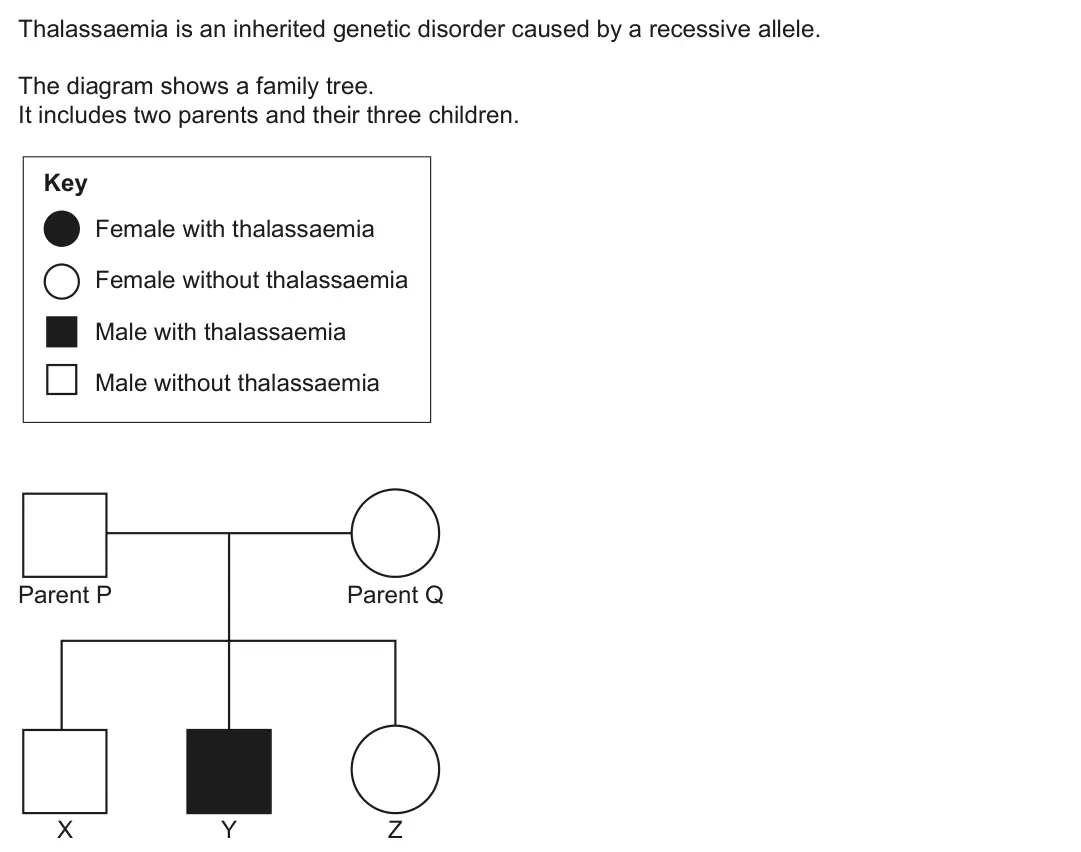
Q8(b)(i)
The whole paper ↗Q8(b)(ii)
The whole paper ↗Q9(a)(i)
The whole paper ↗
Q9(a)(ii)
The whole paper ↗Q8(a)
The whole paper ↗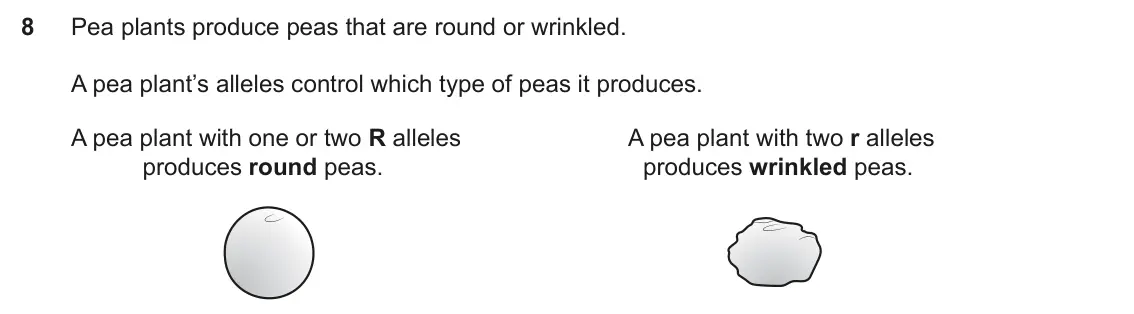
Q8(b)
The whole paper ↗Q5(a)
The whole paper ↗
Q5(b)
The whole paper ↗Q5(c)
The whole paper ↗Q11(a)
The whole paper ↗
Q11(b)(i)
The whole paper ↗Q11(b)(ii)
The whole paper ↗Q2(a)
The whole paper ↗
Q2(b)
The whole paper ↗Q10(a)
The whole paper ↗
Q10(c)
The whole paper ↗Q7(d)(i)
The whole paper ↗
Q7(d)(ii)
The whole paper ↗Q7(d)(iii)
The whole paper ↗
All 67 questions on How is genetic information inherited?, as a list
- June 2025, Paper 1 Foundation, Q8(a) (1 mark): How many of the three children have thalassaemia? Number of children with thalassaemia = [1]
- June 2025, Paper 1 Foundation, Q8(b)(i) (1 mark): Which of the following describes the parents’ genotype? Tick (✓) one box. Heterozygous Homozygous dominant Homozygous recessive [1]
- June 2025, Paper 1 Foundation, Q8(b)(ii) (3 marks): The parents decide to have another child. Complete the Punnett square to find the probability that the child will have thalassaemia. Use T to represent the domi
- June 2025, Paper 3 Higher, Q9(a)(i) (3 marks): Describe the evidence from the family tree that supports this statement: ‘Thalassaemia is caused by a recessive allele.’ [3]
- June 2025, Paper 3 Higher, Q9(a)(ii) (3 marks): Individual W has a child with a female who is homozygous dominant for this genetic disorder. Calculate the probability that this child has thalassaemia. Probabi
- June 2025, Paper 4 Higher, Q8(a) (4 marks): Draw lines to connect each example to its correct description. Example Description Dominant allele Dominant phenotype R Heterozygous genotype Rr Homozygous domi
- June 2025, Paper 4 Higher, Q8(b) (4 marks): Gregor Mendel investigated the inheritance of round and wrinkled peas in the 1860s. Here are the steps Mendel took in one experiment: Step 1: Mendel bred one RR
- June 2024, Paper 1 Foundation, Q5(a) (3 marks): Complete the Punnett square to show that a bird breeder has a 0.5 probability of each offspring being male or female. Sperm cells Egg cells [3]
- June 2024, Paper 1 Foundation, Q5(b) (2 marks): Complete the table to compare sex determination in birds and humans. Tick (✓) one box in each row. Both birds Only birds Only humans and humans Sex is determine
- June 2024, Paper 1 Foundation, Q5(c) (3 marks): Describe how a human male baby develops male characteristics. [3]
- June 2024, Paper 3 Higher, Q11(a) (2 marks): Explain why cat breeders will be more concerned about a genetic condition that is caused by a dominant allele than a recessive allele. [2]
- June 2024, Paper 3 Higher, Q11(b)(i) (4 marks): Show how these cats could produce kittens that have PKD. Use a Punnett square. Use D to represent the dominant allele and d to represent the recessive allele. [
- June 2024, Paper 3 Higher, Q11(b)(ii) (2 marks): When the male homozygous recessive cat mates with the female heterozygous cat, they have 2 kittens. Calculate the probability that both kittens have PKD. Probab
- June 2023, Paper 1 Foundation, Q2(a) (4 marks): Two cocker spaniels have a puppy. • One of the parents has black fur and the alleles Bb. • The other parent has brown fur and the alleles bb. Calculate the prob
- June 2023, Paper 1 Foundation, Q2(b) (1 mark): is recessive. (b) Complete the sentence to explain why many other fur colours and patterns are seen in cocker spaniels. Put a ring around the correct option. Ma
- June 2023, Paper 3 Higher, Q10(a) (3 marks): Jane is 31, and she has started to develop symptoms of the condition. Neither of her parents has the disease. Calculate the probability that Jane has haemochrom
- June 2023, Paper 3 Higher, Q10(c) (4 marks): There are three common variations that cause this condition. The table shows the number of people with each of the three common variations. Variation Number of
- June 2023, Paper 4 Higher, Q7(d)(i) (1 mark): What is the phenotype of an elephant that has the genotype XT Xt? [1]
- June 2023, Paper 4 Higher, Q7(d)(ii) (2 marks): Explain why no female elephants are born homozygous for the no-tusks allele. [2]
- June 2023, Paper 4 Higher, Q7(d)(iii) (2 marks): A female elephant that is heterozygous for the no-tusks allele has a baby. Complete the Punnett square to show the possible genotypes of the baby. Father’s game
- June 2023, Paper 4 Higher, Q7(d)(iv) (2 marks): A scientist concludes that this female elephant is likely to have twice as many female offspring as male offspring. Explain why the scientist is correct. [2]
- June 2022, Paper 1 Foundation, Q9(b) (3 marks): Sickle cell anaemia is an inherited disease. The disease is caused by a recessive allele. The recessive allele is represented with an a, and the dominant allele
- June 2022, Paper 1 Foundation, Q14(a) (2 marks): Explain how sex determination in humans is different to sex determination in turtles. [2]
- June 2022, Paper 1 Foundation, Q14(b)(i) (3 marks): In some locations in 2020 the female turtles outnumbered male turtles in a ratio of 116 : 1. Calculate the number of female turtles in a sample of 18 000 turtle
- June 2022, Paper 1 Foundation, Q14(b)(iii) (1 mark): Suggest how scientists could help return the sex ratio in the next generation of turtles to that seen in the 1970s. [1]
- June 2022, Paper 2 Foundation, Q6(a)(i) (1 mark): State the genotype of ‘parent’ plant 1. [1]
- June 2022, Paper 2 Foundation, Q6(a)(ii) (1 mark): Describe the phenotype of ‘parent’ plant 2. [1]
- June 2022, Paper 2 Foundation, Q6(a)(iii) (1 mark): What is the probability that a plant in the ‘first generation’ will have red flowers? Put a ring around the correct answer. 0.25 0.5 1 4 [1]
- June 2022, Paper 2 Foundation, Q6(a)(iv) (2 marks): What can you conclude about the R and r alleles? Use the information in Table 6.1 and Fig. 6.1 to help you. R allele
- June 2022, Paper 2 Foundation, Q6(b)(i) (1 mark): Describe the flower colours Mendel would have observed in the ‘second generation’ of offspring. Flower colour of plants with alleles RR Flower colour of plants
- June 2022, Paper 2 Foundation, Q6(b)(ii) (2 marks): Calculate the percentage of plants in the ‘second generation’ that have the alleles Rr. Percentage = % [2]
- June 2022, Paper 2 Foundation, Q6(b)(iii) (1 mark): What can you conclude about the ratio of red flowered plants to white flowered plants in the ‘second generation’? Ratio of red flowered plants to white flowered
- June 2022, Paper 3 Higher, Q3(a) (2 marks): Explain how sex determination in humans is different to sex determination in turtles. [2]
- June 2022, Paper 3 Higher, Q3(b) (6 marks): The effect of temperature on the sex of the offspring is shown in the table. Egg incubation temperature (°C) Sex of offspring Below 27.7 male mix of male and fe
- November 2021, Paper 1 Foundation, Q11(b) (1 mark): Charlie and Eve find out they both have the genotype Tt. What word is used to describe this genotype? [1]
- November 2021, Paper 1 Foundation, Q11(c) (3 marks): Charlie and Eve still want to have a child. Complete the Punnett square to find out the probability of their child having Tay-Sachs disease. Probability of chil
- November 2021, Paper 2 Foundation, Q7(c)(i) (2 marks): Describe what evidence her genome would have contained to show that she was female. [2]
- November 2021, Paper 3 Higher, Q2(b) (1 mark): Charlie and Eve find out they both have the genotype Tt. What word is used to describe this genotype? [1]
- November 2021, Paper 3 Higher, Q2(c) (3 marks): Charlie and Eve still want to have a child. Complete the Punnett square to find out the probability of their child having Tay-Sachs disease. Probability of chil
- November 2021, Paper 3 Higher, Q5(b)(ii) (1 mark): A student talks about DNA with their friend. The student tells their friend that all features in a person’s phenotype are controlled by single genes in their DN
- November 2021, Paper 3 Higher, Q7(c) (2 marks): Scientists have discovered six disease-resistant Tasmanian devils in the population. Initially scientists did not know if this resistance was hereditary. Sugges
- November 2021, Paper 4 Higher, Q4(a) (1 mark): Describe what evidence her genome would have contained to show that she was female. [1]
- November 2020, Paper 1 Foundation, Q2(a)(i) (2 marks): Which two words can be used to describe Jack’s genotype? Put a ring around the two correct answers. dominant heterozygous homozygous recessive [2]
- November 2020, Paper 1 Foundation, Q2(a)(ii) (1 mark): Jack’s friend is unable to roll their tongue. What will their genotype be? Tick (✓) one box. RR Rr rr [1]
- November 2020, Paper 1 Foundation, Q2(a)(iii) (3 marks): A male with the genotype Rr and a female with the genotype Rr have a baby. Complete the Punnett square to show how the male and female can have a baby that can
- November 2020, Paper 1 Foundation, Q5(d) (2 marks): A chicken’s sex is determined by genes located on the sex chromosomes. Chickens have two different sex chromosomes, Z and W. Male chickens are ZZ and female chi
- November 2020, Paper 2 Foundation, Q2(c) (2 marks): Fertilisation takes place. The male gamete has the sex chromosome Y. What sex chromosomes will the baby have, and what sex will it be? Sex chromosomes Sex [2]
- November 2020, Paper 3 Higher, Q12(b)(ii) (1 mark): Is this disease likely to be seen more often in males or females? Explain your answer. Use your knowledge of sex determination in your answer. [1]
- November 2020, Paper 4 Higher, Q5(a) (2 marks): The allele that causes the disease is dominant. The other allele is recessive. A couple are planning to have a baby. • The female’s genotype is heterozygous dom
- November 2020, Paper 4 Higher, Q5(b) (2 marks): Give two reasons why a Punnett square cannot be used to predict most of a person’s features. 1 2 [2]
- June 2019, Paper 2 Foundation, Q5(b)(i) (1 mark): What is the phenotype of a person who has the alleles FF? [1]
- June 2019, Paper 2 Foundation, Q5(b)(ii) (1 mark): What is the phenotype of a person who has the alleles Ff? [1]
- June 2019, Paper 2 Foundation, Q5(b)(iii) (1 mark): What is the genotype of a person who has cystic fibrosis? [1]
- June 2019, Paper 2 Foundation, Q5(c)(i) (1 mark): What proportion of their offspring is likely to have the allele combination FF? in every [1]
- June 2019, Paper 2 Foundation, Q5(c)(ii) (2 marks): What percentage of their offspring is likely to have the allele combination Ff? Percentage = % [2]
- June 2019, Paper 2 Foundation, Q5(c)(iii) (2 marks): What is the probability that any one of their offspring will have cystic fibrosis? Probability = [2]
- June 2019, Paper 2 Foundation, Q5(d) (6 marks): Cystic fibrosis is a disease caused by a person’s DNA. (d)* A different couple is also thinking about having a baby. • The woman has had a genetic test. It show
- June 2019, Paper 3 Higher, Q11(a)(i) (2 marks): Use the letter F to write down the genotypes for a horse with the following coat colours. Solid coloured Frame patterned [2]
- June 2019, Paper 3 Higher, Q11(a)(ii) (4 marks): Lethal white syndrome (LWS) is a genetic disorder found in these horses. Foals born to these horses have all white or nearly white coats and blue eyes and appea
- June 2019, Paper 4 Higher, Q6(c)(i) (5 marks): Use the information to explain why sickle-cell disease is common in regions in which malaria is widespread. [5]
- June 2018, Paper 1 Foundation, Q3(a)(i) (1 mark): Jack is homozygous for this gene. What is Jack’s genotype? Tick (3) one box. TT Tt tT tt [1]
- June 2018, Paper 1 Foundation, Q3(a)(ii) (2 marks): Jack wants to know if any of his children will be able to taste the bitter substance. Nina has the genotype tt. Complete the Punnett square to show the possible
- June 2018, Paper 1 Foundation, Q3(a)(iii) (1 mark): What is the probability that any children born will be able to taste the bitter substance. Probability = [1]
- June 2018, Paper 1 Foundation, Q3(a)(iv) (2 marks): Jack and Nina have two children, one boy and one girl. Describe how sex is determined in humans. [2]
- June 2018, Paper 3 Higher, Q7(a)(i) (3 marks): Complete the table to show the genotype of each individual. Individual Genotype Jack Nina Mia [3]
- June 2018, Paper 3 Higher, Q7(a)(ii) (2 marks): Jack and Nina decide to have another child. What is the probability that the second child will have dimples? Use the Punnett square to show your working. Probab
- June 2018, Paper 3 Higher, Q7(b) (1 mark): Scientists consider this trait an ‘irregular’ dominant trait. This is because sometimes a person can have dimples but their children do not. What could be respo
Questions, mark schemes and examiner’s reports are © OCR, from their published past papers. Plumi isn’t affiliated with any exam board. Want whole papers? Every OCR GCSE Biology B paper.
Rather write your answers by hand on iPad? Plumi marks them against the same mark schemes.