 plumi
How can we identify the cause of an infection?: OCR GCSE Biology B questions
Every OCR GCSE Biology B exam question on B2.4 How can we identify the cause of an infection?, 2018–2025, with its mark scheme and examiner’s report.
Paper
All papers
Exam
All years
Calculations
Q9(d)
The whole paper ↗
Q1(d)
The whole paper ↗
Q8(a)
The whole paper ↗
Q8(b)
The whole paper ↗Q8(c)
The whole paper ↗Q8(d)
The whole paper ↗Q9(a)
The whole paper ↗Q3(e)
The whole paper ↗
Q7(b)(i)
The whole paper ↗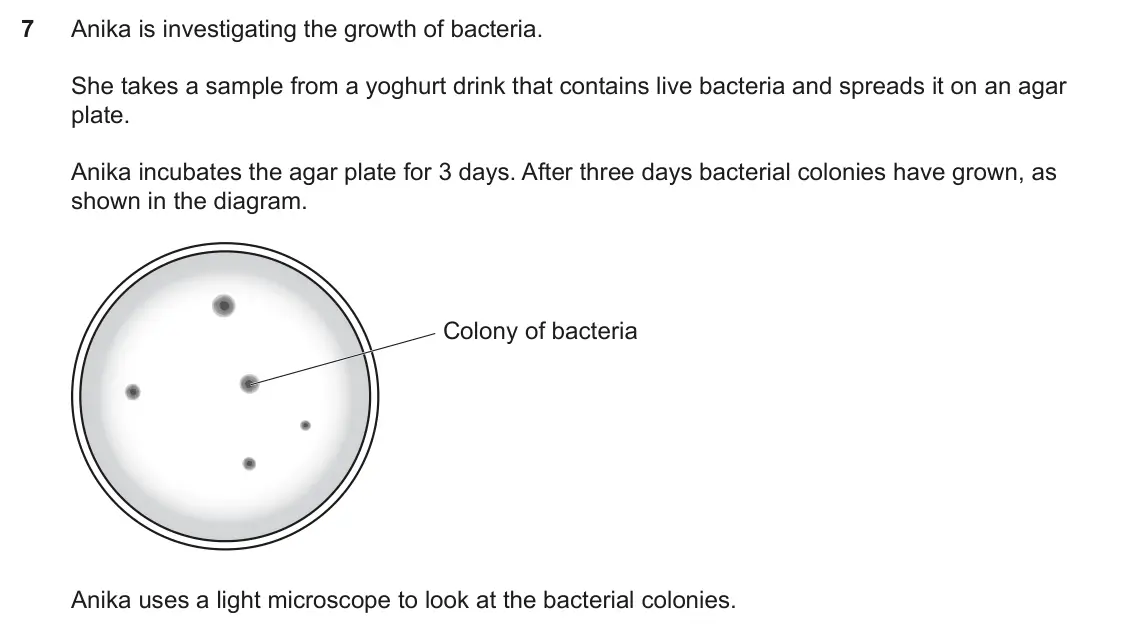
Q7(b)(ii)
The whole paper ↗Q3(f)(i)
The whole paper ↗
Q3(f)(ii)
The whole paper ↗Q3(f)(iii)
The whole paper ↗Q4(d)(i)
The whole paper ↗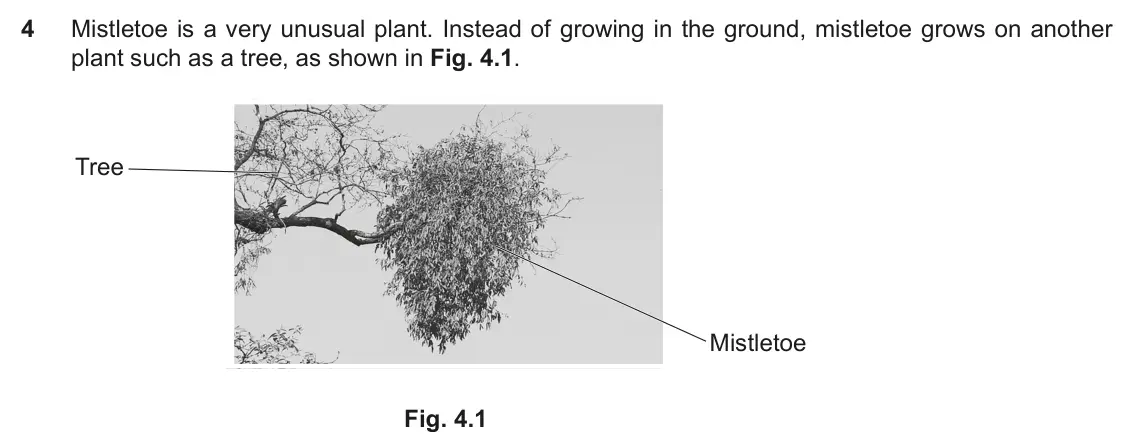
Q4(d)(ii)
The whole paper ↗Q5(b)(i)
The whole paper ↗
Q5(b)(ii)
The whole paper ↗Q3(b)(i)
The whole paper ↗
Q3(b)(ii)
The whole paper ↗Q3(b)(iii)
The whole paper ↗
All 20 questions on How can we identify the cause of an infection?, as a list
- June 2025, Paper 1 Foundation, Q9(d) (2 marks): To identify the type of bacterium responsible for the death of the elephants, the scientists cultured the bacteria. They poured some of the bacteria onto agar j
- June 2025, Paper 3 Higher, Q1(d) (2 marks): To identify the type of bacterium responsible for the death of the elephants, the scientists cultured the bacteria. They poured some of the bacteria onto agar j
- June 2024, Paper 3 Higher, Q8(a) (1 mark): Suggest a suitable sample that could be taken from the patient that can be tested for Salmonella bacteria. [1]
- June 2024, Paper 3 Higher, Q8(b) (2 marks): When the sample arrives at the laboratory the scientists first make a culture of the bacteria. Explain why the scientists make a culture. [2]
- June 2024, Paper 3 Higher, Q8(c) (3 marks): The scientists take a sample from the culture. They prepare a slide so they can view the bacteria. They use a stain that turns Salmonella bacteria pink. Describ
- June 2024, Paper 3 Higher, Q8(d) (1 mark): Explain why it is important that aseptic techniques are used at all stages of the procedure. [1]
- June 2024, Paper 3 Higher, Q9(a) (3 marks): Monoclonal antibodies can be produced in the laboratory and used to treat disease. Put statements A to E in the correct order to describe how monoclonal antibod
- June 2023, Paper 1 Foundation, Q3(e) (2 marks): A scientist collects a sample of pathogen cells from a plant with a disease. The scientist uses different techniques to try to work out how the disease can be t
- June 2022, Paper 1 Foundation, Q7(b)(i) (1 mark): There can be millions of bacteria in one colony. Assume each colony on the agar plate has 2 million bacteria. Use the diagram to estimate the total number of ba
- June 2022, Paper 1 Foundation, Q7(b)(ii) (1 mark): Explain why this estimated number is not accurate. [1]
- June 2022, Paper 2 Foundation, Q3(f)(i) (4 marks): Describe four ways to improve Charlie’s method to include aseptic techniques. [4]
- June 2022, Paper 2 Foundation, Q3(f)(ii) (2 marks): Charlie uses proper aseptic techniques to add a drop of liquid containing the bacteria to the centre of each Petri dish. Fig. 3.3 shows the Petri dishes after t
- June 2022, Paper 2 Foundation, Q3(f)(iii) (2 marks): Charlie concludes that the bacteria are resistant to all of the antibiotics except antibiotic C. Describe the evidence in Fig. 3.3 that supports Charlie’s concl
- November 2020, Paper 4 Higher, Q4(d)(i) (4 marks): Describe how scientists make monoclonal antibodies that recognise the bacteria from the tree. [4]
- November 2020, Paper 4 Higher, Q4(d)(ii) (3 marks): The monoclonal antibodies are designed to recognise the bacteria from the tree. The scientist wants to test whether they also recognise the bacteria from the mi
- June 2019, Paper 3 Higher, Q5(b)(i) (3 marks): The doctor must use aseptic techniques to do this. Describe three aseptic techniques the doctor may use when culturing the microorganisms. 1 2 3 [3]
- June 2019, Paper 3 Higher, Q5(b)(ii) (3 marks): The doctor looks at some bacteria from the culture using a microscope. Look at the image of one bacterium. The actual length of this bacterium is 3.5 µm. 1 µm =
- June 2018, Paper 2 Foundation, Q3(b)(i) (3 marks): Suggest three improvements Amir could make to his method to reduce the risk of contaminating the Petri dish with unwanted bacteria. 1 2 3 [3] After transferring
- June 2018, Paper 2 Foundation, Q3(b)(ii) (3 marks): The radius (r) of the clear zone around the disc soaked in antibiotic A is 11 mm. Calculate the area of this clear zone. Use the equation: area of clear zone =
- June 2018, Paper 2 Foundation, Q3(b)(iii) (2 marks): Amir sets up three more Petri dishes in the same way as the first. The table shows his results for all four dishes. Area of clear zone (mm2) Disc Soaked in Petr
Questions, mark schemes and examiner’s reports are © OCR, from their published past papers. Plumi isn’t affiliated with any exam board. Want whole papers? Every OCR GCSE Biology B paper.
Rather write your answers by hand on iPad? Plumi marks them against the same mark schemes.