 plumi
Uniform fields and the charge on the electron: OCR A‑Level Physics B questions
OCR A-Level Physics B past-paper questions on 6.1.2.1 Uniform fields and the charge on the electron, 2016–2025, with mark schemes and examiner’s reports where available.
Paper
All papers
Exam
All years
Calculations
Q40(b)(i)
The whole paper ↗Q40(b)(ii)
The whole paper ↗Q2(a)(ii)
The whole paper ↗
Q2(a)(iii)
The whole paper ↗Q40(a)(i)
The whole paper ↗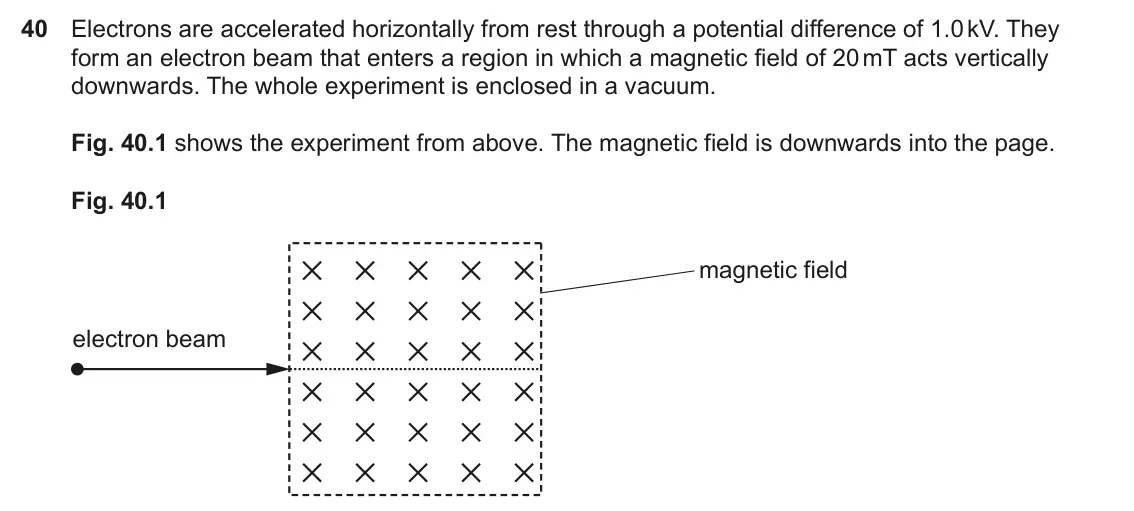
Q40(b)
The whole paper ↗- Your answer
Q1(c)(i)
The whole paper ↗
Q1(c)(ii)
The whole paper ↗Q1(c)(iii)
The whole paper ↗Q42(a)(iii)
The whole paper ↗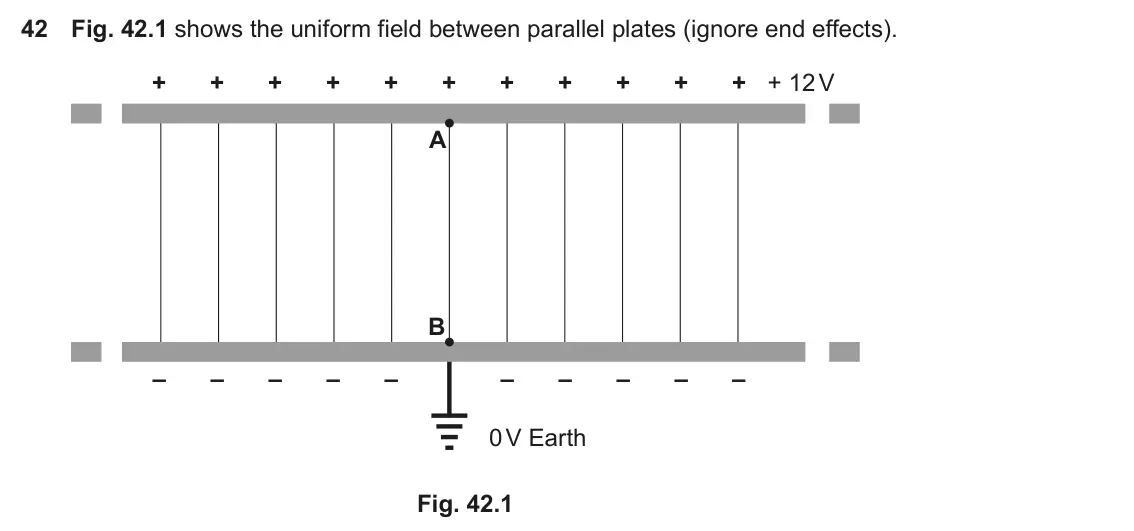
- Your answer
Q4(a)(i)
The whole paper ↗
Q6(a)
The whole paper ↗
Q6(b)(i)
The whole paper ↗- Your answer
Q37(b)(i)
The whole paper ↗
Q37(b)(ii)
The whole paper ↗Q3(b)(i)
The whole paper ↗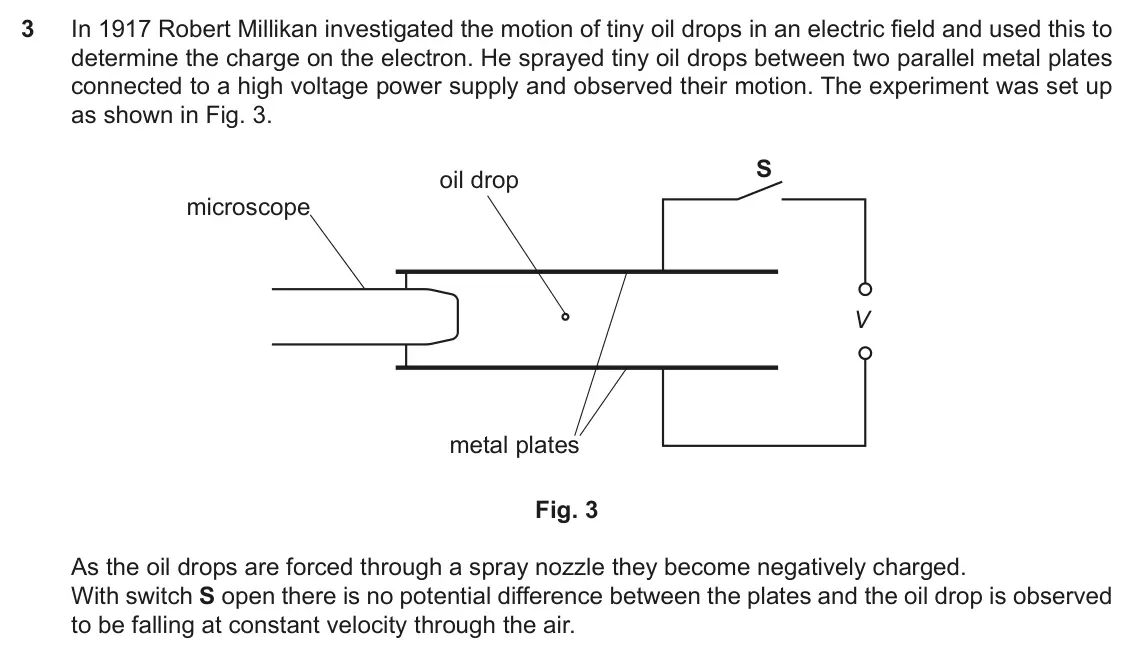
Q3(b)(ii)
The whole paper ↗
All 23 questions on Uniform fields and the charge on the electron, as a list
- June 2025, Paper 1, Q40(b)(i) (3 marks): Use data for the oil drop when it is falling. [3]
- June 2025, Paper 1, Q40(b)(ii) (3 marks): Calculate the charge on the oil drop. Use data for the oil drop when it is stationary. charge = C [3]
- June 2025, Paper 2, Q2(a)(ii) (2 marks): A free electron in air travels about 700 nm between collisions with molecules. Use your answer to (a)(i) to calculate the strength of a uniform electric field r
- June 2025, Paper 2, Q2(a)(iii) (2 marks): Explain why the number of ions formed per second will initially rise at increasing rate after the first ionisation event. [2]
- June 2024, Paper 1, Q40(a)(i) (2 marks): Show that the speed of the electrons when they enter the magnetic field is about 1.9 × 10⁷ m s–1. Ignore relativistic effects. [2]
- June 2024, Paper 1, Q40(b) (2 marks): Fig. 40.2 shows the same experiment when two vertical metal plates are positioned parallel to the initial velocity of the electron. A potential difference is ap
- June 2023, Paper 1, Q6 (1 mark): Two parallel conducting plates P and Q have a p.d. V between them. They are separated by distance d. + V 0 V d P Q Which graph shows the variation of electric f
- June 2022, Paper 2, Q1(c)(i) (2 marks): Draw six lines on Fig. 1.2 to represent the uniform field between the plates. Assume that the oil drop does not distort the field. [2]
- June 2022, Paper 2, Q1(c)(ii) (2 marks): The drop of mass 1.8 × 10⁻¹⁵ kg is held stationary between the plates when the p.d.V between the plates is 200 V. The plate separation is 5.4 mm. Calculate the
- June 2022, Paper 2, Q1(c)(iii) (2 marks): When Millikan and Fletcher performed this experiment with many oil drops, they found that the charge on the drop was always a multiple of about 1.6 × 10⁻¹⁹ C (t
- November 2020, Paper 1, Q42(a)(iii) (1 mark): The distance AB is 5.0 mm. Calculate the electric field between the plates. electric field = V m−1 [1]
- June 2019, Paper 1, Q13 (1 mark): Two horizontal metal plates are 5.0 mm apart. The plates are at potentials of + 120 V and + 40 V. + 120 V 5.0 mm + 40 V What is the force experienced by an elec
- June 2019, Paper 2, Q4(a)(i) (2 marks): An electron is accelerated through a p.d. of 4.3 kV. Calculate the velocity of the accelerated electron. Ignore relativistic effects. velocity = m s–1 [2]
- June 2019, Paper 2, Q6(a) (1 mark): State how Fig. 6.2 shows that the electric field is uniform within the selector. [1]
- June 2019, Paper 2, Q6(b)(i) (2 marks): By considering the forces on the charge, explain why the charge will not be deflected when v = Es . Bs [2]
- June 2018, Paper 1, Q11 (1 mark): An electron is travelling at a speed of 3.1 # 105 m s−1. What is its kinetic energy in electronvolts? 4.4 # 10−20 eV A 8.8 # 10−7 eV B C 0.27 eV D 500 eV Your a
- June 2018, Paper 1, Q37(b)(i) (2 marks): A positive ion of charge Q and mass m is accelerated through a p.d. V. Show that the p it gains is given by the expression momentum per unit mass m p c m. Q 2 V
- June 2018, Paper 1, Q37(b)(ii) (2 marks): Discuss an advantage of using ions of hydrogen 1H+ as propellant instead of xenon 130Xe+. [2]
- June 2018, Paper 3, Q3(b)(i) (2 marks): Calculate the electric field strength E between the two parallel plates. Include a suitable unit. E = …………………. unit ………… [2]
- June 2018, Paper 3, Q3(b)(ii) (3 marks): Calculate the charge q carried by each oil drop. q = C [3]
- June 2018, Paper 3, Q3(b)(iii) (2 marks): This calculation does not take into account the effect of buoyancy from the displaced air. This effect produces an additional upwards force on the oil drop. Exp
- June 2018, Paper 3, Q3(c) (2 marks): The charge on the parallel metal plates is reversed. Explain the effect this has on the motion of the oil drop. [2]
- June 2017, Paper 1, Q25 (1 mark): An oil drop of mass m charged by one electron is balanced between two parallel horizontal metal plates. A potential difference V is applied between the plates a
Questions, mark schemes and examiner’s reports are © OCR, from their published past papers. Plumi isn’t affiliated with any exam board. Want whole papers? OCR A-Level Physics B past papers.
The Plumi iPad app also offers exam-style questions with AI feedback on your handwritten working.