 plumi
Size and spacing of particles: OCR A‑Level Physics B questions
OCR A-Level Physics B past-paper questions on 3.2.2 Size and spacing of particles, 2016–2025, with mark schemes and examiner’s reports where available.
Paper
All papers
Exam
All years
Calculations
Q1(a)
The whole paper ↗
Q1(b)(i)
The whole paper ↗Q1(b)(ii)
The whole paper ↗Q24(b)
The whole paper ↗- Your answer
Q23(a)
The whole paper ↗
Q23(b)
The whole paper ↗Q4(b)(i)
The whole paper ↗
Q21(a)
The whole paper ↗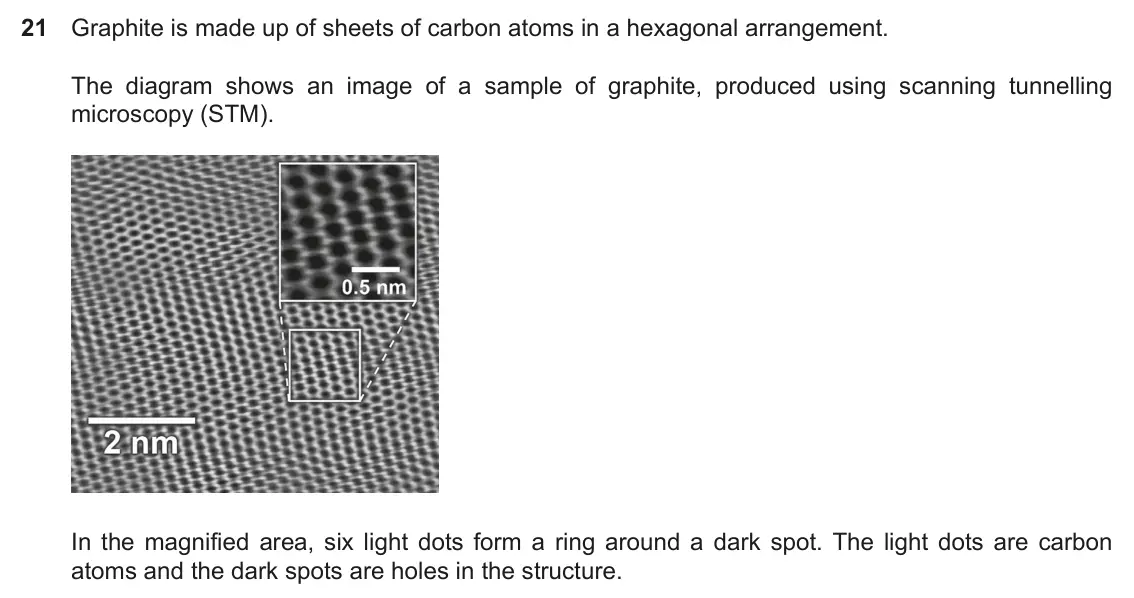
Q21(b)
The whole paper ↗Q21(c)
The whole paper ↗Q6(a)(i)
The whole paper ↗
Q6(a)(ii)
The whole paper ↗Q6(a)(iii)
The whole paper ↗Q6(a)(iv)
The whole paper ↗Q40(c)(i)
The whole paper ↗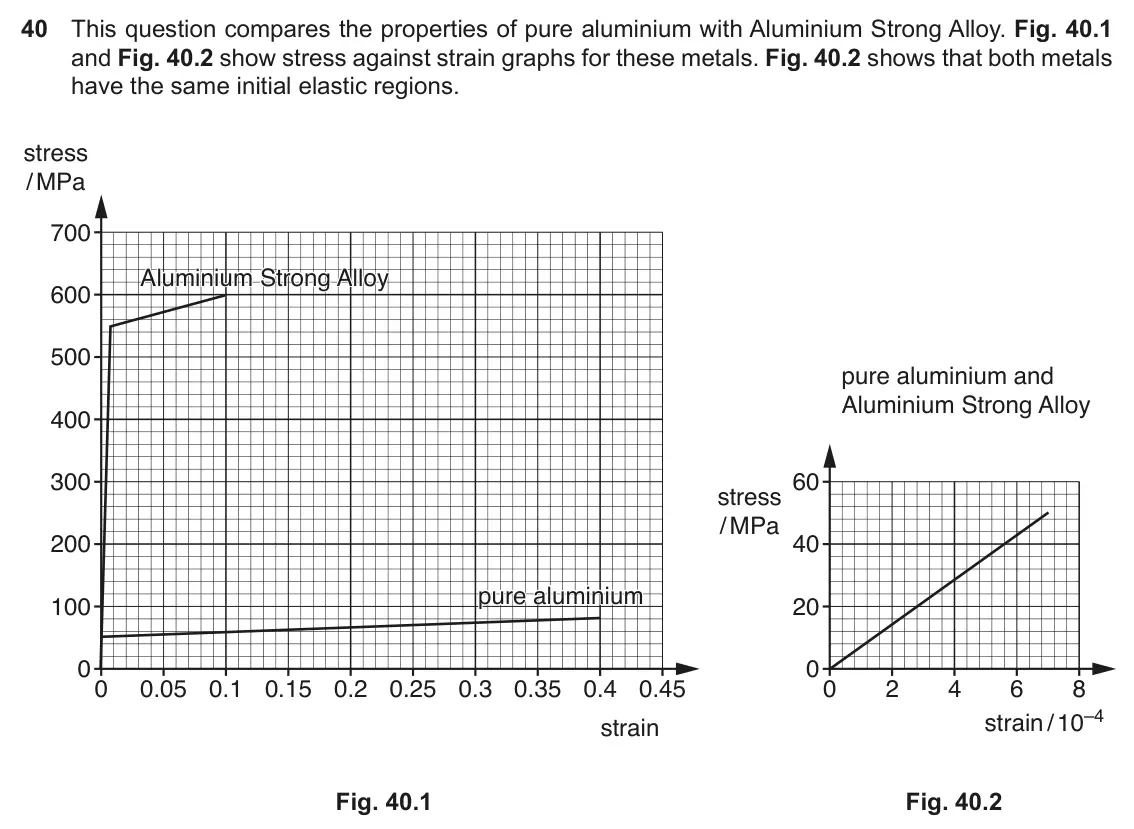
Q27(a)
The whole paper ↗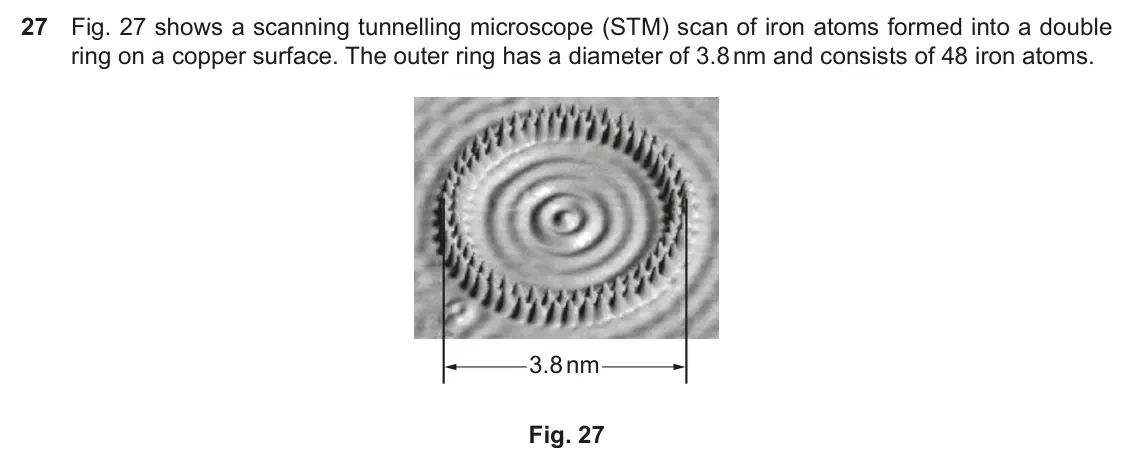
All 20 questions on Size and spacing of particles, as a list
- June 2025, Paper 2, Q1(a) (3 marks): Fig. 1 shows an image of a sheet of gold atoms. Use the image to determine the radius of a gold atom. Explain your choice of the number of significant figures i
- June 2025, Paper 2, Q1(b)(i) (2 marks): [2]
- June 2025, Paper 2, Q1(b)(ii) (2 marks): The manner in which the gold atoms are packed together means that only 74% of the volume of a sample of gold is taken up by the atoms themselves. Use this perce
- June 2025, AS Paper 1, Q24(b) (1 mark): Estimate the spacing between the molybdenum atoms. Spacing = nm [1]
- June 2023, AS Paper 1, Q15 (1 mark): Which experiment does not provide direct evidence of the size or spacing of particles? A Electron diffraction images B Oil drop film experiment C Photoelectric
- June 2022, AS Paper 1, Q23(a) (2 marks): Sketch the relationship between the radius of the patch and its thickness as it spreads. thickness radius [2] The patch spreads out until its thickness can be a
- June 2022, AS Paper 1, Q23(b) (3 marks): Calculate an approximate size of an oil molecule in metres. oil drop volume = 0.05 mm3 patch radius = 20 cm size of molecule = m [3]
- November 2021, Paper 1, Q31 (3 marks): The STM image below shows an open ring of silver atoms. 3.5 nm Use the scaled STM image to estimate the diameter of a silver atom. diameter = nm [3]
- November 2021, Paper 2, Q4(b)(i) (3 marks): Using data from the question, calculate the number of atoms in one plane of area 5.90 × 10⁻⁸ m2 and use this value to calculate the tension force between pairs
- November 2021, AS Paper 1, Q21(a) (1 mark): Use the image to estimate the minimum separation of the carbon atoms in graphite. separation = nm [1]
- November 2021, AS Paper 1, Q21(b) (2 marks): Show that the number of carbon atoms in a 1.0 cm3 sample of graphite is about 1.1 × 10²³. The density of graphite is 2.10 g cm–3. The mass of a carbon atom is 2
- November 2021, AS Paper 1, Q21(c) (2 marks): Estimate the separation of carbon atoms in graphite using data from (b). separation = nm [2]
- June 2019, AS Paper 2, Q6(a)(i) (3 marks): Use data from Fig. 6.1 to show that the volume V of a copper atom is about 9 × 10–30 m3. [3]
- June 2019, AS Paper 2, Q6(a)(ii) (2 marks): The mean molar mass of copper is 63.5 g. 1 mole of copper = NA atoms, where NA = 6.02 × 10²³ atoms mol–1. Calculate the mean mass m of a single copper atom. m =
- June 2019, AS Paper 2, Q6(a)(iii) (1 mark): Density ρ is defined as the mass per unit volume of a material: ρ = m V Use the answers to (i) and (ii) to calculate the mean density of a copper atom. mean den
- June 2019, AS Paper 2, Q6(a)(iv) (2 marks): The density of copper in the data book is 8920 kg m–3. Suggest and explain one reason for the difference between the value obtained in (iii) and the measured de
- June 2017, Paper 1, Q40(c)(i) (2 marks): Use the Fig. 40.3 to estimate the diameter of a metal atom. diameter = m [2]
- June 2017, Paper 2, Q8 (4 marks): The density of silver is 10 500 kg m–3. The mass of one silver atom is 1.8 × 10 –25 kg. 8 Use this data to calculate an estimate for the diameter of an atom of
- June 2017, AS Paper 1, Q24 (3 marks): An experiment to estimate the size of an oil molecule is shown below. A drop of oil with diameter (0.5 ± 0.1) mm is dropped into water dusted with powder. The o
- June 2016, AS Paper 1, Q27(a) (2 marks): Use the data from the STM to calculate the diameter of an iron atom. diameter = m [2]
Questions, mark schemes and examiner’s reports are © OCR, from their published past papers. Plumi isn’t affiliated with any exam board. Want whole papers? OCR A-Level Physics B past papers.
The Plumi iPad app also offers exam-style questions with AI feedback on your handwritten working.