 plumi
Metals, ceramics and polymers: OCR A‑Level Physics B questions
OCR A-Level Physics B past-paper questions on 3.2.3 Metals, ceramics and polymers, 2016–2025, with mark schemes and examiner’s reports where available.
Paper
All papers
Exam
All years
Calculations
- Your answer
Q1(c)
The whole paper ↗
- Your answer
Q36(b)
The whole paper ↗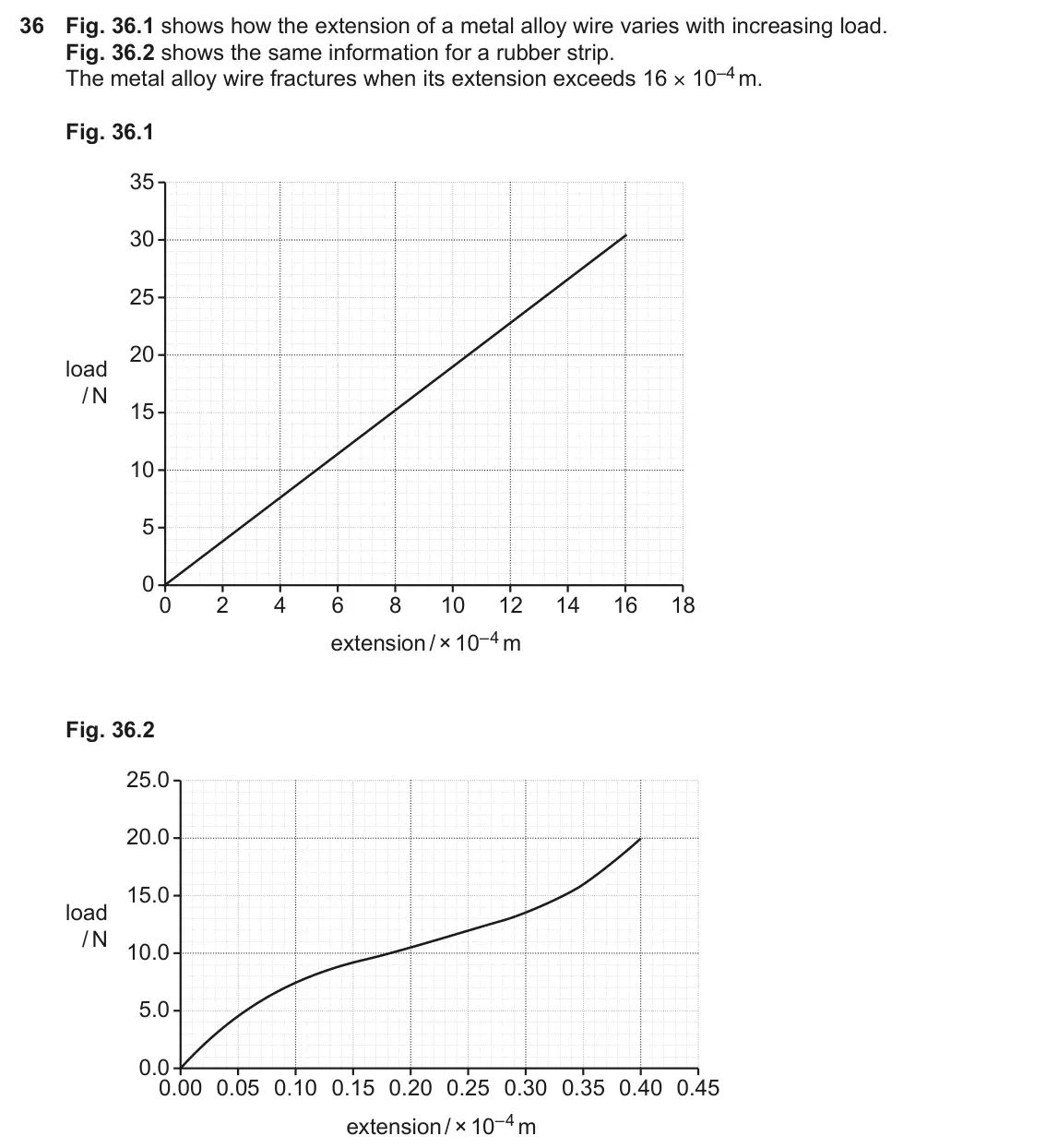
- Your answer
- Your answer
- Your answer
Q23(a)
The whole paper ↗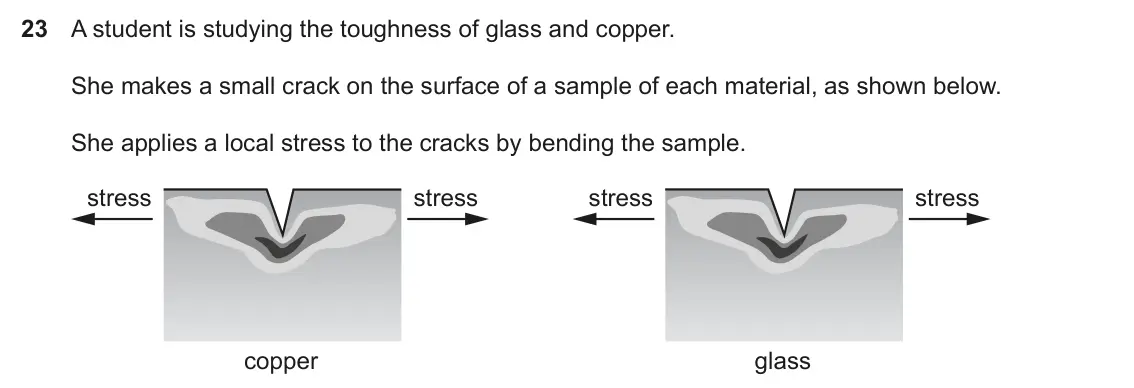
Q23(b)
The whole paper ↗Q6(a)
The whole paper ↗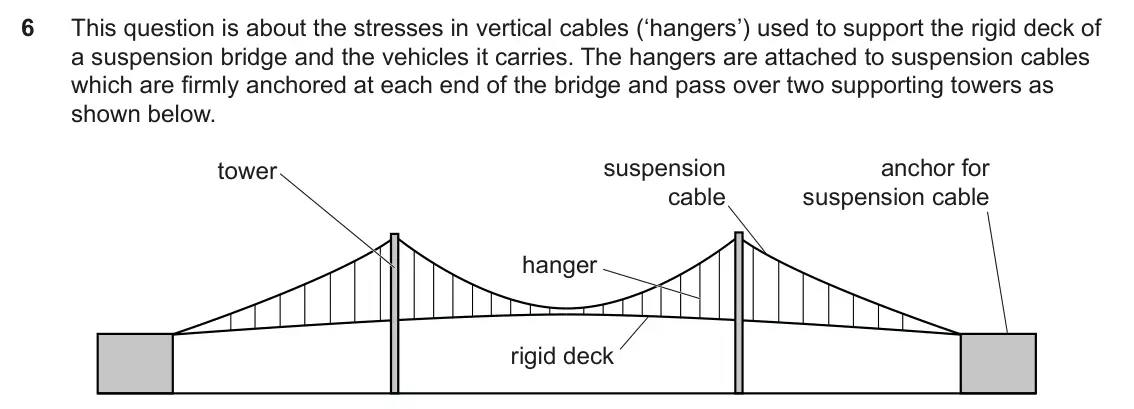
Q6(b)(iii)
The whole paper ↗Q4(a)(ii)
The whole paper ↗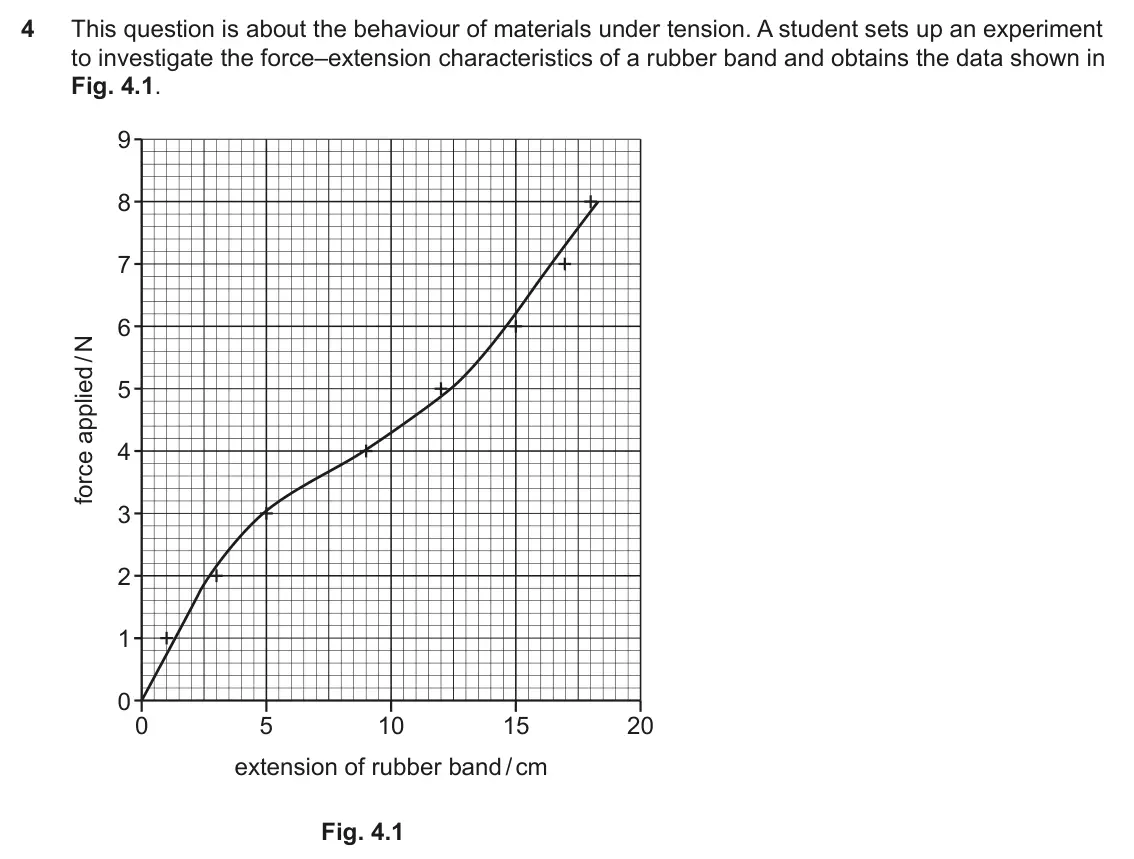
- Your answer
- Your answer
- Your answer
Q4(c)
The whole paper ↗
- Your answer
- Your answer
Q25(a)
The whole paper ↗
Q3(a)
The whole paper ↗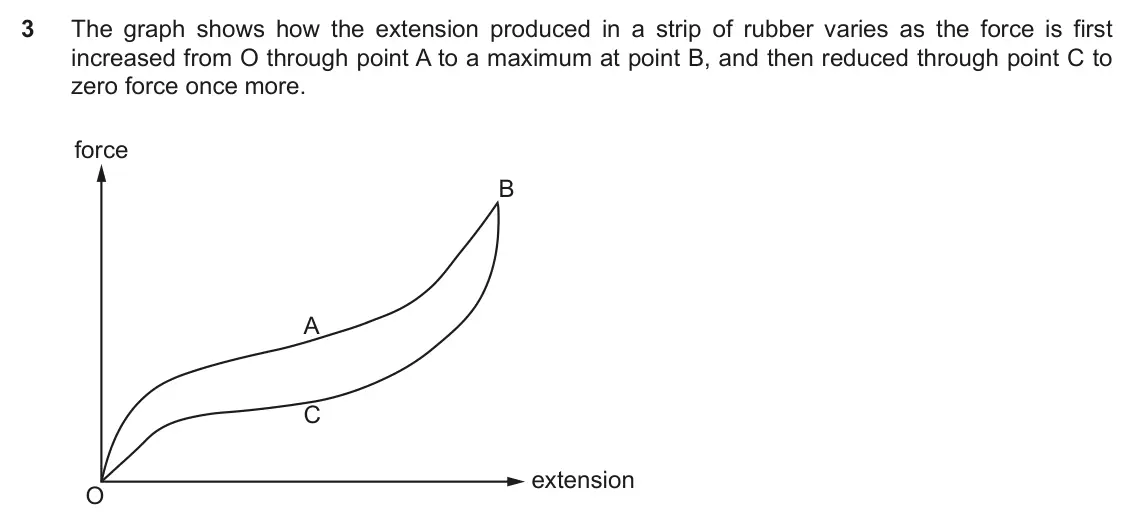
All 42 questions on Metals, ceramics and polymers, as a list
- June 2025, Paper 1, Q10 (1 mark): Which statement describes both the deformations and the nature of the wire? Deformations Nature A elastic followed by plastic brittle B elastic followed by plas
- June 2025, Paper 2, Q1(c) (3 marks): Images of arrangements of atoms in a metal sometimes reveal dislocations in the microscopic structure. Describe what dislocations are and how the presence of di
- June 2025, AS Paper 1, Q10 (1 mark): Which class of material shows behaviour due to chain entanglement? A Ceramic B Glass C Metal D Polymer Your answer [1]
- June 2024, Paper 1, Q36(b) (6 marks): Fig. 36.1 shows how the extension of a metal alloy wire varies with increasing load. Fig. 36.2 shows the same information for a rubber strip. The metal alloy wi
- June 2024, AS Paper 1, Q3 (1 mark): The diagram shows the arrangement of particles in a metal. metal particle X The structure marked X is best described as: A A dislocation B A fracture C Chain en
- June 2023, Paper 1, Q12 (1 mark): Which one of the following statements about materials is correct? A Alloys are tougher than pure metals because small numbers of alloying atoms resist the movem
- June 2023, AS Paper 1, Q1 (1 mark): What defines a weak material? A A low elastic limit B A low fracture stress C A low yield stress D A low Young modulus Your answer [1]
- June 2023, AS Paper 1, Q23(a) (2 marks): Describe the student’s observations as the stress is increased. Glass Copper [2]
- June 2023, AS Paper 1, Q23(b) (2 marks): Explain the observations in terms of mobile dislocations. You may use a diagram to explain your answer. [2]
- June 2023, AS Paper 2, Q6(a) (6 marks): This question is about the stresses in vertical cables (‘hangers’) used to support the rigid deck of a suspension bridge and the vehicles it carries. The hanger
- June 2023, AS Paper 2, Q6(b)(iii) (2 marks): Suggest two reasons why the maximum number of vehicles allowed on the bridge is less than the theoretical number based on calculations of stress. 1. 2. [2]
- June 2022, Paper 3, Q4(a)(ii) (6 marks): This question is about the behaviour of materials under tension. A student sets up an experiment to investigate the force–extension characteristics of a rubber
- June 2022, AS Paper 1, Q2 (1 mark): A rubber band is made from a polymer. At room temperature the polymer is: A Flexible and tough B Stiff and strong C Strong and flexible D Tough and stiff Your a
- June 2022, AS Paper 1, Q16 (1 mark): Which of the statements about metals below is not correct? A Metals contain more free electrons than insulators. B Metals have a high breaking stress due to str
- November 2021, Paper 1, Q7 (1 mark): The chart displays the strength and toughness of various materials. 10 000 metals and alloys 1 000 polymers glasses 100 strength (MPa) 10 1 wood and wood produc
- November 2021, Paper 2, Q4(c) (6 marks): This question is about the macroscopic behaviour of a metal under tension and a model of the microscopic structure of the metal. A 3.951 m length of copper wire
- November 2021, AS Paper 1, Q1 (1 mark): Ceramic materials are typically A Brittle and strong B Brittle and tough C Strong and shiny D Tough and flexible Your answer [1]
- November 2021, AS Paper 1, Q11 (1 mark): Dislocations in the microscopic structure of metals lead to A Brittleness of the material B High conductivity of the material C Molecular chains unravelling D S
- November 2021, AS Paper 1, Q25(a) (2 marks): Explain why metals are a good choice of material for making car suspension springs. [2] The student sets up the apparatus shown in Fig. 25 to investigate the be
- November 2021, AS Paper 2, Q3(a) (2 marks): Imagine that you produced the force by holding the ends of the rubber strip in each hand and pulling. Describe what it would feel like as you pulled the band fr
- November 2020, Paper 1, Q34(b) (2 marks): This table compares some mechanical properties of spider silk and high tensile steel. Density ρ / kg m−3 Breaking stress σB / GPa 1.2 × 10³ Spider silk 1.4 High
- November 2020, Paper 2, Q5(b) (4 marks): In the sport of bungee jumping, the jumper is tied to a long bungee rope and leaps from a high point. The bungee rope stretches until the jumper stops falling a
- November 2020, AS Paper 1, Q22(a) (2 marks): Complete the table to show the class of material for each of A, B and C. Class of material Material Polymer Metal Ceramic [2]
- November 2020, AS Paper 1, Q22(b)(ii) (1 mark): has the greatest strength? [1]
- November 2020, AS Paper 2, Q2(a) (2 marks): Ceramics and metals are both very strong, but metals are much tougher than ceramics. Explain the similarity and difference in terms of their structure. [2]
- November 2020, AS Paper 2, Q2(b) (2 marks): When a sample of a material is stretched until it breaks, the surface area of the sample increases. Explain why the toughness of the material can be measured in
- June 2019, Paper 1, Q3 (1 mark): Which diagram shows the stress–strain graph for a ductile metal? Your answer [1]
- June 2019, Paper 1, Q4 (1 mark): Which diagram shows the stress–strain graph for a rubber polymer? Your answer [1]
- June 2019, AS Paper 1, Q11 (1 mark): Ceramic materials are generally A Hard and brittle B Stiff and tough C Strong and flexible D Tough and hard Your answer [1]
- June 2019, AS Paper 2, Q6(b) (6 marks): This question is about the structure and properties of metals. (b)* One particular copper alloy consists of 95% copper and 5% zinc. The table compares the masse
- June 2018, AS Paper 1, Q1 (1 mark): Which of the following correctly describes ceramic materials? A ductile B plastic C stiff D tough Your answer [1]
- June 2018, AS Paper 1, Q3 (1 mark): Which of these statements about metals is not correct? A They have a high number density of charge carriers. B They have directional bonds between the metal ion
- June 2018, AS Paper 1, Q25(a) (1 mark): Name the feature represented by the lines of atoms added to the image in Fig. 25.1. name of feature [1]
- June 2017, Paper 1, Q40(b) (2 marks): State and justify which of the metals you would use for the crumple zone of a car. [2]
- June 2017, Paper 1, Q40(c)(ii) (1 mark): Name the feature represented by the lines of atoms added to the image. name of structure [1]
- June 2017, Paper 1, Q40(d) (6 marks): This question compares the properties of pure aluminium with Aluminium Strong Alloy. Fig. 40.1 and Fig. 40.2 show stress against strain graphs for these metals.
- June 2017, AS Paper 2, Q4(a)(i) (1 mark): Identify the structure marked X. X is [1]
- June 2017, AS Paper 2, Q4(a)(ii) (2 marks): Explain how structure X makes the metal ductile. You may wish to draw on Fig. 4 to help your explanation. [2]
- June 2017, AS Paper 2, Q4(b) (2 marks): A pure metal is alloyed by adding a small proportion of atoms of a different metal while the metal is molten. The alloy is often much stiffer and harder than th
- June 2016, AS Paper 1, Q4 (1 mark): Which word used to describe materials does not apply to ceramics? A hard B stiff C strong D tough Your answer [1]
- June 2016, AS Paper 1, Q19 (1 mark): The graphs below show the stress against strain relationships for four different materials, A, B, C and D. Each graph has the same scales. Which of the graphs s
- June 2016, AS Paper 2, Q5(c) (6 marks): This question is about archery. The bow, originally a weapon, is now used for sport. An early bow consisted of a single, straight piece of wood about 2.0 m long
Questions, mark schemes and examiner’s reports are © OCR, from their published past papers. Plumi isn’t affiliated with any exam board. Want whole papers? OCR A-Level Physics B past papers.
The Plumi iPad app also offers exam-style questions with AI feedback on your handwritten working.