 plumi
Thermal properties of materials: OCR A‑Level Physics A questions
Every OCR A-Level Physics A exam question on 5.1.3 Thermal properties of materials, 2016–2025, with its mark scheme and examiner’s report.
Find questions1,877
Calculations

Q19(c)
The whole paper ↗
Q20(b)
The whole paper ↗
Q20(c)
The whole paper ↗
Q3(c)
The whole paper ↗
Q6(b)(i)
The whole paper ↗
Q6(b)(ii)
The whole paper ↗
Q6(b)(iii)
The whole paper ↗
Q6(b)(iv)
The whole paper ↗

Q19(b)(iv)
The whole paper ↗
Q4(b)(iv)
The whole paper ↗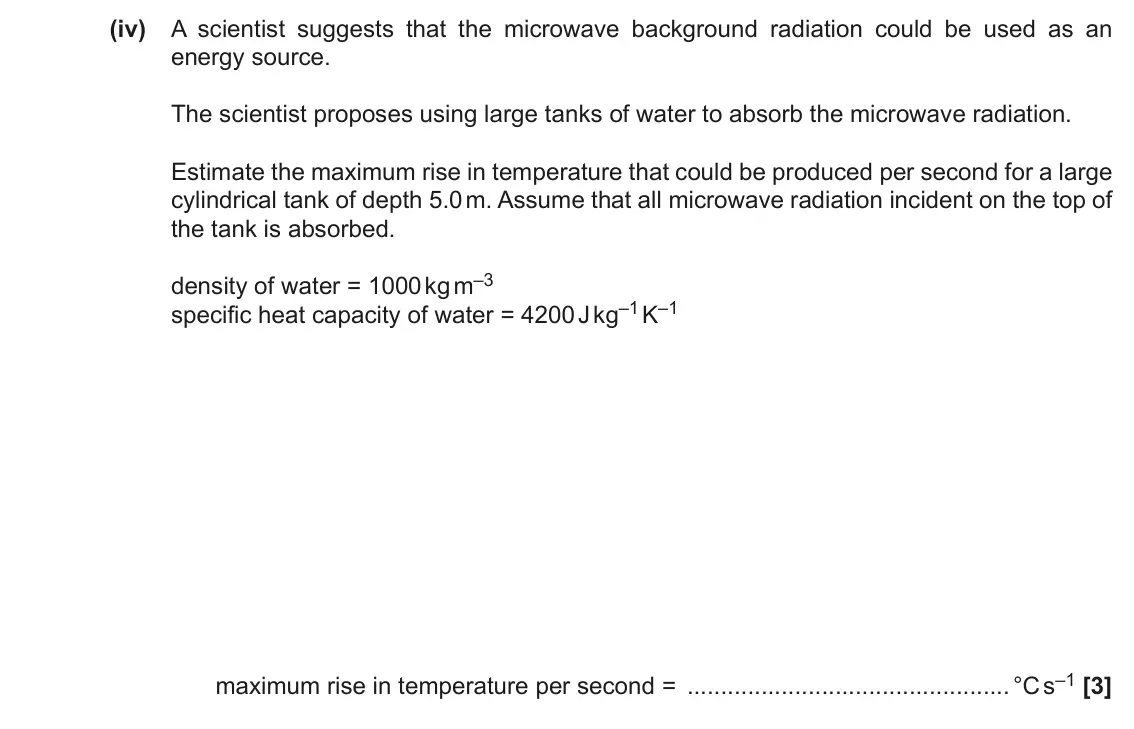
Q18(a)(i)
The whole paper ↗
Q18(a)(ii)
The whole paper ↗
Q18(a)(iii)
The whole paper ↗
Q17(a)(ii)
The whole paper ↗
Q17(b)
The whole paper ↗
Q21(b)
The whole paper ↗


All 21 questions on Thermal properties of materials, as a list
- June 2025, Paper 1, Q2 (1 mark): A metal block of mass m is at temperature T0. An electrical heater of constant power P heats the block for time t and it reaches a temperature T1. The overall e
- June 2025, Paper 1, Q19(c) (3 marks): Show that in one hour the volume of liquid oxygen that evaporates is about 0.02 m3. [3]
- June 2025, Paper 1, Q20(b) (2 marks): Plot the missing data point on the graph above and draw a line of best fit. [2]
- June 2025, Paper 1, Q20(c) (4 marks): Describe the relationship suggested by the graph and suggest an explanation. [4]
- June 2025, Paper 3, Q3(c) (6 marks): This question is about comparing two methods for storing energy. (c)* A gravitational potential energy storage system, as described in (a), is proposed as follo
- June 2023, Paper 3, Q6(b)(i) (1 mark): Define specific latent heat of fusion. [1]
- June 2023, Paper 3, Q6(b)(ii) (2 marks): Calculate the maximum mass m of PLA that the heater could melt in one minute. m = kg [2]
- June 2023, Paper 3, Q6(b)(iii) (2 marks): Explain why the printing process is slower in practice than your answer to (ii) suggests. [2]
- June 2023, Paper 3, Q6(b)(iv) (3 marks): Fig. 6.1 shows the initial and final temperature of the PLA during the printing process. Initially (point A), the solid PLA is at 20 °C and is just entering the
- June 2022, Paper 1, Q7 (1 mark): A metal block of mass m is heated by an electric heater. The graph of temperature θ against time t for this block is shown below. 40 / °C θ 30 20 0 100 200 300
- June 2022, Paper 1, Q19(b)(iv) (4 marks): The nitrogen at the factory is stored as a liquid. The liquid expands at constant temperature to form gas in a short section of pipe. When the air temperature i
- June 2022, Paper 3, Q4(b)(iv) (3 marks): A scientist suggests that the microwave background radiation could be used as an energy source. The scientist proposes using large tanks of water to absorb the
- November 2021, Paper 1, Q18(a)(i) (3 marks): Use the graph to determine the specific heat capacity c of the ice. c = J kg–1 K–1 [3]
- November 2021, Paper 1, Q18(a)(ii) (2 marks): Use the graph to determine the specific latent heat of fusion of ice Lf. Lf = J kg–1 [2]
- November 2021, Paper 1, Q18(a)(iii) (2 marks): Use the graph to compare the specific heat capacities of ice and water. Explain your answer. [2]
- November 2020, Paper 1, Q17(a)(ii) (3 marks): The heater is now switched on. The power of the heater is 200 W. The mass of the water in the beaker is 500 g. It takes 10.0 minutes to increase the temperature
- November 2020, Paper 1, Q17(b) (6 marks): (b)* A student is carrying out an experiment to determine the specific latent heat of fusion Lf of ice. The student has two sets of apparatus next to each other
- June 2019, Paper 1, Q21(b) (2 marks): Use Fig. 21 to explain how the specific heat capacity of the liquid compares with the specific heat capacity of the solid. [2]
- June 2018, Paper 1, Q3 (1 mark): A metal block of mass 0.28 kg has an initial temperature of 82 °C. It is dropped into cold water. The temperature of the block after 1.2 minutes is 20 °C. The s
- June 2018, Paper 1, Q6 (1 mark): The latent heat of vaporisation of a liquid is 2300 kJ kg−1 and it has a molar mass of 0.018 kg mol−1. 6 What is the energy required to change 30 moles of the l
- June 2017, Paper 1, Q20(b) (4 marks): The specific heat capacity of water is 4200 J kg−1 K−1 and the specific latent heat of vaporisation of water is 2.3 × 10⁶ J kg−1. The boiling point of water is
Questions, mark schemes and examiner’s reports are © OCR, from their published past papers. Plumi isn’t affiliated with any exam board. Want whole papers? Every OCR A-Level Physics A paper, or our free OCR-style practice pack.
Rather write your answers by hand on iPad? Plumi marks them against the same mark schemes.