 plumi
Photons: OCR A‑Level Physics A questions
Every OCR A-Level Physics A exam question on 4.5.1 Photons, 2016–2025, with its mark scheme and examiner’s report.
Find questions1,877
Calculations
Q7(a)
The whole paper ↗

Q19(a)
The whole paper ↗
Q26(a)
The whole paper ↗
Q26(b)
The whole paper ↗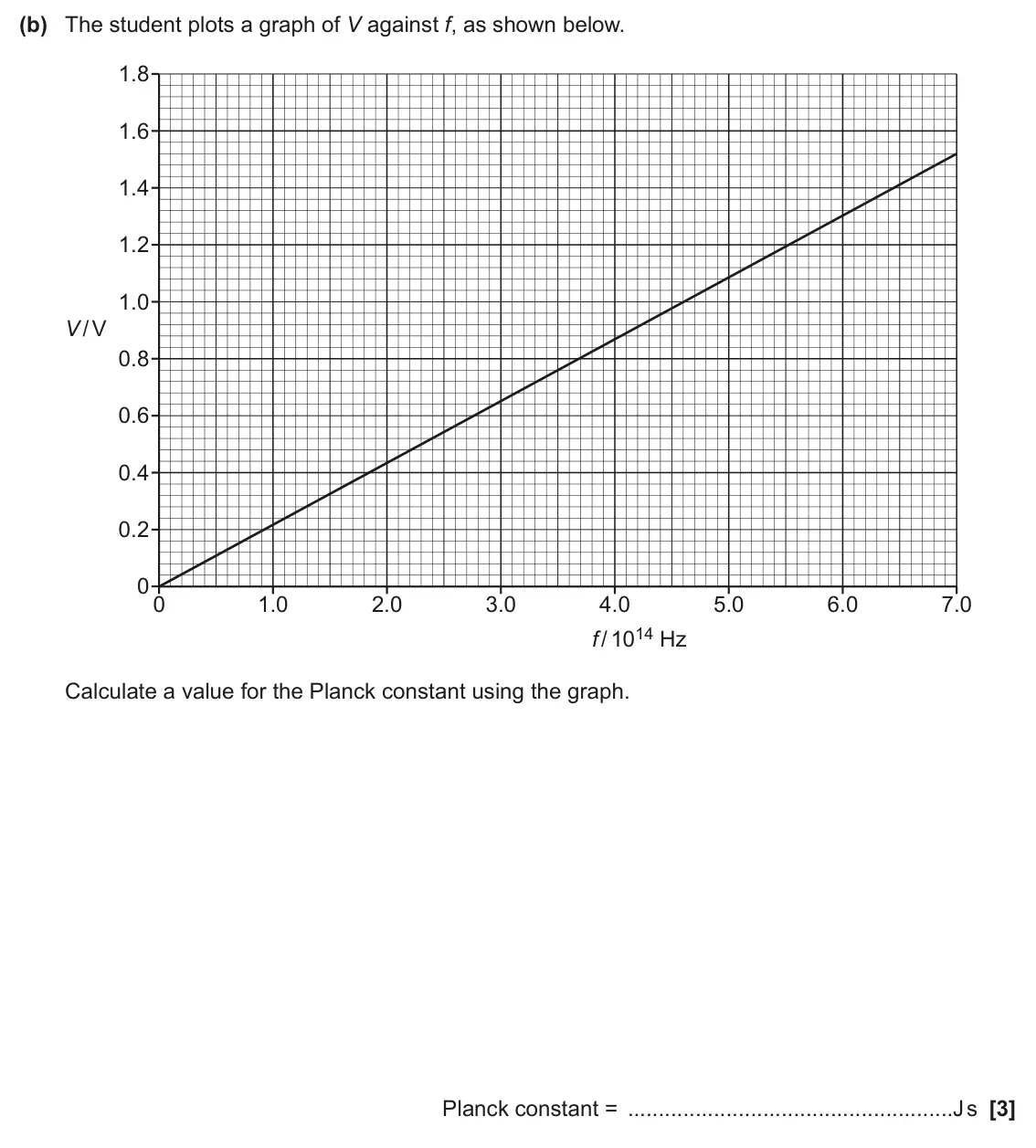
Q26(d)
The whole paper ↗
Q8(b)(i)
The whole paper ↗
Q17(b)
The whole paper ↗
Q4(b)(ii)
The whole paper ↗
Q4(b)(iii)
The whole paper ↗

Q23(a)
The whole paper ↗
Q24(c)
The whole paper ↗
Q7(a)(i)
The whole paper ↗
Q7(a)(ii)
The whole paper ↗
Q17(a)
The whole paper ↗
Q28(b)(i)
The whole paper ↗
Q28(b)(ii)
The whole paper ↗
All 32 questions on Photons, as a list
- June 2025, AS Paper 2, Q7(a) (2 marks): The power of the laser is 1.0 mW. Calculate the number of photons N emitted per second. N = s–1 [2]
- June 2025, AS Paper 2, Q8 (6 marks): 8* A student carries out an experiment to determine the Planck constant. They use the circuit shown. V The frequency of the emitted light from the LED is f and
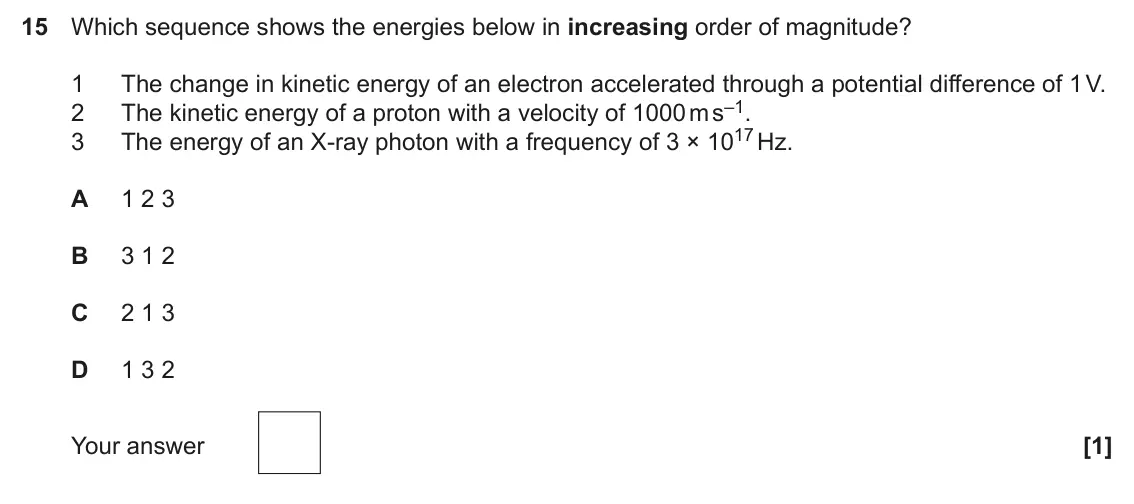
- June 2024, Paper 2, Q15 (1 mark): Which sequence shows the energies below in increasing order of magnitude? 1 The change in kinetic energy of an electron accelerated through a potential differen
- June 2024, Paper 2, Q19(a) (3 marks): Show that each X‑ray photon produces about 2000 light photons. [3]
- June 2024, AS Paper 1, Q26(a) (2 marks): The student views the LED through a cardboard tube when making each measurement. Explain how this can help to improve the accuracy of each measurement. [2]
- June 2024, AS Paper 1, Q26(b) (3 marks): The student plots a graph of V against f, as shown below. 1.8 1.6 1.4 1.2 1.0 V / V 0.8 0.6 0.4 0.2 0 0 1.0 2.0 3.0 4.0 5.0 6.0 7.0 f / 1014 Hz Calculate a valu
- June 2024, AS Paper 1, Q26(d) (3 marks): On e of the LEDs emits red light. Another of the LEDs emits blue light. The red LED emits 3.3 × 10¹⁵ photons per second. The blue LED emits light with frequency
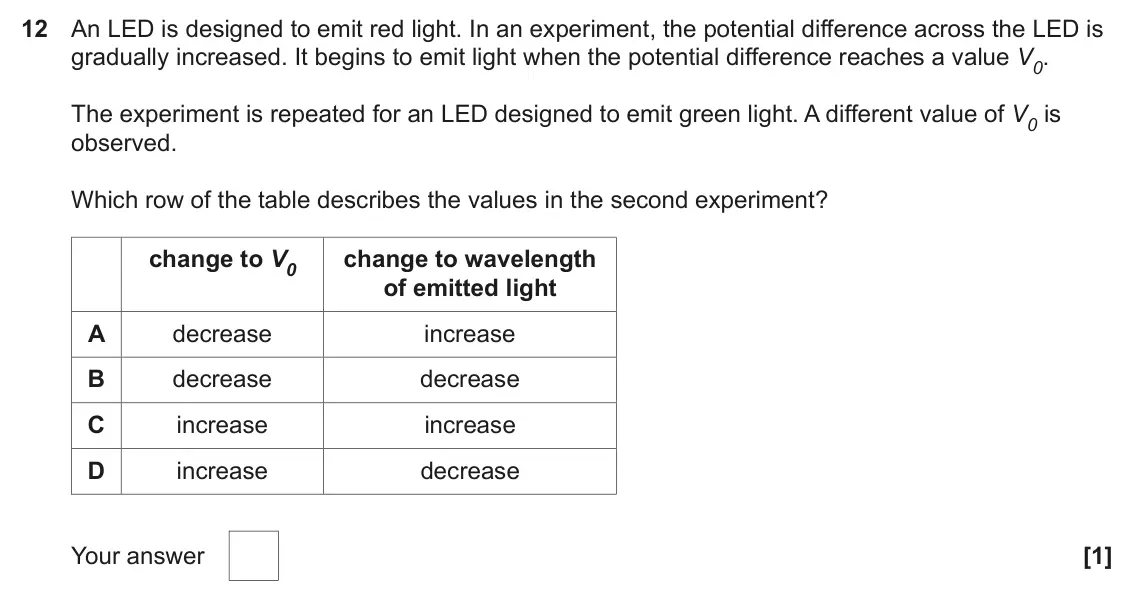
- June 2023, AS Paper 1, Q12 (1 mark): An LED is designed to emit red light. In an experiment, the potential difference across the LED is gradually increased. It begins to emit light when the potenti
- June 2023, AS Paper 2, Q8(b)(i) (1 mark): Show that the maximum kinetic energy of the emitted photoelectrons, is about 3.0 × 10⁻¹⁹ J. [1]
- June 2022, Paper 2, Q17(b) (6 marks): A light-emitting diode (LED) can be used to determine the Planck constant h. When the LED just starts to emit light, the equation below is valid eV = hc λ where
- June 2022, Paper 3, Q4(b)(ii) (2 marks): Calculate the energy of a photon which has a wavelength of 1.1 mm. energy = J [2]
- June 2022, Paper 3, Q4(b)(iii) (2 marks): Estimate the number of photons of microwave background radiation incident per second on the back of your hand. Assume that all emitted photons have the energy c
- November 2021, AS Paper 1, Q16 (1 mark): The energy of a photon is 2.5 eV. What is the principal radiation for this photon? A infrared B radio waves C visible light D x-rays [1] Your answer
- November 2021, AS Paper 1, Q23(a) (3 marks): A light-emitting diode (LED) emits visible light when the potential difference across it exceeds a threshold voltage. Describe, with the help of a circuit diagr
- November 2021, AS Paper 1, Q24(c) (3 marks): Special detectors at the Earth were used to detect the individual X-ray photons. In one type of detector, the interaction of a single X-ray photon with the mate
- November 2021, AS Paper 2, Q7(a)(i) (2 marks): Show that the gradient of the straight line of best fit is about 1.2 × 10⁻⁶ V m. [2]
- November 2021, AS Paper 2, Q7(a)(ii) (2 marks): Use the gradient from (i) to determine a value for h. Write your answer to 2 significant figures. h = J s [2]
- November 2020, Paper 2, Q17(a) (3 marks): The energy of a photon of red light is about 1.8 eV. Calculate the wavelength λ of this red light. λ = m [3]
- November 2020, AS Paper 1, Q28(b)(i) (2 marks): the energy of each photon of light from the laser. energy = J [2]
- November 2020, AS Paper 1, Q28(b)(ii) (2 marks): the number of photons of light emitted in each second. number of photons = [2]
- June 2019, Paper 2, Q19(c)(i) (3 marks): Estimate the number of blue light photons emitted from the LED per second. number of photons per second = s–1 [3]
- June 2019, Paper 3, Q5(b)(i) (1 mark): Show that the energy of a photon of wavelength 486 nm is 4.09 × 10⁻¹⁹ J. [1]
- June 2018, Paper 2, Q20(a)(i) (2 marks): Draw the straight line of best fit on Fig 20.1 and determine the gradient of the line.
- June 2018, Paper 2, Q20(a)(ii) (3 marks): Use your answer in (i) and the equation on page 20 to determine a value for h to 2 significant figures. Show your working. h = J s [3]
- June 2018, Paper 2, Q20(a)(iii) (1 mark): Calculate the percentage difference between your value in (ii) and the accepted value of the Planck constant. difference = % [1]
- June 2018, Paper 2, Q20(a)(iv) (4 marks): Identify the two types of errors shown by the data in Fig. 20.1 and suggest how you could have refined the experiment to reduce or eliminate these errors. [4]
- June 2018, Paper 3, Q6(b) (3 marks): A high energy gamma photon passing through the scintillator crystal converts some of its energy into visible light photons of mean wavelength 450 nm. Show that
- June 2018, AS Paper 1, Q27(b)(ii) (2 marks): Calculate the energy of a photon of wavelength 5.0 × 10⁻⁷ m. energy = J [2]
- June 2018, AS Paper 1, Q27(b)(iii) (1 mark): Estimate the total number of photons emitted per second from the surface of Procyon. number per second = s−1 [1]
- June 2017, AS Paper 1, Q10 (1 mark): The minimum potential difference across a light-emitting diode (LED) before it conducts is 2.1 V. The wavelength of the light emitted by the LED is λ. e = eleme
- June 2017, AS Paper 2, Q5(c)(i) (2 marks): Calculate the number of photons n that the laser emits per second. n = [2]
- June 2016, AS Paper 1, Q27(c) (3 marks): The wavelength of light from the LED is 480 nm. The radiant power emitted from the LED is 1.2 mW. Calculate the number of photons N emitted from the LED per sec
Questions, mark schemes and examiner’s reports are © OCR, from their published past papers. Plumi isn’t affiliated with any exam board. Want whole papers? Every OCR A-Level Physics A paper, or our free OCR-style practice pack.
Rather write your answers by hand on iPad? Plumi marks them against the same mark schemes.