Skip to content

Mean drift velocity: OCR A‑Level Physics A questions

Every OCR A-Level Physics A exam question on 4.1.2 Mean drift velocity, 2016–2025, with its mark scheme and examiner’s report.

Find questions1,877
Calculations

1,877 questions

  1. Q4

    June 2025 · Paper 2

    The whole paper ↗
    June 2025 Paper 2, question 4: The current in a copper wire of radius 2.5 × 10⁻⁴ m is 1.4 A. 4 The number density of charge carriers (electrons) in copper is 8.5 × 1028 m3. What is the mean d
  2. Q16(d)

    June 2025 · Paper 2

    The whole paper ↗
    June 2025 Paper 2, question 16(d): The LED is made from two semiconducting materials. Compare the number density of charge carriers in semiconductors, metals and insulators. [2]
  3. Q1

    June 2025 · AS Paper 1

    The whole paper ↗
    June 2025 AS Paper 1, question 1: A metal wire has cross-sectional area of 4.0 × 10⁻⁶ m2. The number density of charge carriers in 1 the metal is 8.5 × 1028 m–3. The current in the wire is 1.5 A
  4. Q7(b)(iii)

    June 2024 · AS Paper 2

    The whole paper ↗
    June 2024 AS Paper 2, question 7(b)(iii): the ratio mean drift speed of electrons in resistor X mean drift speed of electrons in resistor Y . ratio = [2]
  5. Q9

    June 2023 · AS Paper 1

    The whole paper ↗
    June 2023 AS Paper 1, question 9: Two copper wires, X and Y, are connected in series to a source of e.m.f. The length of X is equal to the length of Y. The cross-sectional area of X is greater t
  6. Q5(a)(i)

    June 2022 · Paper 3

    The whole paper ↗
    June 2022 Paper 3, question 5(a)(i): Show that the maximum drift velocity of each free electron in the wire is about 0.1 mm s–1. [3]
  7. Q25(c)(ii)

    June 2022 · AS Paper 1

    The whole paper ↗
    June 2022 AS Paper 1, question 25(c)(ii): The number of electrons per unit volume n in the metal wire is 8.5 × 1028 m–3. Calculate the mean drift velocity v of the electrons in the metal. v = m s–1 [2]
  8. Q18(a)(iii)

    November 2021 · Paper 2

    The whole paper ↗
    November 2021 Paper 2, question 18(a)(iii): The insulated wire has diameter 4.6 × 10⁻⁴ m. The number density of charge carriers in R is 4.2 × 1028 m–3. Calculate the mean drift velocity v of the charge ca
  9. Q9

    November 2021 · AS Paper 1

    The whole paper ↗
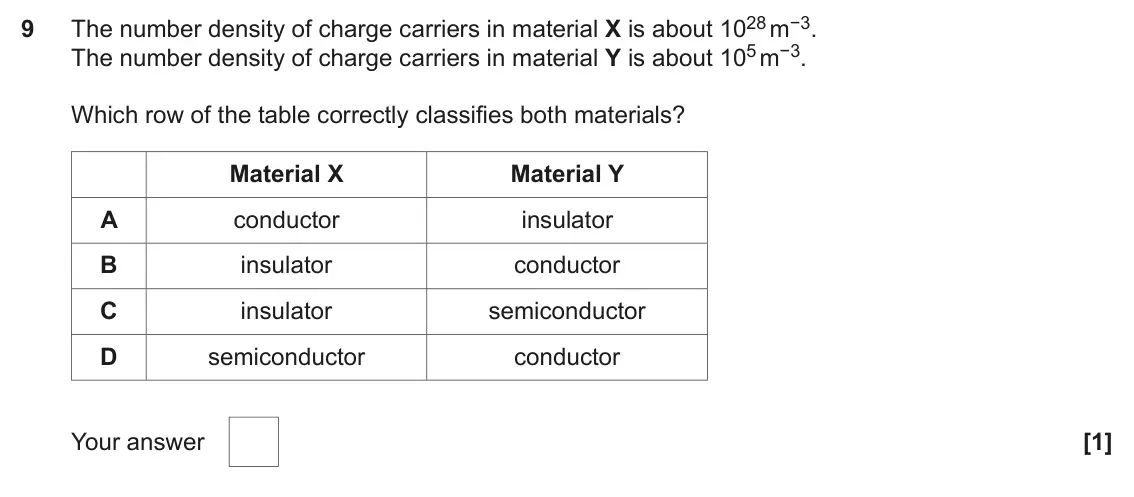
    November 2021 AS Paper 1, question 9: The number density of charge carriers in material X is about 1028 m−3. 9 The number density of charge carriers in material Y is about 105 m−3. Which row of the
  10. Q23(b)(ii)

    November 2021 · AS Paper 1

    The whole paper ↗
    November 2021 AS Paper 1, question 23(b)(ii): Calculate the mean drift velocity v of the electrons within the filament. v = m s−1 [3]
  11. Q2

    November 2020 · Paper 2

    The whole paper ↗
    November 2020 Paper 2, question 2: Which sequence shows the materials arranged in the order of increasing number density of charge carriers? increasing number density A conductor, insulator, semi
  12. Q8

    November 2020 · AS Paper 1

    The whole paper ↗
    November 2020 AS Paper 1, question 8: The diagram below shows an electrical circuit. 100 Ω 200 Ω 300 Ω The resistance of each resistor is shown. All resistors are made from the same material and hav
  13. Q7(a)(iii)

    November 2020 · AS Paper 2

    The whole paper ↗
    November 2020 AS Paper 2, question 7(a)(iii): the mean drift velocity v of the electrons (charge carriers) in the heater. v = m s−1 [2]
  14. Q7(c)

    November 2020 · AS Paper 2

    The whole paper ↗
    November 2020 AS Paper 2, question 7(c): Nichrome is a metal. Silicon is a semiconductor. State how the number density of charge carriers n and the resistivity ρ of silicon compare with that of nichrom
  15. Q6

    June 2019 · Paper 2

    The whole paper ↗
    June 2019 Paper 2, question 6: Wires P and Q, made from the same metal, are connected in parallel across a cell of negligible internal resistance. The table shows some data. Wire Length Diame
  16. Q4(b)

    June 2019 · AS Paper 2

    The whole paper ↗
    June 2019 AS Paper 2, question 4(b): Explain how the mean drift velocity of electrons in resistor Y compares with the mean drift velocity of electrons in resistor Z. [3]
  17. Q4(c)

    June 2019 · AS Paper 2

    The whole paper ↗
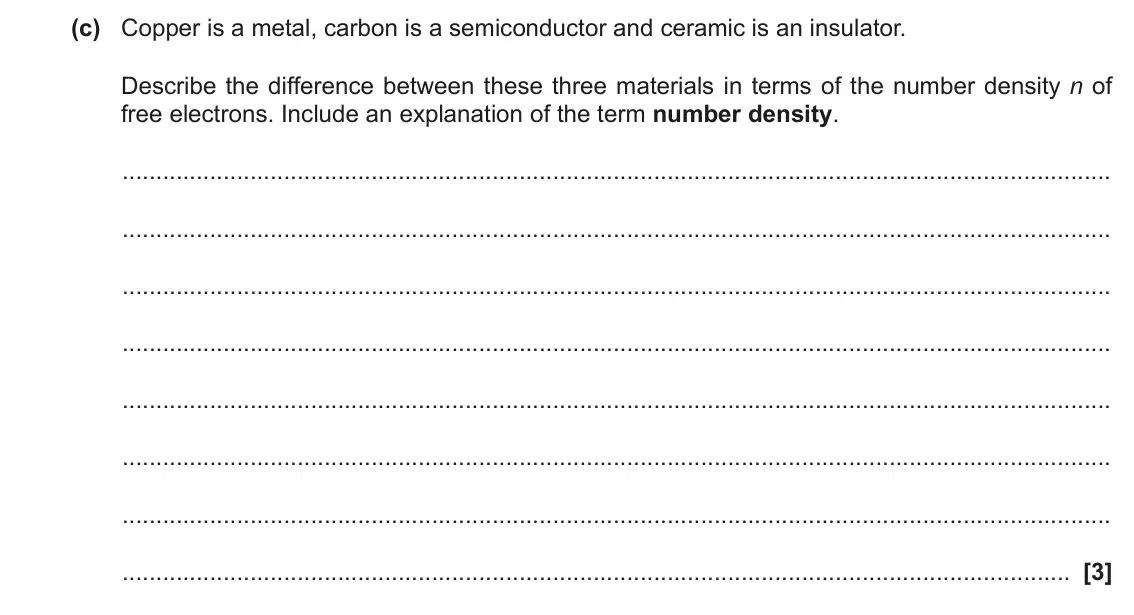
    June 2019 AS Paper 2, question 4(c): Copper is a metal, carbon is a semiconductor and ceramic is an insulator. Describe the difference between these three materials in terms of the number density n
  18. Q2(b)(i)

    June 2017 · Paper 3

    The whole paper ↗
    June 2017 Paper 3, question 2(b)(i): the mean drift velocity v of electrons within the semiconductor v = m s–1 [3]
  19. Q24(a)(i)

    June 2017 · AS Paper 1

    The whole paper ↗
    June 2017 AS Paper 1, question 24(a)(i): Calculate the mean drift velocity v of the free electrons in the thermistor. v = m s–1 [2]
  20. Q25(a)(ii)

    June 2016 · AS Paper 1

    The whole paper ↗
    June 2016 AS Paper 1, question 25(a)(ii): The resistor is cylindrical in shape. It has cross-sectional area 1.2 × 10⁻⁶ m2 and length 6.0 × 10⁻³ m. In this resistor there are 9.6 × 10¹⁶ free electrons. C
All 20 questions on Mean drift velocity, as a list
  1. June 2025, Paper 2, Q4 (1 mark): The current in a copper wire of radius 2.5 × 10⁻⁴ m is 1.4 A. 4 The number density of charge carriers (electrons) in copper is 8.5 × 1028 m3. What is the mean d
  2. June 2025, Paper 2, Q16(d) (2 marks): The LED is made from two semiconducting materials. Compare the number density of charge carriers in semiconductors, metals and insulators. [2]
  3. June 2025, AS Paper 1, Q1 (1 mark): A metal wire has cross-sectional area of 4.0 × 10⁻⁶ m2. The number density of charge carriers in 1 the metal is 8.5 × 1028 m–3. The current in the wire is 1.5 A
  4. June 2024, AS Paper 2, Q7(b)(iii) (2 marks): the ratio mean drift speed of electrons in resistor X mean drift speed of electrons in resistor Y . ratio = [2]
  5. June 2023, AS Paper 1, Q9 (1 mark): Two copper wires, X and Y, are connected in series to a source of e.m.f. The length of X is equal to the length of Y. The cross-sectional area of X is greater t
  6. June 2022, Paper 3, Q5(a)(i) (3 marks): Show that the maximum drift velocity of each free electron in the wire is about 0.1 mm s–1. [3]
  7. June 2022, AS Paper 1, Q25(c)(ii) (2 marks): The number of electrons per unit volume n in the metal wire is 8.5 × 1028 m–3. Calculate the mean drift velocity v of the electrons in the metal. v = m s–1 [2]
  8. November 2021, Paper 2, Q18(a)(iii) (2 marks): The insulated wire has diameter 4.6 × 10⁻⁴ m. The number density of charge carriers in R is 4.2 × 1028 m–3. Calculate the mean drift velocity v of the charge ca
  9. November 2021, AS Paper 1, Q9 (1 mark): The number density of charge carriers in material X is about 1028 m−3. 9 The number density of charge carriers in material Y is about 105 m−3. Which row of the
  10. November 2021, AS Paper 1, Q23(b)(ii) (3 marks): Calculate the mean drift velocity v of the electrons within the filament. v = m s−1 [3]
  11. November 2020, Paper 2, Q2 (1 mark): Which sequence shows the materials arranged in the order of increasing number density of charge carriers? increasing number density A conductor, insulator, semi
  12. November 2020, AS Paper 1, Q8 (1 mark): The diagram below shows an electrical circuit. 100 Ω 200 Ω 300 Ω The resistance of each resistor is shown. All resistors are made from the same material and hav
  13. November 2020, AS Paper 2, Q7(a)(iii) (2 marks): the mean drift velocity v of the electrons (charge carriers) in the heater. v = m s−1 [2]
  14. November 2020, AS Paper 2, Q7(c) (2 marks): Nichrome is a metal. Silicon is a semiconductor. State how the number density of charge carriers n and the resistivity ρ of silicon compare with that of nichrom
  15. June 2019, Paper 2, Q6 (1 mark): Wires P and Q, made from the same metal, are connected in parallel across a cell of negligible internal resistance. The table shows some data. Wire Length Diame
  16. June 2019, AS Paper 2, Q4(b) (3 marks): Explain how the mean drift velocity of electrons in resistor Y compares with the mean drift velocity of electrons in resistor Z. [3]
  17. June 2019, AS Paper 2, Q4(c) (3 marks): Copper is a metal, carbon is a semiconductor and ceramic is an insulator. Describe the difference between these three materials in terms of the number density n
  18. June 2017, Paper 3, Q2(b)(i) (3 marks): the mean drift velocity v of electrons within the semiconductor v = m s–1 [3]
  19. June 2017, AS Paper 1, Q24(a)(i) (2 marks): Calculate the mean drift velocity v of the free electrons in the thermistor. v = m s–1 [2]
  20. June 2016, AS Paper 1, Q25(a)(ii) (3 marks): The resistor is cylindrical in shape. It has cross-sectional area 1.2 × 10⁻⁶ m2 and length 6.0 × 10⁻³ m. In this resistor there are 9.6 × 10¹⁶ free electrons. C

Questions, mark schemes and examiner’s reports are © OCR, from their published past papers. Plumi isn’t affiliated with any exam board. Want whole papers? Every OCR A-Level Physics A paper, or our free OCR-style practice pack.

Rather write your answers by hand on iPad? Plumi marks them against the same mark schemes.