 plumi
E.m.f. and p.d: OCR A‑Level Physics A questions
Every OCR A-Level Physics A exam question on 4.2.2 E.m.f. and p.d, 2016–2025, with its mark scheme and examiner’s report.
Find questions1,877
Calculations
Q4(a)
The whole paper ↗
Q5(a)(ii)
The whole paper ↗
Q19(c)(i)
The whole paper ↗
Q23(a)
The whole paper ↗
Q18(a)
The whole paper ↗

Q25(a)
The whole paper ↗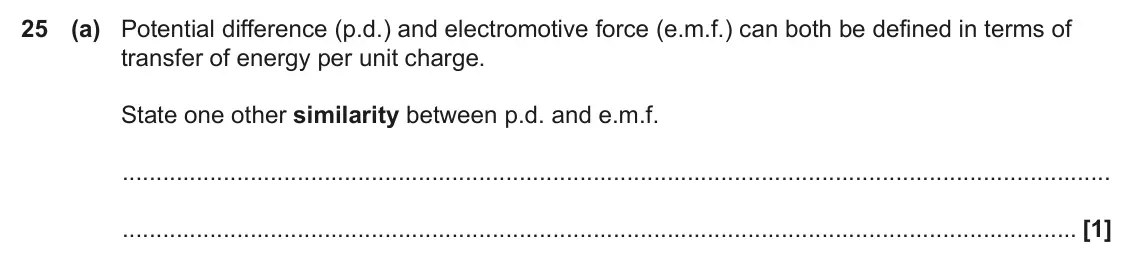


Q25(b)(i)
The whole paper ↗


Q25(a)(i)
The whole paper ↗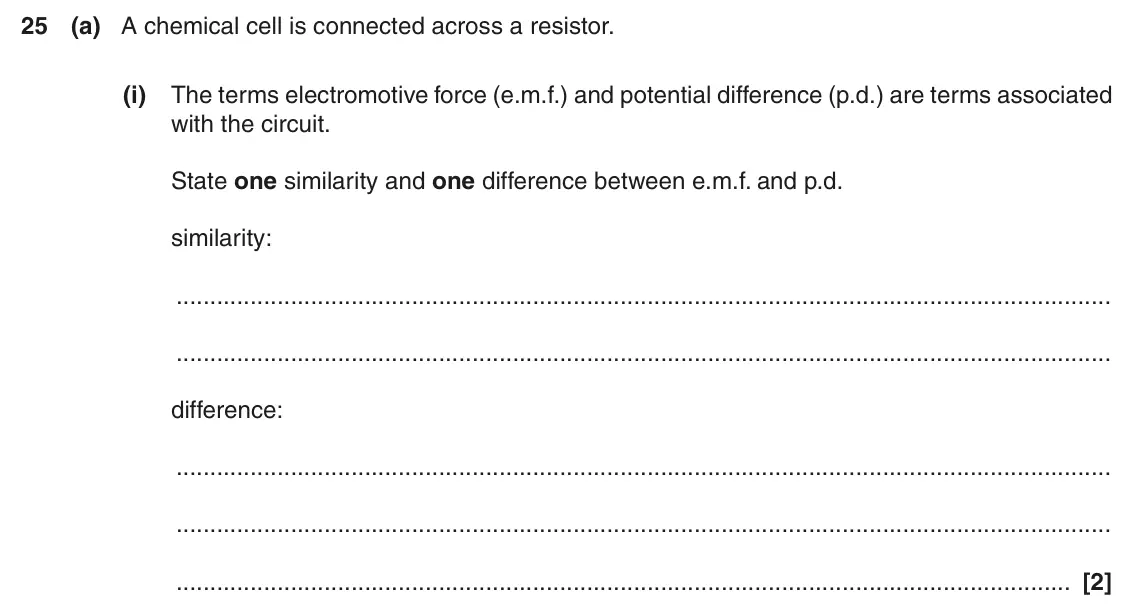
Q8(a)
The whole paper ↗
All 15 questions on E.m.f. and p.d, as a list
- June 2025, AS Paper 2, Q4(a) (2 marks): The quantities e.m.f. and potential difference (p.d.) are both measured in volts, V. Describe one other similarity and one difference between e.m.f. and p.d. si
- June 2024, Paper 3, Q5(a)(ii) (1 mark): e.m.f. of a cell. [1]
- June 2023, Paper 2, Q19(c)(i) (1 mark): Calculate the work done W on the electrons. W = J [1]
- June 2023, AS Paper 1, Q23(a) (2 marks): Calculate the work done on an electron as it moves from the metal plate to the electrode. work done = J [2]
- June 2022, Paper 2, Q18(a) (1 mark): Compare the e.m.f. of the battery and the potential difference (p.d.) across the variable resistor in terms of energy transfers or changes. [1]
- June 2022, AS Paper 1, Q18 (1 mark): What is the total energy E gained by N electrons travelling through a potential difference V? A E = N × V E = V × 10–19 B E = V × 1.60 × 10⁻¹⁹ C E = N × V × 1.6
- June 2022, AS Paper 1, Q25(a) (1 mark): Potential difference (p.d.) and electromotive force (e.m.f.) can both be defined in terms of transfer of energy per unit charge. State one other similarity betw
- November 2021, AS Paper 1, Q2 (1 mark): Which of the following is not a source of electromotive force (e.m.f.)? A chemical cell B light-dependent resistor C power supply D solar cell Your answer [1]
- November 2020, AS Paper 1, Q4 (1 mark): An electron with initial kinetic energy of 100 eV and initial speed of 5.9 × 10⁶ m s−1 is accelerated 4 through a potential difference of 250 V. What is the fin
- June 2019, AS Paper 1, Q25(b)(i) (3 marks): Show that the final speed of each electron is about 9 × 10⁶ m s–1. [3]
- June 2018, AS Paper 1, Q14 (1 mark): The total energy gained by 20 electrons travelling through a potential difference V is 30 keV. What is the potential difference V? A 1.5 V B 3.0 V C 1500 V D 30
- June 2017, Paper 2, Q2 (1 mark): One million electrons travel between two points in a circuit. The total energy gained by the electrons is 1.6 × 10⁻¹⁰ J. What is the potential difference betwee
- June 2016, AS Paper 1, Q15 (1 mark): An electron gun is used to accelerate electrons from rest through a voltage V. The electrons emerge with a speed u. electron u path voltage – + V The voltage in
- June 2016, AS Paper 1, Q25(a)(i) (2 marks): The terms electromotive force (e.m.f.) and potential difference (p.d.) are terms associated with the circuit. State one similarity and one difference between e.
- June 2016, AS Paper 2, Q8(a) (3 marks): Show that the final speed v of the electrons is 1.0 × 10⁷ m s−1. [3]
Questions, mark schemes and examiner’s reports are © OCR, from their published past papers. Plumi isn’t affiliated with any exam board. Want whole papers? Every OCR A-Level Physics A paper, or our free OCR-style practice pack.
Rather write your answers by hand on iPad? Plumi marks them against the same mark schemes.