Skip to content

Monetary policy: OCR A‑Level Economics questions

Every OCR A-Level Economics exam question on 3.2 Monetary policy, 2021–2025, with its mark scheme and examiner’s report.

Find questions478
Exam
All years
Calculations
478 questions

  1. Q11

    June 2025 · Paper 3

    The whole paper ↗
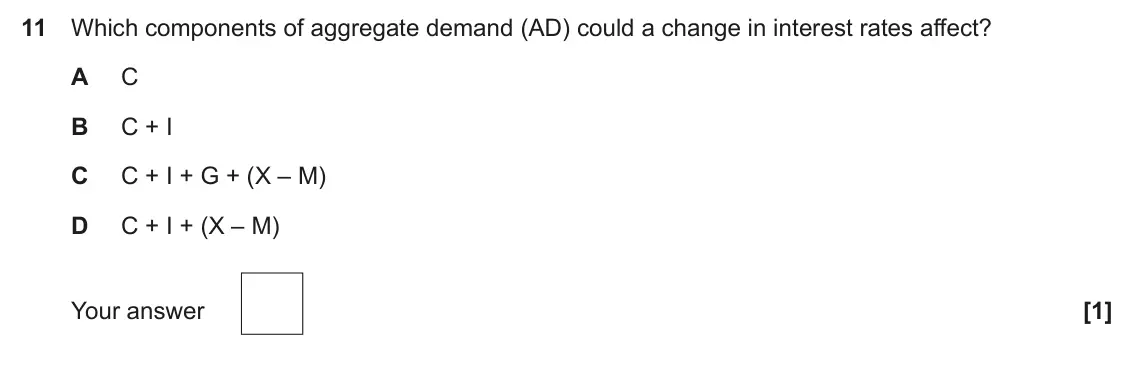
    June 2025 Paper 3, question 11: Which components of aggregate demand (AD) could a change in interest rates affect? A C B C + I C C + I + G + (X – M) D C + I + (X – M) [1]
    Your answer
  2. Q2

    June 2025 · AS Paper 2

    The whole paper ↗
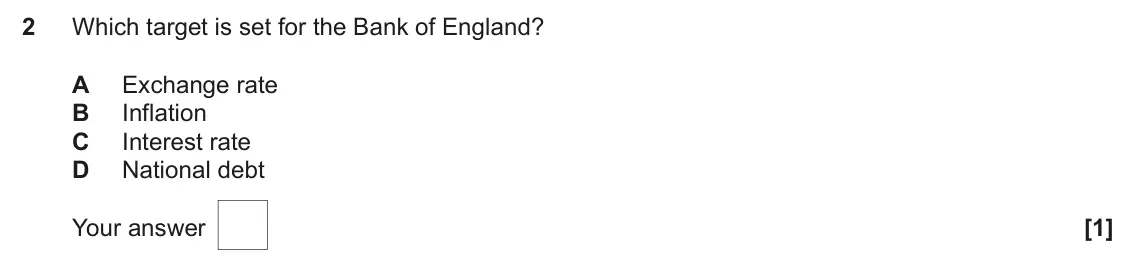
    June 2025 AS Paper 2, question 2: Which target is set for the Bank of England? A Exchange rate B Inflation C Interest rate D National debt [1]
    Your answer
  3. Q12

    June 2025 · AS Paper 2

    The whole paper ↗
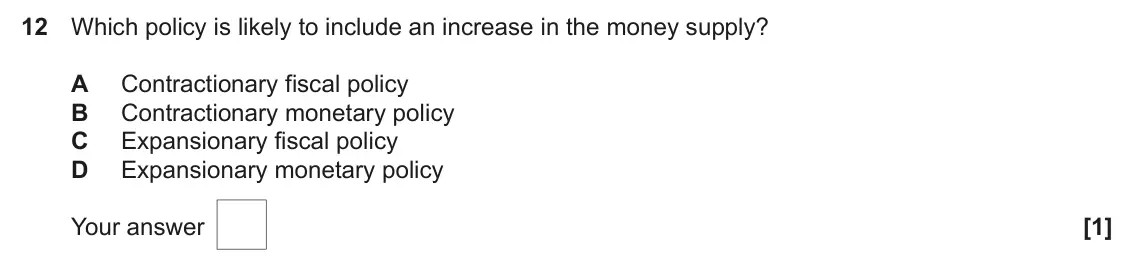
    June 2025 AS Paper 2, question 12: Which policy is likely to include an increase in the money supply? A Contractionary fiscal policy B Contractionary monetary policy C Expansionary fiscal policy
    Your answer
  4. Q5

    June 2024 · Paper 2

    The whole paper ↗
    June 2024 Paper 2, question 5: 5* In 2021, the Economic Affairs Committee of the House of Lords in the UK published a report which questioned whether the Bank of England was addicted to using
  5. Q35

    June 2024 · Paper 3

    The whole paper ↗
    June 2024 Paper 3, question 35: Using Fig. 2.2, identify what evidence there is that the rate of interest may not have been a large determinant of household saving in the UK between 2020 and 2
  6. Q36

    June 2024 · Paper 3

    The whole paper ↗
    June 2024 Paper 3, question 36: 36* Evaluate, using the information in Extract 2, whether increasing the interest rate was an effective way to combat rising inflation. [15]
  7. Q7

    June 2024 · AS Paper 2

    The whole paper ↗
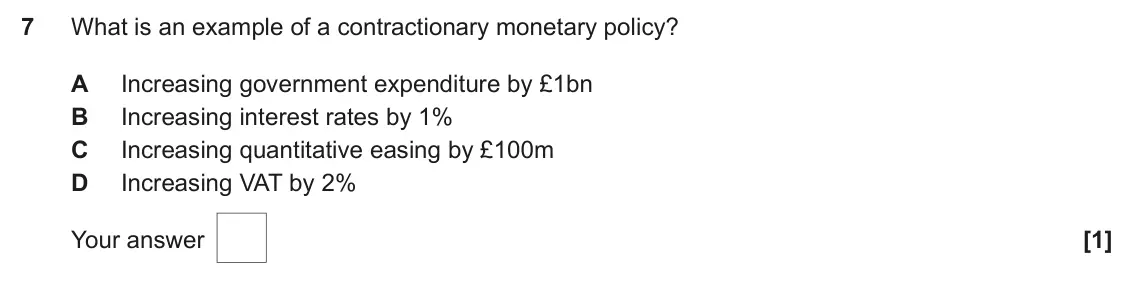
    June 2024 AS Paper 2, question 7: What is an example of a contractionary monetary policy? A Increasing government expenditure by £1bn B Increasing interest rates by 1% C Increasing quantitative
    Your answer
  8. Q3

    June 2023 · Paper 2

    The whole paper ↗
    June 2023 Paper 2, question 3: 3* Between July 2018 and August 2020, the value of the Turkish lira fell from 4.73 lira to 1 US dollar to 7.32 lira to 1 US dollar. The Turkish central bank spe
  9. Q27

    June 2023 · Paper 3

    The whole paper ↗
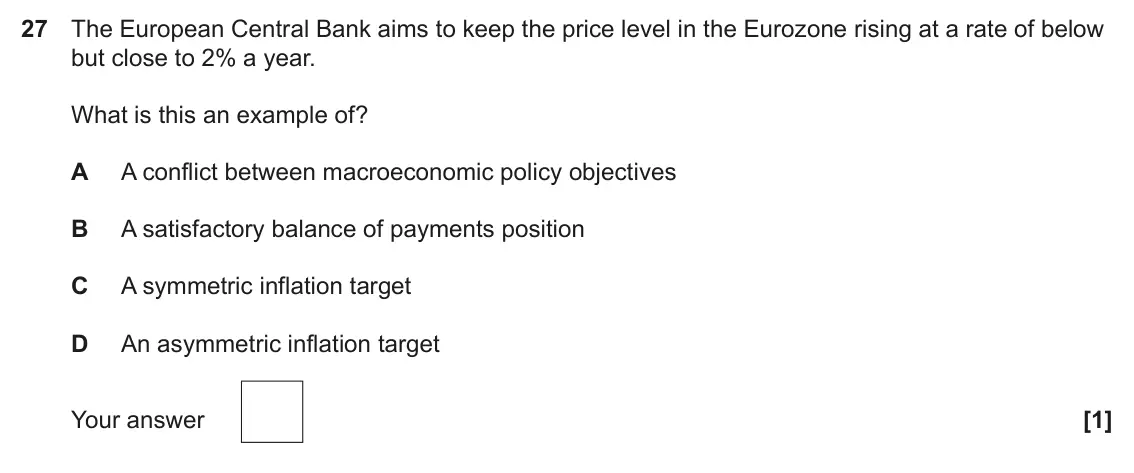
    June 2023 Paper 3, question 27: The European Central Bank aims to keep the price level in the Eurozone rising at a rate of below but close to 2% a year. What is this an example of? A A conflic
    Your answer
  10. Q1

    June 2023 · AS Paper 2

    The whole paper ↗
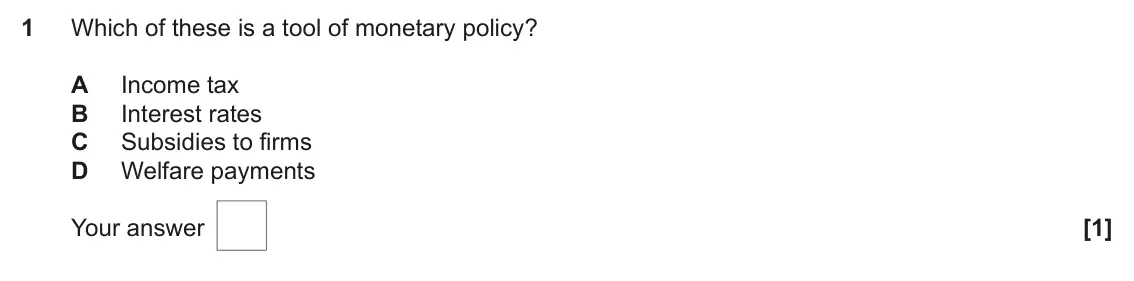
    June 2023 AS Paper 2, question 1: Which of these is a tool of monetary policy? A Income tax B Interest rates C Subsidies to firms D Welfare payments [1]
    Your answer
  11. Q17

    June 2023 · AS Paper 2

    The whole paper ↗
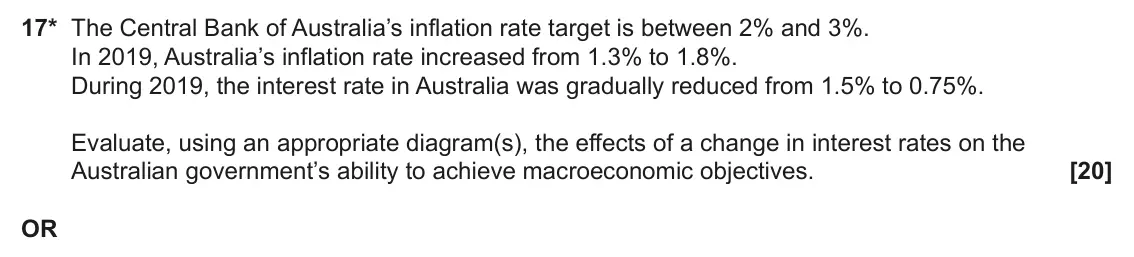
    June 2023 AS Paper 2, question 17: 17* The Central Bank of Australia’s inflation rate target is between 2% and 3%. In 2019, Australia’s inflation rate increased from 1.3% to 1.8%. During 2019, th
  12. Q1(e)

    June 2022 · Paper 2

    The whole paper ↗
    June 2022 Paper 2, question 1(e): Using information from the stimulus material, evaluate whether setting an inflation rate target is likely to result in low and stable inflation. [8]
  13. Q16(b)(i)

    June 2022 · AS Paper 2

    The whole paper ↗
    June 2022 AS Paper 2, question 16(b)(i): Using Fig. 2, state what has happened to Japan’s interest rate between 2017 and 2019. [1]
  14. Q16(b)(ii)

    June 2022 · AS Paper 2

    The whole paper ↗
    June 2022 AS Paper 2, question 16(b)(ii): Other than interest rates, explain one expansionary monetary policy that Japan’s central bank could use. [2]
  15. Q1(d)

    November 2021 · Paper 2

    The whole paper ↗
    November 2021 Paper 2, question 1(d): Using Fig. 3, explain what is likely to have happened to UK share prices at the start and the end of the period shown. [4]
  16. Q1(f)

    November 2021 · Paper 2

    The whole paper ↗
    November 2021 Paper 2, question 1(f): (f)* Using information from the stimulus material, evaluate whether a negative interest rate would help the government achieve its macroeconomic objectives. [12
All 16 questions on Monetary policy, as a list
  1. June 2025, Paper 3, Q11 (1 mark): Which components of aggregate demand (AD) could a change in interest rates affect? A C B C + I C C + I + G + (X – M) D C + I + (X – M) [1]
  2. June 2025, AS Paper 2, Q2 (1 mark): Which target is set for the Bank of England? A Exchange rate B Inflation C Interest rate D National debt [1]
  3. June 2025, AS Paper 2, Q12 (1 mark): Which policy is likely to include an increase in the money supply? A Contractionary fiscal policy B Contractionary monetary policy C Expansionary fiscal policy
  4. June 2024, Paper 2, Q5 (25 marks): 5* In 2021, the Economic Affairs Committee of the House of Lords in the UK published a report which questioned whether the Bank of England was addicted to using
  5. June 2024, Paper 3, Q35 (2 marks): Using Fig. 2.2, identify what evidence there is that the rate of interest may not have been a large determinant of household saving in the UK between 2020 and 2
  6. June 2024, Paper 3, Q36 (15 marks): 36* Evaluate, using the information in Extract 2, whether increasing the interest rate was an effective way to combat rising inflation. [15]
  7. June 2024, AS Paper 2, Q7 (1 mark): What is an example of a contractionary monetary policy? A Increasing government expenditure by £1bn B Increasing interest rates by 1% C Increasing quantitative
  8. June 2023, Paper 2, Q3 (25 marks): 3* Between July 2018 and August 2020, the value of the Turkish lira fell from 4.73 lira to 1 US dollar to 7.32 lira to 1 US dollar. The Turkish central bank spe
  9. June 2023, Paper 3, Q27 (1 mark): The European Central Bank aims to keep the price level in the Eurozone rising at a rate of below but close to 2% a year. What is this an example of? A A conflic
  10. June 2023, AS Paper 2, Q1 (1 mark): Which of these is a tool of monetary policy? A Income tax B Interest rates C Subsidies to firms D Welfare payments [1]
  11. June 2023, AS Paper 2, Q17 (20 marks): 17* The Central Bank of Australia’s inflation rate target is between 2% and 3%. In 2019, Australia’s inflation rate increased from 1.3% to 1.8%. During 2019, th
  12. June 2022, Paper 2, Q1(e) (8 marks): Using information from the stimulus material, evaluate whether setting an inflation rate target is likely to result in low and stable inflation. [8]
  13. June 2022, AS Paper 2, Q16(b)(i) (1 mark): Using Fig. 2, state what has happened to Japan’s interest rate between 2017 and 2019. [1]
  14. June 2022, AS Paper 2, Q16(b)(ii) (2 marks): Other than interest rates, explain one expansionary monetary policy that Japan’s central bank could use. [2]
  15. November 2021, Paper 2, Q1(d) (4 marks): Using Fig. 3, explain what is likely to have happened to UK share prices at the start and the end of the period shown. [4]
  16. November 2021, Paper 2, Q1(f) (12 marks): (f)* Using information from the stimulus material, evaluate whether a negative interest rate would help the government achieve its macroeconomic objectives. [12

Questions, mark schemes and examiner’s reports are © OCR, from their published past papers. Plumi isn’t affiliated with any exam board. Want whole papers? Full past papers.

Rather write your answers by hand on iPad? Plumi marks them against the same mark schemes.