 plumi
Inorganic chemistry and the periodic table: OCR A‑Level Chemistry B questions
Every OCR A-Level Chemistry B exam question on DM Inorganic chemistry and the periodic table (specification points DM(g)–(m)), 2016–2025, with its mark scheme and examiner’s report.
Find questions2,049
Calculations


Q2(c)
The whole paper ↗
Q5(a)
The whole paper ↗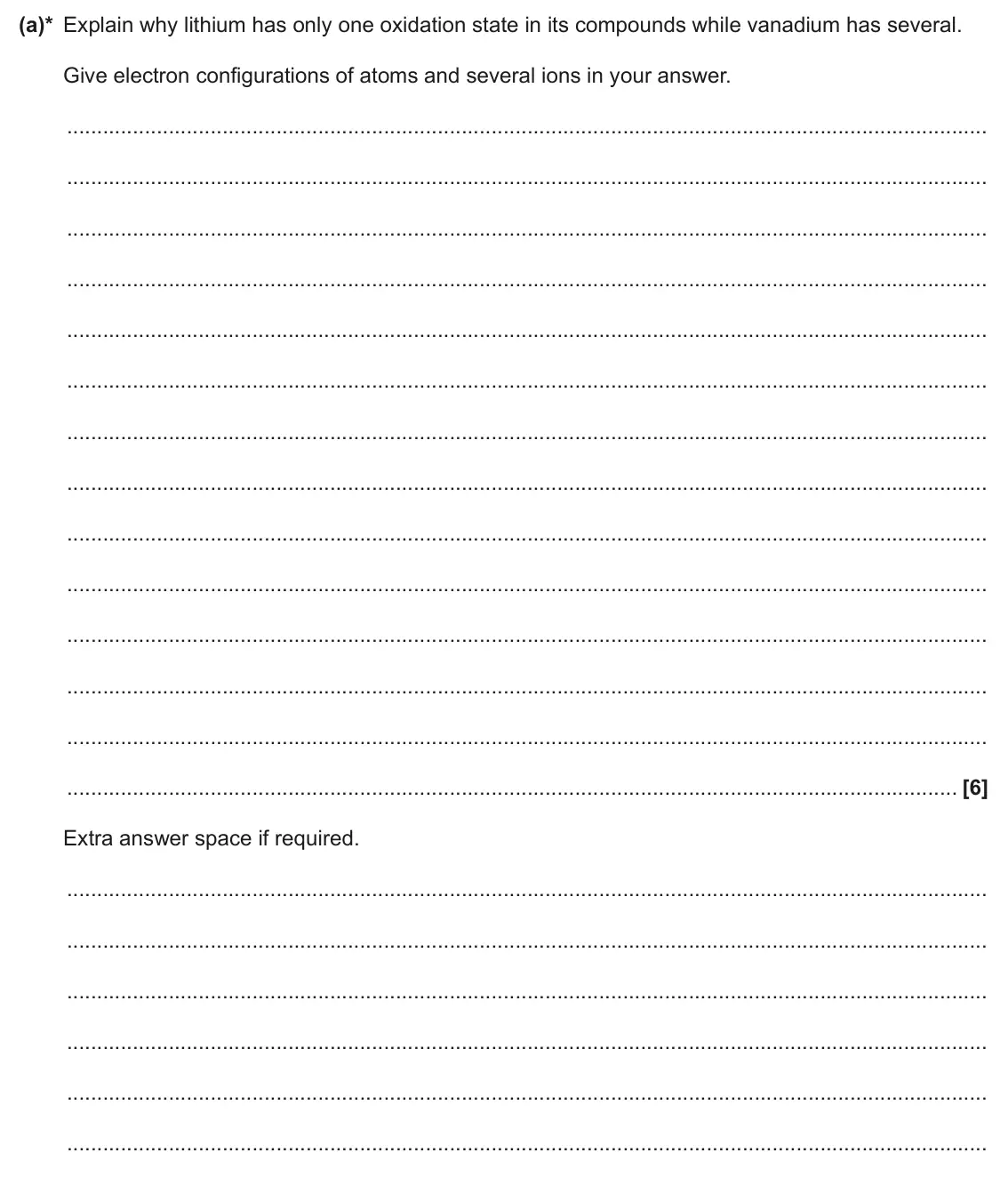
Q5(e)(i)
The whole paper ↗
Q5(e)(ii)
The whole paper ↗
Q33(d)(iii)
The whole paper ↗
Q2(d)(i)
The whole paper ↗
Q2(d)(ii)
The whole paper ↗
Q2(a)(i)
The whole paper ↗
Q2(a)(ii)
The whole paper ↗
Q2(b)
The whole paper ↗

Q1(d)(ii)
The whole paper ↗
Q1(d)(iii)
The whole paper ↗
Q1(e)(i)
The whole paper ↗
Q4(c)(i)
The whole paper ↗
Q4(d)
The whole paper ↗
Q33(b)(i)
The whole paper ↗
All 41 questions on Inorganic chemistry and the periodic table, as a list
- June 2025, Paper 1, Q4 (1 mark): Which statement about transition metals is correct? Copper(II) ions form an octahedral complex with chloride ions. A B Most manganese compounds have Mn in the o
- June 2025, Paper 1, Q7 (1 mark): Which row shows the correct electron configurations of Cr and Cr3+? 7 Cr3+ Cr [Ar] 3d4 4s2 [Ar] 3d3 A [Ar] 3d4 4s2 [Ar] 3d1 4s2 B [Ar] 3d5 4s1 [Ar] 3d3 C [Ar] 3
- June 2025, Paper 2, Q2(c) (3 marks): The students add an aqueous solution of ammonia to a solution of FeSO4. A precipitate forms. Give the colour of the precipitate and write an ionic equation for
- June 2025, Paper 2, Q5(a) (6 marks): This question refers to the Advance Notice Article Battery Tech Report: ‘Lithium-Ion vs Vanadium Redox Flow Batteries (VRFB)’ that is included as an Insert to t
- June 2025, Paper 2, Q5(e)(i) (2 marks): Explain why they are coloured, selecting terms from the following list as required: absorption complementary emission transmission [2]
- June 2025, Paper 2, Q5(e)(ii) (2 marks): Explain why the colours are different. [2]
- June 2024, Paper 1, Q33(d)(iii) (2 marks): The catalyst used in the reaction in Equation 33.1 is a solid mixture of platinum and rhodium. Explain why this solid is able to behave as a catalyst. [2]
- June 2024, Paper 2, Q2(d)(i) (1 mark): The complex contains two gluconate ions. What type of ligand is the gluconate ion? [1]
- June 2024, Paper 2, Q2(d)(ii) (1 mark): Name the type of bonds between the O atoms and Fe2+ ions in the structure. [1]
- June 2023, Paper 3, Q2(a)(i) (2 marks): Complete the diagram below to show the electronic configuration of a Cu2+ ion. 4p 3d 4s 3p 3s energy 2p 2s 1s [2]
- June 2023, Paper 3, Q2(a)(ii) (1 mark): Explain why copper is classed as a transition metal. [1]
- June 2023, Paper 3, Q2(b) (6 marks): Copper is a d-block metal and forms many complexes. (b)* The Cu2+ ion forms several complex ions with different ligands. A group of students performs a simple m
- June 2022, Paper 1, Q9 (1 mark): Which row is correct? Cu2+(aq) + NaOH(aq) Cu2+(aq) + NH3(aq) A Blue precipitate soluble in excess NaOH(aq) Blue precipitate insoluble in excess NH3(aq) B Blue p
- June 2022, Paper 2, Q1(d)(ii) (1 mark): The electron configuration of a calcium ion is 1s22s22p63s23p6. How does the electron configuration of the cation in Fe2O3 differ from this? [1]
- June 2022, Paper 2, Q1(d)(iii) (1 mark): Explain why iron can form two stable cations. [1]
- June 2022, Paper 2, Q1(e)(i) (1 mark): Fe2O3 is soluble in concentrated hydrochloric acid. Excess sodium hydroxide is added to this solution. Name the precipitate formed and describe its colour. name
- June 2022, Paper 3, Q4(c)(i) (1 mark): Explain the term ligand. [1]
- June 2022, Paper 3, Q4(d) (4 marks): d-block elements form a variety of differently coloured complex ions. Explain, in terms of electronic structure, why these complex ions are coloured and why dif
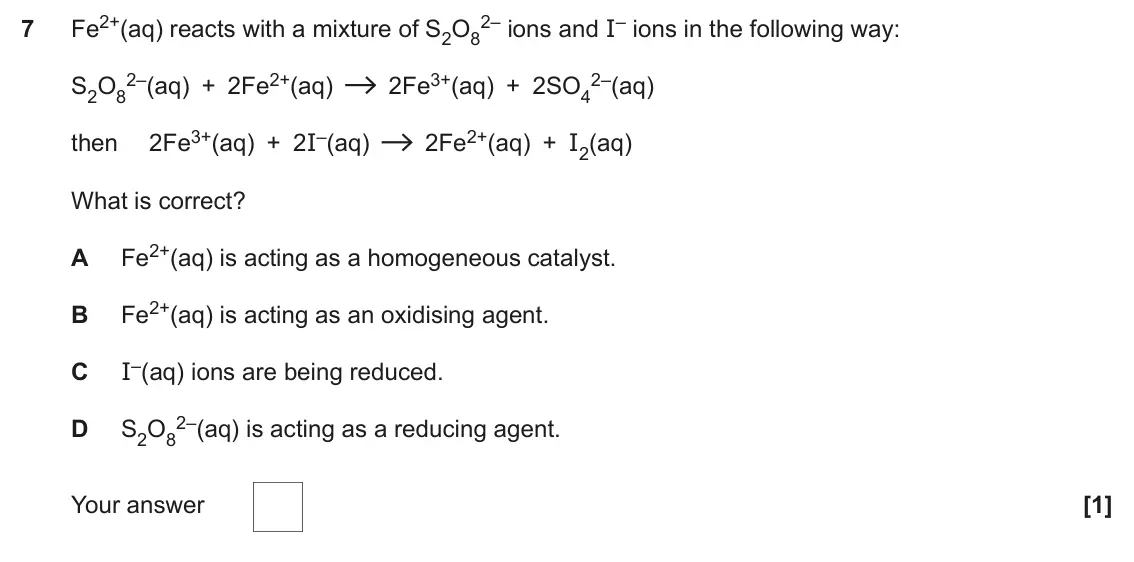
- November 2021, Paper 1, Q7 (1 mark): Fe2+(aq) reacts with a mixture of S2O8 2– ions and I– ions in the following way: 7 2–(aq) + 2Fe2+(aq) 2Fe3+(aq) + 2SO4 2–(aq) S2O8 then 2Fe3+(aq) + 2I–(aq) 2Fe2
- November 2021, Paper 1, Q33(b)(i) (3 marks): Explain the formation of the pale blue precipitate in terms of a property of ammonia, writing equations. Property of ammonia: Equations: [3]
- November 2021, Paper 1, Q33(c)(i) (1 mark): What type of ligand is 1,2-diaminoethane? [1]
- November 2021, Paper 1, Q33(d) (4 marks): Some students want to find the formula of the complex ion formed between 1,2-diaminoethane (H2NC2H4NH2) and Cu2+ ions. The students have a solution of 1,2-diami
- November 2021, Paper 2, Q2(d) (3 marks): The students add aqueous sodium hydroxide to a fresh aqueous solution of an iron(II) salt. A precipitate of iron(II) hydroxide forms that gradually turns to iro
- November 2020, Paper 1, Q8 (1 mark): Which ion would have a coloured chloride? A Cu+ B Sc3+ C Ti3+ D Zn2+ Your answer [1]
- November 2020, Paper 2, Q5(a)(ii) (1 mark): Suggest the electronic configuration of the outermost sub-shell in a Pt2+ ion. [1]
- November 2020, Paper 2, Q5(a)(iii) (1 mark): Is platinum a transition metal? Give a reason. [1]
- November 2020, Paper 2, Q5(b) (2 marks): Some ligands are described as bidentate. Give the full structural formula of a bidentate ligand from a compound in the article. [2]
- November 2020, Paper 2, Q5(c)(iii) (2 marks): Name the type of bond at C in Fig. 5.1 and describe how it is formed. [2]
- June 2019, Paper 1, Q2 (1 mark): A solution of salt X gives a green precipitate with sodium hydroxide solution. What is X? A Iron(II) chloride B Iron(III) sulfate C Barium chloride D Barium sul
- June 2019, Paper 1, Q17 (1 mark): Excess ammonia solution is added separately to Cu2+(aq) and Fe2+(aq). The solutions are left in the air. Which row of the table represents the colour changes se
- June 2019, Paper 3, Q4(d) (6 marks): This question refers to the Practical Insert that is provided as an insert to this paper. (d)* There are several d block metal ions, including complex ions, men
- June 2018, Paper 1, Q13 (1 mark): What is correct for the complex [Fe(C2O4)3]3–? A The charge on each ligand is 2–. B The co-ordination number of the metal ion is 3. C The oxidation state of the
- June 2018, Paper 1, Q23 (1 mark): Which row gives the correct appearances of the products of the reactions? [Fe(H2O)6]3+(aq) and sodium [Cu(H2O)6]2+(aq) and excess hydroxide solution conc. ammon
- June 2018, Paper 1, Q35(d) (1 mark): Give the electron configuration of the Fe2+ ion. [1] 28 The chemists investigated making the bolts from a nickel-copper alloy that has high strength and resista
- June 2018, Paper 1, Q35(f)(i) (1 mark): Suggest why the colour changes as the EDTA4– is added and name the type of reaction taking place. [1]
- June 2018, Paper 1, Q35(f)(ii) (2 marks): In a separate experiment, 25.0 cm3 of a 0.250 mol dm–3 [Ni(H2O)6]2+ solution is found to react exactly with 41.7 cm3 of 0.150 mol dm–3 EDTA4– solution. Calculat
- June 2018, Paper 2, Q5(e)(ii) (1 mark): State which part of Scheele’s green is responsible for the green colour. [1]
- June 2017, Paper 1, Q11 (1 mark): Which ion is coloured? Zn2+ A Sc3+ B Ti3+ C Ti4+ D Your answer [1]
- June 2017, Paper 2, Q4(b)(i) (1 mark): Write the electron configuration of a Cr3+ ion, using sub-shells and atomic orbitals. [1]
- June 2017, Paper 2, Q4(c)(i) (1 mark): Name the ligands in the green complex. [1]
- June 2017, Paper 2, Q5(d) (2 marks): The article gives two equations for the ‘Fenton mechanism’. Give the overall equation represented by the two equations. Explain why the two equations alone do n
Questions, mark schemes and examiner’s reports are © OCR, from their published past papers. Plumi isn’t affiliated with any exam board. Want whole papers? Every OCR A-Level Chemistry B paper.
Rather write your answers by hand on iPad? Plumi marks them against the same mark schemes.