 plumi
Energetics: OCR A‑Level Chemistry B questions
Every OCR A-Level Chemistry B exam question on DF Energetics (specification points DF(d)–(g)), 2016–2025, with its mark scheme and examiner’s report.
Find questions2,049
Calculations
Q23(c)(i)
The whole paper ↗
Q23(c)(ii)
The whole paper ↗
Q23(d)(i)
The whole paper ↗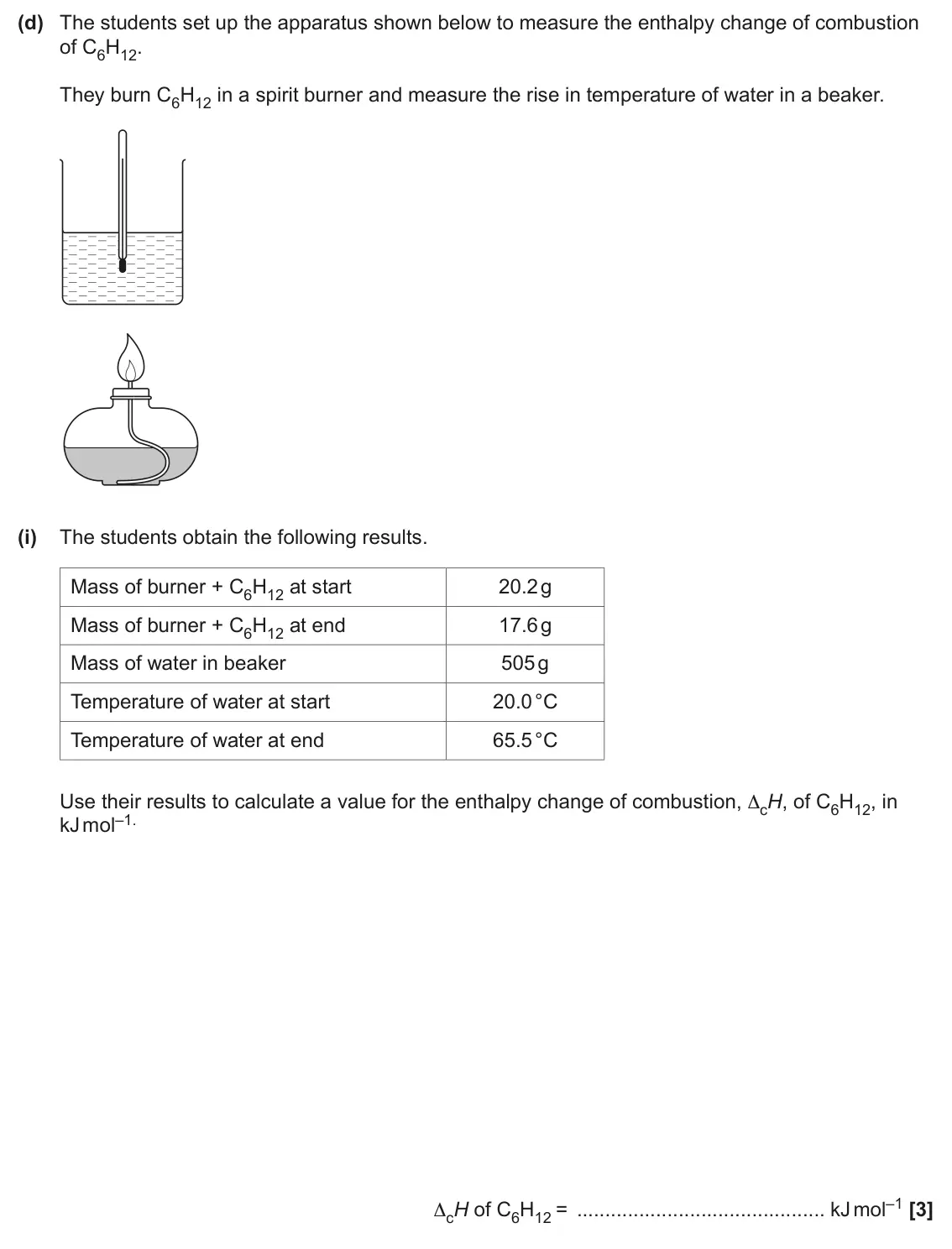
Q23(d)(ii)
The whole paper ↗
Q4(b)
The whole paper ↗

Q21(c)(i)
The whole paper ↗
Q21(c)(ii)
The whole paper ↗
Q21(c)(iii)
The whole paper ↗
Q21(c)(iv)
The whole paper ↗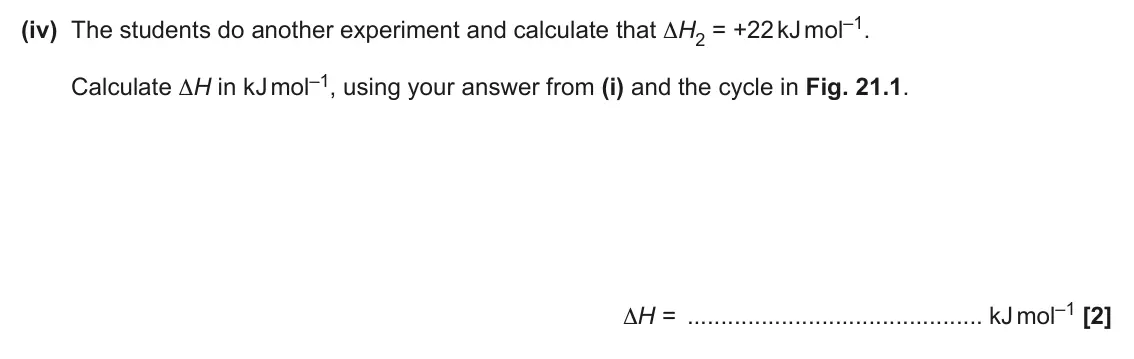
Q32(c)(i)
The whole paper ↗
Q32(c)(ii)
The whole paper ↗
Q32(d)(i)
The whole paper ↗
Q32(d)(ii)
The whole paper ↗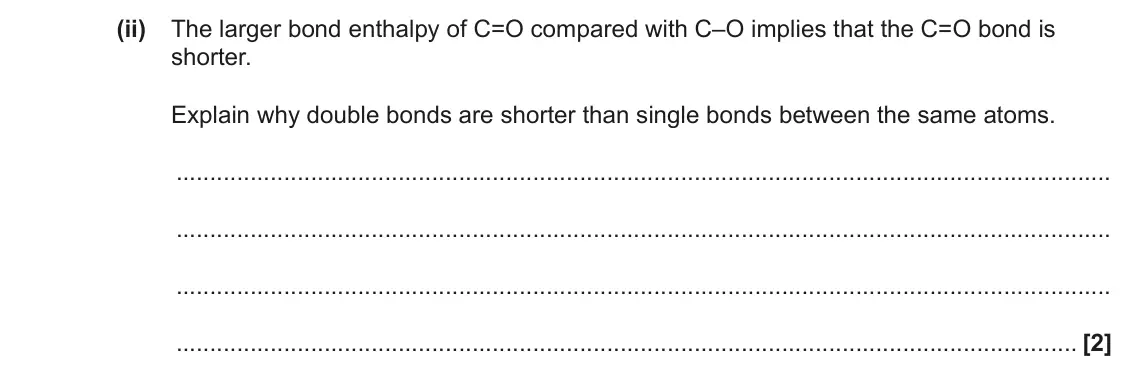
Q32(d)(iii)
The whole paper ↗
Q23(a)
The whole paper ↗
Q23(b)
The whole paper ↗
Q23(c)(i)
The whole paper ↗
Q23(c)(ii)
The whole paper ↗
Q23(d)(i)
The whole paper ↗
All 73 questions on Energetics, as a list
- June 2025, AS Paper 1, Q23(c)(i) (1 mark): Which one-word term describes a reaction with a negative enthalpy change? [1]
- June 2025, AS Paper 1, Q23(c)(ii) (1 mark): Explain, in terms of bonds broken and made, why some enthalpy changes are negative. [1] Question 3(c) starts on Page 16
- June 2025, AS Paper 1, Q23(d)(i) (3 marks): The students obtain the following results. Mass of burner + C6H12 at start 20.2 g Mass of burner + C6H12 at end 17.6 g Mass of water in beaker 505 g Temperature
- June 2025, AS Paper 1, Q23(d)(ii) (3 marks): The value in (i) is less negative than the Data Book value. A student makes two statements: • One reason for this is that some C6H12 vapour might have evaporate
- June 2024, Paper 3, Q4(b) (1 mark): What term describes a reaction where the temperature decreases? [1]
- June 2024, AS Paper 1, Q5 (1 mark): This question is about the relationship between enthalpy changes and bonds broken and made. Which row is correct? sign of ΔH description bonds broken and made m
- June 2024, AS Paper 1, Q21(c)(i) (3 marks): (Assume there are 27.0 g of solution with the same specific heat capacity as water.) ΔH1 = kJ mol–1 [3]
- June 2024, AS Paper 1, Q21(c)(ii) (1 mark): The greatest measurement uncertainty is 0.05 g in the mass. What percentage is 0.05 of 2.0? answer = % [1]
- June 2024, AS Paper 1, Q21(c)(iii) (2 marks): As well as measurement uncertainties, there are also errors caused by experimental limitations. One such error is ‘heat loss’ during the measurement of ΔH1. The
- June 2024, AS Paper 1, Q21(c)(iv) (2 marks): The students do another experiment and calculate that ΔH2 = +22 kJ mol–1. Calculate ΔH in kJ mol–1, using your answer from (i) and the cycle in Fig. 21.1. ΔH =
- June 2023, Paper 1, Q32(c)(i) (3 marks): Use the results in Table 32.1 to calculate a value for the enthalpy change of combustion, ΔcH, of ethanol, C2H5OH, in kJ mol–1. ΔcH of ethanol = kJ mol–1 [3]
- June 2023, Paper 1, Q32(c)(ii) (4 marks): The student found that the value of ΔcH obtained using this method was considerably less exothermic than that in a data book. State two sources of error in the
- June 2023, Paper 1, Q32(d)(i) (1 mark): Why are the bond enthalpies in Table 32.2 described as average values? [1]
- June 2023, Paper 1, Q32(d)(ii) (2 marks): The larger bond enthalpy of C=O compared with C–O implies that the C=O bond is shorter. Explain why double bonds are shorter than single bonds between the same
- June 2023, Paper 1, Q32(d)(iii) (3 marks): The equation for the combustion of ethanol is shown below: 2CO2 + 3H2O ΔcH = –1367 kJ mol–1 Equation 32.1 C2H5OH + 3O2 Use the data in Table 32.2 and the value
- June 2023, AS Paper 1, Q23(a) (1 mark): The bond enthalpy for C–C in Table 23.1 is described as an average bond enthalpy. Explain the meaning of average in this context. [1]
- June 2023, AS Paper 1, Q23(b) (3 marks): Use Equation 23.1 and data from Table 23.1 to calculate the bond enthalpy of C≡N in cyanogen. bond enthalpy = kJ mol–1 [3]
- June 2023, AS Paper 1, Q23(c)(i) (2 marks): Explain why the bond enthalpies in Table 23.1 are all endothermic. [2]
- June 2023, AS Paper 1, Q23(c)(ii) (1 mark): Use the information in Table 23.1 to compare the relative bond lengths in CO and CO2. [1]
- June 2023, AS Paper 1, Q23(d)(i) (3 marks): Complete labelled diagrams of simple apparatus that could be used for Experiment 1 and Experiment 2. Experiment 1 Experiment 2 flow of cyanogen flow of cyanogen
- June 2023, AS Paper 1, Q23(d)(ii) (1 mark): Describe one improvement that could have been made to Experiment 2 to improve the accuracy of the result. [1]
- June 2023, AS Paper 1, Q23(d)(iii) (4 marks): Calculate the maximum possible temperature rise of the water. Use the scientists’ result and measurements from part (d) and Equation 23.1. Give your answer to a
- June 2022, Paper 3, Q2(a)(ii) (3 marks): The student measures the temperature of the contents of the beaker over a period of 20 minutes and plots the data on the graph below. 32 31 30 highest temp 29 2
- June 2022, Paper 3, Q2(b) (1 mark): Calculate ΔrH o for Reaction 2.1 using the data shown below. ΔfH o / kJ mol–1 Cu2+(aq) + 64.4 Zn2+(aq) –152.4 ΔrH o = kJ mol–1 [1]
- June 2022, Paper 3, Q2(c) (6 marks): This question is about the enthalpy change of the reaction of zinc with copper(II) sulfate solution. (c)* The value obtained from the student’s experiment is co
- June 2022, AS Paper 1, Q20 (1 mark): What represents the enthalpy change of neutralisation of sulfuric acid? A H2SO4 + 2NaOH Na2SO4 + 2H2O 1 1 B 2H2SO4 + NaOH 2Na2SO4 + H2O C H2SO4 + 2Na Na2SO4 + H
- June 2022, AS Paper 2, Q4(c)(i) (3 marks): Methanol burns in oxygen as shown in equation 4.1. CO2(g) + 2H2O(g) ΔcH298 = –676 kJ mol–1 CH3OH(g) + 1½O2(g) Equation 4.1 Some average bond enthalpy data are g
- June 2022, AS Paper 2, Q4(c)(ii) (1 mark): The standard enthalpy change of combustion of methanol (ΔcH o 298) is not the same as the value given in equation 4.1. Give a reason for this. [1]
- June 2022, AS Paper 2, Q4(d) (3 marks): A student carries out an experiment to measure ΔcH for methanol, CH3OH. The student burns the methanol in a spirit burner below a beaker containing 100 cm3 wate
- June 2022, AS Paper 2, Q4(e) (6 marks): Vehicles using petrol as fuel will still be on the roads for some time to come. It is important that developments continue to improve fuel efficiency and furthe
- November 2021, Paper 1, Q4 (1 mark): Which equation represents the enthalpy change of formation of CO2? A C(s) + 2O(g) CO2(g) B C(s) + O2(g) CO2(g) C CO(g) + 0.5O2(g) CO2(g) D C(g) + O2(g) CO2(g) Y
- November 2021, AS Paper 1, Q6 (1 mark): Which statement is correct for an endothermic reaction? A Heat is given out. B More bonds are made than broken. C More energy is taken in to break bonds than is
- November 2021, AS Paper 1, Q24(b)(i) (2 marks): Complete a labelled diagram of their apparatus. spirit burner containing butan-1-ol [2]
- November 2021, AS Paper 1, Q24(b)(ii) (3 marks): The students find that the combustion of 2.5 g of butan-1-ol raises the temperature of 200 cm3 of water by 52 °C. Calculate their value for ∆cH for butan-1-ol,
- November 2021, AS Paper 1, Q24(c)(i) (2 marks): Use the data below to complete a Hess cycle and calculate ∆cH o for butan-1-ol, C4H9OH(l). ∆fHo/ kJ mol–1 Substance C4H9OH(l) –327 CO2(g) –394 H2O(l) –286 C4H9O
- November 2021, AS Paper 1, Q24(c)(ii) (1 mark): Suggest one reason why the answers to parts (b)(ii) and (c)(i) are not the same. [1]
- November 2020, Paper 3, Q3(a) (3 marks): A student measures the enthalpy change of combustion of propan-1-ol, C3H7OH. The apparatus used is shown in Fig. 3.1. thermometer clamp metal can water spirit b
- November 2020, Paper 3, Q3(b)(i) (2 marks): One reason for the difference is heat loss to the surroundings. Suggest two other reasons for the difference between the experimental value and the data book va
- November 2020, Paper 3, Q3(b)(ii) (1 mark): Describe one addition to the apparatus in Fig. 3.1 that would improve the accuracy of the experimental value for the enthalpy change of combustion. [1]
- November 2020, Paper 3, Q3(c)(ii) (3 marks): Explain why the enthalpy change of combustion values are exothermic and very similar. Use your answer to (c)(i) and the idea of average bond enthalpies in your
- November 2020, AS Paper 2, Q4(a) (1 mark): Suggest why it is difficult to measure ΔH1 directly. [1]
- November 2020, AS Paper 2, Q4(b) (2 marks): A student does an experiment to measure ΔH2. The student adds 7.50 × 10⁻² mol of NaHCO3 to 50.00 cm3 (an excess) of 2.00 mol dm−3 HCl. The temperature decreases
- November 2020, AS Paper 2, Q4(c) (6 marks): Sodium hydrogencarbonate is used in baking powder. When it is heated above about 80 °C it begins to break down as shown in equation 4.1. 2NaHCO3(s) Na2CO3(s) +
- November 2020, AS Paper 2, Q4(d) (4 marks): In separate accurately performed experiments the following enthalpy changes were determined. ΔH2 = +23 kJ mol−1 NaHCO3(s) + HCl (aq) NaCl (aq) + CO2(g) + H2O(l)
- November 2020, AS Paper 2, Q4(e) (2 marks): Bond enthalpies can be used in some calculations involving ΔH values. Use the data below to calculate a value for the bond enthalpy of the H–O bond. 2H2O(g) ΔH
- November 2020, AS Paper 2, Q4(f) (1 mark): Why can bond enthalpies not be used to estimate ΔH1? 2NaHCO3(s) Na2CO3(s) + CO2(g) + H2O(l) ΔH1 [1]
- June 2019, Paper 1, Q34(c) (3 marks): Another theory is that life developed near hot vents deep under the sea. At these hot vents geothermally heated water rich in minerals emerges from the ocean fl
- June 2019, Paper 2, Q5(a) (3 marks): The enthalpy change of combustion of acetylene, C2H2, can be calculated using enthalpy changes of formation. Draw the Hess cycle that shows this, giving formula
- June 2019, AS Paper 1, Q21(a) (1 mark): Write down the value of ∆fH o for NH3(g). Include the unit in your answer. [1]
- June 2019, AS Paper 1, Q23(a)(i) (3 marks): Calculate the enthalpy change on dissolving 1 mol of ammonium nitrate in water. Give your answer in kJ mol–1 and to an appropriate number of significant figures
- June 2019, AS Paper 1, Q23(a)(ii) (2 marks): The students want to get a larger temperature change. Some suggest using a greater mass of ammonium nitrate, others suggest using more water. Evaluate the stude
- June 2019, AS Paper 1, Q23(b)(i) (5 marks): The students are provided with powdered zinc metal and solid CuSO4•5H2O (Mr = 250). They measure the temperature rise when 100 cm3 (an excess) of 0.2 mol dm–3 c
- June 2019, AS Paper 1, Q23(b)(ii) (2 marks): The students repeat the experiment, measuring the temperature at different times. They plot the graph shown. 28 26 24 22 temperature / °C 20 18 16 14 12 0 2 4 6
- June 2018, Paper 1, Q31(b)(i) (1 mark): Describe an experiment they could use to determine the enthalpy change of combustion of liquid hexane in the laboratory. [1]
- June 2018, Paper 1, Q31(b)(ii) (1 mark): Show how the result would be calculated from the measurements made when carrying out the experiment in part (b)(i). [1]
- June 2018, Paper 1, Q31(b)(iii) (2 marks): Describe two ways in which the students could make the basic experiment more accurate. 1 2 [2]
- June 2018, Paper 1, Q31(c) (2 marks): The students are given some enthalpy changes of formation and use them to check the accuracy of their answer. Calculate the standard enthalpy change of combusti
- June 2018, AS Paper 2, Q2(b) (2 marks): Explain why the combustion of butan-1-ol is exothermic, using ideas about bond-breaking and bond-making. You do not need to list the specific bonds broken and m
- June 2018, AS Paper 2, Q2(d) (3 marks): In a simple laboratory experiment, the combustion of 1.00 g of a biofuel compound raised the temperature of 500 g of water by 16.0 °C. Calculate a value for the
- June 2018, AS Paper 2, Q2(e) (1 mark): The laboratory set-up used to obtain the data in part (d) is shown below. thermometer/stirrer 500 g water in glass beaker flame from burning biofuel This set-up
- June 2018, AS Paper 2, Q2(f) (3 marks): Another alcohol that is used in some fuels is methanol, CH3OH. An equation for the complete combustion of methanol is shown below. CO2(g) + 2H2O(g) ΔcH = –677 k
- June 2017, Paper 1, Q14 (1 mark): Why are many bond enthalpies described as averages? A They are averaged out over many molecules with different kinetic energies. B They are averaged out over di
- June 2017, AS Paper 1, Q16 (1 mark): What is correct about an exothermic reaction? A Heat is taken in. B More bonds are made than broken. C The sign of ∆H is positive. D It is represented by a down
- June 2017, AS Paper 1, Q23(b)(i) (2 marks): Calculate a value for the ∆fH of fuel C using the data below. C7H16(l) + 11O2(g) 7CO2(g) + 8H2O(l) ∆cH = –4811kJ mol–1 fuel C ∆fH / kJ mol–1 Compound CO2(g) –39
- June 2017, AS Paper 1, Q23(c)(i) (2 marks): State the measurements that the students would make to calculate a value for the energy produced. Show how these measurements would be used to calculate this en
- June 2017, AS Paper 1, Q23(c)(ii) (4 marks): State and explain two improvements that could be made to increase the accuracy of the calculated value of the energy produced. 1 2 [4]
- June 2016, AS Paper 2, Q1(a) (2 marks): Write a chemical equation to represent the standard enthalpy change of combustion of butane (ΔcH ○). Show state symbols. [2]
- June 2016, AS Paper 2, Q1(b) (3 marks): Calculate a value for the enthalpy change of combustion (in kJ mol–1) of butane (ΔcH) using the experimental results in Table 1.1. enthalpy change of combustion
- June 2016, AS Paper 2, Q1(c)(i) (1 mark): Estimate the standard enthalpy change of combustion of butane. ΔcH ○ = kJ mol–1 [1]
- June 2016, AS Paper 2, Q1(c)(ii) (2 marks): Suggest two reasons, apart from ‘heat losses’, why the value calculated in the simple experiment in (b) is much less exothermic than the value estimated. 1 2 [2
- June 2016, AS Paper 2, Q1(c)(iii) (1 mark): The students repeat the experiment using the same thermometer and balance. State and explain one way in which they could modify the procedure in order to obtain
- June 2016, AS Paper 2, Q1(d) (1 mark): The enthalpy change of combustion of butane can be measured directly using the method in (b). The standard enthalpy change of formation of butane is represented
- June 2016, AS Paper 2, Q1(f) (3 marks): The enthalpy change of combustion of methanol and some bond enthalpies are shown below. CH3OH(g) + 11 CO2(g) + 2H2O(g) ΔcH = –726 kJ mol–1 2O2(g) Bond enthalpy
Questions, mark schemes and examiner’s reports are © OCR, from their published past papers. Plumi isn’t affiliated with any exam board. Want whole papers? Every OCR A-Level Chemistry B paper.
Rather write your answers by hand on iPad? Plumi marks them against the same mark schemes.