 plumi
Spectroscopy: OCR A‑Level Chemistry A questions
Every OCR A-Level Chemistry A exam question on 6.3.2 Spectroscopy, 2016–2025, with its mark scheme and examiner’s report.
Find questions1,820
Calculations

Q23(a)
The whole paper ↗
Q23(b)
The whole paper ↗
Q1(b)
The whole paper ↗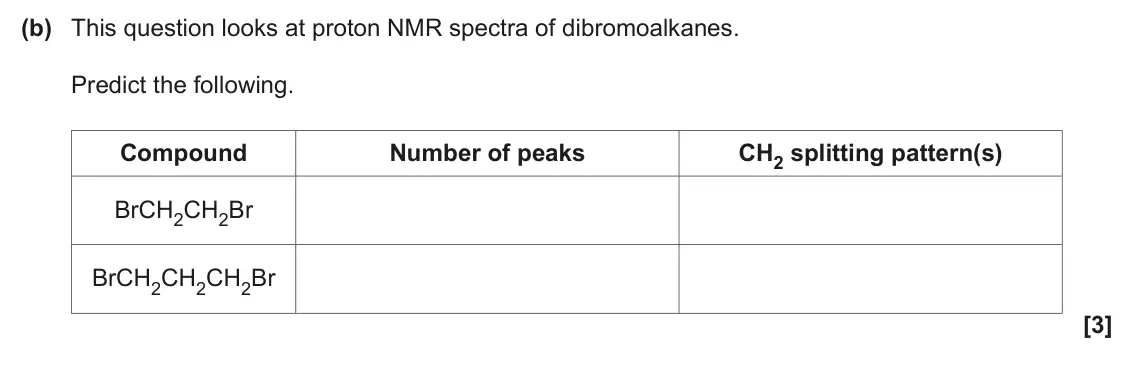


Q17(d)
The whole paper ↗


Q16(b)(v)
The whole paper ↗
Q18(c)
The whole paper ↗
Q20(a)(ii)
The whole paper ↗
Q1(c)(i)
The whole paper ↗
Q1(c)(ii)
The whole paper ↗

Q20(b)(ii)
The whole paper ↗

All 37 questions on Spectroscopy, as a list
- June 2025, Paper 2, Q15 (1 mark): Which compound(s) has/have three peaks in their 13C NMR spectrum? OH 1 OH OH 2 HO HO OH 3 A 1, 2 and 3 B Only 1 and 2 C Only 2 and 3 D Only 1 Your answer [1]
- June 2025, Paper 2, Q23(a) (4 marks): Compound K, C4H10O, is refluxed with H2SO4 to form a mixture of compound L and compound M. The infrared spectrum of compound K is shown. 100 50 Transmittance (%
- June 2025, Paper 2, Q23(b) (6 marks): This question is about spectral analysis. (b)* An unknown organic compound N is analysed and produces the following results. Elemental analysis by mass C, 62.07
- June 2025, Paper 3, Q1(b) (3 marks): This question looks at proton NMR spectra of dibromoalkanes. Predict the following. Compound Number of peaks CH2 splitting pattern(s) BrCH2CH2Br BrCH2CH2CH2Br [
- June 2024, Paper 2, Q14 (1 mark): The structures of 3 compounds, 1, 2 and 3, are shown below. Which compound(s) would produce a carbon-13 NMR spectrum with 2 peaks? HO OH 1 2 3 A 1, 2 and 3 B On
- June 2024, Paper 2, Q24 (6 marks): 24* Analysis of an unknown organic compound J produces the following results. Elemental analysis by mass of compound J C, 80.60%; H, 7.46%; O, 11.94% Mass spect
- June 2023, Paper 2, Q1 (1 mark): Which compound is used for proton exchange in NMR spectroscopy? A CCl4 B CDCl3 C D2O D Si(CH3)4 Your answer [1]
- June 2023, Paper 2, Q9 (1 mark): Which compound has the greatest number of peaks in its proton NMR spectrum? O A O Br B Br O O C OH HO OH O D Your answer [1]
- June 2023, Paper 2, Q17(d) (5 marks): There are 4 structural isomers of C4H10O that are alcohols. A student predicts that these structural isomers could be distinguished using carbon-13 NMR spectros
- June 2023, Paper 2, Q23 (6 marks): 23* An unknown organic compound is analysed. The results are shown below. Addition of 2,4-DNP No visible change Elemental analysis by mass C, 66.63%; H, 11.18%;
- June 2022, Paper 2, Q12 (1 mark): Which compound produces two triplets in its 1H NMR spectrum? A CH3CH2COOCH2CH3 B CH3CH2COCH2CH3 C HOOCCH2CH2COOH D HOOCCH2CH2CH2COOH Your answer [1]
- June 2022, Paper 2, Q15 (1 mark): Which isomer(s) of C5H12O has/have 4 peaks in its/their 13C NMR spectrum? 1 3-methylbutan-2-ol 2 2-methylbutan-2-ol 3 2-methylbutan-1-ol A 1, 2 and 3 B Only 1 a
- June 2022, Paper 2, Q16(b)(v) (4 marks): Compounds D and E are two more structural isomers of C6H12. Compounds D and E do not show stereoisomerism. Table 16.1 shows NMR and infrared (IR) spectral data
- June 2022, Paper 2, Q18(c) (4 marks): The organic compound H contains carbon, hydrogen and oxygen only and has an Mr of 114.0. Compound H has two carbonyl groups and no other functional groups. The
- June 2022, Paper 2, Q20(a)(ii) (3 marks): A student thought that 13C NMR spectroscopy could be used to distinguish between compounds J, K and L. Explain, with reasoning, whether the student is correct.
- June 2022, Paper 3, Q1(c)(i) (2 marks): Fill in the table to predict the splitting patterns in the proton NMR spectrum of the organic compound. Proton environment Splitting pattern 1 2 3 4 [2]
- June 2022, Paper 3, Q1(c)(ii) (2 marks): The table shows the chemical shifts for the peaks in the proton NMR spectrum at proton environments 2 and 3. Proton environment 2 3 Chemical shift, δ 2.5 ppm 3.
- November 2021, Paper 2, Q13 (1 mark): Which compound(s) has/have four peaks in a 13C NMR spectrum? O 1 2 O 3 A 1, 2 and 3 B Only 1 and 2 C Only 2 and 3 D Only 1 Your answer [1]
- November 2021, Paper 2, Q20(b)(ii) (6 marks): The pure sample of C is analysed to give the following results. Percentage composition by mass: C, 31.44%; H, 1.31%; N, 18.34%; O, 48.91%. The mass spectrum of
- November 2020, Paper 2, Q8 (1 mark): Which isomer of C6H12O2 produces the smallest number of peaks in its 13C NMR spectrum? 8 O A OH O B O O C OH O D OH Your answer [1]
- November 2020, Paper 2, Q17(c)(i) (2 marks): Predict the number of peaks in the 13C NMR spectra of compounds C and D. Compound C Compound D Number of peaks [2]
- November 2020, Paper 2, Q22(a) (2 marks): Explain the use of two deuterated compounds in NMR spectroscopy. [2]
- November 2020, Paper 2, Q22(b) (6 marks): An organic compound I is analysed, using a combination of techniques. The analytical data is shown below. Elemental analysis by mass C, 56.69%; H, 7.09%; N, 11.
- November 2020, Paper 3, Q1(b)(ii) (6 marks): Amine A is a liquid at room temperature and pressure. When vaporised, 0.202 g of the amine produces 72.0 cm3 of gas at 1.00 × 10⁵ Pa and 100 °C. The 13C NMR spe
- June 2019, Paper 2, Q10 (1 mark): Which compound shows 4 peaks in its carbon-13 NMR spectrum? A B C D Your answer [1]
- June 2019, Paper 2, Q12 (1 mark): A compound produces the 13C NMR spectrum below. 80 70 60 50 40 30 20 10 0 chemical shift, d / ppm Which compound could have produced this spectrum? A Propane B
- June 2019, Paper 2, Q18(b) (4 marks): The protons in ester A are in four different environments, labelled 1– 4 on the structure below. 1 3 O 4 CH2 CH2 C Br CH2 O CH3 2 Complete the table to predict
- June 2019, Paper 2, Q18(c) (1 mark): Compound B is a structural isomer of ester A. • Compound B reacts with aqueous sodium carbonate. • The 13C NMR spectrum of B has 4 peaks. Draw a possible struct
- June 2019, Paper 2, Q21 (6 marks): 21* Analysis of an unknown organic compound produced the following results. Elemental analysis by mass C: 73.17%; H: 7.32%; O: 19.51% Mass spectrum Molecular io
- June 2019, Paper 3, Q4(a)(ii) (1 mark): Predict the number of peaks in a 13C NMR spectrum of chloroxylenol. [1]
- June 2018, Paper 2, Q1 (1 mark): Which compound is used as a standard for NMR chemical shift measurements? A Si(CH3)4 B CDCl3 C D2O D CCl4 Your answer [1]
- June 2018, Paper 2, Q6 (1 mark): What is the number of peaks in the 1H NMR spectrum of HOOCCH2CHOHCH2COOH? 6 A 3 B 4 C 5 D 6 Your answer [1]
- June 2018, Paper 2, Q18(a)(i) (3 marks): A student carries out the nitration of phenol with dilute nitric acid to produce 2-nitrophenol and 4-nitrophenol. A small amount of 3-nitrophenol is also produc
- June 2018, Paper 2, Q22(d) (6 marks): The relative molecular masses and boiling points of some fuels are shown in Table 22.1. Fuel Relative molecular mass Boiling point / °C hexane 86 69 pentan-1-ol
- June 2017, Paper 2, Q11 (1 mark): The compound below is analysed by 1H NMR spectroscopy. O O HO OH How many peaks are observed in the 1H NMR spectrum? A 5 B 4 C 3 D 2 Your answer [1]
- June 2017, Paper 2, Q20(c) (3 marks): The carbon-13 NMR spectrum of the compound is shown below. 200 180 160 140 120 100 80 60 40 20 0 chemical shift, / ppm δ Using the spectrum and the results from
- June 2017, Paper 2, Q21 (6 marks): 21* Compound L is an organic compound containing carbon, hydrogen and oxygen only. The 1H NMR spectrum of compound L is shown below. The numbers by the peaks ar
Questions, mark schemes and examiner’s reports are © OCR, from their published past papers. Plumi isn’t affiliated with any exam board. Want whole papers? Every OCR A-Level Chemistry A paper, or our free OCR-style practice pack.
Rather write your answers by hand on iPad? Plumi marks them against the same mark schemes.