 plumi
Repeat units, monomers and polymer type: OCR A‑Level Chemistry A questions
OCR A-Level Chemistry A past-paper questions on 6.2.3.2 Repeat units, monomers and polymer type, 2016–2025, with mark schemes and examiner’s reports where available.
Paper
All papers
Exam
All years
Calculations
Q18(a)
The whole paper ↗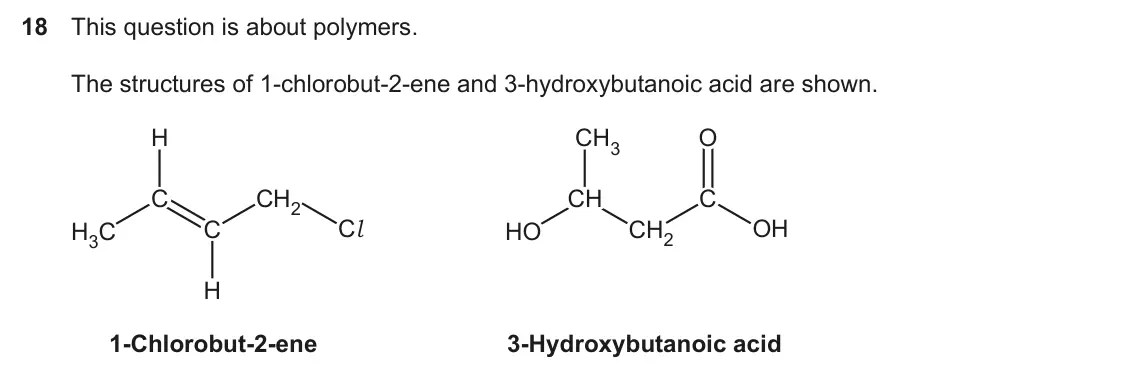
Q20(c)
The whole paper ↗
Q22(b)
The whole paper ↗
Q20(b)(i)
The whole paper ↗
Q19(c)(ii)
The whole paper ↗
Q19(c)(iii)
The whole paper ↗Q19(d)(i)
The whole paper ↗Q19(d)(ii)
The whole paper ↗Q17(c)
The whole paper ↗
Q18(b)(i)
The whole paper ↗
- Your answer
Q19(b)(i)
The whole paper ↗
Q19(b)(ii)
The whole paper ↗Q18(a)(iv)
The whole paper ↗
Q18(b)(i)
The whole paper ↗Q18(b)(ii)
The whole paper ↗
All 16 questions on Repeat units, monomers and polymer type, as a list
- June 2025, Paper 2, Q18(a) (4 marks): 1-Chlorobut-2-ene and 3-hydroxybutanoic acid can both form polymers. Draw two repeat units of each of the polymers formed. State the type of polymerisation reac
- June 2024, Paper 2, Q20(c) (2 marks): The repeat unit of a polyester is shown below. O O O O Draw the structures of monomers required to form this polyester. [2]
- June 2024, Paper 2, Q22(b) (3 marks): The amino acid below can form addition and condensation polymers. H H O C C H CH C H2N OH Draw 2 repeat units of these polymers. Display the sections linking th
- June 2023, Paper 2, Q20(b)(i) (3 marks): A student predicts that PAS could polymerise to form a polymer containing both ester and amide linkages. Draw a section of this polymer. The section should cont
- June 2022, Paper 2, Q19(c)(ii) (2 marks): Butanedicarboxylic acid and 1,4-dihydroxy-2-methylbenzene react to form a condensation polymer. Draw one repeat unit of this condensation polymer. [2]
- June 2022, Paper 2, Q19(c)(iii) (1 mark): Three repeat units of a condensation polymer are shown below. O O O O O O O O O O O O Draw the structure of the monomer required to form this polymer. [1]
- June 2022, Paper 2, Q19(d)(i) (1 mark): Draw one repeat unit of this polymer. [1]
- June 2022, Paper 2, Q19(d)(ii) (2 marks): What is the relative molecular mass, Mr, of the polymer? Mr = [2]
- November 2021, Paper 2, Q17(c) (4 marks): A polymer can be made from the monomers: • 1,4-diaminobutane • benzene-1,4-diacyl dichloride. Draw the structures of these monomers and one repeat unit of the p
- November 2020, Paper 2, Q18(b)(i) (2 marks): Draw one repeat unit of polymer E. The functional groups should be clearly displayed. [2]
- June 2019, Paper 2, Q9 (1 mark): The repeat unit of a polymer is shown below. H H H H O O C C O C C C C H H O H H Which monomers could form this polymer? O OH HO A OH HO O O OH HO OH B HO O O O
- June 2019, Paper 2, Q19(b)(i) (3 marks): Draw two repeat units of these polymers. Two repeat units of polymer formed from D Two repeat units of polymer formed from E [3]
- June 2019, Paper 2, Q19(b)(ii) (1 mark): State the type of polymer formed from compounds D and E. From compound D From compound E [1]
- June 2017, Paper 2, Q18(a)(iv) (3 marks): Compound I is the monomer for the biodegradable polymer J. Draw two repeat units of polymer J and suggest a reason why it is biodegradable. [3]
- June 2017, Paper 2, Q18(b)(i) (2 marks): Draw the structures of two monomers that can be used to form Nylon 6,6. [2]
- June 2017, Paper 2, Q18(b)(ii) (1 mark): A sample of Nylon 6,6 has a relative molecular mass of 21500. Estimate the number of repeat units in the sample. Give your answer as a whole number. number of r
Questions, mark schemes and examiner’s reports are © OCR, from their published past papers. Plumi isn’t affiliated with any exam board. Want whole papers? OCR A-Level Chemistry A past papers, or our free OCR-style practice pack.
The Plumi iPad app also offers exam-style questions with AI feedback on your handwritten working.