 plumi
Radical substitution with halogens: OCR A‑Level Chemistry A questions
OCR A-Level Chemistry A past-paper questions on 4.1.2.3 Radical substitution with halogens, 2016–2025, with mark schemes and examiner’s reports where available.
Paper
All papers
Exam
All years
Calculations
Q4(d)(i)
The whole paper ↗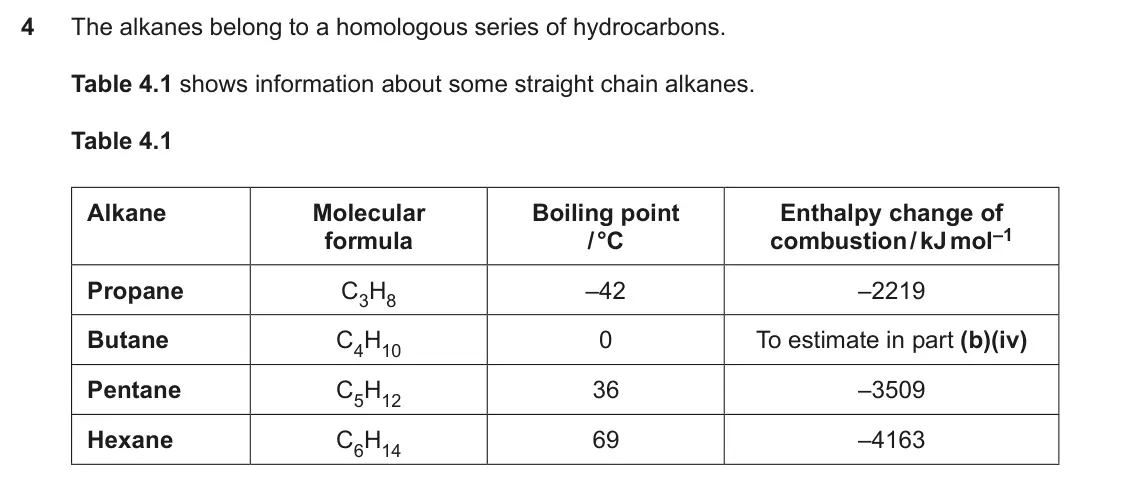
Q4(d)(iii)
The whole paper ↗Q4(d)(iv)
The whole paper ↗Q18(a)(i)
The whole paper ↗
Q18(a)(ii)
The whole paper ↗Q24(b)
The whole paper ↗
Q16(b)(i)
The whole paper ↗
Q16(b)(ii)
The whole paper ↗Q25(b)
The whole paper ↗
- Your answer
Q5(a)(i)
The whole paper ↗
Q5(a)(ii)
The whole paper ↗Q5(a)(iii)
The whole paper ↗- Your answer
Q2(c)
The whole paper ↗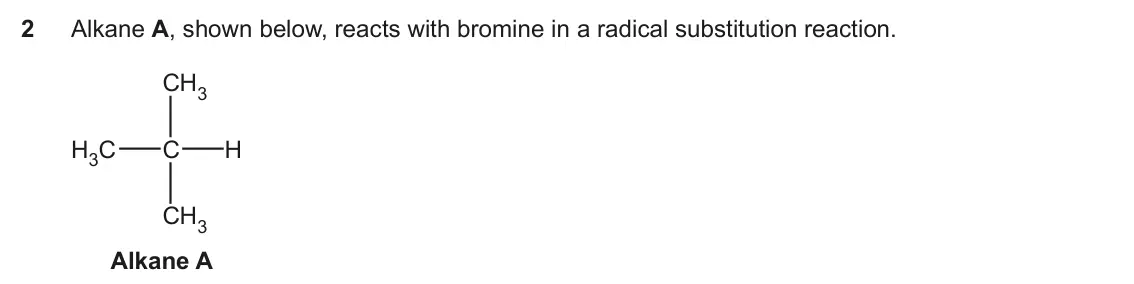
Q2(d)
The whole paper ↗Q16(c)
The whole paper ↗
Q16(d)
The whole paper ↗- Your answer
Q25(b)(i)
The whole paper ↗
All 31 questions on Radical substitution with halogens, as a list
- June 2025, AS Paper 2, Q4(d)(i) (1 mark): Write an equation, using molecular formulae, for the formation of C3H7Br from propane. [1]
- June 2025, AS Paper 2, Q4(d)(iii) (2 marks): Complete the equations for the propagation steps in the mechanism. Use molecular formulae for organic species and dots (•) for unpaired electrons on radicals. C
- June 2025, AS Paper 2, Q4(d)(iv) (1 mark): Pentane C5H12 36 –3509 Hexane C6H14 69 –4163 (iv) Explain why two structural isomers of C3H7Br are formed. [1]
- June 2024, Paper 2, Q18(a)(i) (3 marks): Write the equation for this reaction, showing the structures of the organic compounds. Name the reaction mechanism and the type of bond fission that occurs. Equ
- June 2024, Paper 2, Q18(a)(ii) (2 marks): Describe two limitations of the synthesis of 2-bromo-2-methylpropane from an alkane and bromine. 1 2 [2]
- June 2024, AS Paper 1, Q24(b) (5 marks): The hydrocarbon C2H6 reacts with bromine, Br2, to form C2H5Br under suitable conditions. Complete the table below to show the mechanism for the three stages of
- June 2023, Paper 2, Q16(b)(i) (6 marks): Complete the table below to show the mechanism for the formation of 3-bromo-2-methylpentane and three possible equations for termination. In your equations, use
- June 2023, Paper 2, Q16(b)(ii) (2 marks): Organic compound A is formed by the substitution of all 14 H atoms in 2-methylpentane by Br atoms. Write the equation, using molecular formulae, for the formati
- June 2023, AS Paper 1, Q25(b) (2 marks): Butane reacts with bromine by radical substitution to form a mixture of organic products. The reaction needs UV radiation for the initiation stage. Write equati
- June 2022, Paper 2, Q13 (1 mark): Which equation(s) could be part of the propagation step in the radical substitution of C5H12 to form C5H11Cl ? 1 C5H11• + Cl 2 C5H11Cl + Cl • 2 C5H12 + Cl • C5H
- June 2022, AS Paper 2, Q5(a)(i) (1 mark): State the conditions for the formation of bromine radicals from bromine. [1]
- June 2022, AS Paper 2, Q5(a)(ii) (2 marks): Write two equations for the propagation steps in the mechanism for Reaction 5.1. Use structural formulae for organic species and dots (•) for unpaired electrons
- June 2022, AS Paper 2, Q5(a)(iii) (2 marks): The yield of CH3CH2CHBrCH3 is only 30%. Suggest two reasons why the yield of CH3CH2CHBrCH3 is so low. 1 2 [2]
- November 2021, Paper 2, Q1 (1 mark): 2-Methylbutane is reacted with chlorine by radical substitution. What is the number of structural isomers with the molecular formula C5H11Cl that could be forme
- November 2021, AS Paper 2, Q2(c) (2 marks): In this reaction with bromine, monosubstitution of alkane A forms a mixture of organic products. Show the structures of two monosubstituted organic products tha
- November 2021, AS Paper 2, Q2(d) (2 marks): With excess bromine, further substitution takes place. Write an equation for the reaction of alkane A with excess bromine to produce 1,3-dibromo-2-methylpropane
- November 2020, Paper 2, Q16(c) (3 marks): Complete the table to show the mechanism for the reaction of hydrocarbon A with Br2 to form (CH3)3CCHBrCH3. Use skeletal formulae for all organic compounds. Use
- November 2020, Paper 2, Q16(d) (2 marks): State two limitations of using radical substitution in organic synthesis. 1 2 [2]
- June 2019, Paper 2, Q2 (1 mark): Butane reacts with chlorine in the presence of ultraviolet radiation to form a mixture of organic products. Which equation shows a propagation step in the mecha
- June 2019, AS Paper 1, Q25(b)(i) (3 marks): Complete the table below to show the mechanism for the initiation and propagation stages of the reaction of C4H10 with chlorine to form C4H9Cl . In your equatio
- June 2019, AS Paper 1, Q25(b)(ii) (1 mark): Organic compound D is formed by substitution of all the H atoms in butane by Cl atoms. Write the equation for the formation of compound D from butane. Use molec
- June 2018, AS Paper 1, Q24(b)(i) (1 mark): Name the mechanism for this reaction. [1]
- June 2018, AS Paper 1, Q24(b)(ii) (2 marks): Complete the table to show the number of structural isomers of C5H11Cl that could be formed from the reaction of chlorine with A and B. A B Number of structural
- June 2018, AS Paper 1, Q24(b)(iii) (2 marks): The reaction of compound A with excess chlorine forms a compound D, which has a molar mass of 175.5 g mol−1. Draw a possible structure for compound D and write
- June 2017, Paper 2, Q14 (1 mark): Ethane reacts with chlorine by radical substitution to form chloroethane. Which radical(s) is/are present in the mechanism? 1 H 2 Cl 3 C2H5 A 1, 2 and 3 B On
- June 2017, AS Paper 2, Q5(d)(i) (1 mark): State the conditions for the reaction. [1]
- June 2017, AS Paper 2, Q5(d)(ii) (1 mark): Write the overall equation for the reaction. [1]
- June 2017, AS Paper 2, Q5(d)(iv) (2 marks): Write two equations to show the propagation steps in the mechanism for this reaction. Use dots,•, to show the unpaired electrons on radicals. [2]
- June 2017, AS Paper 2, Q5(d)(v) (1 mark): Draw the displayed formula of the radical formed in the first propagation step. Use a dot,•, to show the position of the unpaired electron. [1]
- June 2017, AS Paper 2, Q5(d)(vi) (1 mark): Further substitution forms a mixture of organic products. Draw the structure of an organic product formed from 2-chloropropanoic acid by further substitution. [
- June 2016, AS Paper 1, Q17 (1 mark): Chlorine reacts with 1-chloropropane in the presence of ultraviolet radiation via a radical substitution mechanism. Which equation shows a propagation step in t
Questions, mark schemes and examiner’s reports are © OCR, from their published past papers. Plumi isn’t affiliated with any exam board. Want whole papers? OCR A-Level Chemistry A past papers, or our free OCR-style practice pack.
The Plumi iPad app also offers exam-style questions with AI feedback on your handwritten working.