 plumi
Qualitative analysis: OCR A‑Level Chemistry A questions
Every OCR A-Level Chemistry A exam question on 3.1.4 Qualitative analysis, 2016–2025, with its mark scheme and examiner’s report.
Find questions1,820
Calculations
Q4(a)(ii)
The whole paper ↗
Q22(c)
The whole paper ↗

Q1(c)(iii)
The whole paper ↗

Q4(c)(iii)
The whole paper ↗
Q2(b)(iii)
The whole paper ↗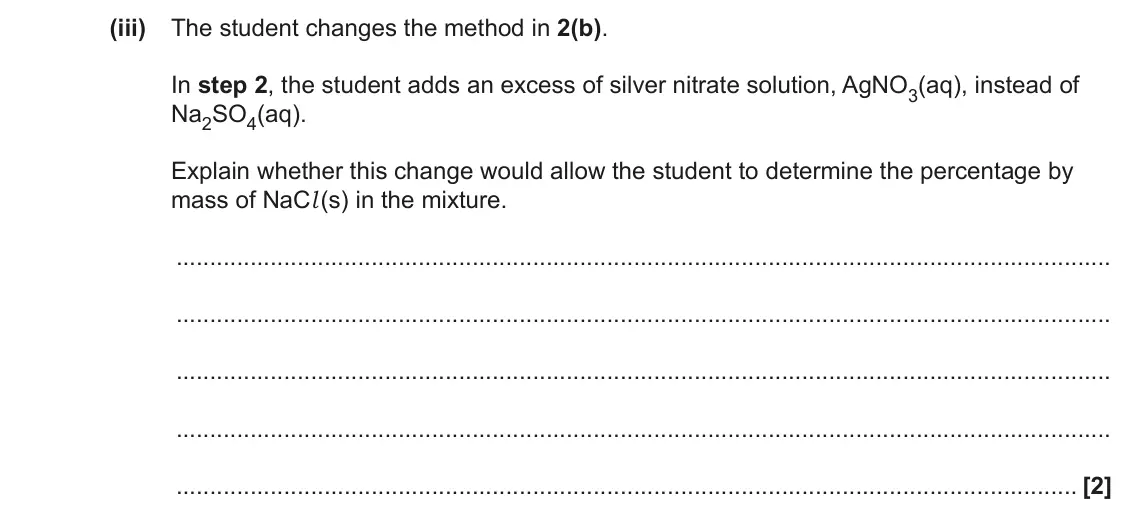
Q24(b)
The whole paper ↗
Q2(b)(ii)
The whole paper ↗
Q1(c)
The whole paper ↗
Q23(b)
The whole paper ↗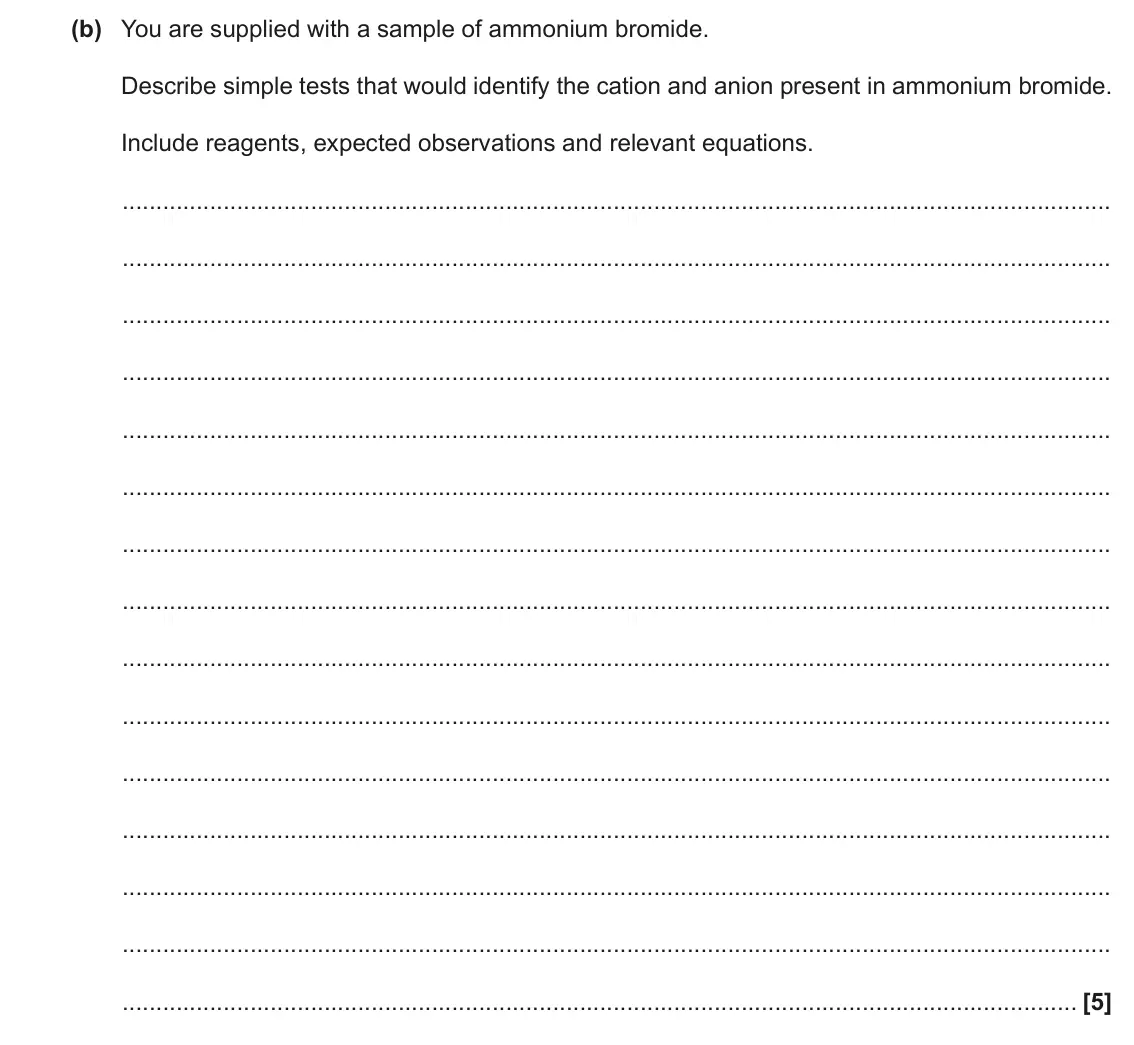

Q23(a)(ii)
The whole paper ↗
Q22(b)
The whole paper ↗
Q1(b)(ii)
The whole paper ↗

All 17 questions on Qualitative analysis, as a list
- June 2025, Paper 3, Q4(a)(ii) (7 marks): Complete the flowchart by adding formulae in the boxes. white precipitate white precipitate Ag+(aq) Ba2+(aq) acidic solution containing three ions Cl2(aq)/H2O(I
- June 2025, AS Paper 1, Q22(c) (4 marks): A group of students is provided with aqueous solutions of sodium chloride, sodium bromide and sodium iodide in three unlabelled bottles. Explain how the student
- June 2024, AS Paper 1, Q10 (1 mark): An unknown compound is tested to identify whether it contains sulfate, carbonate or halide ions. What is the correct sequence of tests required? A carbonate, ha
- June 2024, AS Paper 2, Q1(c)(iii) (2 marks): Outline how you would test for the presence of NH4 Your answer should include observations. [2]
- June 2023, Paper 1, Q11 (1 mark): A student adds aqueous potassium carbonate to one test tube and aqueous silver nitrate to a second test tube. The student adds dilute hydrochloric acid to each
- June 2023, Paper 3, Q4(c)(iii) (2 marks): How could the student carry out a test-tube test to confirm the anion in the Tutton’s salt? [2]
- June 2023, AS Paper 2, Q2(b)(iii) (2 marks): The student changes the method in 2(b). In step 2, the student adds an excess of silver nitrate solution, AgNO3(aq), instead of Na2SO4(aq). Explain whether this
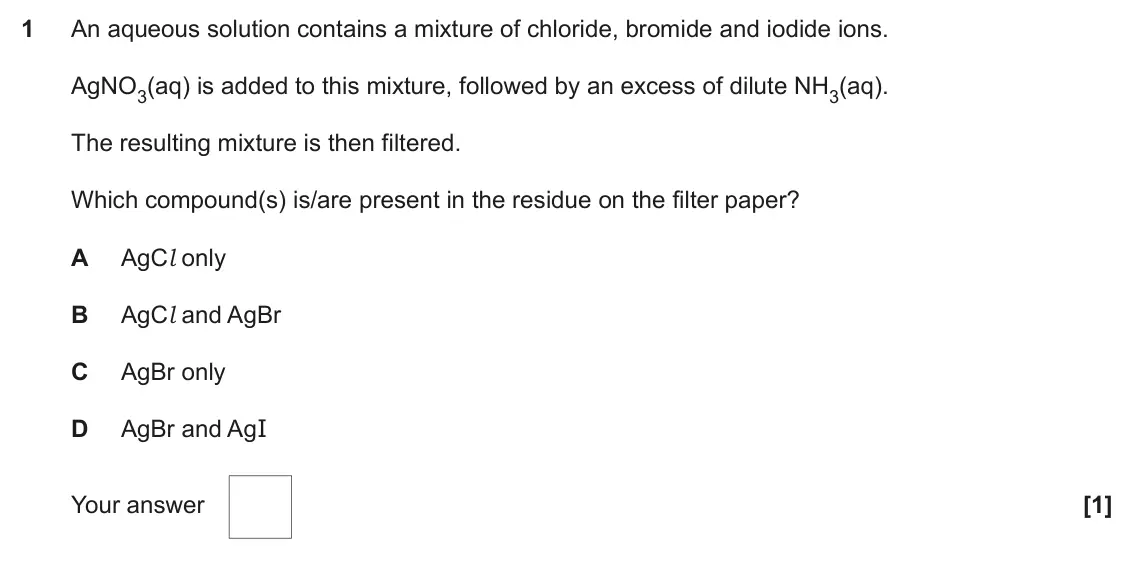
- June 2022, Paper 1, Q1 (1 mark): An aqueous solution contains a mixture of chloride, bromide and iodide ions. AgNO3(aq) is added to this mixture, followed by an excess of dilute NH3(aq). The re
- June 2022, AS Paper 1, Q24(b) (5 marks): A student is supplied with aqueous solutions of ionic compounds B and C. Compound B is a chloride, bromide or iodide of a Group 1 element. Compound C is a chlor
- June 2022, AS Paper 2, Q2(b)(ii) (2 marks): A student adds a few drops of dilute sulfuric acid to the colourless solution. Describe what the student would observe, and give the formula of the barium compo
- November 2020, AS Paper 2, Q1(c) (6 marks): This question is about nickel and its compounds. (c)* A student is provided with samples of three nickel compounds. One sample is nickel(II) bromide, another is
- June 2019, AS Paper 1, Q23(b) (5 marks): You are supplied with a sample of ammonium bromide. Describe simple tests that would identify the cation and anion present in ammonium bromide. Include reagents
- June 2018, Paper 1, Q7 (1 mark): Which statement about ammonium carbonate is not correct? A It reacts with Ba(NO3)2(aq) to form a white precipitate. B It effervesces with dilute nitric acid. C
- June 2018, AS Paper 1, Q23(a)(ii) (2 marks): At the end of the experiment, the student adds a few drops of aqueous sodium chloride to the reaction mixture in the polystyrene cup to test whether all the aqu
- June 2017, AS Paper 1, Q22(b) (5 marks): B and C are ionic compounds of two different Group 1 elements. The molar masses of B and C are both approximately 140 g mol–1. A student dissolves B and C in wa
- June 2017, AS Paper 2, Q1(b)(ii) (2 marks): Describe the use of aqueous barium chloride in qualitative analysis. [2]
- June 2016, AS Paper 1, Q11 (1 mark): A student adds aqueous sodium carbonate to one test-tube and aqueous silver nitrate to a second test-tube. The student adds dilute sulfuric acid to each test-tu
Questions, mark schemes and examiner’s reports are © OCR, from their published past papers. Plumi isn’t affiliated with any exam board. Want whole papers? Every OCR A-Level Chemistry A paper, or our free OCR-style practice pack.
Rather write your answers by hand on iPad? Plumi marks them against the same mark schemes.