 plumi
Haloalkanes: OCR A‑Level Chemistry A questions
Every OCR A-Level Chemistry A exam question on 4.2.2 Haloalkanes, 2016–2025, with its mark scheme and examiner’s report.
Find questions1,820
Calculations
Q5(a)(iii)
The whole paper ↗


Q5(d)(ii)
The whole paper ↗

Q5(a)(ii)
The whole paper ↗
Q5(a)(iii)
The whole paper ↗
Q25(d)(i)
The whole paper ↗
Q25(d)(ii)
The whole paper ↗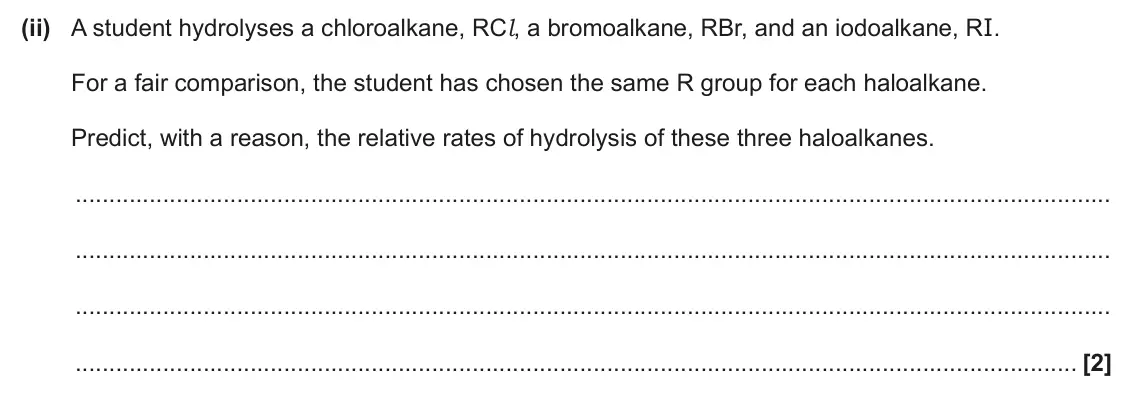
Q3(c)
The whole paper ↗
Q3(d)(i)
The whole paper ↗
Q3(d)(ii)
The whole paper ↗


Q3(b)
The whole paper ↗

Q26(a)
The whole paper ↗
Q17(a)
The whole paper ↗
Q1(f)
The whole paper ↗
All 40 questions on Haloalkanes, as a list
- June 2025, Paper 3, Q5(a)(iii) (1 mark): In the preparation, LiAl H4 behaves as a nucleophile. What is meant by the term nucleophile? [1]
- June 2025, AS Paper 1, Q16 (1 mark): Which equation is a propagation step in the catalytic breakdown of ozone? A C2F2Cl 2 C2F2Cl • + Cl • B O3 + O 2O2 C Cl • + Cl • Cl 2 D Cl O• + O Cl • + O2 Your
- June 2025, AS Paper 1, Q18 (1 mark): The hydrolysis of 1-iodopropane by aqueous potassium hydroxide takes place at a faster rate than 1-bromopropane. Which statement explains the different rates of
- June 2025, AS Paper 2, Q5(d)(ii) (1 mark): State the name of the mechanism of the reaction in Stage 2. [1]
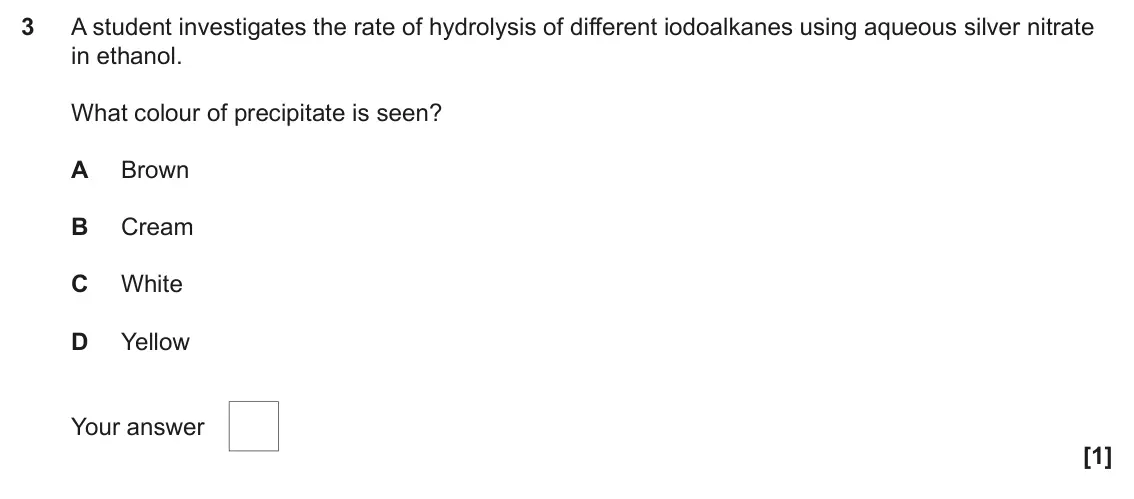
- June 2024, Paper 2, Q3 (1 mark): A student investigates the rate of hydrolysis of different iodoalkanes using aqueous silver nitrate in ethanol. What colour of precipitate is seen? A Brown B Cr
- June 2024, Paper 2, Q8 (1 mark): The CFC CCl 2F2 can cause the breakdown of ozone in the upper atmosphere. Which initiation step could occur with ultraviolet radiation to catalyse this breakdow
- June 2024, Paper 3, Q5(a)(ii) (1 mark): Write an equation for the alkaline hydrolysis of 1-bromopropane. Show structures of organic compounds. [1]
- June 2024, Paper 3, Q5(a)(iii) (3 marks): A student investigates the alkaline hydrolysis of 1-chloropropane using the same method as for 1-bromopropane. Predict, with reasons, how the appearance of the
- June 2024, AS Paper 1, Q25(d)(i) (2 marks): Write an equation for the hydrolysis of 2‑bromo‑2‑methylpropane. Show organic compounds as structures. [2]
- June 2024, AS Paper 1, Q25(d)(ii) (2 marks): A student hydrolyses a chloroalkane, RCl, a bromoalkane, RBr, and an iodoalkane, RI. For a fair comparison, the student has chosen the same R group for each hal
- June 2023, AS Paper 2, Q3(c) (3 marks): A student is studying the hydrolysis of haloalkanes. The equation for the alkaline hydrolysis of 2-bromopropane, CH3CHBrCH3, is shown below. CH3CHBrCH3 + OH– CH
- June 2023, AS Paper 2, Q3(d)(i) (2 marks): Complete the table below to show the formula and colour of each precipitate formed. Haloalkane Formula of precipitate Colour of precipitate 2-bromopropane 2-iod
- June 2023, AS Paper 2, Q3(d)(ii) (1 mark): Predict which precipitate would form first and explain the difference in the rates of hydrolysis of 2-bromopropane and 2-iodopropane. [1]
- June 2022, Paper 2, Q1 (1 mark): Which statement is correct for the different rates of hydrolysis of RCl and RBr? A RBr is hydrolysed faster because Cl is more electronegative than Br. B RBr is
- June 2022, Paper 2, Q14 (1 mark): Which species could react as a nucleophile? 1 NH3 OH– 2 3 CH3NH2 A 1, 2 and 3 B Only 1 and 2 C Only 2 and 3 D Only 1 Your answer [1]
- June 2022, Paper 3, Q3(b) (4 marks): Butan-1-ol reacts with sodium bromide and sulfuric acid to form 1-bromobutane by nucleophilic substitution. The mechanism for this reaction takes place by two s
- June 2022, AS Paper 1, Q18 (1 mark): When heated with NaOH(aq), 1-chlorobutane is hydrolysed at a slower rate than 1-bromobutane. Which statement explains the different rates? A The C–Br bond entha
- June 2022, AS Paper 1, Q26(a) (3 marks): 1-Chloropropane, C2H5CH2Cl , can be hydrolysed with aqueous sodium hydroxide, NaOH. Outline the mechanism for this reaction. The structure of 1-chloropropane ha
- November 2021, Paper 2, Q17(a) (3 marks): Freon-13, is a CFC with the molecular formula CCl F3. In the upper atmosphere, the presence of Freon-13 can lead to ozone depletion. Explain, with the aid of eq
- November 2021, Paper 3, Q1(f) (3 marks): The ester, methyl ethanoate, can be synthesised by reacting a haloalkane with a carboxylate ion. The mechanism is nucleophilic substitution. Outline the mechani
- November 2021, AS Paper 1, Q24(c)(i) (2 marks): Choose a reagent for this reaction and complete the equation for this reaction. Your equation should show the structure of alcohol C. CH3 H H3C C C H + + Reagen
- November 2020, Paper 2, Q14 (1 mark): Which of the following reactions produce propan-1-ol? 1 The alkaline hydrolysis of 1-chloropropane. 2 The acid hydrolysis of propyl methanoate. 3 The acid hydro
- November 2020, AS Paper 2, Q5(d)(ii) (3 marks): Outline the mechanism for the alkaline hydrolysis of (CH3)2CHCH2CH2Br. The structure of (CH3)2CHCH2CH2Br has been provided. Show curly arrows, relevant lone pai
- November 2020, AS Paper 2, Q5(d)(iii) (1 mark): Name this type of mechanism. [1]
- November 2020, AS Paper 2, Q5(e) (2 marks): The student decides to prepare alcohol A using the same method as in (d) but using the chloroalkane (CH3)2CHCH2CH2Cl instead of the bromoalkane, (CH3)2CHCH2CH2B
- June 2019, Paper 2, Q6 (1 mark): What is the organic product of the reaction below? CH2Cl KOH(aq) Cl CH2OH A Cl CH2Cl B OH CH2OH C OH HO CH2Cl D Cl Your answer [1]
- June 2019, Paper 2, Q18(a)(ii) (5 marks): In the boxes, draw the organic products for the reactions of the functional groups in ester A shown below. Each reaction forms two organic products. + H+(aq) O
- June 2019, Paper 2, Q20(b)(ii) (1 mark): What is the role of OH− in this mechanism? [1]
- June 2019, AS Paper 2, Q3(a)(i) (3 marks): Outline the mechanism for this reaction. Include curly arrows, relevant dipoles and the final product(s). H CH3CH2CH2CH2 C I H [3]
- June 2019, AS Paper 2, Q3(a)(ii) (1 mark): 1-Iodopentane can also be hydrolysed by water using aqueous silver nitrate, with ethanol as the solvent. A student uses this method to compare the rates of hydr
- June 2019, AS Paper 2, Q3(a)(iii) (2 marks): 1-Iodopentane was found to react faster than 1-bromopentane. Explain why. [2]
- June 2018, Paper 2, Q8 (1 mark): The breakdown of ozone is catalysed by NO radicals. Which equation is a propagation step in the mechanism for this process? A NO + O2 → N + O3 B NO + O2 → NO2 +
- June 2018, Paper 2, Q19(a) (2 marks): The rate of hydrolysis of a haloalkane depends on the halogen present. State and explain how the halogen in the haloalkane affects the rate of hydrolysis. [2]
- June 2018, Paper 2, Q19(b) (3 marks): Chlorocyclohexane is hydrolysed with aqueous sodium hydroxide. Outline the mechanism for this reaction. Show curly arrows, relevant dipoles and the products. Cl
- June 2018, Paper 2, Q19(c)(ii) (3 marks): Analyse the information to identify E, F and G. Show your working. [3]
- June 2018, AS Paper 1, Q25(b)(i) (3 marks): Outline the mechanism for this reaction. Show curly arrows and relevant dipoles. [3]
- June 2017, Paper 2, Q1 (1 mark): A chemist compares the rates of hydrolysis of 1-chloropropane and 1-bromopropane in ethanol. Which reagent in aqueous solution should be used? A Silver chloride
- June 2016, AS Paper 1, Q19 (1 mark): A reaction sequence is shown below: → Step 1 CH3CH=CHCH3 + HBr CH3CH2CHBrCH3 → Step 2 CH3CH2CHBrCH3 + NaOH CH3CH2CH(OH)CH3 + NaBr Which type of reaction mechani
- June 2016, AS Paper 1, Q20 (1 mark): When heated with NaOH(aq), 1-iodobutane is hydrolysed at a much faster rate than 1-chlorobutane. Which statement explains the different rates? The C–I bond enth
- June 2016, AS Paper 2, Q4(c) (2 marks): NO radicals catalyse the breakdown of ozone in the stratosphere. Write two equations to show how NO radicals catalyse this breakdown. [2]
Questions, mark schemes and examiner’s reports are © OCR, from their published past papers. Plumi isn’t affiliated with any exam board. Want whole papers? Every OCR A-Level Chemistry A paper, or our free OCR-style practice pack.
Rather write your answers by hand on iPad? Plumi marks them against the same mark schemes.