 plumi
Bonding and structure: OCR A‑Level Chemistry A questions
Every OCR A-Level Chemistry A exam question on 2.2.2 Bonding and structure, 2016–2025, with its mark scheme and examiner’s report.
Find questions1,820
Calculations
Q16(d)
The whole paper ↗
Q5(b)
The whole paper ↗


Q5(a)(i)
The whole paper ↗
Q5(a)(ii)
The whole paper ↗
Q5(b)
The whole paper ↗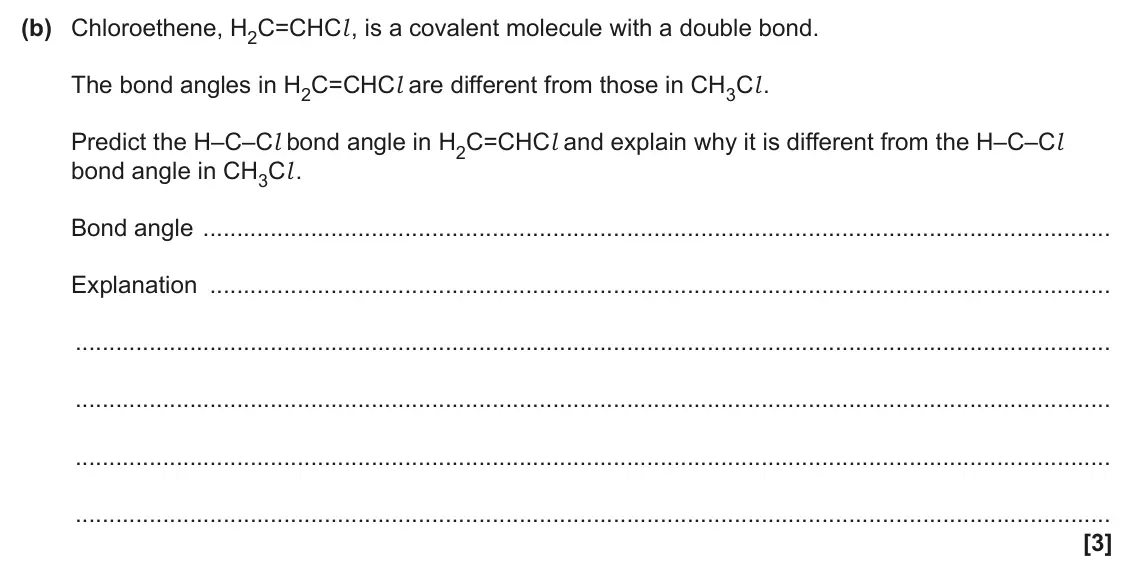

Q18(b)(i)
The whole paper ↗
Q18(b)(ii)
The whole paper ↗

Q4(a)(ii)
The whole paper ↗
Q4(c)(iv)
The whole paper ↗

Q23(c)
The whole paper ↗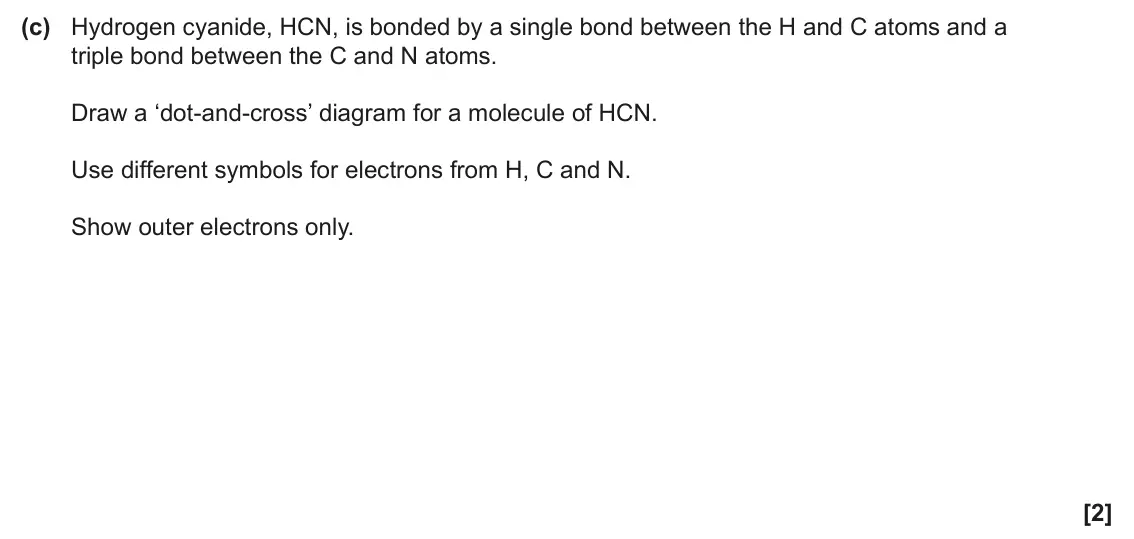
Q24(c)
The whole paper ↗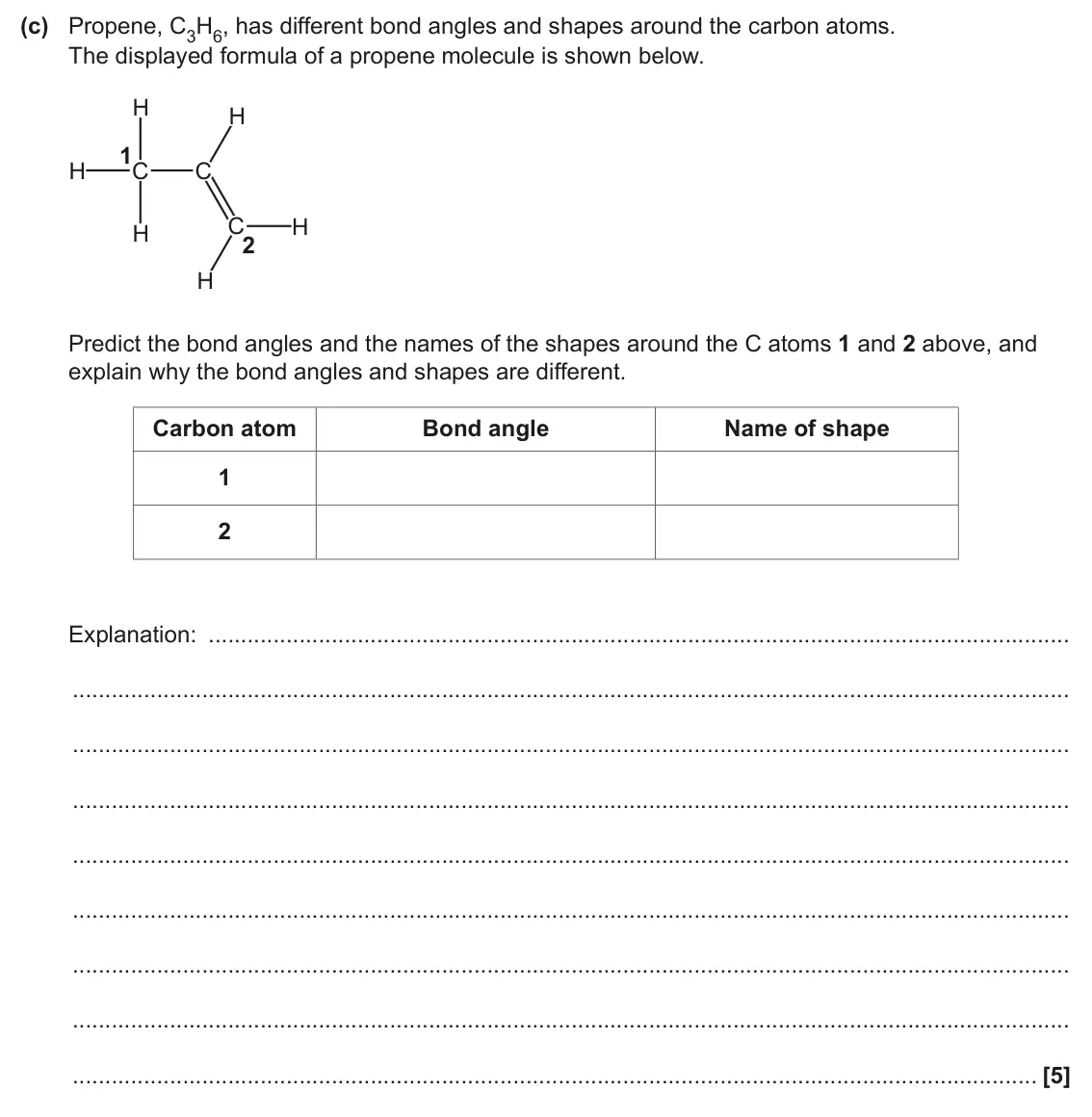
Q1(a)
The whole paper ↗
Q1(b)(i)
The whole paper ↗
Q1(b)(ii)
The whole paper ↗
All 102 questions on Bonding and structure, as a list
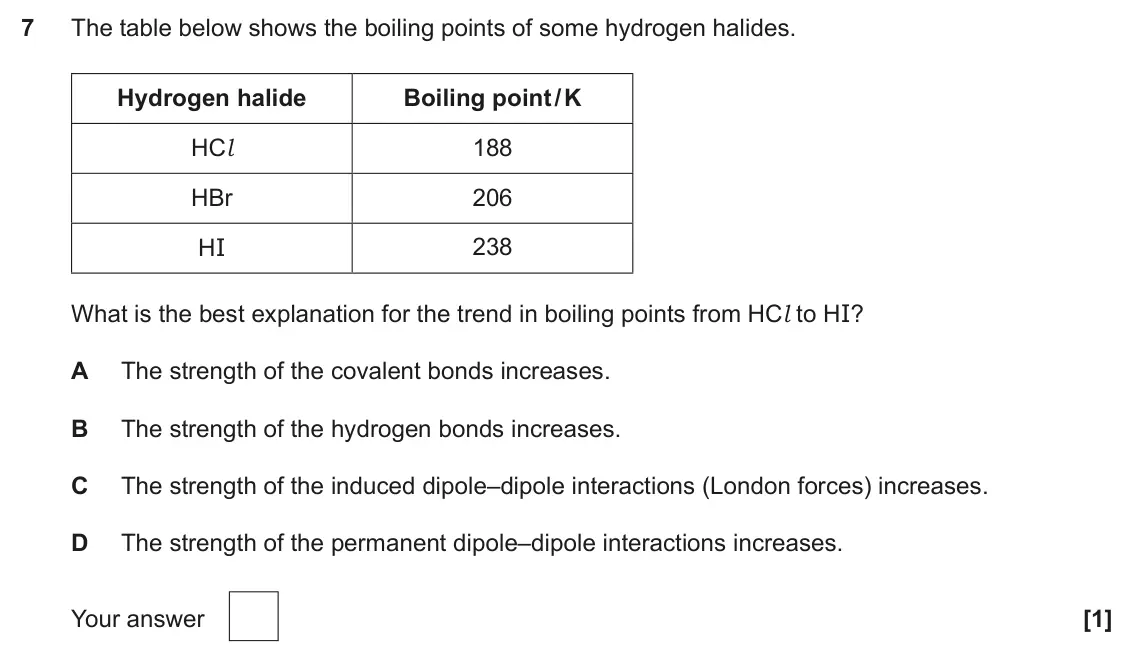
- June 2025, Paper 1, Q7 (1 mark): The table below shows the boiling points of some hydrogen halides. Hydrogen halide Boiling point / K HCl 188 HBr 206 238 HI What is the best explanation for the
- June 2025, Paper 1, Q16(d) (6 marks): This question is about trends in the periodic table. (d)* The hydrides of silicon, phosphorus and sulfur have simple molecular structures, but their molecules h
- June 2025, Paper 3, Q5(b) (2 marks): NaBH4 contains Na+ and BH4 – ions. Draw a ‘dot‑and‑cross’ diagram for NaBH4. Use a different symbol for the electrons from each element. Show outer electrons on
- June 2025, AS Paper 1, Q8 (1 mark): Which compound has molecules with a trigonal planar shape? A BeCl 2 B BCl 3 C NCl 3 D PCl 3 Your answer [1]
- June 2025, AS Paper 1, Q10 (1 mark): Which molecule is polar? A H2S B CO2 C CCl4 D C2F4 Your answer [1]
- June 2025, AS Paper 2, Q5(a)(i) (1 mark): Draw a ‘dot-and-cross’ diagram for CH3Cl . Show outer electrons only. Use a different symbol for the electrons of each element. [1]
- June 2025, AS Paper 2, Q5(a)(ii) (2 marks): Name the shape of the chloromethane molecule and predict the value of the H–C–Cl bond angle. Name of shape Bond angle [2]
- June 2025, AS Paper 2, Q5(b) (3 marks): Chloroethene, H2C=CHCl , is a covalent molecule with a double bond. The bond angles in H2C=CHCl are different from those in CH3Cl . Predict the H–C–Cl bond angl
- June 2024, Paper 1, Q2 (1 mark): Water has the anomalous properties below. • Water has relatively high melting and boiling points. • Ice is less dense than water. Which statement explains these
- June 2024, Paper 1, Q18(b)(i) (1 mark): Explain why the bond angles in SO3 are 120°. [1]
- June 2024, Paper 1, Q18(b)(ii) (2 marks): Explain why both SO2 and SO3 have polar bonds, but only SO2 has polar molecules. [2]
- June 2024, Paper 2, Q1 (1 mark): All organic compounds have covalent bonds. What is the electrostatic attraction in a covalent bond between? A A shared pair of electrons and the nuclei of the b
- June 2024, Paper 3, Q4(a)(ii) (3 marks): In a H3PO3 molecule, the O atoms are covalently bonded to the P atom. The H atoms are bonded to the O atoms. Draw the structure of a H3PO3 molecule, showing all
- June 2024, Paper 3, Q4(c)(iv) (2 marks): In a molecule of P3N3Cl 6 all the N and Cl atoms are bonded to P atoms. Suggest a possible structure for a molecule of P3N3Cl 6. [2]
- June 2024, AS Paper 1, Q5 (1 mark): Which reaction produces a product with linear molecules? A 2B + 3F2 B C + O2 C 2H2 + O2 D N2 + 3H2 Your answer [1]
- June 2024, AS Paper 1, Q23(c) (2 marks): Hydrogen cyanide, HCN, is bonded by a single bond between the H and C atoms and a triple bond between the C and N atoms. Draw a ‘dot‑and‑cross’ diagram for a mo
- June 2024, AS Paper 1, Q24(c) (5 marks): Propene, C3H6, has different bond angles and shapes around the carbon atoms. The displayed formula of a propene molecule is shown below. H H 1 H C C C H H 2 H P
- June 2024, AS Paper 2, Q1(a) (2 marks): Hydrogen and oxygen have different electronegativities. What is meant by the term electronegativity? [2]
- June 2024, AS Paper 2, Q1(b)(i) (2 marks): Complete the diagram below to show hydrogen bonding between the H2O molecule shown and another H2O molecule. Include relevant dipoles and lone pairs. Label the
- June 2024, AS Paper 2, Q1(b)(ii) (1 mark): Explain why molecules of H2O are polar. [1]
- June 2024, AS Paper 2, Q1(b)(iii) (1 mark): One unusual property of H2O is that ice floats on water. Explain why ice has a lower density than water. [1]
- June 2024, AS Paper 2, Q1(c)(i) (2 marks): Suggest why solid ammonia has a lower melting point than ice. [2]
- June 2024, AS Paper 2, Q1(c)(ii) (2 marks): When ammonia dissolves in water, ammonium ions, NH4 + ion. Draw a ‘dot-and-cross’ diagram to show the bonding in an NH4 Show outer electrons only. [2]
- June 2023, Paper 1, Q5 (1 mark): Which compound has polar molecules? A HCN B BCl3 C CO2 D C2F4 Your answer [1]
- June 2023, Paper 1, Q13 (1 mark): Which substance(s) has/have induced dipole–dipole interactions (London forces) in the solid state? 1 C2H6 2 H2O 3 Si A 1, 2 and 3 B Only 1 and 2 C Only 2 and 3
- June 2023, Paper 2, Q15 (1 mark): Which ion(s) contain(s) bond angles of approximately 120º? CH3COO– 1 C6H5O– 2 (CH3)3C+ 3 A 1, 2 and 3 B Only 1 and 2 C Only 2 and 3 D Only 1 Your answer [1]
- June 2023, Paper 3, Q1(a) (1 mark): The three elements that, when in a molecule, can form hydrogen bonds with other suitable molecules. [1]
- June 2023, Paper 3, Q1(f) (1 mark): The p-block element in Period 3 that forms a compound with fluorine with octahedral molecules. [1]
- June 2023, Paper 3, Q6(a) (4 marks): Nitric acid has 2 single covalent bonds, 1 double covalent bond and 1 dative covalent bond as shown below. H O N O O Nitric acid Predict the H–O–N and O–N–O bon
- June 2023, Paper 3, Q6(b)(ii) (2 marks): The solution contains nitrate ions, NO3 – ion. Draw a ‘dot-and-cross’ diagram for the NO3 Use a different symbol for the extra electron. [2]
- June 2023, AS Paper 1, Q21(a)(i) (1 mark): What is meant by a covalent bond? [1]
- June 2023, AS Paper 1, Q21(a)(ii) (2 marks): Draw ‘dot-and-cross’ diagrams for NF3 and BF3. Show outer electrons only. NF3 BF3 [2]
- June 2023, AS Paper 1, Q21(b)(i) (2 marks): Predict the different shapes of, and bond angles in, NF3 and BF3 molecules. Bond angle Name of shape NF3 BF3 [2]
- June 2023, AS Paper 1, Q21(b)(ii) (2 marks): Explain why NF3 and BF3 molecules have different shapes and bond angles. [2]
- June 2023, AS Paper 2, Q1(b)(iii) (2 marks): Reaction 1.2 produces a mixture of titanium and sodium chloride. Suggest how titanium could be separated from this mixture at room temperature. Explain your ans
- June 2023, AS Paper 2, Q2(c)(i) (4 marks): Complete the table above to show the type of lattice structure of each substance. [4]
- June 2023, AS Paper 2, Q2(c)(ii) (4 marks): Explain the following: • MgS has a higher melting point than PCl 3. • Al has a greater electrical conductivity than Si. Melting points Conductivities [4]
- June 2022, Paper 1, Q14 (1 mark): The three reactions below each form one product only. Which reaction(s) form(s) a product with non-polar molecules? 1 2CO + O2 2 Si + 2Cl 2 3 S + 3F2 A 1, 2 and
- June 2022, Paper 3, Q1(a)(i) (2 marks): The boiling point of NH3 is –33 °C. The boiling point of NH4NO3 is 210 °C. Explain why there is a large difference in boiling points. [2]
- June 2022, Paper 3, Q1(d)(i) (3 marks): Glycine reacts with NaOH to form the salt H2NCH2COONa. Glycine reacts with HCl to form the salt HOOCCH2NH3Cl. The salts have different H–N–H bond angles. State
- June 2022, AS Paper 1, Q2 (1 mark): What is the meaning of the term electronegativity? A The ability of an atom to attract the electrons in a covalent bond. B The ability of an atom to gain an ele
- June 2022, AS Paper 1, Q23(a)(i) (1 mark): What is meant by ionic bonding? [1]
- June 2022, AS Paper 1, Q23(a)(ii) (2 marks): Magnesium reacts with sulfur to form a compound which has a giant ionic lattice structure. The diagram shows ions as circles in part of the lattice. Complete th
- June 2022, AS Paper 2, Q4(c) (4 marks): CO2 and H2O molecules have different shapes. State the bond angles in CO2 and H2O molecules and explain, in terms of electron pair repulsion, why the bond angle
- November 2021, Paper 1, Q1 (1 mark): Which statement describes electronegativity? A A measure of the reactivity of an element. B The ability of an atom to attract an electron to become a 1– ion. C
- November 2021, Paper 1, Q14 (1 mark): Which statement(s) about a molecule of Cl–N=O is/are correct? 1: It is a polar molecule. 2: It contains 6 lone pairs of electrons. 3: It has a bond angle of 180
- November 2021, Paper 2, Q8 (1 mark): Which compound contains a bond angle of approximately 120º? A CH3CH2CN B CH3CH(OH)CH3 C CH3COOCH2CH2CH3 D CH3CH2CH2NH2 Your answer [1]
- November 2021, Paper 2, Q17(b)(ii) (2 marks): The boiling point of the lubricating oil can be increased by increasing the number of repeat units. Explain this statement. [2]
- November 2021, Paper 3, Q1(c) (3 marks): The electronegativities of H, C, N and F, and the boiling points of methane, ammonia and hydrogen fluoride are shown below. Electronegativity H: 2.1 C: 2.5 N: 3
- November 2021, AS Paper 1, Q1 (1 mark): Which compound has the highest boiling point? A ethanol B heptane C sodium chloride D water Your answer [1]
- November 2021, AS Paper 1, Q2 (1 mark): Pauling electronegativity values for the halogens F to I and some elements in period 2 of the periodic table are shown below. B C N O F 2.04 2.55 3.04 3.44 3.98
- November 2021, AS Paper 1, Q16 (1 mark): Which compound contains the smallest bond angle? A bromoethane B ethanol C ethane D ethene Your answer [1]
- November 2021, AS Paper 2, Q1(a)(i) (1 mark): Explain what is meant by ionic bonding. [1]
- November 2021, AS Paper 2, Q1(a)(ii) (2 marks): Draw a ‘dot-and-cross’ diagram to show the bonding in K2S. Show outer electrons only. [2]
- November 2021, AS Paper 2, Q1(b) (2 marks): Sulfur difluoride, SF2, shows covalent bonding. Draw a ‘dot-and-cross’ diagram to show the bonding in SF2. Show outer electrons only. [2]
- November 2021, AS Paper 2, Q1(c) (3 marks): At room temperature, K2S is a solid, but SF2 is a gas. Use ideas about structure and bonding to explain this difference. [3]
- November 2021, AS Paper 2, Q1(d)(i) (2 marks): State the shape of, and F—S—F bond angle in, an SF6 molecule. Shape Bond angle [2]
- November 2021, AS Paper 2, Q1(d)(ii) (1 mark): Suggest why SF6 is unreactive. [1]
- November 2020, Paper 1, Q16(b)(i) (2 marks): Draw a ‘dot-and-cross’ diagram for MgBr2. Show outer electron shells only. [2]
- November 2020, Paper 1, Q16(c) (6 marks): This question is about magnesium, bromine and magnesium bromide. (c)* Table 16.1 shows some physical properties of magnesium, bromine and magnesium bromide. Ele
- November 2020, Paper 3, Q1(b)(i) (4 marks): The table shows the structures and boiling points of three amines, which are structural isomers of C3H9N. Amine CH3CH2CH2NH2 (CH3)2CHNH2 (CH3)3N NH2 Skeletal fo
- November 2020, Paper 3, Q6(a) (2 marks): Complete Table 6.1 to predict bond angles a and b and name the shapes which makes these bond angles in the functional groups of carboxylic acids and sulfonic ac
- November 2020, AS Paper 1, Q1 (1 mark): Which substance contains polar molecules? A C2H4 B CO2 C NCl 3 D SF6 Your answer [1]
- November 2020, AS Paper 1, Q3 (1 mark): Which statement explains why ice is less dense than water? A Hydrogen bonds are stronger in ice than in water. B Hydrogen bonds hold H2O molecules apart in ice.
- November 2020, AS Paper 1, Q22(b) (2 marks): A compound of bromine is a solid at room temperature. The electrical conductivity of the compound at different physical states is shown in the table. Physical s
- November 2020, AS Paper 2, Q3(a) (5 marks): The table shows the melting point and electrical conductivity of two elements in Period 4. Element Melting Point / °C Electrical conductivity Calcium 842 Good B
- November 2020, AS Paper 2, Q3(b)(i) (2 marks): Draw a ‘dot-and-cross’ diagram to show the bonding in CaBr2. Show outer electrons only. [2]
- November 2020, AS Paper 2, Q3(c)(ii) (3 marks): The boiling points of H2O and H2Se are shown below. Compound Boiling point /°C H2O 100 H2Se –41 Explain why H2O has a higher boiling point than H2Se. [3]
- November 2020, AS Paper 2, Q4(a) (3 marks): The ‘dot-and-cross’ diagram for nitrosyl chloride is shown below. N O Cl Predict the O=N–Cl bond angle and explain why NOCl has this bond angle. Bond angle Expl
- June 2019, Paper 3, Q1(a) (2 marks): Explain why a CF4 molecule has polar bonds but does not have an overall dipole. [2]
- June 2019, Paper 3, Q3(b) (4 marks): SiO2 and CO2 are oxides of other Group 14 (Group 4) elements. Solid SiO2 melts at 2156 °C. Solid CO2 melts at −56 °C. Suggest the type of lattice structure in s
- June 2019, Paper 3, Q5(c)(i) (1 mark): Predict the O–S–S bond angle and name of the shape of the thiosulfate ion. Bond angle Name of shape [1]
- June 2019, Paper 3, Q5(c)(ii) (1 mark): In some of its reactions, the thiosulfate ion forms the tetrathionate ion, S4O6 2− ion is a ‘dimer’ of S2O3 2−. The S4O6 2− ion. Draw a displayed formula for th
- June 2019, AS Paper 1, Q2 (1 mark): Which molecule contains the largest bond angle? A C2H4 B H2O C NH3 D CH4 Your answer [1]
- June 2019, AS Paper 1, Q21(d)(i) (2 marks): Construct a ‘dot-and-cross’ diagram for Ca3N2. Show outer electrons only and the charges on each ion. [2]
- June 2019, AS Paper 1, Q21(d)(iii) (2 marks): Calcium reacts with oxygen to form a compound which has a giant ionic lattice structure. The diagram shows ions as circles in part of the lattice. Complete the
- June 2019, AS Paper 1, Q21(d)(iv) (2 marks): Nitrogen forms an oxide with the formula N2O. A molecule of N2O is linear and has a nitrogen atom in the centre. Draw a ‘dot-and-cross’ diagram for an N2O molec
- June 2018, Paper 1, Q19(c) (2 marks): Sodium carbonate, Na2CO3, is a base used in washing soda. 2–, shown below. Na2CO3 contains the carbonate ion, CO3 O– C O– O Draw the ‘dot-and-cross’ diagram for
- June 2018, Paper 2, Q5 (1 mark): Which molecule is not planar? A C2H4 B C2H6 C H2CO D HCN Your answer [1]
- June 2018, Paper 3, Q1(a)(iv) (1 mark): The element which forms a compound with fluorine that has octahedral molecules. [1]
- June 2018, Paper 3, Q1(b) (5 marks): Table 1.1 shows some properties of Period 3 chlorides. Group 1 2 14 (4) 15 (5) 16 (6) Chloride NaCl MgCl2 SiCl4 PCl3 SCl2 Solid poor poor poor poor poor Electri
- June 2018, AS Paper 1, Q21(b)(i) (1 mark): Draw a ‘dot-and-cross’ diagram of a phosgene molecule. Show outer electrons only. [1]
- June 2018, AS Paper 1, Q21(b)(ii) (3 marks): Name the shape of a phosgene molecule and explain why it has this shape. Name of shape Explanation [3]
- June 2018, AS Paper 2, Q2(a) (2 marks): Draw a ‘dot-and-cross’ diagram to show the bonding in sodium sulfide. Show outer electrons only. [2]
- June 2018, AS Paper 2, Q2(b) (3 marks): The table below compares the properties of sodium sulfide, sodium and sulfur. Complete the table. Sodium sulfide Sodium Sulfur Melting point / °C 1180 98 113 Ty
- June 2017, Paper 1, Q16(a) (1 mark): Lithium aluminium hydride, LiAl H4, contains the Al H4 – ion. Draw a ‘dot-and-cross’ diagram to show the bonding in an Al H4 Show outer electrons only. [1]
- June 2017, Paper 1, Q16(b) (2 marks): Nitrogen forms NH4 + and NH2 –. Predict the name of the shape of, and H–N–H bond angle in, NH4 Ion Name of shape H–N–H bond angle + NH4 – NH2 [2]
- June 2017, Paper 1, Q16(c)(i) (2 marks): Explain why the boiling point of PH3 is lower than the boiling point of NH3. [2]
- June 2017, Paper 1, Q16(c)(ii) (2 marks): Explain why the boiling point of PH3 is lower than the boiling point of AsH3. [2]
- June 2017, Paper 2, Q6 (1 mark): Four atoms, 1–4, are labelled in the structure below. 4 NH2 CH OH 1 3 2 H3C C O Which atom has a trigonal planar arrangement of bonds around it? A Atom 1 B Atom
- June 2017, Paper 3, Q1(a) (3 marks): The H–O–H bond angle in ice is about 109° but about 105° in gaseous H2O. Explain why there is this difference. [3]
- June 2017, AS Paper 1, Q7 (1 mark): Which compound has polar molecules? A OCl2 B BCl3 C CCl4 D SCl6 Your answer [1]
- June 2017, AS Paper 2, Q1(a)(i) (1 mark): State what is meant by the term ionic bond. [1]
- June 2017, AS Paper 2, Q1(a)(ii) (2 marks): Draw a ‘dot-and-cross’ diagram to show the bonding in barium oxide. Show outer electrons only. [2]
- June 2017, AS Paper 2, Q1(b)(i) (2 marks): Compare the electrical conductivities of solid and aqueous barium chloride. Explain your answer in terms of the particles involved. [2]
- June 2017, AS Paper 2, Q4(a) (2 marks): Methanol, CH3OH, is soluble in water because it has polar bonds. Pauling electronegativity values for carbon, oxygen and hydrogen are shown below. Element Elect
- June 2017, AS Paper 2, Q5(b)(i) (2 marks): State the shape and bond angle around a carbon atom in the alkyl group of propanoic acid. Explain the shape. Shape Bond angle Explanation [2]
- June 2017, AS Paper 2, Q5(b)(ii) (1 mark): Suggest a value for the C–O–H bond angle in propanoic acid. [1]
- June 2016, AS Paper 1, Q7 (1 mark): A ‘dot-and-cross’ diagram for nitrogen trichloride, NCl3, is shown below. 7 X X X Cl Cl N X X Cl Which row shows the correct shape and bond angle in a molecule
- June 2016, AS Paper 1, Q15 (1 mark): Which compound has non-polar molecules? A E-1,2-dichlorobut-2-ene B E-2,3-dichlorobut-2-ene C Z-2,3-dichlorobut-2-ene D Z-1,4-dichlorobut-2-ene Your answer [1]
- June 2016, AS Paper 1, Q21(c)(ii) (2 marks): Ni(NO3)2 contains the NO3 single covalent bond, a double covalent bond and a dative covalent bond, as shown below. O– N O O – ion, showing outer shell electrons
- June 2016, AS Paper 2, Q6(b) (4 marks): The shape around the oxygen atom in butan-2-ol is non-linear. Predict the C–O–H bond angle and explain this shape. bond angle explanation [4]
Questions, mark schemes and examiner’s reports are © OCR, from their published past papers. Plumi isn’t affiliated with any exam board. Want whole papers? Every OCR A-Level Chemistry A paper, or our free OCR-style practice pack.
Rather write your answers by hand on iPad? Plumi marks them against the same mark schemes.