 plumi
Water and its importance in plants and animals: OCR A‑Level Biology B questions
Every OCR A-Level Biology B exam question on 2.1.2 Water and its importance in plants and animals, 2016–2025, with its mark scheme and examiner’s report.
Find questions1,889
Calculations
Q1(c)
The whole paper ↗


Q31(b)(iii)
The whole paper ↗
Q3(a)
The whole paper ↗
Q3(b)(i)
The whole paper ↗
Q3(b)(ii)
The whole paper ↗
Q3(c)(i)
The whole paper ↗
Q3(c)(ii)
The whole paper ↗
Q3(c)(iii)
The whole paper ↗
Q3(c)(iv)
The whole paper ↗


All 117 questions on Water and its importance in plants and animals, as a list
- June 2025, Paper 3, Q1(c) (4 marks): The roots of plants can store starch in high concentrations. Outline how the starch concentration of a sample of root tissue could be estimated using colorimetr
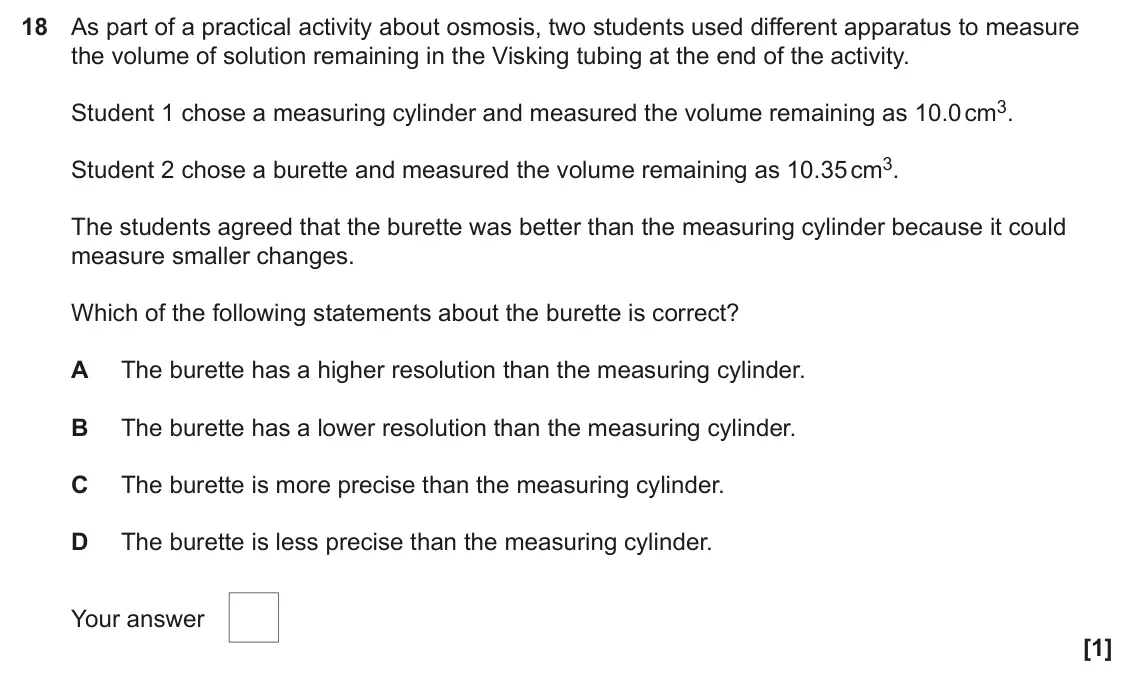
- June 2025, AS Paper 1, Q18 (1 mark): As part of a practical activity about osmosis, two students used different apparatus to measure the volume of solution remaining in the Visking tubing at the en
- June 2025, AS Paper 2, Q2(a)(i) (2 marks): Draw a molecule of lactose using the galactose molecule above. [2]
- June 2025, AS Paper 2, Q2(a)(ii) (1 mark): During digestion lactose is broken down into monosaccharides. Name the reaction involved in digestion. [1]
- June 2025, AS Paper 2, Q2(b)(i) (1 mark): Suggest a source of random error in the method. [1]
- June 2025, AS Paper 2, Q2(b)(ii) (1 mark): Explain how the method can be modified to reduce the effect of random error. [1] 8 The table shows the data from the investigation. Volume of milk at Volume of
- June 2025, AS Paper 2, Q2(b)(iii) (2 marks): Calculate the percentage change in volume for condensed milk. Percentage change = [2]
- June 2025, AS Paper 2, Q2(b)(iv) (4 marks): Plot these data using an appropriate format on the grid below. [4]
- June 2025, AS Paper 2, Q2(c) (1 mark): Soya milk does not contain lactose. Suggest why the soya milk increased in volume. [1]
- June 2024, Paper 1, Q1 (1 mark): The diagram shows a molecule of α-glucose. X O H H H OH H Y OH Z OH The table below shows chemical groups X, Y and Z labelled on the diagram. Chemical group X Y
- June 2024, Paper 1, Q31(b)(iii) (3 marks): The students concluded that ‘mock’ urine sample Y represented the urine of a patient with untreated diabetes. One of the students suggested that a colorimeter c
- June 2024, Paper 2, Q3(a) (4 marks): Water has some unique properties that make it particularly important as a biological molecule. The table lists some properties of water. Complete the table to d
- June 2024, Paper 2, Q3(b)(i) (3 marks): Explain why the different fluids have different total concentrations of solutes and electrolytes. [3]
- June 2024, Paper 2, Q3(b)(ii) (1 mark): Based on the values in the table, state and explain the direction you would expect water to move between the tissue fluid and cytosol. [1]
- June 2024, Paper 2, Q3(c)(i) (2 marks): Explain one variable that should be controlled in an experiment to measure the osmotic pressure of different solutions. [2]
- June 2024, Paper 2, Q3(c)(ii) (1 mark): Describe one improvement to the method to increase the accuracy of the individual measurements. [1]
- June 2024, Paper 2, Q3(c)(iii) (2 marks): A student plans to use Pfeffer’s method to study the formation of tissue fluid. A textbook gave the osmotic pressure of blood as 780 kPa at 25 °C. The relations
- June 2024, Paper 2, Q3(c)(iv) (1 mark): The student also plans to use a sodium chloride solution with the same osmotic pressure as blood. The van’t Hoff factor takes account of the number of particles
- June 2024, AS Paper 1, Q1 (1 mark): Which statement about the fatty acids found in lipids is correct? A They contain only carbon and hydrogen atoms. B One fatty acid joins with three glycerol mole
- June 2024, AS Paper 1, Q2 (1 mark): A group of students were testing plant extracts for biological molecules. The table shows the colour of each solution before and after testing the extracts. Col
- June 2024, AS Paper 1, Q3 (1 mark): Which statement about water is not correct? A A large amount of heat energy is required to change the temperature of water. B The forces of attraction between w
- June 2024, AS Paper 1, Q4 (1 mark): A person weighing 75 kg contains 45 dm3 of body fluid. 4 Approximately 70% of this body fluid is contained within cells as intracellular fluid. Researchers inve
- June 2023, Paper 1, Q1 (1 mark): The image shows an erythrocyte after being placed in a solution. Which option explains the appearance of the erythrocyte? A The solution was distilled water. B
- June 2023, Paper 3, Q2(b)(iii) (2 marks): The student performed the Benedict’s test on solutions from the leaves of both species. • For each of the species, the same method was used to prepare the solut
- June 2023, Paper 3, Q2(b)(iv) (1 mark): The student also tested for the presence of starch in various tissues of the plants. State how to test for starch. [1]
- June 2022, Paper 1, Q6 (1 mark): The structure of a polymer is shown below. O HOCH2 H H HO CH2OH OH H O O CH2 H H HO CH2OH OH H O CH2OH 29 repeating units O O CH2 H H H H O OH H H HO HO CH2OH H
- June 2022, Paper 1, Q7 (1 mark): Water forms pleural fluid, a lubricant that reduces the friction between the lungs and the thoracic cavity during ventilation. Which of the statements about the
- June 2022, Paper 1, Q8 (1 mark): A scientist used a colorimeter during an investigation to measure the concentration of glucose in samples of urine. Which of the statements is/are correct? 1 Th
- June 2022, Paper 2, Q1(a) (3 marks): The table shows several conversions that occur in carbohydrate metabolism. Place one tick (3) in the appropriate box in each row to indicate the type of reactio
- June 2022, Paper 3, Q1(c) (1 mark): An incomplete structure of α-glucose is shown in Fig. 1.2. CH2OH C O H H C C OH C C H OH Fig. 1.2 Complete the structure of α-glucose in Fig. 1.2 to show all of
- June 2022, Paper 3, Q1(d) (2 marks): The table lists glucose and two other carbohydrate molecules: lactose and amylose. Fill in the table to show, for each carbohydrate, a reagent that would give a
- June 2022, Paper 3, Q5(a)(i) (3 marks): Suggest and explain three changes that the student could make to the experimental set-up that would increase the rate of osmosis. Change Explanation Change Expl
- June 2022, Paper 3, Q5(a)(ii) (1 mark): The student decided to measure the rate of osmosis by measuring how the height of the solution changed over time in the thistle funnel. Suggest appropriate unit
- June 2022, Paper 3, Q5(a)(iii) (1 mark): Suggest a semipermeable material that the student could use instead of the goat bladder. [1]
- June 2022, AS Paper 1, Q21(b)(i) (1 mark): Name the reagent in the qualitative test that could have been used by the researchers to confirm the presence of starch. [1]
- June 2022, AS Paper 1, Q21(b)(ii) (1 mark): Give one reason why the researchers chose a red filter when using colorimetry in this investigation. [1]
- June 2022, AS Paper 1, Q21(b)(iii) (3 marks): To determine the concentration of starch in each sample from the colorimetry readings, the researchers needed a calibration curve. Outline how a calibration cur
- June 2022, AS Paper 1, Q21(c) (4 marks): Some of the data from this investigation are shown in Fig. 21.1 and Fig. 21.2. 4000 3500 Starch 3000 concentration 2500 in sugarcane 2000 extract (mg dm–3) 1500
- June 2022, AS Paper 1, Q21(d)(i) (1 mark): Name the type of reaction catalysed by these enzymes. [1]
- June 2022, AS Paper 1, Q21(d)(ii) (1 mark): Name one possible product of the reaction catalysed by α-amylase. [1]
- June 2022, AS Paper 1, Q21(d)(iii) (1 mark): Suggest why pullulanase is used to increase the solubility of starch suspensions. [1]
- November 2021, Paper 1, Q2 (1 mark): Which of the biofluids, A to D, is not an extracellular fluid? A cell sap B lymph C plasma D urine Your answer [1]
- November 2021, Paper 2, Q6(a)(iii) (2 marks): Describe how you could extend this experiment to test the student’s hypothesis. [2]
- November 2021, AS Paper 1, Q20 (1 mark): Glutathione (GSH) is a small polymer found in most cells in the human body. The structure of glutathione is shown below. O O H H H H H O O C C C C C N C C N C C
- November 2021, AS Paper 1, Q22(a)(i) (2 marks): Identify two precautions that must be taken when using the apparatus in Fig. 22.1 to obtain valid data. 1.. 2.. [2]
- November 2021, AS Paper 1, Q22(a)(ii) (2 marks): For one of the precautions you identified in (a)(i) explain why it must be taken to ensure valid data. [2]
- November 2021, AS Paper 1, Q22(b)(i) (3 marks): Using your knowledge of osmosis, explain the trends shown by the data in Fig. 22.2 [3]
- November 2021, AS Paper 1, Q22(b)(ii) (2 marks): The students used data collected to calculate the rate of pressure change for each concentration of sucrose. They recorded their results in Table 22. Rate of pr
- November 2021, AS Paper 1, Q22(b)(iii) (3 marks): Using the grid below, draw a suitable graph to show the results recorded in Table 22. [3]
- November 2021, AS Paper 1, Q22(b)(iv) (1 mark): Use your graph in (b)(iii) to estimate the concentration of sucrose solution for which the rate of pressure change was zero. Concentration = mol dm 3 [1]
- November 2021, AS Paper 2, Q1(c) (2 marks): Saline is salt solution. Using your knowledge of osmosis, explain how breathing in a fine mist of saline could reduce oxygen consumption. [2]
- November 2021, AS Paper 2, Q5(a) (3 marks): State three improvements that the scientist could make to the method. 1 2 3 [3]
- November 2021, AS Paper 2, Q5(b) (1 mark): Suggest a suitable control for the investigation. [1]
- November 2021, AS Paper 2, Q5(c) (1 mark): The results of the investigation are shown in the graph. 1.2 1.0 0.8 mass of precipitate 0.6 (g) 0.4 0.2 0 0 1 2 3 4 5 6 concentration of reducing sugar (%) The
- November 2021, AS Paper 2, Q5(d) (4 marks): The concentration of sugar in the energy drink was 5.5% as it also contained non-reducing sugars. State two additional steps that could be added to the method t
- November 2020, Paper 1, Q29 (1 mark): Water flows continuously through xylem vessels due to cohesion. Which of the options, A to D, is responsible for the cohesive properties of water? A covalent bo
- November 2020, Paper 1, Q33(a)(i) (2 marks): Outline a test that could be used to detect glucose in a urine sample. [2]
- November 2020, Paper 1, Q33(a)(ii) (2 marks): Draw the ring structure of a molecule of glucose in the space below. [2]
- November 2020, Paper 1, Q34(d)(i) (1 mark): Name a technique that can determine the concentration of a known molecule in a solution by measuring light absorbance. [1]
- November 2020, AS Paper 1, Q17 (1 mark): α-glucose is an example of a monosaccharide sugar. Which of the options, A to D, is not a property of monosaccharides? A general formula CnH2nOn B soluble in wa
- November 2020, AS Paper 2, Q3(a)(i) (2 marks): Calculate the percentage increase in the distance moved by the meniscus between 0.4 mol dm–3 and 0.6 mol dm–3 sodium chloride. percentage increase = % [2]
- November 2020, AS Paper 2, Q3(a)(ii) (1 mark): Explain why the Visking tubing containing carrot extract was left for 24 hours in the sodium chloride solution. [1]
- November 2020, AS Paper 2, Q3(a)(iii) (2 marks): What conclusions can be made about the movement of water from the results given in the table? [2]
- November 2020, AS Paper 2, Q3(a)(iv) (3 marks): Explain how the investigation could be modified to find the concentration of sodium chloride solution that has the same water potential as the carrot extract. [
- November 2020, AS Paper 2, Q3(a)(v) (2 marks): Explain how the student could have calculated the initial rate of osmosis in the different concentrations of sodium chloride. [2]
- November 2020, AS Paper 2, Q3(b)(i) (2 marks): It is important to use carrots of a similar age when preparing extracts for this investigation. Explain how using carrots of different ages could affect the res
- November 2020, AS Paper 2, Q3(b)(ii) (1 mark): Give one reason why using a Benedict’s test to compare the sugar content of carrot extracts may not give valid results. [1]
- June 2019, Paper 1, Q2 (1 mark): Which of the options, A to D, is a type of reaction involved in the breakdown of a phospholipid? A condensation B dehydrogenation C hydrolysis D phosphorylation
- June 2019, Paper 1, Q33(a)(i) (2 marks): Calculate the standard deviation for the final mass of potato slices soaked in 0.6 mol dm–3 sucrose concentration. 2 - / ( x x ) Use the formula: s = n 1 - stan
- June 2019, Paper 1, Q33(a)(ii) (2 marks): The graph below represents the data in Table 33. 2.90 2.80 2.70 2.60 mean final mass 2.50 of potato slice / g 2.40 2.30 2.20 2.10 0.0 0.2 0.4 0.6 0.8 1.0 sucros
- June 2019, Paper 1, Q33(a)(iii) (3 marks): With reference to the data in Table 33, explain how the sucrose concentration of the solution determines the final mass of potato. [3]
- June 2019, Paper 1, Q33(a)(iv) (2 marks): Suggest two factors in the method that could have contributed error to the data, as shown by the error bars in the graph in (a)(ii) on page 25. 1 2 [2]
- June 2019, Paper 3, Q3(a) (1 mark): Give one reason why the student chose method 2. [1]
- June 2019, Paper 3, Q3(b) (6 marks): A student was asked to find out the glucose concentration in mock body fluids. The student was provided with three samples. The student’s plan contained the fol
- June 2019, Paper 3, Q3(c) (3 marks): A teacher was asked to comment on the method and results collected. Complete the paragraph by choosing the most appropriate word from the list below. anomaly ac
- June 2019, AS Paper 1, Q5 (1 mark): Linseed oil is a polyunsaturated triglyceride that can be extracted from the seeds of the flax plant, Linum usitatissimum. A diagram of a linseed oil molecule i
- June 2019, AS Paper 2, Q1(a)(i) (1 mark): Using Fig. 1.1, describe one visible similarity between fructose and α-glucose. [1]
- June 2019, AS Paper 2, Q1(a)(ii) (1 mark): Using Fig. 1.1, describe one visible difference between fructose and α-glucose. [1]
- June 2019, AS Paper 2, Q1(c)(i) (1 mark): Suggest the expected observation for test tube D and give a reason for your answer. [1]
- June 2019, AS Paper 2, Q1(c)(ii) (1 mark): Suggest why sodium hydrogencarbonate was added to all four test tubes. [1]
- June 2019, AS Paper 2, Q1(c)(iii) (2 marks): The student proposed that: Dilute hydrochloric acid played a significant part in the hydrolysis of potato starch. Describe a suitable control that the student c
- June 2019, AS Paper 2, Q1(c)(iv) (1 mark): The students found it difficult to compare each other’s observations on the colour changes. What method could they have used to obtain quantitative results? [1]
- June 2018, Paper 1, Q36(a) (3 marks): Draw a second water molecule on Fig. 36.1, in the position it might take up beside the first water molecule. Your drawing should show: • the bond(s) between the
- June 2018, Paper 1, Q36(b)(i) (1 mark): State the precise name of the chemical bond in starch that is hydrolysed by amylase. [1]
- June 2018, Paper 1, Q36(b)(ii) (1 mark): Reagent X was used to indicate the presence or absence of starch in the agar plates. State the name of this reagent and its colour in the presence of starch. Na
- June 2018, Paper 3, Q2(a)(i) (1 mark): All equipment and sections of carrot were washed with distilled water before use. Explain why. [1]
- June 2018, Paper 3, Q2(a)(ii) (1 mark): The absorbance value obtained in step 4 was used as a reference value for further tests. This absorbance value was considered to represent the highest chloride
- June 2018, Paper 3, Q2(b) (1 mark): Look at the trend in the results in Table 2.1. Identify the anomalous result in this trend and give its expected absorbance value. Anomalous result Expected abs
- June 2018, Paper 3, Q2(c) (6 marks): The student used the method for the preliminary experiment to plan their investigation into the effect of temperature on the rate of chloride ion diffusion. Des
- June 2018, Paper 3, Q2(d)(i) (1 mark): Use Fig. 2.1 to calculate the increase in absorbance between 10 °C and 40 °C. Answer = [1]
- June 2018, Paper 3, Q2(d)(ii) (2 marks): Suggest why the absorbance changed between 10 °C and 40 °C. [2] 11 Fig. 2.2 shows absorbance measured at different concentrations of chloride ions. 1 0.1 absorb
- June 2018, Paper 3, Q2(d)(iii) (2 marks): Using the graph in Fig. 2.1 and the graph in Fig. 2.2, estimate the chloride ion concentration at a temperature of 45 °C. [2]
- June 2018, AS Paper 1, Q1 (1 mark): Which of the options, A to D, is an intracellular biofluid? A blood plasma B cytoplasm C tissue fluid D serum Your answer [1]
- June 2018, AS Paper 1, Q2 (1 mark): A plant cell with a water potential of −500 KPa was placed in a solution which caused the cell membrane to completely pull away from the cell wall. Which of the
- June 2018, AS Paper 1, Q23(a) (4 marks): The table below shows some of the properties of water and their importance to living organisms. Complete the table using the most appropriate term(s) or sentenc
- June 2018, AS Paper 1, Q23(b)(i) (1 mark): Name the types of reaction taking place at X and Y. Reaction X Reaction Y [1]
- June 2018, AS Paper 1, Q23(b)(ii) (1 mark): Name both products of reaction X. [1]
- June 2018, AS Paper 1, Q23(b)(iii) (1 mark): Name the bond labelled Z. [1]
- June 2018, AS Paper 2, Q5(a) (2 marks): Using the information in Fig. 5, draw a diagram of a sucrose molecule in the space below. [2]
- June 2018, AS Paper 2, Q5(d) (3 marks): The presence of starch in seeds can be detected using iodine-KI reagent. When tested with iodine-KI reagent, dry seeds showed a high concentration of starch but
- June 2017, Paper 1, Q13 (1 mark): Three diagnostic tests were performed on a solution containing a biological molecule. The results of the tests are shown in the table below. Colour of test reag
- June 2017, Paper 2, Q6(b)(i) (1 mark): Explain why the term ‘plasmolysis’ is used incorrectly in this student’s description. [1]
- June 2017, Paper 2, Q6(b)(ii) (2 marks): State two ways in which the experimental procedure described by the student could be improved. improvement 1 improvement 2 [2]
- June 2017, AS Paper 1, Q19 (1 mark): Which of the molecules, A to D, can be described as a pentose monosaccharide with a general formula of Cx(H2O)y ? CH2OH O CH2OH H O H H H HO CH2OH OH H H HO OH
- June 2017, AS Paper 2, Q6(a)(i) (1 mark): What is the purpose of the differential stain in this investigation? [1]
- June 2017, AS Paper 2, Q6(a)(ii) (1 mark): The student made the following statement: ‘The water potential of the onion cells changes when the cells are stained with the differential stain.’ Is this state
- June 2017, AS Paper 2, Q6(a)(iii) (4 marks): Identify two sources of error in the procedure used and suggest an improvement for each. error improvement error improvement [4]
- June 2017, AS Paper 2, Q6(b)(i) (3 marks): Using the data in Table 6, complete an appropriate graph on the grid provided. 70 60 50 40 30 20 10 0 0 0.1 0.2 0.3 0.4 0.5 0.6 0.7 0.8 0.9 [3]
- June 2017, AS Paper 2, Q6(b)(ii) (1 mark): Using your graph plotted in (b)(i), state the sucrose concentration at which 50% of the onion cells are plasmolysed. [1]
- June 2016, AS Paper 1, Q8 (1 mark): Lactose is formed by a reaction between glucose and galactose, both of which have the chemical formula C6H12O6. Which of the options, A to D, is the correct che
- June 2016, AS Paper 1, Q10 (1 mark): A student wrote the following statement: ‘Water is polar because the oxygen side of the molecule is slightly positive in charge.’ Which of the following options
- June 2016, AS Paper 1, Q21(a) (2 marks): Using Fig. 21, explain the results for the suspension in test tube B. [2]
- June 2016, AS Paper 1, Q21(b) (1 mark): The students waited for 15 minutes after adding the erythrocyte suspensions to the sodium chloride solutions before recording their observations. Explain why. [
- June 2016, AS Paper 1, Q21(c) (3 marks): The students repeated the experiment using a colorimeter to measure the absorbance of each erythrocyte suspension after 15 minutes. Table 21.1 below shows the d
- June 2016, AS Paper 1, Q21(d)(i) (2 marks): Compare the results for concentrations of glucose and sodium chloride between 0.05 and 0.20 mol dm–3. [2]
- June 2016, AS Paper 1, Q21(d)(ii) (1 mark): The students forgot to take the measurement for absorbance at 0.25 mol dm–3 glucose concentration. Suggest how the missing data could affect the conclusions mad
- June 2016, AS Paper 2, Q2(a) (2 marks): Describe a method the students could use to confirm the presence of protein in the sports drink. [2]
Questions, mark schemes and examiner’s reports are © OCR, from their published past papers. Plumi isn’t affiliated with any exam board. Want whole papers? Every OCR A-Level Biology B paper.
Rather write your answers by hand on iPad? Plumi marks them against the same mark schemes.