 plumi
Photosynthesis, food production and management of the environment: OCR A‑Level Biology B questions
Every OCR A-Level Biology B exam question on 4.3.1 Photosynthesis, food production and management of the environment, 2016–2025, with its mark scheme and examiner’s report.
Find questions1,889
Calculations


Q33(c)
The whole paper ↗
Q4(b)
The whole paper ↗
Q3(e)
The whole paper ↗


Q7(a)
The whole paper ↗
Q7(b)(i)
The whole paper ↗
Q7(b)(ii)
The whole paper ↗
Q7(c)(i)
The whole paper ↗
Q7(c)(ii)
The whole paper ↗
Q7(c)(iii)
The whole paper ↗
Q5(a)(ii)
The whole paper ↗

Q31(a)(i)
The whole paper ↗
Q31(a)(ii)
The whole paper ↗
Q31(c)(i)
The whole paper ↗
All 99 questions on Photosynthesis, food production and management of the environment, as a list
- June 2025, Paper 1, Q19 (1 mark): The diagram shows the ultrastructure of a chloroplast. A D B C What is the site of light-independent reactions? Your answer [1]
- June 2025, Paper 1, Q20 (1 mark): A student uses paper chromatography to separate a mixture of photosynthetic pigments. The student allows the solvent to run 6.5 cm up the paper. They measure th
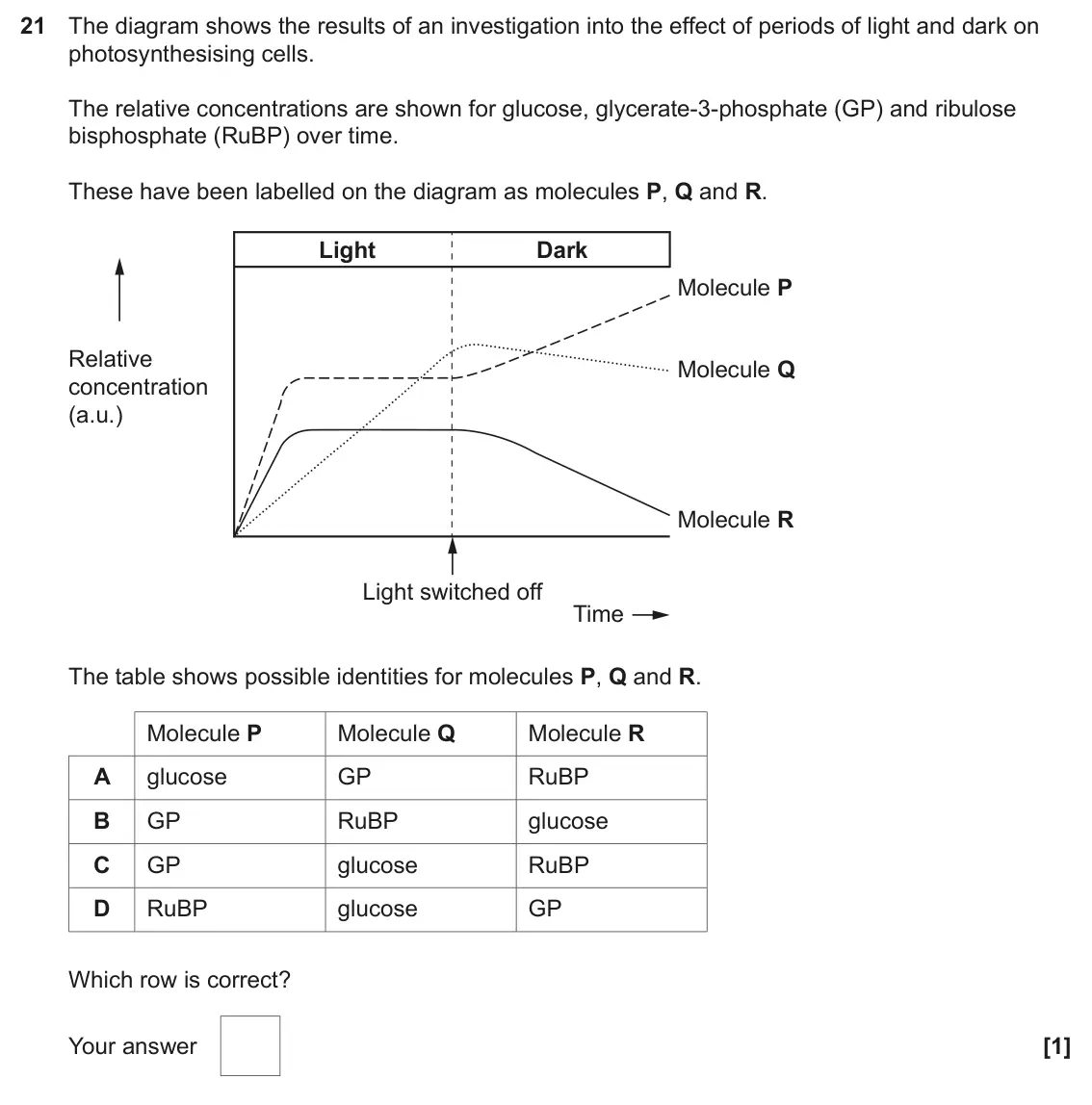
- June 2025, Paper 1, Q21 (1 mark): The diagram shows the results of an investigation into the effect of periods of light and dark on photosynthesising cells. The relative concentrations are shown
- June 2025, Paper 1, Q33(c) (2 marks): Explain how soybean plants benefit from having root nodules. [2]
- June 2025, Paper 2, Q4(b) (2 marks): In the same study, the scientists compared the biodiversity of insect species in the solar farm and in two parts of an adjacent field that was growing soybean c
- June 2025, Paper 3, Q3(e) (6 marks): Parakaryon myojinensis is a species of single-celled organism that was discovered in 2012. P. myojinensis is unique among species that have been discovered beca
- June 2024, Paper 1, Q21 (1 mark): Which statement about the Calvin cycle is correct? A ATP is produced using reduced NADP. B GP is converted to TP using reduced NADP. C Reduced NADP is produced
- June 2024, Paper 1, Q22 (1 mark): The diagram shows absorption spectra for different photosynthetic pigments. 100 80 Key: 60 Carotene Chlorophyll a Absorption Chlorophyll b (A.U.) 40 Xanthophyll
- June 2024, Paper 1, Q25 (1 mark): The table shows the roles of some of the bacteria involved in the nitrogen cycle. Role of bacteria in the nitrogen cycle Azotobacter Nitrobacter Rhizobium A den
- June 2024, Paper 2, Q7(a) (2 marks): State the two products of the light-dependent stage of photosynthesis that are used in the Calvin cycle. 1 2 [2]
- June 2024, Paper 2, Q7(b)(i) (2 marks): Fig. 7.2 shows the effect of oxygen concentration on the rate of absorption of carbon dioxide by the leaves of a crop plant. Fig. 7.2 60 50 40 Rate of CO2 absor
- June 2024, Paper 2, Q7(b)(ii) (2 marks): Use your knowledge of the Calvin cycle and the information in Fig. 7.1 and Fig. 7.2 to explain why higher concentrations of oxygen reduce the yield of this crop
- June 2024, Paper 2, Q7(c)(i) (1 mark): Compound(s) Amino acids A Glucose phosphates B Glycerate 3-phosphate (GP) C Triose phosphate (TP) D Use the letters in the table to indicate the order in which
- June 2024, Paper 2, Q7(c)(ii) (3 marks): Explain the order you have listed the compounds in part (i). [3]
- June 2024, Paper 2, Q7(c)(iii) (3 marks): Explain how 14C would be incorporated into triglycerides in a plant. [3]
- June 2024, Paper 3, Q5(a)(ii) (3 marks): One of the scientists plans to investigate how the number of plant species changes across one of the saltwater wetlands. Outline how the scientist could measure
- June 2023, Paper 1, Q14 (1 mark): Which of the statements about the production of ATP during photophosphorylation is correct? A Each turn of the Calvin cycle produces 3 molecules of ATP. B It oc
- June 2023, Paper 1, Q31(a)(i) (2 marks): The population of Draa goats in the region was estimated at 200 000 animals. The goats produce milk during a lactation period of 120 days. The goats have one la
- June 2023, Paper 1, Q31(a)(ii) (1 mark): State a conclusion that can be drawn from the standard deviation values about milk yield in these two breeds. [1]
- June 2023, Paper 1, Q31(c)(i) (3 marks): Calculate the efficiency of biomass transfer between the forest plants and the goats. Efficiency = % [3]
- June 2023, Paper 1, Q31(c)(ii) (2 marks): Explain two ways in which the goat farmer could improve the efficiency of biomass transfer to increase meat production of their goats without introducing other
- June 2023, Paper 1, Q31(d)(i) (1 mark): Use the diagram and your knowledge of the ruminant digestive system, to suggest why the alpaca is not considered to be a ‘true’ ruminant. [1]
- June 2023, Paper 1, Q31(d)(ii) (3 marks): Use your knowledge of the ruminant digestive system to explain the importance of stomach chamber C1 in obtaining nutrients. [3]
- June 2023, Paper 2, Q6(a)(i) (1 mark): Explain the significance of the compensation point shown on Fig. 6.1. [1]
- June 2023, Paper 2, Q6(a)(ii) (3 marks): Use the data in Fig. 6.1 to explain why crops growing in greenhouses during the winter months are often grown under artificial lights. [3]
- June 2023, Paper 2, Q6(b)(i) (4 marks): Explain two steps that the student should take to ensure an accurate comparison of compensation points. 1 2 [4]
- June 2023, Paper 2, Q6(b)(ii) (4 marks): The colour of the hydrogen carbonate indicator after each plant extract was exposed to light is indicated by the labels H and J in Fig. 6.2 on the Insert. On th
- June 2023, Paper 3, Q2(a) (2 marks): Explain why plants are dependent on photosynthesis for their survival. [2]
- June 2023, Paper 3, Q2(b)(i) (4 marks): A student observed both species of plant growing in their local area, which is shown in the diagram. Grassland Pond Woodland 50 m The student outlined a plan fo
- June 2023, Paper 3, Q2(b)(ii) (6 marks): The conditions in a plant’s habitat affect its rate of photosynthesis. (ii)* The student read that woodland plants, such as lady fern, might not receive all wav
- June 2023, Paper 3, Q2(c)(i) (2 marks): Explain why the continuation of NPQ in low light intensities reduces the rate of CO2 fixation. [2]
- June 2022, Paper 1, Q3 (1 mark): Which part of a chloroplast contains the enzymes required for the light-independent reaction? A Granum B Inner membrane C Intergranal lamella D Stroma Your answ
- June 2022, Paper 1, Q4 (1 mark): Which of the options would not prevent a climax community from forming? A Animal grazing B Coppicing C Pine forest plantation D Volcanic eruption Your answer [1
- June 2022, Paper 1, Q33(b)(iii) (1 mark): Give one reason why, as seedling leaves appear, less oxygen is taken in from the surrounding soil even though the need for oxygen increases. [1]
- June 2022, Paper 1, Q36(a)(i) (3 marks): Comment on the suitability of using this sampling method in the study. [3]
- June 2022, Paper 1, Q36(a)(ii) (2 marks): Using the method shown, estimate the population density of sea ginger. Population density = m–2 [2]
- June 2022, Paper 2, Q6(b)(i) (1 mark): State one variable that should be controlled during the 45 days to allow a valid comparison between the two
- June 2022, Paper 2, Q6(b)(ii) (1 mark): Explain why the seeds were grown in unfertilised soil. [1]
- June 2022, Paper 2, Q6(b)(iii) (2 marks): Suggest, with a reason, another control group that the researchers should have used. [2]
- June 2022, Paper 2, Q6(b)(iv) (2 marks): The researchers used a paired t-test to analyse their results. Suggest whether this was an appropriate test to use. [2]
- June 2022, Paper 2, Q6(b)(v) (1 mark): State the number of degrees of freedom used for this paired t-test. [1]
- June 2022, Paper 2, Q6(b)(vi) (3 marks): The researchers concluded that farmers should use inoculated V. mungo seeds to maximise their yields. Evaluate this conclusion. [3]
- June 2022, Paper 2, Q6(c)(i) (2 marks): Calculate the efficiency of biomass transfer in the period when the cattle are fed on grass and in the period when they are fed on grain. Give your answer to 2
- June 2022, Paper 2, Q6(c)(ii) (3 marks): A student concluded that it would be more sustainable to raise beef cattle entirely on grass. Evaluate this conclusion. [3]
- June 2022, Paper 3, Q3(a)(i) (2 marks): Use Fig. 3.1 to calculate the Rf value of chlorophyll a. Give your answer to 2 significant figures. Rf = [2]
- June 2022, Paper 3, Q3(a)(ii) (1 mark): Another student carried out paper chromatography on the four photosynthetic pigments but they used a different solvent. Suggest why the Rf values obtained by th
- June 2022, Paper 3, Q3(b)(i) (2 marks): Describe and explain how the student obtained the leaf extract pellets and supernatant. [2]
- June 2022, Paper 3, Q3(b)(ii) (1 mark): Explain why the student stored the leaf extracts in an ice-cold water bath before they added the DCPIP solution. [1]
- June 2022, Paper 3, Q3(b)(iii) (2 marks): The student monitored the colour change in the four tubes using colorimetry. State and explain the colour of filter that the student should have placed in the c
- June 2022, Paper 3, Q3(b)(iv) (3 marks): The sentences below describe some of the details of the colorimetry procedure used by the student. Complete the sentences using the most appropriate words or ph
- June 2022, Paper 3, Q3(b)(v) (3 marks): Fig. 3.2 shows the results from two of the student’s tubes. 5 Key: A B 4 3 Absorption (a.u.) 2 1 0 1 2 3 4 5 6 7 8 9 10 Time (min) Fig. 3.2 The student forgot t
- November 2021, Paper 1, Q23 (1 mark): Which of the statements, A to D, about why respiration in animals and plants is dependent on photosynthesis is correct? A Triose phosphate (TP) can be hydrolyse
- November 2021, Paper 1, Q24 (1 mark): Which of the structures, A to D, in the ruminant digestive system secretes hydrochloric acid and digestive enzymes? A abomasum B omasum C reticulum D rumen Your
- November 2021, Paper 1, Q30 (1 mark): Hydrogen carbonate indicator was used to investigate gaseous exchange in plants by measuring the change in pH. • The indicator ranges from yellow at pH 7.6 to p
- November 2020, Paper 1, Q27 (1 mark): Which of the units, A to D, is suitable in calculating the energy content of areas of tidal mud? A megajoules (MJ) MJ m–1 B MJ m–2 C MJ m–2 yr –1 D Your answer
- November 2020, Paper 2, Q3(a)(i) (2 marks): Identify the following from Fig. 3.1: gas X gas Y compound Z [2]
- November 2020, Paper 2, Q3(a)(ii) (1 mark): Name the structure in the chloroplast in which the light-dependent stage of photosynthesis takes place. [1]
- November 2020, Paper 2, Q3(a)(iii) (2 marks): Describe two ways in which the structure you named in (ii) is adapted to its function. [2]
- November 2020, Paper 2, Q3(b)(i) (1 mark): Explain why the student did not allow the solvent to reach the end of the paper. [1]
- November 2020, Paper 2, Q3(b)(ii) (2 marks): Calculate the Rf value for spot 5. Give your answer to two significant figures. Rf = [2]
- November 2020, Paper 2, Q3(b)(iii) (2 marks): The student had a table of Rf values. However, these values were determined using a different solvent mixture than the one used by the student. Explain why usin
- November 2020, Paper 2, Q3(c)(i) (4 marks): Explain how energy from the excited electrons is transferred to ATP. [4]
- November 2020, Paper 2, Q3(c)(ii) (2 marks): Suggest two reasons why the transfer of energy from excited electrons to ATP is not 100% efficient. 1. 2. [2]
- November 2020, Paper 3, Q2(c)(ii) (6 marks): Plants are usually adapted to living in conditions of different light intensities. The leaf of a plant that is adapted to living in shade will differ from the l
- June 2019, Paper 1, Q4 (1 mark): Which of the options, A to D, is the number of molecules of triose phosphate required to produce two molecules of glucose? A 1 B 2 C 4 D 8 Your answer [1]
- June 2019, Paper 1, Q6 (1 mark): Which of the options, A to D, is the location of ATP synthase in a chloroplast? A inner membrane B stroma C thylakoid lumen D thylakoid membrane Your answer [1]
- June 2019, Paper 1, Q7 (1 mark): Photosynthetic pigments in a leaf were separated using paper chromatography. The resulting chromatogram is shown below. solvent front paper origin Which of the
- June 2019, Paper 1, Q10 (1 mark): The table below shows some energy data for a forest ecosystem. 70 000kcal m–2 total plant biomass 4 300kcal m–2 total animal biomass 18 000kcal m–2 yr –1 gross
- June 2019, Paper 2, Q4(a) (3 marks): Suggest the reasons for the following steps in the experiment. 1. Illuminating the algae for 30 minutes before the start of the experiment. 2. Placing heat-abso
- June 2019, Paper 2, Q4(b)(i) (1 mark): Name the enzyme responsible for the initial incorporation of radioactive CO2 into organic compounds. [1]
- June 2019, Paper 2, Q4(b)(ii) (3 marks): Use the results in Table 4 to explain the order in which the organic compounds are produced during photosynthesis. [3]
- June 2019, Paper 2, Q4(c) (2 marks): Calvin isolated the compounds formed at the earliest time points and found they contained three carbon atoms. This led him to conclude that the first reaction i
- June 2019, Paper 2, Q4(d)(i) (2 marks): The plant had a leaf area of 0.97 m2. Calculate the maximum amount of CO2 that the plant can take up in 1 minute. maximum amount of CO2 taken up in 1 minute = µ
- June 2019, Paper 2, Q4(d)(ii) (1 mark): Explain the significance of the point labelled B on Fig. 4.2. [1]
- June 2018, Paper 1, Q27 (1 mark): A study was conducted to compare the effectiveness of two fertilisers, TomatoXL® and TomatoGro®, on the growth of tomato plants. Twenty plants of similar height
- June 2018, Paper 1, Q28 (1 mark): Which of the molecules, A to D, is the source of electrons in photosynthesis? A ATP B CO2 C H2O D NADPH Your answer [1]
- June 2018, Paper 1, Q29 (1 mark): DCPIP is a molecule that is used to measure the rate of the Hill reaction in isolated chloroplasts. Which of the options, A to D, correctly describes DCPIP duri
- June 2018, Paper 1, Q30 (1 mark): Proton pumps establish electrochemical gradients, which are required for ATP production. Which of the options, A to D, are regions of a plant cell into which pr
- June 2018, Paper 1, Q33(a) (3 marks): Complete the paragraph below about ecosystems using the most appropriate terms. Natural change in the community of an ecosystem over time is known as succession
- June 2018, Paper 1, Q33(b) (1 mark): Pioneer species are the first to colonise an ecosystem. How do pioneer species promote future biodiversity? [1]
- June 2018, Paper 1, Q33(c) (3 marks): Fig. 33 shows a region of coastal land, stretching from tide to woodland. water 200 m Fig. 33 Outline a sampling method that could be used to investigate succes
- June 2018, Paper 1, Q33(d)(i) (2 marks): Beef cattle that are produced for their meat are fed maize. In a cow, 13 100 MJ of stored biomass energy are produced from 83 000 MJ of maize. Calculate the eff
- June 2018, Paper 1, Q33(d)(ii) (1 mark): In snail farming, snails are fed lettuce leaves. The efficiency of energy transfer from the lettuce leaves to stored biomass energy in snails is greater than th
- June 2018, Paper 1, Q33(e) (6 marks): (e)* Cattle are ruminant animals. The stomach of a ruminant animal contains specialised chambers. Explain how the ruminant stomach digests food to produce impor
- June 2018, Paper 3, Q1(a) (1 mark): Name the type of crop, such as beans, that can fix nitrogen. [1]
- June 2018, Paper 3, Q1(b)(i) (1 mark): The table shows information for the preparation of agar plates used to culture Rhizobium. Complete the table by suggesting a role for mannitol. Constituent adde
- June 2018, Paper 3, Q1(b)(ii) (6 marks): Farmers rotate different crops on their land to produce higher yields. Crops like beans are used in the rotation to fix atmospheric nitrogen. This reduces the n
- June 2018, Paper 3, Q1(b)(iii) (2 marks): After preparation in the laboratory, Rhizobium cultures are usually kept at 30 °C. Explain why this is a suitable temperature. [2]
- June 2017, Paper 1, Q8 (1 mark): Photolysis is the process of splitting water using light energy. Which of the options, A to D, is the region of the chloroplast in which this process takes plac
- June 2017, Paper 1, Q17 (1 mark): The statements below relate to the Calvin cycle. Which of the following statements is/are correct? 1 Molecules of triose phosphate are required for the synthesi
- June 2017, Paper 1, Q35(a)(ii) (2 marks): State two variables that should have been controlled to ensure a valid comparison between fields M and R. 1 2 [2]
- June 2017, Paper 1, Q35(c) (3 marks): Modern agricultural methods involve the use of chemical fertilisers added to the soil to increase crop yield. However, the use of chemical fertilisers can have
- June 2017, Paper 2, Q1(a)(i) (1 mark): State the precise location of the photosystems involved in the light-dependent reaction of photosynthesis. [1]
- June 2017, Paper 2, Q1(a)(ii) (2 marks): Describe how the structures containing the photosystems are arranged differently in plant cells and cyanobacteria. [2]
- June 2017, Paper 2, Q1(a)(iii) (2 marks): State the precise location of Rubisco in: unmodified plant cells cyanobacteria [2]
- June 2017, Paper 2, Q1(a)(iv) (3 marks): Explain how cyanobacteria are able to almost eliminate oxygen (O2) fixation by Rubisco. [3]
- June 2017, Paper 2, Q1(b)(ii) (4 marks): Plot a graph of these results on the grid below. Include error bars showing two standard deviations. [4]
- June 2017, Paper 2, Q1(b)(iii) (3 marks): Using Table 1 and your graph in (b)(ii), analyse whether the researchers successfully demonstrated that replacing Rubisco in tobacco plants with the cyanobacter
- June 2017, Paper 2, Q1(b)(iv) (2 marks): A student made the following statement: “Photosynthesis is more effective in the M35 strain than the Rbcx strain.” Use Table 1 and your graph in (b)(ii) to eval
Questions, mark schemes and examiner’s reports are © OCR, from their published past papers. Plumi isn’t affiliated with any exam board. Want whole papers? Every OCR A-Level Biology B paper.
Rather write your answers by hand on iPad? Plumi marks them against the same mark schemes.