 plumi
Pathogenic microorganisms: OCR A‑Level Biology B questions
Every OCR A-Level Biology B exam question on 3.2.1 Pathogenic microorganisms, 2016–2025, with its mark scheme and examiner’s report.
Find questions1,889
Calculations

Q32(a)
The whole paper ↗
Q32(b)(ii)
The whole paper ↗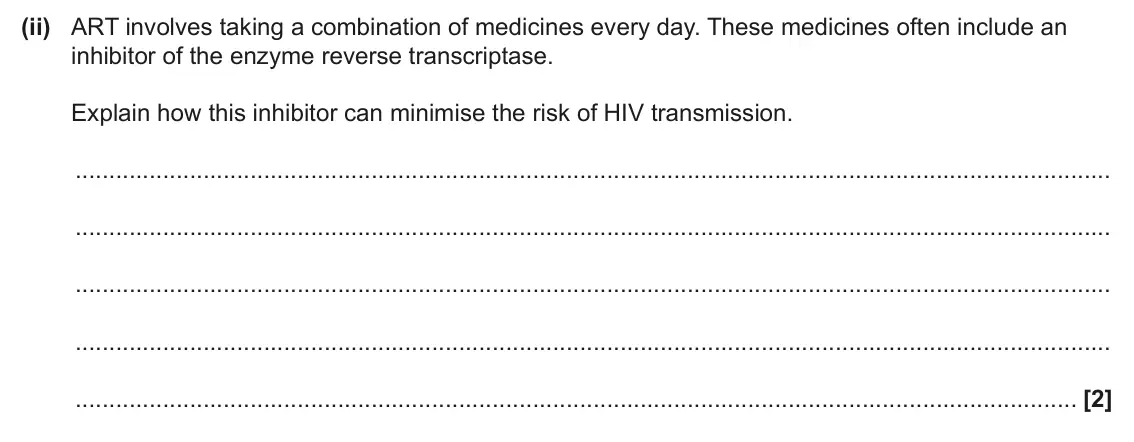
Q3(d)
The whole paper ↗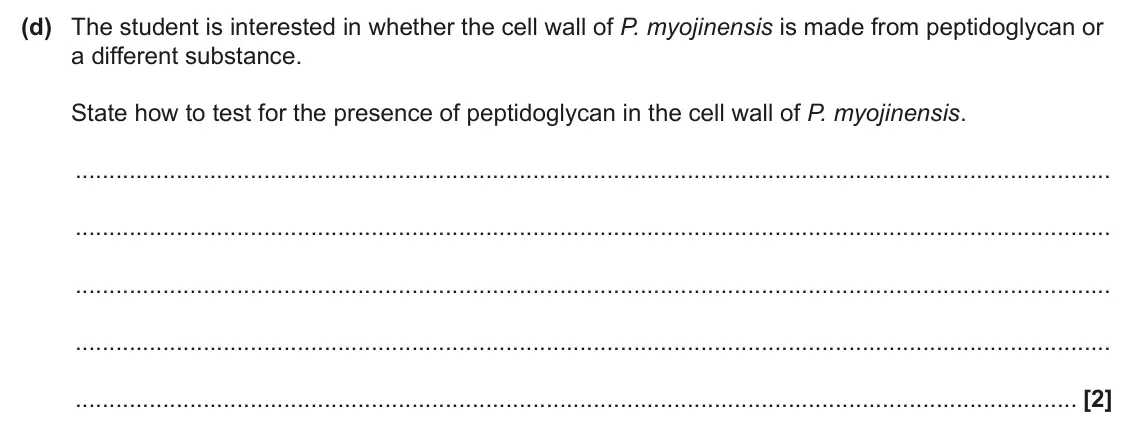
Q24(a)
The whole paper ↗
Q24(b)(i)
The whole paper ↗
Q24(b)(iii)
The whole paper ↗
Q24(b)(iv)
The whole paper ↗

Q36(a)
The whole paper ↗
Q36(b)(i)
The whole paper ↗
Q36(b)(iii)
The whole paper ↗
Q36(c)(i)
The whole paper ↗
Q36(c)(ii)
The whole paper ↗


All 83 questions on Pathogenic microorganisms, as a list
- June 2025, Paper 1, Q12 (1 mark): The diagram shows bacterial colonies after Gram-staining procedure. Pink-stained bacteria Purple-stained bacteria Which statement about the Gram-staining proced
- June 2025, Paper 1, Q32(a) (2 marks): Apart from breastfeeding, suggest and explain one other way in which HIV can be transmitted from an HIV-positive mother to their baby. [2]
- June 2025, Paper 1, Q32(b)(ii) (2 marks): ART involves taking a combination of medicines every day. These medicines often include an inhibitor of the enzyme reverse transcriptase. Explain how this inhib
- June 2025, Paper 3, Q3(d) (2 marks): The student is interested in whether the cell wall of P. myojinensis is made from peptidoglycan or a different substance. State how to test for the presence of
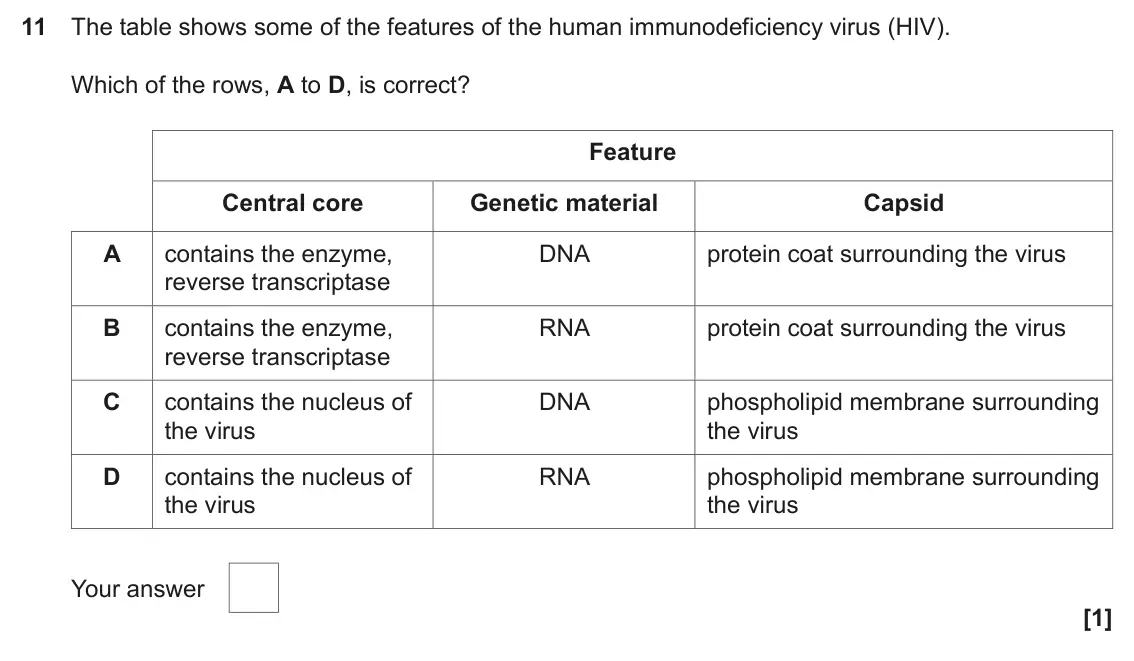
- June 2025, AS Paper 1, Q11 (1 mark): The table shows some of the features of the human immunodeficiency virus (HIV). Which of the rows, A to D, is correct? Feature Central core Genetic material Cap
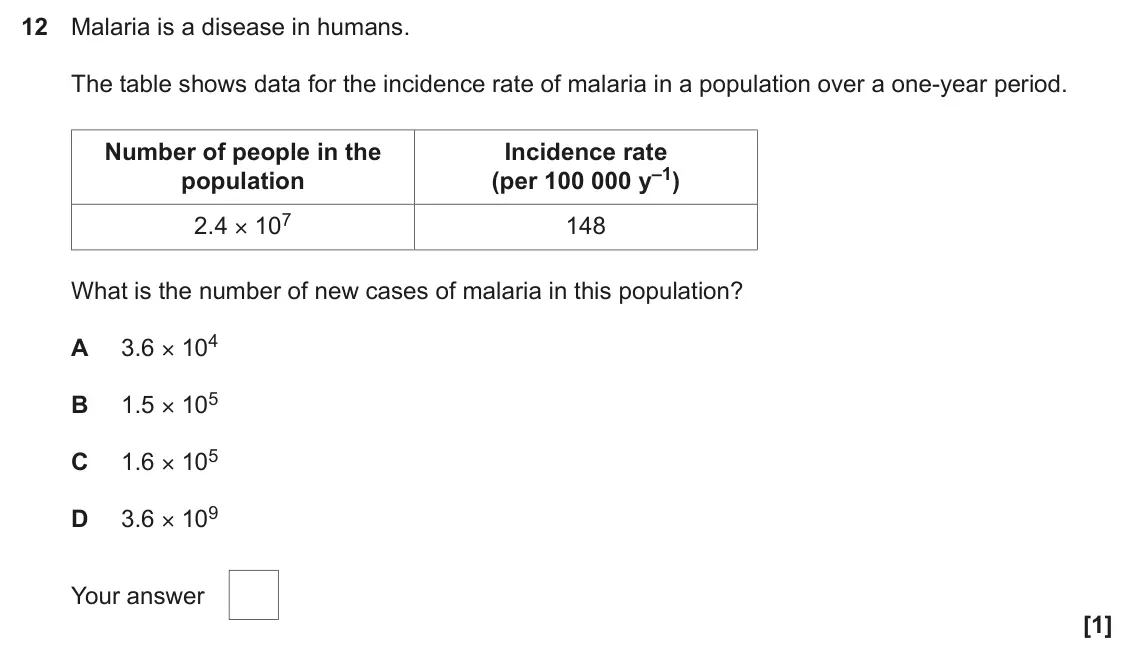
- June 2025, AS Paper 1, Q12 (1 mark): Malaria is a disease in humans. The table shows data for the incidence rate of malaria in a population over a one-year period. Number of people in the Incidence
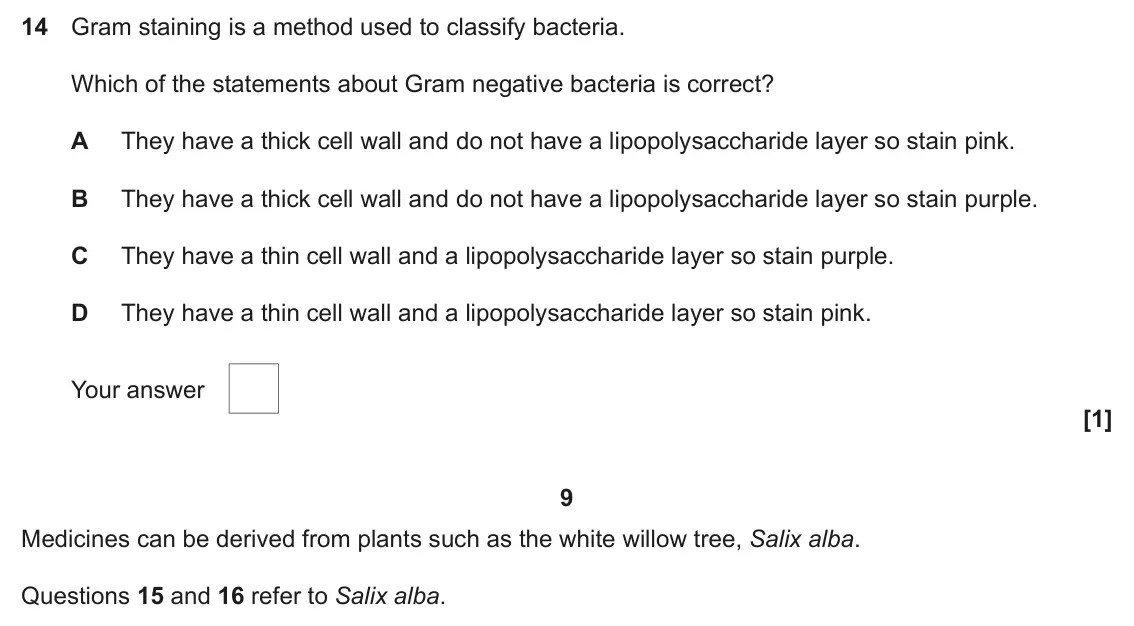
- June 2025, AS Paper 1, Q14 (1 mark): Gram staining is a method used to classify bacteria. Which of the statements about Gram negative bacteria is correct? A They have a thick cell wall and do not h
- June 2025, AS Paper 1, Q24(a) (4 marks): These are some revision notes made by a student about the features of acquired immunodeficiency syndrome (AIDS) and tuberculosis (TB). 1 AIDS is caused by the h
- June 2025, AS Paper 1, Q24(b)(i) (1 mark): State the name of a type of cell that is a host cell for HIV. [1]
- June 2025, AS Paper 1, Q24(b)(iii) (1 mark): Explain why a logarithmic scale is appropriate for presenting the data obtained in this study. [1]
- June 2025, AS Paper 1, Q24(b)(iv) (3 marks): Discuss how the data support the suggestion that dynamin is involved in the entry of HIV into host cells. [3]
- June 2025, AS Paper 2, Q5(a)(i) (4 marks): The following conclusions were drawn from the data in Figs. 5.1 and 5.2. • Urban communities have a better understanding of antibiotic use. • There is less risk
- June 2024, Paper 1, Q36(a) (3 marks): Complete the student’s diagram including labels to show the main components in the structure of HIV. [3]
- June 2024, Paper 1, Q36(b)(i) (2 marks): Explain how HIV protease enzymes are produced when the virus infects a host cell. [2]
- June 2024, Paper 1, Q36(b)(iii) (2 marks): Suggest how treatment with saquinavir leads to non-functional, immature and non-infectious HIV viruses. [2]
- June 2024, Paper 1, Q36(c)(i) (2 marks): Explain what the term syndrome means, using AIDS as an example. [2]
- June 2024, Paper 1, Q36(c)(ii) (2 marks): State two ways the spread of AIDS can be controlled. 1 2 [2]
- June 2024, AS Paper 1, Q15 (1 mark): Some of the stages of the Gram staining method used for identifying bacteria are shown below. 1 A counterstain, safranin, is added to the microscope slide. 2 A
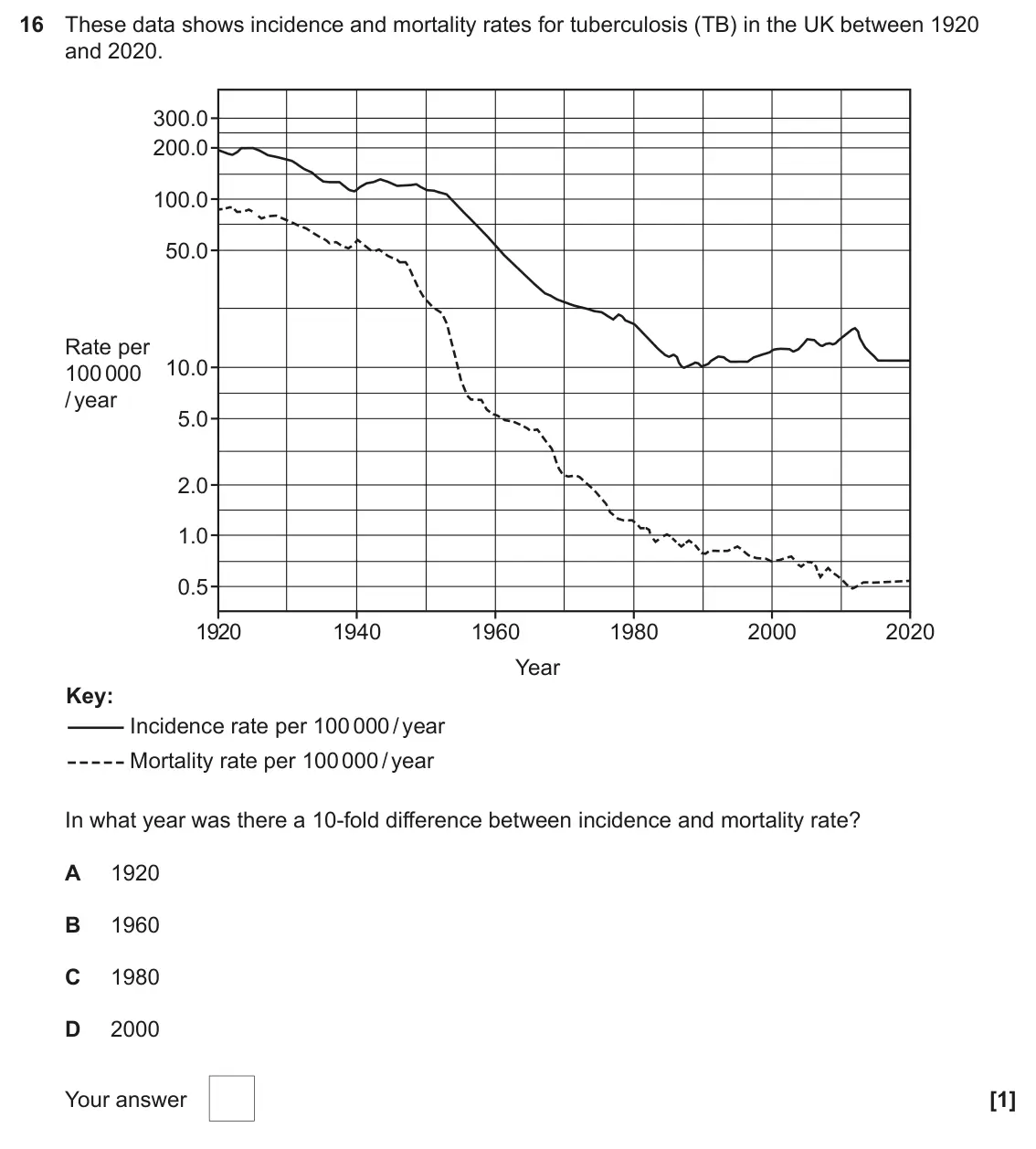
- June 2024, AS Paper 1, Q16 (1 mark): These data shows incidence and mortality rates for tuberculosis (TB) in the UK between 1920 and 2020. 300.0 200.0 100.0 50.0 Rate per 10.0 100 000 / year 5.0 2.
- June 2024, AS Paper 1, Q17 (1 mark): What would not be included in a campaign to prevent the spread of tuberculosis (TB)? A Chest x-rays for diagnosis B Treatment with antibiotics C Treatment with
- June 2023, Paper 1, Q17 (1 mark): The table below contains information about acquired immunodeficiency disease (AIDS). Pathogen Means of transmission Principal treatment A Bacteria Body fluids i
- June 2023, Paper 1, Q34(a) (1 mark): State the name of the pathogen that causes TB. [1]
- June 2023, Paper 1, Q34(b)(i) (1 mark): Suggest one advantage of recording data on notifiable diseases such as TB. [1]
- June 2023, Paper 1, Q34(b)(ii) (2 marks): In 2015 the population of the USA was estimated at 320 million people. Calculate the prevalence rate of TB in the USA in 2015. Give your answer to 3 significant
- June 2023, Paper 1, Q34(b)(iii) (1 mark): The overall trend in the data shows a decrease in the prevalence rate of TB. Suggest why there was an increase in prevalence rate that occurred between 1985 and
- June 2023, Paper 1, Q34(c)(i) (3 marks): Plot the results from the table on the grid. [3]
- June 2023, Paper 1, Q34(c)(ii) (4 marks): The following conclusions were drawn from these data: • The risk of TB increases with age. • Males have a greater risk of contracting TB than females. Evaluate
- June 2022, Paper 1, Q31(c)(iii) (1 mark): Suggest one reason why daptomycin may not be effective against gram negative bacteria. [1]
- June 2022, Paper 3, Q4(a) (3 marks): The table shows some of the features of Gram-positive and Gram-negative bacteria. Use ticks (3) to indicate in the table whether each feature is observed in Gra
- June 2022, AS Paper 1, Q6 (1 mark): The pie chart shows the percentage number of deaths in a population from respiratory diseases and from all other causes during a flu epidemic. A 4.6% B 22.9% 15
- June 2022, AS Paper 2, Q3(a)(i) (2 marks): Using Fig. 3.1, calculate the incidence rate of TB in 2018 per 100 000 of the population. Incidence rate = per 100 000 people [2]
- June 2022, AS Paper 2, Q3(a)(ii) (2 marks): Some people claim that TB will be eradicated from the UK by the year 2050. Comment on whether the data in Fig. 3.1 supports this claim. [2]
- June 2022, AS Paper 2, Q3(b) (3 marks): TB is a notifiable disease and is reported to Public Health England (PHE). State three ways that PHE can use data about the spread of TB to reduce the incidence
- June 2022, AS Paper 2, Q3(c)(i) (2 marks): Calculate how many times more likely an individual aged 65+ is to die from TB compared to an individual aged 0–14 years old. You can assume that the number of m
- June 2022, AS Paper 2, Q3(c)(ii) (2 marks): Give two reasons why comparing age groups in this way may not be a valid method. 1 2 [2]
- November 2021, Paper 2, Q1(a)(i) (2 marks): Describe how a virus replicates. [2]
- November 2021, Paper 2, Q1(a)(ii) (1 mark): Explain why myxomatosis could not be described as endemic in Australia before 1950. [1]
- November 2021, Paper 2, Q1(a)(iii) (1 mark): Explain why the myxomatosis outbreak in the 1950s could be described as an epidemic. [1]
- November 2021, Paper 2, Q1(b) (3 marks): HIV is a retrovirus but MYXV is not. Use this information and your knowledge to complete the following table by placing a tick (✓) if the feature is found in HI
- November 2021, Paper 2, Q1(c) (2 marks): The graph shows how the virulence of MYXV changed over the period from 1950 to 1990. 100 75 Virulence 50 (% of victims killed) 25 0 1950 1960 1970 1980 1990 Des
- November 2021, AS Paper 1, Q7 (1 mark): The graph below shows the infant mortality rate in the UK from 1930 to 2010. 60 50 infant mortality rate (deaths per 1000 live births) 40 30 20 10 0 1930 1940 1
- November 2021, AS Paper 1, Q8 (1 mark): Rubella is a viral disease that was eliminated from the UK population in 2015. Medical practitioners must report suspected cases to local authorities. Which of
- November 2021, AS Paper 1, Q23(a)(ii) (1 mark): A Gram stain can be used to identify the type of bacterium causing the infection. State one other method that can be used to identify different types of bacteri
- November 2021, AS Paper 2, Q4(a)(i) (2 marks): State the roles of the following structures. M N [2]
- November 2021, AS Paper 2, Q4(a)(ii) (1 mark): Identify molecule P. P [1]
- November 2021, AS Paper 2, Q4(b) (6 marks): It is estimated that 100 000 people in the UK carry the Human Immunodeficiency Virus (HIV). Fig. 4.1 shows the structure of HIV. M N P Fig. 4.1 (b)* The UK has
- November 2020, Paper 1, Q10 (1 mark): Which of the components, A to D, is not present in the human immunodeficiency virus? A glycoprotein B helicase C reverse transcriptase D RNA Your answer [1]
- November 2020, Paper 2, Q5(a)(i) (3 marks): A student concluded that there were two different species of bacteria in the culture. Evaluate the student’s conclusion. [3]
- November 2020, Paper 2, Q5(a)(ii) (6 marks): (ii)* Outline a practical procedure to obtain pure cultures of the bacterial species growing on the plate in Fig. 5.1. In your answer you should include the ste
- November 2020, Paper 2, Q5(b)(i) (2 marks): Explain what can be concluded about the types of bacteria present in this culture. [2]
- November 2020, Paper 2, Q5(b)(ii) (2 marks): Describe how Gram stain changes the colour of bacterial cells. [2]
- November 2020, AS Paper 1, Q10 (1 mark): The following procedure was used to calculate the number of bacteria in a culture: 10 cm3 of the bacterial culture was put into a test-tube • serial dilution wa
- November 2020, AS Paper 1, Q20 (1 mark): Which of the structures, A to D, would not be found in Gram-positive bacteria? A lipopolysaccharide envelope B plasmid C peptidoglycan cell wall D flagellum You
- November 2020, AS Paper 2, Q5(a)(i) (2 marks): Calculate the rate of increase in people living with HIV globally between 1990 and 1998. rate of increase = yr–1 [2]
- November 2020, AS Paper 2, Q5(a)(ii) (2 marks): Some scientists believe the rise in people living with HIV globally is proof that HIV has become a bigger problem since 1990. Using only the information in the
- November 2020, AS Paper 2, Q5(a)(iii) (1 mark): Suggest why the data given in the graph is an estimate of the number of deaths and not the actual value. [1]
- November 2020, AS Paper 2, Q5(c) (6 marks): Acquired immune deficiency syndrome (AIDS) is caused by the Human Immunodeficiency Virus (HIV). The graph shows the estimated global number of AIDS-related deat
- June 2019, Paper 1, Q31(a)(i) (2 marks): The population of the USA in 1993 was 260 million. Estimate the mortality rate of AIDS in the USA in 1993. mortality rate = deaths per 100 000 population [2]
- June 2019, Paper 1, Q31(a)(ii) (4 marks): Patients with HIV/AIDS are managed with highly active antiretroviral therapy (HAART), which was introduced in 1996. Discuss the effectiveness of HAART as a trea
- June 2019, Paper 1, Q31(b) (2 marks): HIV testing can prevent the spread of infection. In the UK, HIV testing must be carried out with consent from the patient. The results must be treated in a conf
- June 2019, Paper 1, Q31(e)(i) (2 marks): In the UK, TB is a notifiable disease. State two possible consequences of the reporting of a notifiable disease. 1 2 [2]
- June 2019, AS Paper 1, Q9 (1 mark): During a clinical trial, two groups of patients that had received blood transfusions were compared. Some of the results are shown below. Patient Number of Numbe
- June 2019, AS Paper 1, Q24(a)(i) (1 mark): Using A. fumigatus as an example, explain what is meant by the term opportunistic. [1]
- June 2019, AS Paper 1, Q24(a)(ii) (2 marks): Outline one mechanism used by pathogenic fungi such as A. fumigatus to infect body tissues. [2]
- June 2019, AS Paper 2, Q2(a)(iii) (2 marks): Cumulative incidence rate (CIR) can be used to estimate the risk of a disease in a population over a period of time. In 2007, 41 000 cases of lung cancer were d
- June 2019, AS Paper 2, Q6(a) (2 marks): Using the information in Fig. 6, suggest why the mortality rate from flu changes throughout the year. [2]
- June 2019, AS Paper 2, Q6(b) (2 marks): Droplets containing the flu virus are released into the air when an infected person coughs. Assume that: • approximately 3000 droplets are produced in a single
- June 2018, Paper 2, Q3(a)(i) (1 mark): State the name of one organism that causes TB. [1]
- June 2018, Paper 2, Q3(a)(ii) (2 marks): Explain why patients with pulmonary TB are advised to cover their mouths when coughing, to open windows when possible and not sleep in the same room as other pe
- June 2018, Paper 2, Q3(b)(i) (1 mark): State the type of nucleic acid that forms the genetic material of HIV. [1]
- June 2018, Paper 2, Q3(b)(ii) (1 mark): Identify the structures labelled B and C in Fig. 3. B C [1]
- June 2018, Paper 2, Q3(b)(iii) (2 marks): State the name and describe the function of the enzyme labelled A in Fig. 3. name function [2]
- June 2018, Paper 2, Q3(c)(i) (2 marks): There can be a long period (up to ten years) between infection and the onset of symptoms. [2]
- June 2018, Paper 2, Q3(c)(ii) (2 marks): A person infected with HIV becomes more susceptible to infections such as candidiasis, pneumonia and TB. [2]
- June 2018, AS Paper 1, Q13 (1 mark): The diagram shows a type of pathogen that can cause disease in humans. RNA lipid membrane reverse transcriptase Which of the statements, A to D, correctly descr
- June 2018, AS Paper 1, Q23(c)(i) (2 marks): Comment on the trends shown by the data in Fig. 23.2 for the infection caused by C.jejuni. [2]
- June 2018, AS Paper 1, Q23(c)(ii) (2 marks): The data for the infection caused by C.cayetanensis suggests that an epidemic occurred between the months of May and August. Comment on the validity of this sug
- June 2018, AS Paper 1, Q23(d)(ii) (3 marks): Using the information in Fig. 23.3 comment on and explain the results that would be obtained following Gram staining of a culture of C.jejuni. [3]
- June 2017, AS Paper 1, Q7 (1 mark): The table below shows the results of a survey investigating asthma in children from an urban population of China in 2010. Males Females Number in 6096 5986 popu
- June 2017, AS Paper 2, Q4(a) (6 marks): Tuberculosis (TB) is caused by the bacterium Mycobacterium tuberculosis. (a)* TB can be transmitted by droplet infection. It is also an opportunistic infection.
- June 2016, AS Paper 1, Q26(c)(i) (1 mark): RSV contains the enzyme reverse transcriptase. What type of nucleic acid will be found in RSV? [1]
- June 2016, AS Paper 2, Q4(b)(i) (1 mark): Streptococcus pneumoniae is a Gram-positive bacterium commonly found in the throat of humans. These bacteria can spread from person to person and may cause pneu
- June 2016, AS Paper 2, Q4(b)(ii) (3 marks): A sample of S. pneumoniae was prepared for viewing under a light microscope by Gram- staining a sample taken from a colony on an agar plate. Suggest three steps
Questions, mark schemes and examiner’s reports are © OCR, from their published past papers. Plumi isn’t affiliated with any exam board. Want whole papers? Every OCR A-Level Biology B paper.
Rather write your answers by hand on iPad? Plumi marks them against the same mark schemes.