 plumi
Controlling communicable diseases: OCR A‑Level Biology B questions
Every OCR A-Level Biology B exam question on 3.2.3 Controlling communicable diseases, 2016–2025, with its mark scheme and examiner’s report.
Find questions1,889
Calculations

Q32(d)
The whole paper ↗


Q31(d)
The whole paper ↗
Q4(b)(i)
The whole paper ↗
Q4(b)(ii)
The whole paper ↗
Q4(a)(i)
The whole paper ↗
Q4(a)(ii)
The whole paper ↗
Q4(b)
The whole paper ↗
Q4(c)(i)
The whole paper ↗
Q4(c)(ii)
The whole paper ↗
Q4(d)
The whole paper ↗
Q1(d)(ii)
The whole paper ↗
All 67 questions on Controlling communicable diseases, as a list
- June 2025, Paper 1, Q13 (1 mark): Amoxicillin is an antibiotic that can be used to treat bacterial infections in young children. A one-year-old child with a mass of 10 kg requires 40 mg kg–1 of
- June 2025, Paper 1, Q32(d) (6 marks): Mothers infected with the human immunodeficiency virus (HIV) are usually discouraged from breastfeeding as the virus can be transmitted from mother to baby duri
- June 2025, AS Paper 2, Q5(a)(ii) (3 marks): Outline how a population of M. tuberculosis may become multi-drug resistant. [3]
- June 2025, AS Paper 2, Q5(b)(i) (2 marks): Explain why capreomycin is safe for human use. [2]
- June 2025, AS Paper 2, Q5(b)(ii) (1 mark): Suggest why capreomycin may cause some side effects despite being safe for human use. [1]
- June 2024, Paper 1, Q29 (1 mark): What is an advantage of live-attenuated vaccines? A Can be given to people with compromised immune systems B Can trigger the production of antitoxins as they co
- June 2024, AS Paper 1, Q20 (1 mark): The MMR (Measles, Mumps and Rubella) vaccine uses modified versions of the viruses to give long lasting immunity. What type of vaccine describes the MMR vaccine
- June 2023, Paper 1, Q18 (1 mark): The graph shows data for Staphylococcus aureus infections in a population over a 10-year period. No. of infections Percentage of methicillin-resistant infection
- June 2022, Paper 1, Q31(d) (2 marks): The bactericidal activity of some antibiotics is concentration-dependent which means that the higher the concentration of antibiotic given to a patient, the gre
- June 2022, Paper 3, Q4(b)(i) (2 marks): The bacteria in the control group were suspended in 10 cm3 of a nutrient solution at the beginning of the experiment. Estimate the number of bacterial cells in
- June 2022, Paper 3, Q4(b)(ii) (6 marks): The structure of bacterial cells determines how they are identified and the type of antibiotics that are used against them. (ii)* Describe and explain the resul
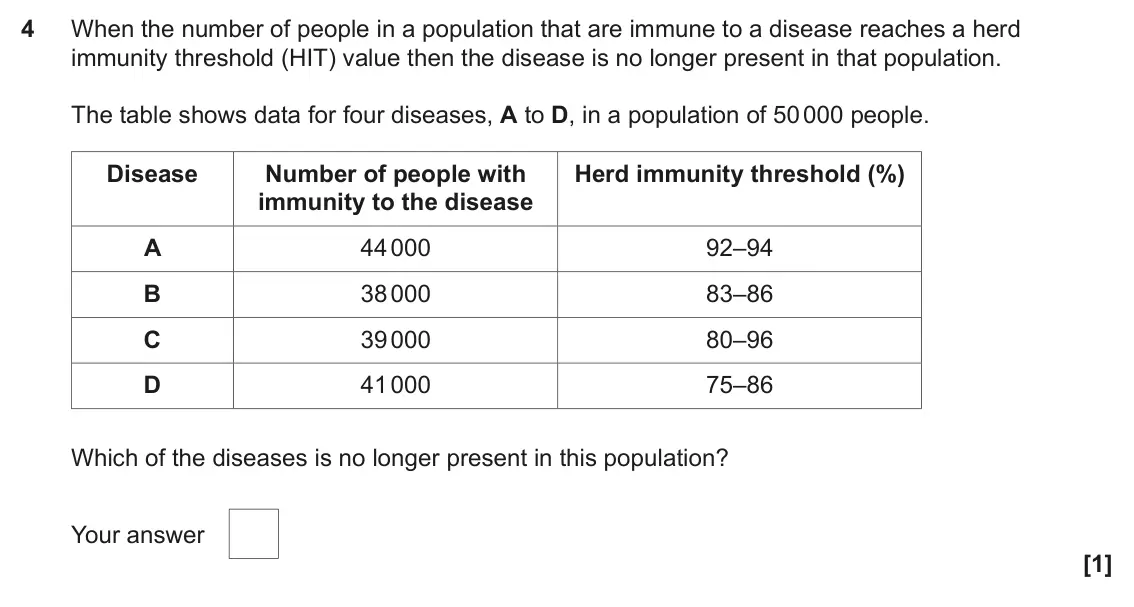
- June 2022, AS Paper 1, Q4 (1 mark): When the number of people in a population that are immune to a disease reaches a herd immunity threshold (HIT) value then the disease is no longer present in th
- June 2022, AS Paper 2, Q4(a)(i) (1 mark): Explain why it is not possible to contract meningitis B from an inactivated vaccine. [1]
- June 2022, AS Paper 2, Q4(a)(ii) (2 marks): There are currently no live vaccines for meningitis B. Explain one advantage and one disadvantage of using a live vaccine. Advantage Disadvantage [2]
- June 2022, AS Paper 2, Q4(b) (2 marks): Give one reason for and one reason against giving vaccines to healthy babies when they are under one year old. For Against [2]
- June 2022, AS Paper 2, Q4(c)(i) (1 mark): Some premature babies are unable to have the meningitis B vaccine. Explain why it is important for premature babies that as many other babies as possible are va
- June 2022, AS Paper 2, Q4(c)(ii) (2 marks): One reason that premature babies may not be given the meningitis B vaccine is that they can be born suffering from protein deficiency. Babies born with protein
- June 2022, AS Paper 2, Q4(d) (6 marks): In the first year of life, a baby will be given a vaccination against meningitis B. There are two types of meningitis B vaccine. Both are inactivated vaccines.
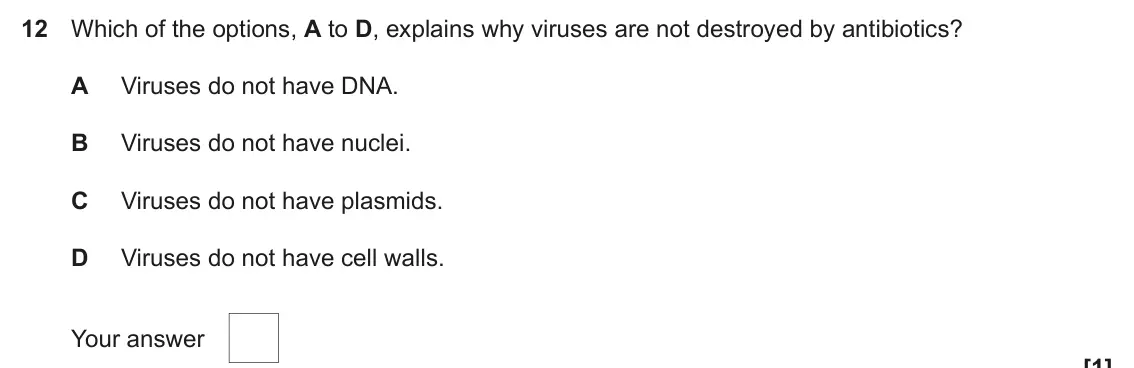
- November 2021, Paper 1, Q12 (1 mark): Which of the options, A to D, explains why viruses are not destroyed by antibiotics? A Viruses do not have DNA. B Viruses do not have nuclei. C Viruses do not h
- November 2021, Paper 2, Q1(d)(ii) (3 marks): The article discusses how resistance to infection can be affected by two common agricultural practices: vaccination and selective breeding. Explain how vaccinat
- November 2021, Paper 2, Q1(d)(iii) (2 marks): Explain why vaccination might not prevent epidemics of Marek’s disease in poultry. [2]
- November 2021, Paper 2, Q1(d)(iv) (4 marks): Evaluate the suggestion that birds should be bred for susceptibility to MDV rather than resistance. [4]
- November 2021, AS Paper 1, Q23(a)(i) (2 marks): Suggest one advantage and one disadvantage of using antibiotics to treat sepsis before test results confirm the type of bacterium causing the infection. advanta
- November 2021, AS Paper 1, Q23(a)(iii) (4 marks): Outline a method that could be used to select an antibiotic specific to the type of bacterium. [4]
- November 2021, AS Paper 1, Q23(b) (2 marks): Viral infections can also cause sepsis but treatment with antibiotics is ineffective. Suggest two reasons why antibiotics are effective against bacteria but not
- November 2021, AS Paper 2, Q6(c) (2 marks): Plant research is an important part of biology as plants are a potential source of medicinal drugs. Describe how a scientist could investigate if a plant extrac
- November 2020, Paper 1, Q19 (1 mark): Which of the following statements is/are true of herd immunity? 1: Herd immunity can protect against all diseases. 2: Herd immunity may eventually eradicate a d
- November 2020, Paper 2, Q5(c)(i) (3 marks): Evaluate the student’s conclusions. [3]
- November 2020, Paper 2, Q5(c)(ii) (2 marks): Describe two improvements that could be made to the student’s method to increase the accuracy of their results. 1. 2. [2]
- November 2020, Paper 2, Q5(c)(iii) (1 mark): Suggest the mechanism of action of penicillin. [1]
- November 2020, Paper 2, Q5(c)(iv) (1 mark): Suggest how the mechanism of action of polymyxin B differs from that of penicillin. [1]
- November 2020, Paper 2, Q5(c)(v) (3 marks): Outline an experiment to distinguish between a bactericidal antibiotic and a bacteriostatic antibiotic. [3]
- November 2020, AS Paper 2, Q2(b) (6 marks): Human Papilloma Virus (HPV) has been linked to the development of cervical cancer. A study was carried out involving 1000 women from five hospital trusts. The t
- November 2020, AS Paper 2, Q5(b) (2 marks): Discuss the effectiveness of antibiotics in the treatment of AIDS. [2]
- June 2019, Paper 1, Q31(c) (3 marks): Vaccines against HIV are currently being developed: • to protect individuals from contracting HIV • to boost the immune response in HIV-positive individuals. Ex
- June 2019, Paper 1, Q31(d)(i) (1 mark): The vaccine contains a purified viral protein known as Tat, which is required for transcription of the HIV genome. State one advantage of using purified Tat pro
- June 2019, Paper 1, Q31(d)(ii) (2 marks): Fig. 31.2 shows CD4 cell levels over time in patients immunised with 7.5 µg or 30 µg Tat protein. 110 Key 7.5 μg 100 30 μg 90 80 70 CD4 cells 60 μl–1 blood 50 4
- June 2019, Paper 1, Q31(e)(ii) (1 mark): Active TB infection is treated with a combination of antibiotics. The cell wall of the TB pathogen Mycobacterium tuberculosis is strengthened by complex lipid m
- June 2019, Paper 1, Q31(e)(iii) (3 marks): Multi-drug resistance is a major challenge in the treatment of patients with TB. Outline how a population of M. tuberculosis may become resistant to antibiotics
- June 2019, AS Paper 1, Q25(a)(ii) (2 marks): A vaccine against HPV has been developed to protect young women from cervical cancer. It has been suggested that young men could also benefit from this vaccine.
- June 2019, AS Paper 2, Q6(c)(i) (2 marks): The UK has a routine flu vaccination programme which is free for ‘at risk’ groups. ‘At risk’ groups include diabetic and immuno-compromised patients. Describe t
- June 2019, AS Paper 2, Q6(c)(ii) (2 marks): Suggest why a different flu vaccine is required each year. [2]
- June 2018, Paper 1, Q18 (1 mark): Scientists are producing a vaccine against a disease-causing bacterium. The table below shows the locations and mutation rates of four proteins, A to D, in the
- June 2018, Paper 2, Q3(a)(iii) (2 marks): Most bacterial infections are treated with a single antibiotic for 7–10 days. Explain why TB requires treatment with a combination of antibiotics for a much lon
- June 2018, Paper 3, Q4(c)(i) (3 marks): Calculate the Spearman’s rank correlation coefficient for these data. You may complete Table 4.2 to help you with your working. Give your answer to four decimal
- June 2018, Paper 3, Q4(c)(ii) (3 marks): Use Table 4.3 to decide if the null hypothesis was correct. [3]
- June 2018, AS Paper 1, Q17 (1 mark): Carbapenems are a class of broad-spectrum antibiotics. In recent years, there has been an increase in the number of carbapenem-resistant strains of bacteria. Wh
- June 2018, AS Paper 2, Q4(b) (2 marks): The BCG vaccination can be given to babies and young children considered to be at high risk of contracting TB. • In 2004, approximately 95 000 babies born in th
- June 2017, Paper 1, Q6 (1 mark): Which of the options, A to D, is a cellular target of a bacteriostatic antibiotic? A cell wall B plasma membrane C 70S ribosome D 80S ribosome Your answer [1]
- June 2017, Paper 1, Q34(b)(i) (4 marks): Using the information in Table 34, evaluate the effectiveness of different vaccination regimes. [4]
- June 2017, Paper 2, Q5(a)(i) (1 mark): The MenB vaccine is a subunit vaccine. Explain what is meant by a subunit vaccine. [1]
- June 2017, Paper 2, Q5(a)(ii) (1 mark): Parents have been reassured that the MenB vaccine cannot cause meningitis in their children. Explain why the MenB vaccine cannot cause the disease. [1]
- June 2017, Paper 2, Q5(a)(iii) (2 marks): The MenB vaccine has also been shown to be effective against other types of meningococcal infection. Suggest why. [2]
- June 2017, Paper 2, Q5(b) (6 marks): The MenB vaccine was developed to protect against disease caused by the bacterium Neisseria meningitidis. Infection with this bacterium (meningococcal infection
- June 2017, Paper 3, Q5(d) (4 marks): A sample of bacteria from a patient with pneumonia was collected and a pure culture was prepared. A Kirby-Bauer test was carried out to allow the doctor treatin
- June 2017, Paper 3, Q5(e) (3 marks): Fig. 5.2 shows the result of the Kirby-Bauer test. B A C bacteria F D E Fig. 5.2 Use the information in Fig. 5.2 to advise the doctor on the most appropriate co
- June 2017, AS Paper 1, Q13 (1 mark): A group of students was investigating the effect of different antibiotics on the growth of colonies of the bacterium, Escherichia coli. The results are shown be
- June 2017, AS Paper 1, Q25(a) (3 marks): Type of vaccine Features of the vaccine Advantage Non-pathogenic, modified strains of the bacteria or virus are used Isolated Can produce vaccines extracted for
- June 2017, AS Paper 1, Q25(b)(i) (1 mark): What was the purpose of group two in this trial? [1]
- June 2017, AS Paper 1, Q25(b)(ii) (2 marks): Discuss the ethical issues related to this trial. [2]
- June 2017, AS Paper 1, Q25(b)(iii) (2 marks): Using the information, evaluate the effectiveness of the rVSV-ZEBOV vaccine. [2]
- June 2017, AS Paper 2, Q4(b)(i) (3 marks): Explain how isoniazid causes the death of M. tuberculosis cells. [3]
- June 2017, AS Paper 2, Q4(b)(ii) (1 mark): Isoniazid kills bacterial cells but has no effect on human cells. Explain why. [1]
- June 2016, AS Paper 1, Q26(c)(ii) (1 mark): Currently, no vaccines have been developed for preventing RSV infection. Suggest one biological problem in developing a vaccine for RSV. [1]
- June 2016, AS Paper 2, Q4(a) (2 marks): Suggest why the zone of inhibition is smaller on the plate with the Gram-negative bacteria. [2]
- June 2016, AS Paper 2, Q4(d)(i) (2 marks): Using Fig. 4.2, calculate the mean percentage decrease per year in the number of MDR-TB cases between 2000 and 2010. Show your working. Answer = % [2]
- June 2016, AS Paper 2, Q4(d)(ii) (3 marks): Scientists have concluded that the increase in MDR-TB cases is due to the overuse of antibiotics. Evaluate this conclusion using the data in Fig. 4.2. [3]
Questions, mark schemes and examiner’s reports are © OCR, from their published past papers. Plumi isn’t affiliated with any exam board. Want whole papers? Every OCR A-Level Biology B paper.
Rather write your answers by hand on iPad? Plumi marks them against the same mark schemes.