 plumi
Transpiration: OCR A‑Level Biology A questions
OCR A-Level Biology A past-paper questions on 3.1.3.2 Transpiration, 2016–2025, with mark schemes and examiner’s reports where available.
Paper
All papers
Exam
All years
Calculations
Q3(c)(i)
The whole paper ↗
Q3(c)(ii)
The whole paper ↗- Your answer
Q21(b)(iii)
The whole paper ↗Q2(a)(i)
The whole paper ↗Q2(a)(ii)
The whole paper ↗Q2(b)(i)
The whole paper ↗Q2(b)(ii)
The whole paper ↗Q2(b)(iii)
The whole paper ↗Q2(c)
The whole paper ↗Q20(a)
The whole paper ↗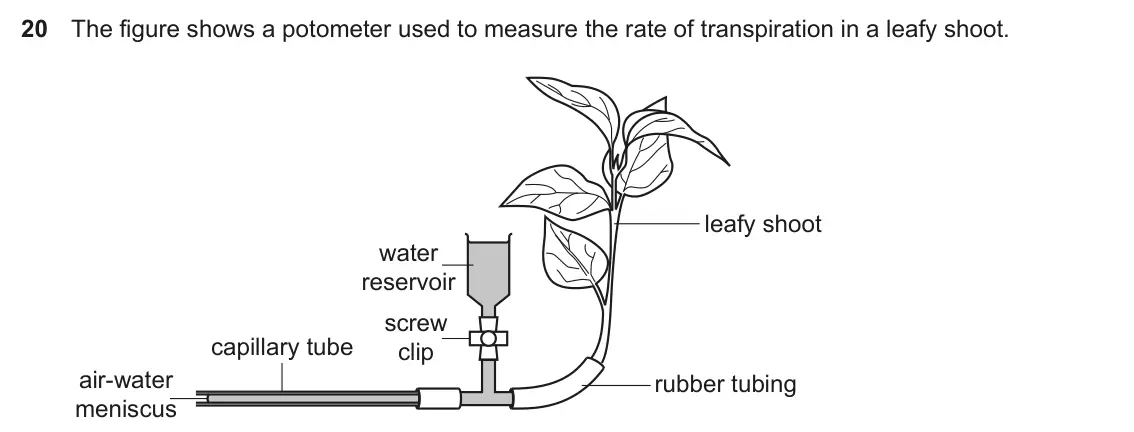
Q20(b)(i)
The whole paper ↗Q20(b)(ii)
The whole paper ↗Q20(c)(i)
The whole paper ↗Q20(c)(ii)
The whole paper ↗- Your answer
- Your answer
Q24(a)
The whole paper ↗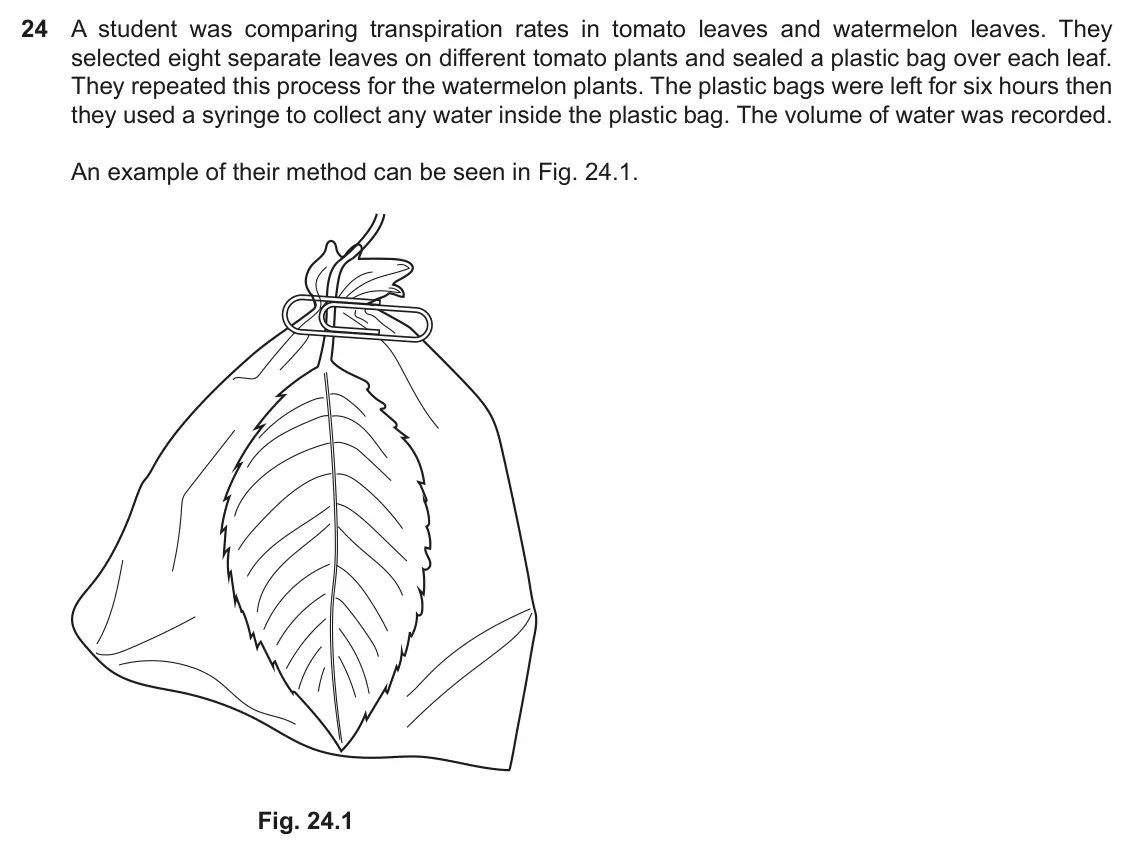
Q24(b)
The whole paper ↗Q24(c)
The whole paper ↗
All 33 questions on Transpiration, as a list
- June 2024, Paper 3, Q3(c)(i) (2 marks): The scientist plans to calculate the rate of transpiration by measuring the distance moved by the air bubble. The scientist carries out a preliminary trial by m
- June 2024, Paper 3, Q3(c)(ii) (6 marks): Xylem vessels maintain the transpiration stream by transporting water up plant stems. (ii)* Describe how the scientist could use the potometer to collect the da
- June 2024, AS Paper 1, Q7 (1 mark): A potometer was used to estimate the rate of transpiration. The graph below shows the results from the experiment. 80 60 Volume of water taken up 40 by plant sh
- June 2023, Paper 1, Q21(b)(iii) (2 marks): Explain why plants growing in high light intensity require more water than plants growing in shade, even when the temperatures are the same. [2]
- June 2023, AS Paper 2, Q2(a)(i) (1 mark): State the cause of transpiration in plants. [1]
- June 2023, AS Paper 2, Q2(a)(ii) (1 mark): Two factors that affect the rate of transpiration in plants are humidity and air movement. Name one other factor that affects the rate of transpiration in plant
- June 2023, AS Paper 2, Q2(b)(i) (3 marks): Suggest three improvements the students could have made to their investigation. Improvement 1 Improvement 2 Improvement 3 [3] 8 The students’ results are shown
- June 2023, AS Paper 2, Q2(b)(ii) (2 marks): Complete the table by filling in the missing values for mean and rate of bubble movement for group A. Give your answers to 1 decimal place. Mean = mm Rate of bu
- June 2023, AS Paper 2, Q2(b)(iii) (1 mark): State the conclusion that can be drawn from the students’ results. [1]
- June 2023, AS Paper 2, Q2(c) (2 marks): The students wanted to see how air movement affects rate of transpiration. Describe how you would modify the apparatus shown in Fig. 2.1 and Fig. 2.2 to determi
- November 2021, Paper 1, Q20(a) (2 marks): Besides safety precautions, explain one practical precaution that should be taken when using a potometer. Precaution Explanation [2]
- November 2021, Paper 1, Q20(b)(i) (2 marks): Calculate the standard deviation for the distance travelled when the fan was switched on. 2 / ( x x ) - Use the formula: s = n 1 - Give your answer to 2 signifi
- November 2021, Paper 1, Q20(b)(ii) (1 mark): What can you conclude from comparing the standard deviations of the two means? [1]
- November 2021, Paper 1, Q20(c)(i) (2 marks): The student wanted to estimate the total leaf surface area of the shoot. At the end of the investigation they removed all the leaves from the shoot. They placed
- November 2021, Paper 1, Q20(c)(ii) (2 marks): In this investigation, the student calculated the rate of transpiration to be 30 mm3 min–1. They estimated the total leaf surface area of the shoot to be 37 cm2
- November 2021, AS Paper 1, Q5 (1 mark): The rate of transpiration of water can be estimated by recording the rate of water uptake using a potometer. Two potometers were set up, one with large leaves a
- November 2020, Paper 1, Q7 (1 mark): Which of the following statements about water transport in plants is/are correct? 1 Transpiration happens as a consequence of the need for gas exchange. 2 There
- November 2020, AS Paper 1, Q24(a) (4 marks): Identify two problems with this method and for each problem suggest how the method can be improved. 1 2 [4]
- November 2020, AS Paper 1, Q24(b) (2 marks): The results of the experiment are shown in Fig. 24.2. 0.05 0.04 0.03 volume of water collected after 6 hours per area of leaf (cm3 cm–2) 0.02 0.01 0 tomato wate
- November 2020, AS Paper 1, Q24(c) (4 marks): Describe how a potometer can be used to calculate a more accurate rate of transpiration. [4]
- June 2019, AS Paper 1, Q22(a) (3 marks): Table 22 is a list of practical apparatus used in biological investigations. Each piece of apparatus has been assigned a letter. Letter Apparatus A calorimeter
- June 2019, AS Paper 2, Q4(a)(i) (1 mark): State what assumption is made when using this apparatus to measure the rate of transpiration. [1]
- June 2019, AS Paper 2, Q4(a)(ii) (6 marks): An investigation was carried out into the loss of water from a leafy shoot. The apparatus used is shown in Fig. 4.1. water leafy shoot syringe rubber tube tap a
- June 2019, AS Paper 2, Q4(b)(i) (3 marks): Identify an anomalous reading in the data and evaluate the extent to which it has affected the mean that has been calculated. [3]
- June 2019, AS Paper 2, Q4(b)(ii) (1 mark): Suggest a reason for the reading that you identified as anomalous in (i). [1]
- June 2019, AS Paper 2, Q4(b)(iii) (3 marks): The internal diameter of the capillary tubing was 0.7 mm. Table 4.2 shows the mean rate of transpiration in each of the experimental conditions. Mean rate of tr
- June 2019, AS Paper 2, Q4(b)(iv) (1 mark): The control experiment in this investigation was to measure the mean rate of transpiration in still air. Explain why the control experiment is carried out in th
- June 2019, AS Paper 2, Q4(c) (1 mark): Another student suggested using an alternative apparatus for measuring the rate of transpiration of a leafy shoot. Fig. 4.2 shows this apparatus. leafy shoot ca
- June 2019, AS Paper 2, Q4(d) (2 marks): The student wanted to compare the rates of transpiration of the two leafy shoots shown in Fig. 4.3. Fig. 4.3 Describe how the student could ensure that a valid
- June 2018, Paper 1, Q6 (1 mark): Which of the statements, A to D, applies to transpiration and evaporation? A It occurs at a faster rate at higher humidity. B It occurs at a slower rate at grea
- June 2018, Paper 1, Q18(a) (6 marks): (a)* Plants lose water by transpiration. The rate of transpiration varies between different species of plant. The rate of transpiration can be measured using a
- June 2018, AS Paper 1, Q3 (1 mark): A student designed an investigation into the rate of transpiration in plants. They used eight leaves of the same size, age and species. They kept environmental
- June 2016, AS Paper 1, Q13 (1 mark): A diagram of a potometer is shown below. screw clip air bubble Which of the following options, A to D, is a precaution that is not needed when setting up a poto
Questions, mark schemes and examiner’s reports are © OCR, from their published past papers. Plumi isn’t affiliated with any exam board. Want whole papers? OCR A-Level Biology A past papers, or our free OCR-style practice pack.
The Plumi iPad app also offers exam-style questions with AI feedback on your handwritten working.