 plumi
Temperature control: OCR A‑Level Biology A questions
OCR A-Level Biology A past-paper questions on 5.1.1.3 Temperature control, 2016–2025, with mark schemes and examiner’s reports where available.
Paper
All papers
Exam
All years
Calculations
Q20(a)(i)
The whole paper ↗Q20(a)(ii)
The whole paper ↗Q20(b)
The whole paper ↗Q20(c)(i)
The whole paper ↗Q2(a)(i)
The whole paper ↗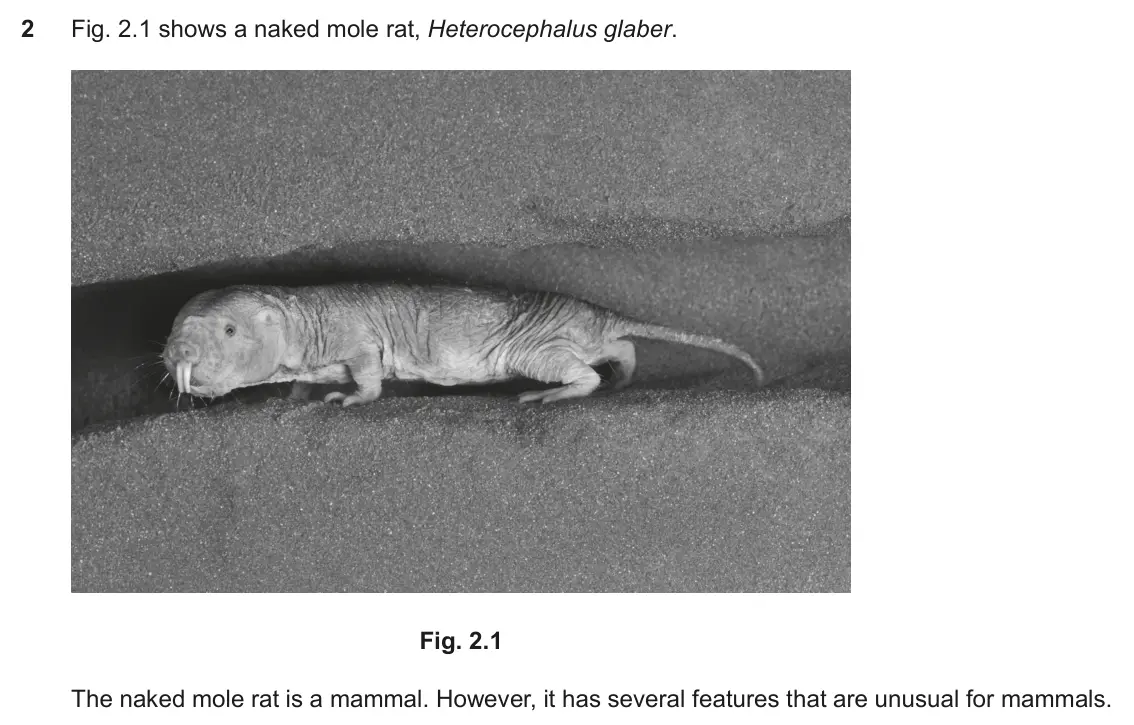
Q2(a)(ii)
The whole paper ↗Q2(a)(iii)
The whole paper ↗- Your answer
Q16(a)(i)
The whole paper ↗Q16(a)(ii)
The whole paper ↗
All 10 questions on Temperature control, as a list
- June 2023, Paper 1, Q20(a)(i) (1 mark): Define the term endotherm. [1]
- June 2023, Paper 1, Q20(a)(ii) (2 marks): Suggest one advantage and one disadvantage that ectotherms have compared to endotherms. Advantage Disadvantage [2]
- June 2023, Paper 1, Q20(b) (6 marks): (b)* During a class discussion, one student stated: ‘Ectotherms cannot control their body temperature.’ Another student stated: ‘Ectotherms control their body t
- June 2023, Paper 1, Q20(c)(i) (2 marks): Suggest the consequences of an increase in the thermogenic set point. [2]
- June 2019, Paper 3, Q2(a)(i) (2 marks): Some features of thermoregulation in naked mole rats are listed below: • They live in complex underground tunnel systems, which tend to have a stable temperatur
- June 2019, Paper 3, Q2(a)(ii) (4 marks): In humans, when core body temperature falls below 35 °C, positive feedback causes this decrease in core body temperature to continue. This process is known as h
- June 2019, Paper 3, Q2(a)(iii) (2 marks): Mammals, including naked mole rats, have temperature receptors that play a role in thermoregulation. The table below lists four statements about mammalian tempe
- June 2017, Paper 1, Q1 (1 mark): Which of the options, A to D, correctly describes how an endotherm would respond to an increase in temperature? A dilation of arterioles near the surface of the
- June 2017, Paper 1, Q16(a)(i) (1 mark): Using the information provided, explain why many moths and bumblebees are described as endothermic. [1]
- June 2017, Paper 1, Q16(a)(ii) (2 marks): It is more difficult for moths and bumblebees to maintain their body temperature than for mammals and birds to maintain their body temperature. Explain why. [2]
Questions, mark schemes and examiner’s reports are © OCR, from their published past papers. Plumi isn’t affiliated with any exam board. Want whole papers? OCR A-Level Biology A past papers, or our free OCR-style practice pack.
The Plumi iPad app also offers exam-style questions with AI feedback on your handwritten working.