 plumi
Ecosystems: OCR A‑Level Biology A questions
Every OCR A-Level Biology A exam question on 6.3.1 Ecosystems, 2016–2025, with its mark scheme and examiner’s report.
Find questions1,984
Calculations


Q20(a)(i)
The whole paper ↗
Q20(a)(ii)
The whole paper ↗
Q20(a)(iii)
The whole paper ↗
Q20(b)(i)
The whole paper ↗
Q20(b)(ii)
The whole paper ↗
Q20(b)(iii)
The whole paper ↗
Q21(a)
The whole paper ↗
Q21(b)
The whole paper ↗

Q20(a)(i)
The whole paper ↗
Q20(a)(ii)
The whole paper ↗
Q20(c)(i)
The whole paper ↗
Q20(c)(ii)
The whole paper ↗
Q17(a)(i)
The whole paper ↗
Q17(a)(ii)
The whole paper ↗
Q17(a)(iii)
The whole paper ↗
All 43 questions on Ecosystems, as a list
- June 2025, Paper 2, Q14 (1 mark): Land can be used for producing food for human populations. A 50 m2 field can support a larger human population if used for growing crops for plant-based foods t
- June 2024, Paper 2, Q1 (1 mark): Biomass is transferred through ecosystems. What process makes biomass available for transfer to the next trophic level in the food chain? A Excretion B Growth C
- June 2024, Paper 2, Q2 (1 mark): What explains why food chains rarely have more than five trophic levels? A Parts of the food organism are not eaten by organisms higher in the food chain. B Pla
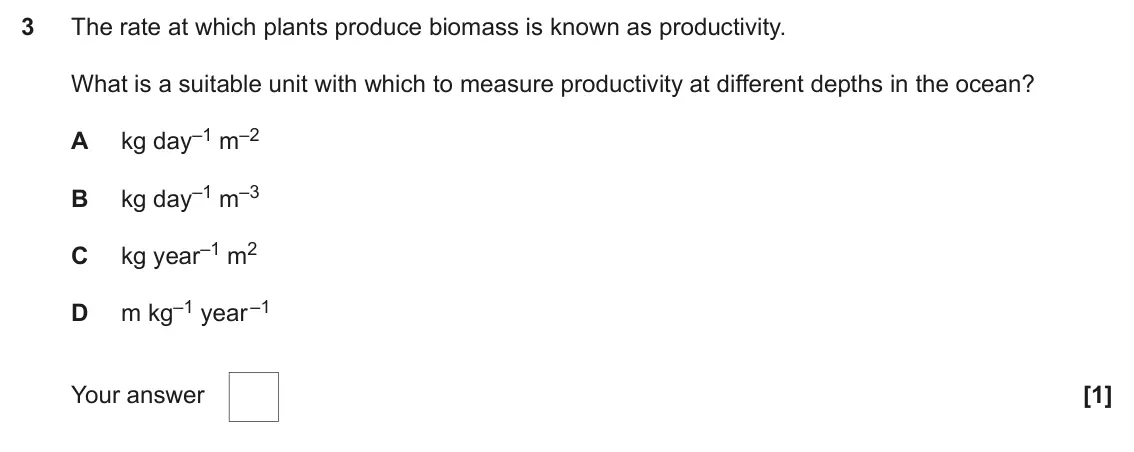
- June 2024, Paper 2, Q3 (1 mark): The rate at which plants produce biomass is known as productivity. What is a suitable unit with which to measure productivity at different depths in the ocean?
- June 2024, Paper 2, Q20(a)(i) (3 marks): 2 / ( O E ) - 2 Use the equation | = E You may use the empty columns in the table to help with your calculation. |2 = [3]
- June 2024, Paper 2, Q20(a)(ii) (3 marks): The critical value for |2 in this investigation at p = 0.05 is 5.991. Discuss what can be concluded from the |2 calculation in part (a)(i). [3]
- June 2024, Paper 2, Q20(a)(iii) (2 marks): The teacher suggested that, in order to have confidence in their results, the students should include data from more than one tree for each species. The student
- June 2024, Paper 2, Q20(b)(i) (6 marks): The teacher described the mixed woodland as a climax community that had resulted from succession. Succession involves a series of changes in community over time
- June 2024, Paper 2, Q20(b)(ii) (1 mark): Succession involves changes in the species that live in an area over time. State one other change that takes place in the same area over the same time. [1]
- June 2024, Paper 2, Q20(b)(iii) (1 mark): Suggest what was present in the area that is now occupied by mixed woodland before the pioneer community arrived. [1]
- June 2023, Paper 2, Q21(a) (6 marks): Complete the sentences using the most appropriate terms. When animals die microorganisms convert nitrogen-containing molecules in the animals’ bodies to ammonia
- June 2023, Paper 2, Q21(b) (2 marks): Use your knowledge of the nitrogen cycle to suggest and explain why plants do not grow well in soil with a low oxygen content. [2]
- June 2022, Paper 2, Q11 (1 mark): Nitrobacter is a bacterium that is involved in recycling nitrogen in an ecosystem. Which nitrogen cycle reaction is carried out by Nitrobacter? − + O2 → 2NO3 −
- June 2022, Paper 2, Q20(a)(i) (1 mark): Suggest an improvement to the method that would allow the distribution of plants to be measured. [1]
- June 2022, Paper 2, Q20(a)(ii) (2 marks): Identify a limitation with step 3 of the students’ method and explain why this limitation might affect the data collected. [2]
- June 2022, Paper 2, Q20(c)(i) (1 mark): Suggest one other advantage of using an ACFOR rating scale for the students’ survey. [1]
- June 2022, Paper 2, Q20(c)(ii) (1 mark): Suggest one limitation of using an ACFOR rating scale, instead of quadrat sampling, to rate the abundance of plant species. [1]
- November 2021, Paper 2, Q17(a)(i) (2 marks): In one year, 8.94 × 10⁹ kJ m–2 of PAR fell on an area of heather moorland. The heather plants then converted 9.08 × 10⁷ kJ m–2 of this energy into biomass. Calc
- November 2021, Paper 2, Q17(a)(ii) (1 mark): Scientists were able to estimate the increase in biomass in heather plants in one year. Suggest how the increase in biomass over time in a plant such as heather
- November 2021, Paper 2, Q17(a)(iii) (1 mark): Some of the solar radiation that falls on the leaves of plants is reflected. Some solar radiation is of a wavelength that is not suitable for use in photosynthe
- November 2021, Paper 2, Q17(a)(iv) (2 marks): Suggest and explain why the percentage of biomass transferred between heather and grouse is smaller than the percentage of biomass transferred between grouse an
- November 2021, Paper 2, Q17(d) (6 marks): Heather is a plant with a woody stem that grows on upland areas of the UK such as the North York Moors. These areas are often described as heather moorland. Hea
- November 2020, Paper 2, Q13 (1 mark): The nitrogen cycle involves a range of reactions and microorganisms. Which of the following processes, A to D, usually requires anaerobic conditions? A conversi
- November 2020, Paper 2, Q14 (1 mark): Which of the following bacteria, A to D, convert ammonium compounds to nitrites? A Azotobacter B Nitrobacter C Nitrosomonas Rhizobium D Your answer [1]
- November 2020, Paper 2, Q15 (1 mark): Ash trees are common throughout the UK. They often grow in dense woodland. Which of the following, A to D, is an abiotic factor that is likely to affect the gro
- November 2020, Paper 2, Q20(a)(i) (2 marks): Identify the processes occurring at A and F. A.... ....F... [2]
- November 2020, Paper 2, Q20(a)(ii) (1 mark): The concentration of carbon dioxide (CO_) in the atmosphere varies depending on the time of year. Suggest why the concentration of CO2 in the atmosphere increas
- November 2020, Paper 2, Q20(c) (6 marks): Carbon and nitrogen are elements that are recycled. The flow chart shows the carbon cycle. CO, in the atmosphere E D A H producers consumers dead fossil fuels d
- November 2020, Paper 2, Q21(a)(ii) (2 marks): The river in which the study was conducted is described as a dynamic ecosystem. Use Fig. 21.1 to explain why this ecosystem could be described as dynamic. [2]
- June 2019, Paper 2, Q2 (1 mark): A teacher wrote: “A garden pond is a dynamic environment that is home to a variety of organisms. The temperature of the pond varies depending on the weather and
- June 2019, Paper 2, Q10 (1 mark): Barnacles are small animals that live on rocky shores. Adult barnacles are fixed to rocks and do not move about. They catch passing food in the water with modif
- June 2018, Paper 2, Q15 (1 mark): Which of the following statements about ecosystems is not true? A An ecosystem is affected by biotic and abiotic factors. B An ecosystem is all of the organisms
- June 2018, Paper 3, Q5(c)(i) (1 mark): State the collective name of the animal and plant populations that are present at the end of primary succession. [1]
- June 2018, Paper 3, Q5(c)(ii) (3 marks): Suggest how the scientist could achieve the following during their investigation: Sample all stages of succession in the habitat Minimise sampling bias Sample i
- June 2018, Paper 3, Q5(c)(iii) (1 mark): The scientist also measured primary production in both the woodland and lake habitats. Suggest the units the scientist should use to measure primary production
- June 2017, Paper 2, Q7 (1 mark): The first stage of primary succession is the pioneer community. Which of the following statements about a pioneer community are correct? 1 species produce large
- June 2017, Paper 2, Q16(a)(i) (2 marks): Suggest why it was not appropriate to estimate the number of jaguars using the capture-recapture technique. [2]
- June 2017, Paper 2, Q16(a)(ii) (4 marks): Most studies estimate the population density of jaguars in the South American rainforest to be 5 individuals per 100 km2. In the 2007 study: 100 camera traps we
- June 2017, Paper 2, Q16(a)(iii) (2 marks): Other evidence used to estimate the jaguar population includes footprints and reports of sightings by local humans. Suggest one disadvantage of each of these me
- June 2017, Paper 3, Q4(a) (4 marks): Complete the table to show the locations of each type of bacterium in the cycle and the reactions they perform. Oxidation or Type of Location Reactant(s) Produc
- June 2017, Paper 3, Q4(b)(ii) (2 marks): Leghaemoglobin is a molecule that improves the performance of nitrogenase. It has very similar properties to mammalian haemoglobin. Suggest two ways in which le
- June 2017, Paper 3, Q4(c)(i) (2 marks): Calculate the energy in the producers’ trophic level in kJ m–2 yr –1. Answer: kJ m–2 yr –1 [2]
- June 2017, Paper 3, Q4(c)(ii) (1 mark): Calculate the percentage efficiency of the energy transfer from producers to decomposers. Give your answer to two significant figures. Answer: % [1]
Questions, mark schemes and examiner’s reports are © OCR, from their published past papers. Plumi isn’t affiliated with any exam board. Want whole papers? Every OCR A-Level Biology A paper, or our free OCR-style practice pack.
Rather write your answers by hand on iPad? Plumi marks them against the same mark schemes.