 plumi
Communicable diseases, disease prevention and the immune system: OCR A‑Level Biology A questions
Every OCR A-Level Biology A exam question on 4.1.1 Communicable diseases, disease prevention and the immune system, 2016–2025, with its mark scheme and examiner’s report.
Find questions1,984
Calculations
Q3(c)(i)
The whole paper ↗
Q7(a)(i)
The whole paper ↗
Q7(a)(ii)
The whole paper ↗
Q7(b)(ii)
The whole paper ↗
Q7(b)(iii)
The whole paper ↗
Q7(b)(iv)
The whole paper ↗
Q7(c)
The whole paper ↗


Q23(a)(iii)
The whole paper ↗
Q23(b)(i)
The whole paper ↗
Q23(b)(ii)
The whole paper ↗
Q23(c)(i)
The whole paper ↗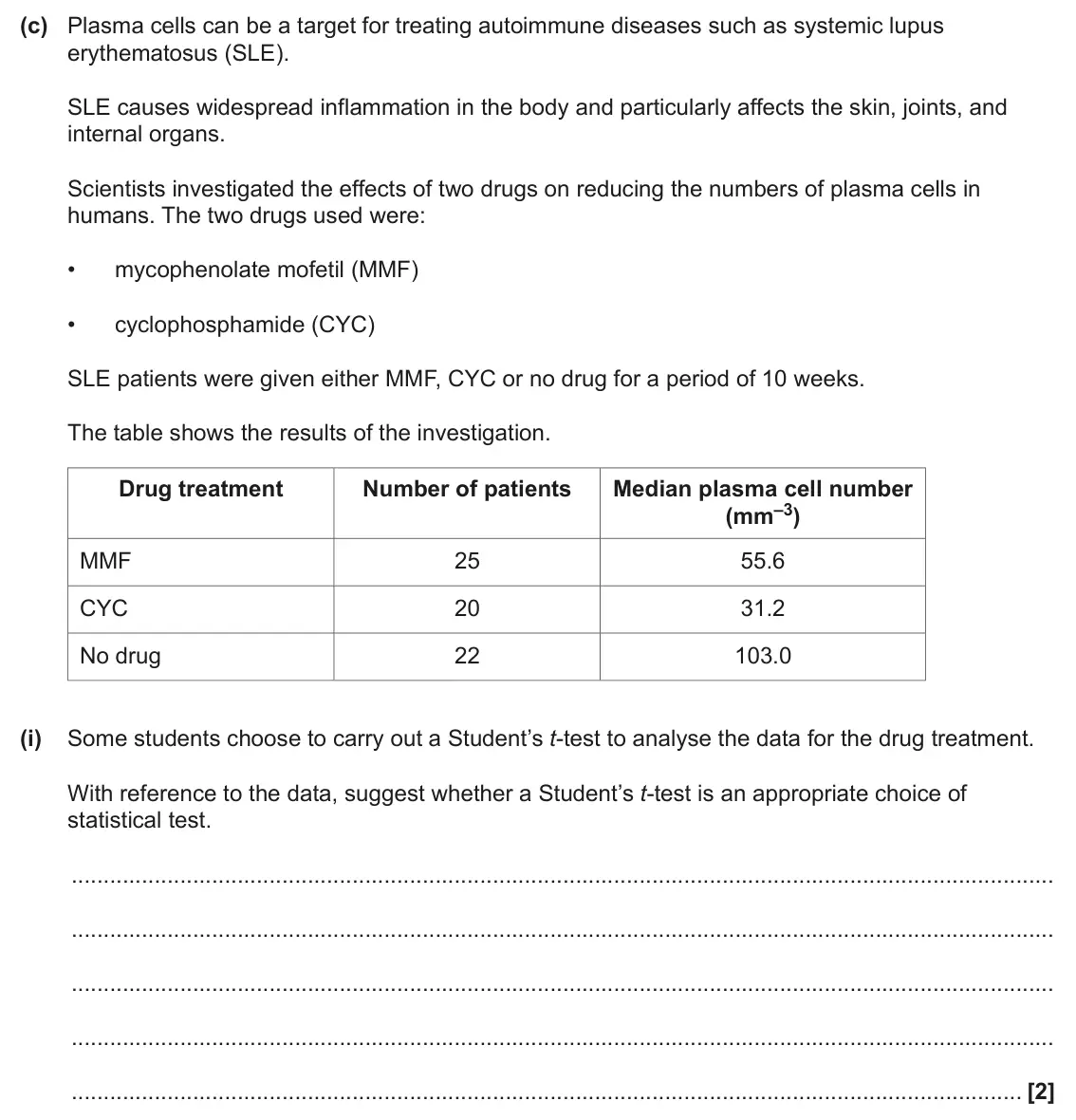
Q23(c)(ii)
The whole paper ↗
Q17(a)
The whole paper ↗
Q17(b)(i)
The whole paper ↗
Q17(b)(ii)
The whole paper ↗
Q19(a)(i)
The whole paper ↗
Q19(a)(ii)
The whole paper ↗
All 150 questions on Communicable diseases, disease prevention and the immune system, as a list
- June 2025, Paper 3, Q3(c)(i) (1 mark): State the name given to diseases such as MG. [1]
- June 2025, Paper 3, Q7(a)(i) (1 mark): Suggest one additional piece of information that is needed to assess the validity of the scientists’ conclusion. [1]
- June 2025, Paper 3, Q7(a)(ii) (1 mark): Suggest why climate change might result in more cases of diseases caused by animal vector‑transmitted pathogens. [1]
- June 2025, Paper 3, Q7(b)(ii) (3 marks): The graph shows the change in hydrogen peroxide concentration in a neutrophil during an oxidative burst. 20 15 H2O2 concentration 10 (μmol dm–3) 5 0 0 25 50 75
- June 2025, Paper 3, Q7(b)(iii) (1 mark): Suggest how an oxidative burst helps neutrophils to perform their function. [1]
- June 2025, Paper 3, Q7(b)(iv) (1 mark): Antibodies can bind to receptors on the cell surface membrane of a neutrophil. The binding of an antibody to a receptor causes the neutrophil to engulf the path
- June 2025, Paper 3, Q7(c) (3 marks): Plants lack immune cells, but they have other defences against pathogenic infection. The sentences describe one form of plant defence against pathogens. Complet
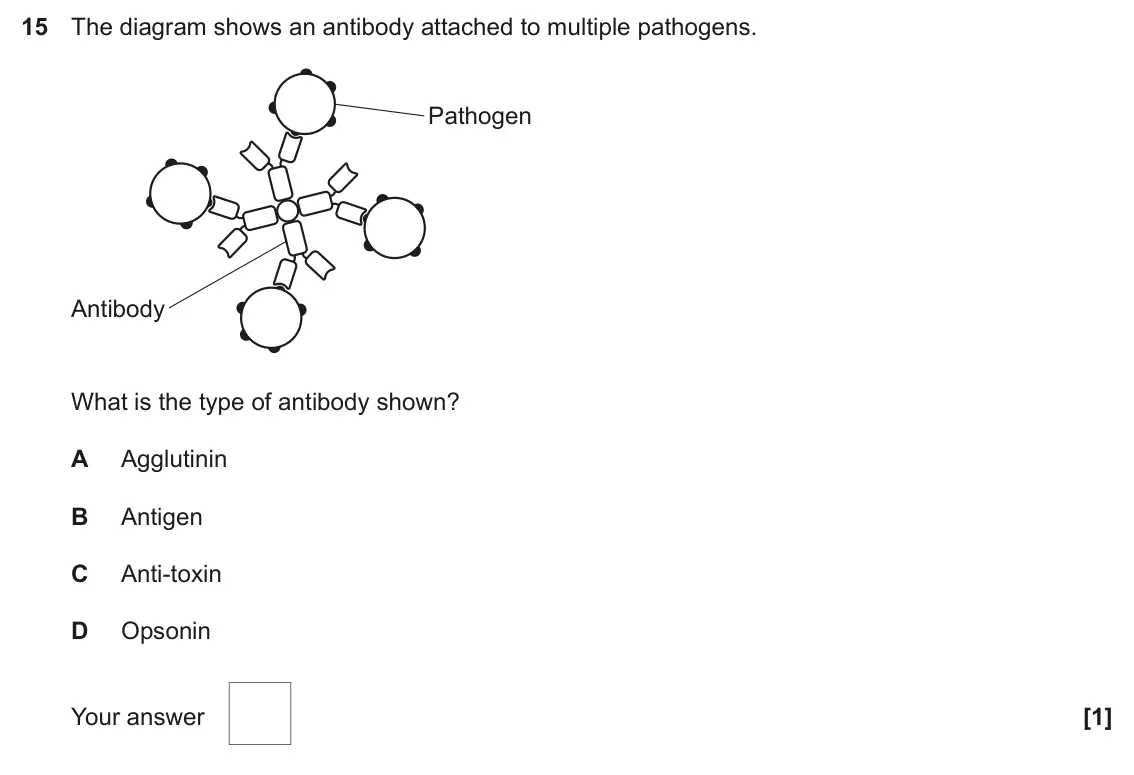
- June 2025, AS Paper 1, Q15 (1 mark): The diagram shows an antibody attached to multiple pathogens. Pathogen Antibody What is the type of antibody shown? A Agglutinin B Antigen C Anti-toxin D Opsoni
- June 2025, AS Paper 1, Q16 (1 mark): Which of these descriptions is not a primary non-specific defence against pathogens? A Blood clotting caused by a damaged blood vessel B Expulsive reflexes caus
- June 2025, AS Paper 1, Q17 (1 mark): A pregnant woman is infected by a virus that causes the common cold. She has an immune response and produces antibodies that are passed on to her fetus. What ty
- June 2025, AS Paper 1, Q23(a)(iii) (3 marks): Using the diagram and your own knowledge, explain why plasma cells are usually larger than B lymphocytes. [3]
- June 2025, AS Paper 1, Q23(b)(i) (1 mark): Name the type of T lymphocyte shown in the diagram. [1]
- June 2025, AS Paper 1, Q23(b)(ii) (2 marks): Describe the role of process X in producing cell Y to fight future infections by the same pathogen. [2]
- June 2025, AS Paper 1, Q23(c)(i) (2 marks): Some students choose to carry out a Student’s t-test to analyse the data for the drug treatment. With reference to the data, suggest whether a Student’s t-test
- June 2025, AS Paper 1, Q23(c)(ii) (2 marks): The students conclude that CYC is the most effective drug in reducing plasma cell numbers. Identify two reasons why the conclusion might not be supported. 1 2 [
- June 2024, Paper 2, Q17(a) (3 marks): This is some equipment that could be used when preparing a blood smear. Pipette Glass slide Blood sample Describe how to use the equipment to prepare a blood sm
- June 2024, Paper 2, Q17(b)(i) (1 mark): The cell labelled A is sometimes known as a red blood cell. Name cell A. [1]
- June 2024, Paper 2, Q17(b)(ii) (4 marks): In the space below, draw a labelled diagram of cell C. [4]
- June 2024, Paper 2, Q19(a)(i) (1 mark): Suggest the contents of the original anti-polio vaccine. [1]
- June 2024, Paper 2, Q19(a)(ii) (4 marks): B-lymphocytes and T-lymphocytes are involved in the immune response. Describe the role of T-lymphocytes in the development of immunity to a virus such as polio.
- June 2024, Paper 2, Q19(b)(i) (2 marks): Calculate the percentage decrease in cases between 1956 and 1960. % decrease = [2]
- June 2024, Paper 2, Q19(b)(ii) (2 marks): A student wants to use the calculation in part (b)(i) to support a conclusion about the effectiveness of the polio vaccination. Another student argues that it w
- June 2024, Paper 2, Q19(b)(iii) (1 mark): There were cases of polio in England and Wales in the 1980s. The scale used on the graph is not sensitive enough to show changes in the number of cases during t
- June 2024, Paper 2, Q19(b)(iv) (2 marks): Between 90% and 95% of UK children are currently fully vaccinated against polio. In 2022 some particles of polio virus were detected in sewage in London. As a r
- June 2024, Paper 3, Q6(b) (2 marks): Potato plants can be naturally cloned from tubers. Many diseases can infect potato plants. State one disease that can infect potato plants and state the type of
- June 2024, AS Paper 1, Q13 (1 mark): Ring rot is an infection that can kill potato plants. Which kingdom does the organism that causes ring rot belong to? A Fungi B Prokaryotae C Protoctista D Viru
- June 2024, AS Paper 1, Q14 (1 mark): What is an example of a disease transmitted by a vector? A Hepatitis C from sharing needles B Herpes simplex virus from sharing lipstick C HIV from unprotected
- June 2024, AS Paper 1, Q15 (1 mark): Plant defences can be described as chemical or physical. Which of the following results in a physical defence against a pathogen? A Plants produce hormones, whi
- June 2024, AS Paper 1, Q16 (1 mark): The image shows a photomicrograph of a blood smear. X Y Which row in the table below correctly identifies cell X and cell Y? X Y A neutrophil erythrocyte B neut
- June 2024, AS Paper 1, Q24(b) (2 marks): The bacterium, Pseudomonas aeruginosa, does not have haemoglobin. P. aeruginosa is found in natural water sources. Infection by P. aeruginosa can cause the dise
- June 2024, AS Paper 1, Q24(c) (3 marks): The treatment for people in hospitals that have HAP due to P. aeruginosa is to give antibiotics. Some populations of P. aeruginosa have become resistant to spec
- June 2024, AS Paper 1, Q24(d) (1 mark): Scientists have suggested that personalised medicine may be used to help with the problem of antibiotic resistance. State what is meant by personalised medicine
- June 2024, AS Paper 1, Q25(c) (2 marks): Phagocytes engulf pathogens during phagocytosis and digest them using enzymes. These enzymes can be found in lysosomes. Explain how the enzymes inside lysosomes
- June 2024, AS Paper 2, Q2(a)(i) (2 marks): Suggest two ways in which the ant’s behaviour helps to increase the spread of the zombie-ant fungus. 1 2 [2]
- June 2024, AS Paper 2, Q2(a)(ii) (6 marks): (ii)* Scientists carried out a study in 2017 in Taiwan to see if various climatic factors affected the numbers of zombie-ant fungus infections. Fig. 2.2 and Fig
- June 2024, AS Paper 2, Q2(b) (3 marks): Complete the table with the type of pathogen that causes the communicable disease. Communicable Disease Type of Pathogen Influenza Malaria Black sigatoka in ban
- June 2023, Paper 2, Q19(a) (2 marks): Influenza is a viral disease that is common in winter months. It is transmitted when an uninfected person inhales droplets of moisture that an infected person h
- June 2023, Paper 2, Q19(b) (5 marks): Antigens on the surface of pathogens can provoke an immune response in a patient. Fig. 19.1 shows the changes in antibody concentration in the blood of a patien
- June 2023, Paper 2, Q19(c)(i) (1 mark): Snakebites can be treated using Fab fragments. Antibodies specific to the snake venom are produced using donor animals, usually sheep. These antibodies are coll
- June 2023, Paper 2, Q19(c)(ii) (3 marks): Fig. 19.2 shows the structure of a Fab fragment. Fig. 19.2 Identify two similarities and one difference in structure between a Fab fragment and a whole antibody
- June 2023, Paper 2, Q19(d) (3 marks): Infectious disease caused by pathogenic bacteria can be treated using antibiotics. The first antibiotics became widely available in the middle of the 20th Centu
- June 2023, Paper 2, Q19(e) (2 marks): Plants and microorganisms have traditionally been used as sources of new medicines. Synthetic biology could play a major role in the development of new medicine
- June 2023, AS Paper 1, Q1 (1 mark): Which statement describes a problem that has resulted from the increased use of antibiotics? A Penicillin can no longer be used to treat infections. B Rates of
- June 2023, AS Paper 1, Q2 (1 mark): The diagram shows a computer model of the structure of an antibody. A B C Constant region D Which part of the antibody, A, B, C or D, is an antigen-binding site
- June 2023, AS Paper 2, Q5(a)(i) (2 marks): Using the data provided in the table, calculate the percentage decrease in the number of vaccinations administered in England between 2013 and 2014. Give your a
- June 2023, AS Paper 2, Q5(a)(ii) (4 marks): Student A studied the data in the table and made the following statement: ‘The MMR vaccination programme is not working because although the number of children
- June 2023, AS Paper 2, Q5(a)(iii) (3 marks): A student made the following statement about the influenza (flu) vaccination programme: ‘The flu vaccination programme involves giving the same flu vaccine to d
- June 2023, AS Paper 2, Q5(a)(iv) (2 marks): Explain how vaccination programmes can play a role in preventing epidemics. [2]
- June 2023, AS Paper 2, Q5(b)(i) (1 mark): Explain the meaning of the term autoimmune disease. [1]
- June 2023, AS Paper 2, Q5(b)(iv) (2 marks): A student wrote the following passage about the immune system: ‘T helper cells produce cell signalling molecules called perforins. These stimulate the activity
- June 2022, Paper 2, Q3 (1 mark): Which of the following changes of lifestyle is/are likely to reduce the spread of a disease that is transmitted by droplets of moisture? 1 Clean drinking water
- June 2022, Paper 2, Q4 (1 mark): Ash trees are an important part of the British landscape. In 2012, a fungal disease known as ash dieback arrived in the UK from mainland Europe. Which of the fo
- June 2022, Paper 2, Q5 (1 mark): What chemical is produced by plants in response to attack by pathogens? A Amylopectin B Amylose C Callose D Cellulose Your answer [1]
- June 2022, Paper 2, Q6 (1 mark): Different types of microorganism can act as pathogens. Which of the diseases is caused by a pathogen without mitochondria in its cells? A Black sigatoka in bana
- June 2022, Paper 3, Q1(a) (3 marks): Fig. 1.1 shows the roles of three different types of antibody, labelled R, S and T. R S Pathogen Pathogen Antibody Receptor White Antibody blood cell T Antibody
- June 2022, Paper 3, Q1(b) (1 mark): A condition called rheumatic heart disease can occur when a person’s antibodies attack antigens on their own heart cells. State the name of the type of disease
- June 2022, Paper 3, Q2(a)(i) (2 marks): The cells labelled X and Y in Fig. 2.1 are two different types of white blood cell. Identify the types of white blood cell labelled X and Y. X Y [2]
- June 2022, Paper 3, Q2(b)(i) (1 mark): State the role of lysosomes in white blood cells. [1]
- June 2022, AS Paper 1, Q16 (1 mark): Diseases can be caused by many different types of pathogen. Which row matches the disease to the correct pathogen? Fungus Protoctist Virus A black sigatoka toma
- June 2022, AS Paper 1, Q17 (1 mark): Which option describes the correct process of blood clotting? A Platelets convert into insoluble fibrin to trap erythrocytes. B The insoluble plasma protein fib
- June 2022, AS Paper 1, Q19 (1 mark): Convalescent plasma immunity is one method used to treat patients infected with Ebola virus disease (EVD). In this method, blood plasma is taken from a person w
- June 2022, AS Paper 2, Q4(a)(i) (1 mark): Name cell X. [1]
- June 2022, AS Paper 2, Q4(b)(i) (1 mark): Identify the type of immunity given by an influenza vaccine. [1]
- June 2022, AS Paper 2, Q4(b)(ii) (2 marks): A patient was participating in influenza vaccination trials. • On day 5 of the trial the patient was injected with antigens extracted from the influenza virus.
- June 2022, AS Paper 2, Q4(b)(iii) (2 marks): Outline the role of B memory cells in the secondary immune response. [2]
- June 2022, AS Paper 2, Q4(c) (3 marks): Outline the roles of phagosomes and lysosomes in phagocytosis. [3]
- November 2021, Paper 2, Q5 (1 mark): Antibodies form part of the immune response. Which of the following types of antibody bind to antigens on the surface of pathogens? 1 opsonins 2 agglutinins 3 a
- November 2021, Paper 2, Q6 (1 mark): The primary immune response involves differentiation and clonal expansion of certain white blood cells. Which of the following cells result from clonal expansio
- November 2021, Paper 2, Q7 (1 mark): Lupus is an autoimmune disease that affects the skin, joints and internal organs. Which of the following is likely to be an effective treatment for lupus? A imm
- November 2021, Paper 2, Q8 (1 mark): Lupus is a rare condition affecting approximately 0.025% of the population. However, 9 out of 10 sufferers are women. The population of England and Wales in 201
- November 2021, Paper 3, Q1(c)(iv) (1 mark): Another disease that affects dogs is caused by parvovirus. Dogs can be vaccinated against parvovirus at six weeks of age. Suggest what the parvovirus vaccine is
- November 2021, Paper 3, Q1(c)(v) (1 mark): Dogs need a booster vaccination against parvovirus when they are one year old. Explain why a booster vaccination is needed. [1]
- November 2021, Paper 3, Q3(b) (6 marks): Callose is a polysaccharide produced by plants. (b)* Plants produce callose in response to pathogenic infection, injury and changes in environmental temperature
- November 2021, Paper 3, Q3(c) (3 marks): Callose production reduces the spread of pathogens in plants. The table below lists pathogens that infect plants together with features of the pathogens and exa
- November 2021, AS Paper 1, Q14 (1 mark): The image below shows an antibody structure with the parts labelled P to T. P P Q S R T Which row, A to D, correctly identifies the parts of the antibody struct
- November 2021, AS Paper 1, Q17 (1 mark): Which row, A to D, identifies cells X and Y and process Q in the immune response in the diagram below? X Q Y X Y Q A B cell T helper cell antigen presentation B
- November 2021, AS Paper 1, Q24(a)(i) (3 marks): Suggest explanations for the positive correlation in the data in the graph. [3]
- November 2021, AS Paper 1, Q24(b)(ii) (2 marks): Explain the importance of maintaining biodiversity for the discovery of new antibiotics like phazolicin. [2]
- November 2021, AS Paper 1, Q24(c) (2 marks): Advances in medical technology include the development of personalised medicines and synthetic biology. Explain what is meant by personalised medicine and synth
- November 2020, Paper 2, Q1 (1 mark): Which of the following human diseases, A to D, is caused by a fungus? A athlete's foot B influenza C malaria D tuberculosis Your answer [1]
- November 2020, Paper 2, Q2 (1 mark): Which of the following plant diseases, A to D, is caused by a pathogen from the kingdom Protoctista? A black sigatoka in bananas B ring rot in tomatoes C tobacc
- November 2020, Paper 2, Q4 (1 mark): Questions 4 and 5 refer to the following image of a human blood smear. A E D C 4 Which of the blood components, labelled A to D, shows a lymphocyte? 11] Your an
- November 2020, Paper 2, Q6 (1 mark): Plants can produce a variety of chemicals in response to pathogens. 6 Which of the following, A to D, is produced by plants in response to pathogens? A antibact
- November 2020, Paper 2, Q22(a)(i) (1 mark): Which letter or letters indicate cells or structures involved in preventing the entry of pathogens into the body? . [1]
- November 2020, Paper 2, Q22(a)(ii) (1 mark): Which letter or letters indicate cells or structures that act as a physical barrier to the entry of pathogens? [1]
- November 2020, Paper 2, Q22(a)(iii) (1 mark): Which letter or letters indicate cells or structures that are involved in phagocytosis? [1]
- November 2020, Paper 2, Q22(b) (2 marks): Phagocytosis involves cytokines and opsonins. State the role of cytokines and opsonins in phagocytosis. cytokines opsonins [2]
- November 2020, Paper 2, Q22(c)(i) (1 mark): Use a tick (V) to indicate in the table below which type of immunity is functioning in a leukaemia patient when given chickenpox antibodies. Type of immunity na
- November 2020, Paper 2, Q22(c)(ii) (2 marks): Explain your answer to part (i). .. [2]
- November 2020, Paper 3, Q4(b) (2 marks): Vancomycin is an antibiotic that has been used to treat bacterial infections for many decades. Several strains of bacteria have evolved resistance to vancomycin
- November 2020, AS Paper 1, Q8 (1 mark): Which of the following, A to D, is an example of disease transmitted by a vector? A athlete’s foot from a shower B bubonic plague from rat fleas C catching bird
- November 2020, AS Paper 2, Q2(d)(i) (2 marks): Using the information provided, calculate how many of the world’s Lupus sufferers by the end of 2019 would be photosensitive. number of photosensitive Lupus suf
- November 2020, AS Paper 2, Q2(d)(ii) (1 mark): Lupus symptoms include pain in joints, inflammation, fatigue, fever and a skin rash. Suggest what component of sunlight causes photosensitivity and which sympto
- November 2020, AS Paper 2, Q2(d)(iii) (2 marks): Explain what is meant by an autoimmune disease and suggest why members of the same family can be sufferers of autoimmune diseases. [2]
- November 2020, AS Paper 2, Q3(a) (2 marks): Different types of pathogen cause communicable diseases in plants and animals. Complete the table by adding the correct type of pathogen for each communicable d
- November 2020, AS Paper 2, Q3(b)(i) (2 marks): Calculate how many of the children who were suffering from malaria were correctly identified by the dogs. number of children = [2]
- November 2020, AS Paper 2, Q3(b)(ii) (1 mark): Suggest one limitation of this trial. [1]
- November 2020, AS Paper 2, Q3(c) (2 marks): Some people are immune to malaria. They produce a specific type of antibody. One way in which antibodies defend the body is by acting as agglutinins. Outline th
- November 2020, AS Paper 2, Q4(a) (4 marks): A student looking at the data in Fig. 4.1 and Fig. 4.2 made the following conclusion: ƇThe data shows that a vaccination program is a successful way of reducing
- November 2020, AS Paper 2, Q4(b) (3 marks): Complete the following sequence to outline how a vaccine gives an individual immunity. The first two steps have been completed for you. Step 1: A vaccine is pro
- November 2020, AS Paper 2, Q4(c) (2 marks): Measles is a highly contagious viral infection. In October 2018, an outbreak of the disease on the island of Madagascar resulted in more than 50 000 cases of me
- June 2019, Paper 2, Q3 (1 mark): Biodiversity is important for the development of new medicines. Which of the following statements about the development of new medicines is incorrect? A Compute
- June 2019, Paper 2, Q14 (1 mark): Which of the following is/are not involved in the primary response against infection? A memory B-cells B mast cells C mitosis D platelets Your answer [1]
- June 2019, Paper 3, Q4(a) (2 marks): An individual’s immune responses can change throughout their lifetime. Fig. 4.1 shows one person’s immune response to the influenza virus when they were first i
- June 2019, Paper 3, Q4(b) (6 marks): (b)* The specific immune response involves B and T lymphocytes. There is variation in specific immune responses between individual animals. Variation between im
- June 2019, Paper 3, Q4(c) (2 marks): It is possible to manufacture antibodies to treat certain diseases. These are known as synthetic antibodies. DNL-Fab3, shown in Fig. 4.2, is an example of a syn
- June 2019, Paper 3, Q6(c) (2 marks): Some microorganisms can be used by humans in industry. Some microorganisms are pathogenic. Pathogenic microorganisms are transmitted in various ways. Complete t
- June 2019, AS Paper 1, Q12 (1 mark): The diagram below shows a pathogen. reverse transcriptase capsid protease RNA lipid envelope glycoprotein Which of the options, A to D, is the disease caused by
- June 2019, AS Paper 1, Q13 (1 mark): Which of the following, A to D, is the percentage increase from the number of cases of malaria in 1995 to 2000? A 85% B 550% C 650% D 55 000% [1] Your answer
- June 2019, AS Paper 1, Q14 (1 mark): Which of the following statements, A to D, could explain the data shown for 1999–2000? A the malarial parasite had developed resistance to insecticides B the ve
- June 2019, AS Paper 1, Q26(a) (5 marks): Complete the following passage by using the most appropriate terms from the list. You may use terms once, more than once or not at all. memory plasma killer T c
- June 2019, AS Paper 1, Q26(b) (3 marks): A student wrote the following passage in an essay on the immune system. Immunisation programmes involve injecting individuals with a small amount of the safe an
- June 2019, AS Paper 2, Q2(b)(ii) (1 mark): Cells A, C and D work together to carry out an important function. State the function that cells A, C and D perform. [1]
- June 2019, AS Paper 2, Q6(a)(i) (1 mark): It is difficult for the virus to enter the sweet potato cell. Suggest a barrier that makes it difficult for potyviruses to enter the sweet potato cell. [1]
- June 2019, AS Paper 2, Q6(a)(ii) (1 mark): Suggest how the potyviruses enter the sweet potato cell. [1]
- June 2019, AS Paper 2, Q6(b)(i) (2 marks): The nucleic acid in potyviruses is RNA. Suggest why this mechanism in sweet potato cells is able to counteract infection by a potyvirus. [2]
- June 2018, Paper 2, Q8 (1 mark): Which of the following antibodies increase(s) the phagocytosis of pathogens? 1 opsonins 2 agglutinins 3 anti-toxins A 1, 2 and 3 B Only 1 and 2 C Only 2 and 3 D
- June 2018, Paper 2, Q9 (1 mark): Which of the following describes an autoimmune disease? A a disease in which an individual’s own body cells are antigenic B a disease in which a pathogen attack
- June 2018, Paper 3, Q4(a)(i) (2 marks): Suggest and explain one symptom of agammaglobulinemia. [2]
- June 2018, AS Paper 1, Q2 (1 mark): Autoimmune diseases are often treated with a course of antibody injections. Which of the following statements, A to D, describes the immunity arising from this
- June 2018, AS Paper 1, Q8 (1 mark): Which of the following types of cells is not involved in a primary immune response? A T-memory cells B T-helper cells C T-killer cells D plasma cells Your answe
- June 2018, AS Paper 1, Q16 (1 mark): Plants such as the soybean have a number of defence strategies to prevent infection by pathogens. Which of the following strategies is a chemical defence agains
- June 2018, AS Paper 2, Q1(b)(iv) (2 marks): Another protease enzyme is HIV1 protease, which is essential for the life cycle of the human immunodeficiency virus (HIV). Inhibition of this protease prevents
- June 2018, AS Paper 2, Q1(b)(v) (2 marks): A student looking at the data in Fig. 1.3 made the following conclusion: “The decrease in deaths from AIDS after 1995 is because of the use of saquinavir by HIV
- June 2018, AS Paper 2, Q3(b) (4 marks): Epithelial cells in the airways of mammals play an essential role in defences against pathogens. Explain the function of epithelial cells in the airways of mamm
- June 2018, AS Paper 2, Q3(c)(i) (2 marks): Phagocytes defend the body by engulfing and destroying pathogens in a process called phagocytosis. A student produced a summary of the stages of phagocytosis, w
- June 2018, AS Paper 2, Q3(c)(ii) (1 mark): Antibodies are defensive proteins carried in the bloodstream. Fig. 3.2 shows the simplified, incomplete structure of an antibody. Complete Fig. 3.2 by drawing a
- June 2017, Paper 2, Q3 (1 mark): The photograph below shows a blood smear. Which row correctly lists the cells that are visible in the smear? erythrocytes lymphocytes monocytes neutrophils A ü
- June 2017, Paper 2, Q10 (1 mark): Which of the options, A to D, is a primary defence against pathogens? A antibody production B inflammation C phagocytosis D T-killer cells Your answer [1]
- June 2017, Paper 2, Q14 (1 mark): Three methods of pathogen transmission between animals or plants are listed below. 1 direct contact 2 vectors 3 droplets Which of the methods of pathogen transm
- June 2017, Paper 2, Q18(a) (2 marks): State two ways in which an individual S. tuberosum plant could respond to infection by P. infestans. 1 2 [2]
- June 2017, Paper 2, Q18(b)(iii) (3 marks): The extent of infection is estimated by comparing the area under the curve from the graph. The area under the curve for clone B is 1250. (Units can be ignored i
- June 2017, Paper 2, Q18(b)(iv) (1 mark): Calculate the area under the curve for clone C as a proportion of the area under the curve for clone B. Answer [1]
- June 2017, Paper 2, Q18(b)(v) (2 marks): Using Fig. 18, suggest why the area under the curve is used as a measure of infection rather than the area of leaf that is visibly affected on a given day. [2]
- June 2017, Paper 2, Q18(b)(vi) (2 marks): The clones were planted in adjacent fields in order to control variables such as temperature, wind speed and rainfall. Suggest two other abiotic variables that
- June 2017, Paper 3, Q2(a)(ii) (2 marks): Coeliac disease is caused by an immune reaction to gliadins in a person’s digestive system. The immune system produces antibodies that bind to part of the gliad
- June 2017, Paper 3, Q5(a)(i) (2 marks): Suggest how the immune system causes damage to the nervous system. [2]
- June 2017, AS Paper 1, Q14 (1 mark): Lupus is an autoimmune disease. One symptom is a facial rash, typically in a butterfly shape across the cheeks. Following a blood test, which of the following w
- June 2017, AS Paper 1, Q16 (1 mark): An individual bitten by a rabid dog can be treated by an injection of human rabies antibodies. Which option, A to D, describes the type of immunity provided by
- June 2017, AS Paper 2, Q4(a) (4 marks): For each of the statements in the table below, use ticks or crosses to identify whether the statement belongs to B lymphocytes, or to T lymphocytes, or to both
- June 2017, AS Paper 2, Q4(b) (3 marks): Fig. 4 shows the concentration of antibodies in a patient’s bloodstream following an influenza (flu) vaccination, and then a subsequent infection with the influ
- June 2017, AS Paper 2, Q4(c) (6 marks): Lymphocytes form an important part of the specific immune system in humans. They can be classified into B lymphocytes and T lymphocytes. (c)* In West Africa dur
- June 2016, AS Paper 1, Q8 (1 mark): Measles is a serious disease that can be prevented by vaccination. The chart below shows the Measles-containing Vaccine (MCV) coverage and annual reported cases
- June 2016, AS Paper 1, Q15 (1 mark): The diagram below shows the simplified structure of an antibody. A B C D Which of the letters, A to D identifies the region of the antibody that allows the dist
- June 2016, AS Paper 1, Q19 (1 mark): Which of the following options, A to D, is a primary defence mechanism against pathogens? A neutralisation B agglutination C phagocytosis D blood clotting Your
- June 2016, AS Paper 1, Q20 (1 mark): Pathogens cause disease and are transmitted from individual to individual in a variety of ways. Which of the rows, A to D, in the table below is correct? Type o
- June 2016, AS Paper 1, Q24(b)(ii) (2 marks): Viruses do not use erythrocytes as host cells, whereas the malarial pathogen Plasmodium spends part of its life cycle inside erythrocytes. Suggest why. [2]
- June 2016, AS Paper 2, Q6(b)(i) (2 marks): Calculate the percentage increase in the number of death certificates that mention MRSA from 1993 to the year when the numbers reach a peak. Show your working a
- June 2016, AS Paper 2, Q6(b)(ii) (2 marks): The proportion of death certificates that mention MRSA in 1993 is 12%. Compare this figure with the proportion of death certificates that mention MRSA in 2012.
- June 2016, AS Paper 2, Q6(b)(iii) (2 marks): What can you conclude from these data about the deaths involving S. aureus and MRSA since 2007? [2]
Questions, mark schemes and examiner’s reports are © OCR, from their published past papers. Plumi isn’t affiliated with any exam board. Want whole papers? Every OCR A-Level Biology A paper, or our free OCR-style practice pack.
Rather write your answers by hand on iPad? Plumi marks them against the same mark schemes.