 plumi
Cloning and biotechnology: OCR A‑Level Biology A questions
Every OCR A-Level Biology A exam question on 6.2.1 Cloning and biotechnology, 2016–2025, with its mark scheme and examiner’s report.
Find questions1,984
Calculations




Q17(a)
The whole paper ↗
Q17(b)(i)
The whole paper ↗
Q17(c)(i)
The whole paper ↗
Q17(c)(ii)
The whole paper ↗
Q17(d)(ii)
The whole paper ↗
Q17(d)(iii)
The whole paper ↗


Q1(b)(i)
The whole paper ↗
Q1(b)(ii)
The whole paper ↗
Q1(c)
The whole paper ↗
Q6(a)
The whole paper ↗
All 93 questions on Cloning and biotechnology, as a list
- June 2025, Paper 1, Q7 (1 mark): In experiment one, what is the number of cells in the culture after 10 hours? 0.9 × 10⁷ A 4.0 × 10⁷ B C 7.6 7.6 × 10⁷ D Your answer [1]
- June 2025, Paper 1, Q8 (1 mark): Which line, A to D, in experiment two represents a culture where the growth rate is approximately double that in experiment one? Your answer [1]
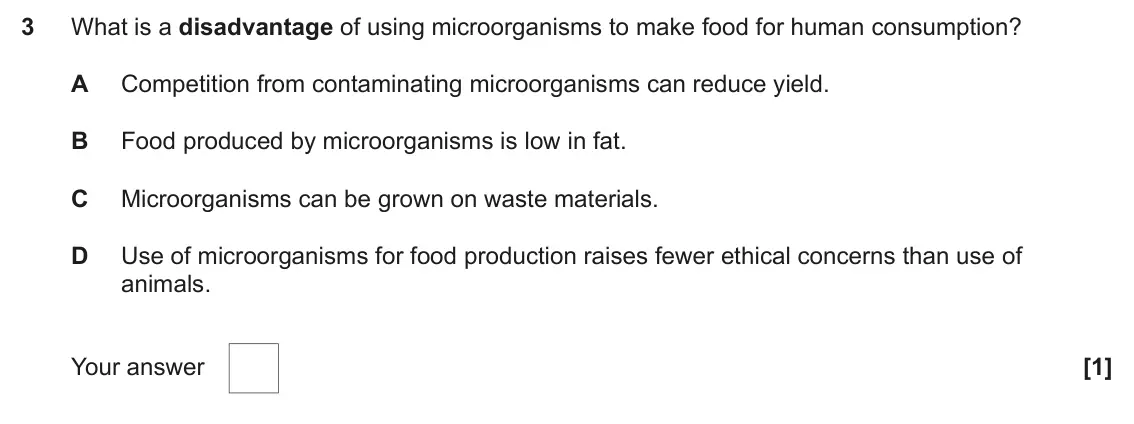
- June 2025, Paper 2, Q3 (1 mark): What is a disadvantage of using microorganisms to make food for human consumption? A Competition from contaminating microorganisms can reduce yield. B Food prod
- June 2025, Paper 2, Q4 (1 mark): Culturing microorganisms on nutrient agar requires aseptic techniques. What is not part of a standard aseptic procedure when culturing microorganisms? A Disinfe
- June 2025, Paper 2, Q5 (1 mark): Batch fermentation with microorganisms is used to produce a range of useful substances. Which of the following are important for achieving maximum yield during
- June 2025, Paper 2, Q8 (1 mark): Plants can be cloned by taking cuttings. New cuttings often experience water stress during the first few weeks. Which of these practical procedures are used to
- June 2025, Paper 2, Q17(a) (1 mark): Human identical twins are an example of natural animal clones. Suggest why human identical twins do not look exactly identical. [1]
- June 2025, Paper 2, Q17(b)(i) (2 marks): The offspring are not the same sex as the parent. Identify two other reasons why parthenogenesis in Komodo dragons is not an example of cloning. 1 2 [2]
- June 2025, Paper 2, Q17(c)(i) (1 mark): State the property of the cells in the embryo that allows cloning to be successful. [1]
- June 2025, Paper 2, Q17(c)(ii) (1 mark): Embryos from stage 3 above are sometimes frozen for later use. State one advantage to agriculture of freezing embryos from stage 3. [1]
- June 2025, Paper 2, Q17(d)(ii) (1 mark): State why SCNT is more useful than embryo splitting when increasing the population of endangered species. [1]
- June 2025, Paper 2, Q17(d)(iii) (1 mark): Suggest one reason why the health of the cloned Przewalski’s horses is better than that of Dolly the sheep, the first mammal to be cloned by SCNT. [1]
- June 2024, Paper 2, Q10 (1 mark): Plants can be cloned artificially by taking cuttings. Which of the following are important steps when cloning a plant by taking a cutting? 1 Keep it regularly w
- June 2024, Paper 2, Q11 (1 mark): Microorganisms can be used to produce food. Which option is not seen as an advantage of using microorganisms to produce food compared to traditional food produc
- June 2024, Paper 2, Q12 (1 mark): Aseptic conditions are important when culturing microorganisms. Which option is not a correct part of the procedure for spreading bacteria on an agar-filled Pet
- June 2024, Paper 2, Q13 (1 mark): A standard growth curve for a population of bacteria of the same species in a closed system involves a death phase. Which option explains the death phase? A Int
- June 2024, Paper 3, Q1(b)(i) (2 marks): Describe two improvements to the student’s method, other than using different equipment, that could improve the accuracy of their population estimate. 1 2 [2]
- June 2024, Paper 3, Q1(b)(ii) (3 marks): The student counts 22 colonies on the agar plate. Calculate the total number of E. coli cells in the original 50 cm3 culture. Give your answer in standard form.
- June 2024, Paper 3, Q1(c) (2 marks): E. coli can be genetically modified to produce useful proteins. State two other reasons why E. coli is a suitable microorganism to use in biotechnology. 1 2 [2]
- June 2024, Paper 3, Q6(a) (4 marks): Describe how artificial clones of plants are produced using micropropagation. [4]
- June 2024, Paper 3, Q6(c)(i) (2 marks): State the name of structure X and outline how a gardener could produce many cloned plants from structure X. [2]
- June 2024, Paper 3, Q6(c)(ii) (2 marks): State the name of structure Y and describe the process by which a new plant can form naturally from structure Y. [2]
- June 2023, Paper 2, Q9 (1 mark): The graph below shows the population of viable bacteria in a flask over 48 hours. B 8 C 7 6 D 5 Number of A bacteria cells 4 (Log) 3 2 1 00 8 16 24 32 40 48 Tim
- June 2023, Paper 2, Q16(c) (6 marks): Many organisms undergo asexual reproduction by mitosis. (c)* Asexual reproduction is also known as cloning. Many organisms can be artificially cloned for commer
- June 2023, Paper 2, Q18(a) (1 mark): State one other method for immobilising enzymes. [1]
- June 2023, Paper 2, Q18(b) (2 marks): One advantage of using immobilised enzymes is that the enzyme can be reused many times. However, the process of immobilisation can reduce the activity of enzyme
- June 2023, Paper 2, Q18(c)(i) (1 mark): Suggest one reason why using immobilised yeast might be more expensive than using immobilised invertase. [1] 20 Investigations involving immobilised enzymes can
- June 2023, Paper 2, Q18(c)(ii) (6 marks): Immobilised enzymes are often used for industrial processes. Fig. 18.1 shows three methods for immobilising enzymes. Fig. 18.1 Adsorption Covalent bonding Entra
- June 2022, Paper 2, Q2 (1 mark): Many industrial processes use immobilised enzymes. Which of the options is not an advantage of using immobilised enzymes rather than free enzymes? A Enzymes can
- June 2022, Paper 2, Q17(a)(i) (1 mark): State why it is important that the technique used for culturing microorganisms be aseptic. [1]
- June 2022, Paper 2, Q17(a)(ii) (2 marks): The students prepared the culture by adding a suspension of bacteria to a flask containing nutrient broth. List two precautions that should be taken when prepar
- June 2022, Paper 2, Q17(b)(i) (1 mark): The students shook each flask before they removed the samples for counting. Suggest why the students shook the flasks. [1]
- June 2022, Paper 2, Q17(b)(ii) (1 mark): It can be more difficult to count bacterial cells using a light microscope than it is to count human cells. Suggest one reason why bacterial cells are difficult
- June 2022, Paper 2, Q17(b)(iii) (3 marks): In one 0.01 cm3 sample the students counted 52 bacterial cells under the microscope. Describe the calculation steps the students would then need to make to esti
- June 2022, Paper 2, Q17(c)(i) (2 marks): Explain, with reference to the graph, why the students used a logarithmic scale on the y-axis. [2]
- June 2022, Paper 2, Q17(c)(ii) (3 marks): Calculate the percentage decrease in the viable population between 40 h and 48 h. Give your answer to 3 significant figures. Percentage decrease = % [3]
- June 2022, Paper 2, Q17(d) (4 marks): Explain, with reference to the graph, the decrease in the population of viable bacteria between 40 h and 48 h. [4]
- June 2022, Paper 2, Q21(a) (2 marks): Microorganisms have simple nutrient requirements, which helps to reduce production costs. List two other advantages of using microorganisms in food production.
- June 2022, Paper 2, Q21(b)(i) (2 marks): The bacteria convert the lactose present in milk into lactic acid. Lactic acid is an important contributor to the flavour of yoghurt. Lactic acid also helps to
- June 2022, Paper 2, Q21(c)(i) (1 mark): Use the diagram to name the type of fermentation process used for mycoprotein production. Justify your answer. Name Justification [1]
- June 2022, Paper 2, Q21(c)(ii) (2 marks): Suggest and explain why a cooling system is necessary. [2]
- June 2022, Paper 2, Q21(c)(iii) (2 marks): The air inlet provides the fungus with oxygen for respiration, and ammonia. Suggest and explain why the fungus is provided with ammonia. [2]
- June 2022, Paper 3, Q3(a) (3 marks): A student wrote a method for taking a cutting to clone a plant: • Select a stem with many flowers and leaves. • Make a slanting cut in the stem, below some leav
- June 2022, Paper 3, Q4(c) (6 marks): The sea sponge, Aplysina aerophoba, and the zebra shark, Stegostoma fasciatum, are both animals. (c)* Humans can produce artificial clones of animals. Describe
- November 2021, Paper 2, Q21(a) (1 mark): Strawberry plants produce clones using runners. This is an example of natural cloning. State one other method of natural cloning in plants. [1]
- November 2021, Paper 2, Q21(b) (1 mark): Name the type of plant tissue from which natural clones are produced. [1]
- November 2021, Paper 2, Q21(c) (2 marks): Tissue culture greatly increases the number of cloned plants that can be produced from a single parent plant. Outline how it is possible to produce many clones
- November 2021, Paper 2, Q21(d)(i) (2 marks): Calculate the percentage increase in mean shoot length caused by adding 5 mg dm–3 BAP. Give your answer to 2 significant figures. Percentage increase = % [2]
- November 2021, Paper 2, Q21(d)(ii) (3 marks): The valid investigation that generated the results shown above featured an independent variable, a dependent variable and several controlled variables. State th
- November 2021, Paper 3, Q2(d)(i) (4 marks): A student looked at Fig. 2.3 and made the following statement: ‘The bacterial growth curve in Fig. 2.3 looks very different from a standard growth curve for bac
- November 2021, Paper 3, Q2(d)(ii) (3 marks): Calculate the total number of bacterial cells that would have been present in a 50 cm3 container on day 1. Write your answer in standard form. Number of bacteri
- November 2021, Paper 3, Q2(d)(iii) (2 marks): Describe a laboratory procedure that the scientists might have used to estimate the bacterial population. [2]
- November 2021, Paper 3, Q2(e) (3 marks): The passage below describes some uses of microorganisms in biotechnology. Complete the passage by writing the most appropriate words in the blank spaces. Microo
- November 2020, Paper 1, Q20(c)(i) (3 marks): Describe how the student could use 1 cm3 pipettes and 10 cm3 measuring cylinders to dilute the sample so that it was 10 000 times less concentrated. [3]
- November 2020, Paper 1, Q20(c)(iii) (2 marks): The student prepared a starter culture using 2.5 × 10⁻³ g yeast cells in 1 dm3 nutrient broth. The average mass of a yeast cell is 2.0 × 10⁻¹¹ g. Calculate the
- November 2020, Paper 1, Q20(c)(iv) (3 marks): The population of this yeast doubles every 90 minutes when growing under ideal conditions. A different starter culture was prepared containing 1 × 10⁷ cells. Us
- November 2020, Paper 2, Q17(a) (1 mark): State one method by which tannase could be immobilised. .. [1]
- November 2020, Paper 2, Q17(b)(i) (2 marks): Calculate how many times more active immobilised tannase is compared to free tannase at pH8.0. Give your answer to an appropriate number of significant figures.
- November 2020, Paper 2, Q17(b)(iv) (2 marks): values than free tannase. Suggest why immobilised tannase is more active at pH8 than free tannase. [2]
- November 2020, Paper 2, Q17(c)(i) (2 marks): Suggest two reasons why using immobilised enzymes in industrial processes could be cheaper than using free enzymes. 1 2 [2]
- November 2020, Paper 2, Q17(c)(ii) (1 mark): State one disadvantage of using immobilised enzymes in industrial processes. • [1]
- November 2020, Paper 3, Q2(d) (1 mark): Mice are often used in laboratory studies to research treatments for heart conditions. These mice are often clones. Suggest one reason why clones are used in th
- June 2019, Paper 2, Q11 (1 mark): Corals are a group of animals that usually live on the sea bed close to the surface of the water. Many corals can reproduce both sexually and asexually. Which o
- June 2019, Paper 2, Q19(a)(i) (2 marks): Describe what is happening at stage A and suggest a practical procedure that could allow this to occur. [2]
- June 2019, Paper 2, Q19(a)(ii) (1 mark): Identify a key difference between the processes between stages A and C and the cloning of Dolly the sheep. [1]
- June 2019, Paper 2, Q19(a)(iii) (1 mark): The frog produced by the process in Fig. 19.1 is not a complete clone of the donor tadpole. Suggest why the cloned frog might not be considered a complete clone
- June 2019, Paper 2, Q19(b)(i) (2 marks): Suggest why the x-axis does not show the age of the donor nuclei. [2]
- June 2019, Paper 2, Q19(b)(ii) (3 marks): Dolly the sheep suffered health problems throughout her life and died at an early age. The donor nucleus that was used to create Dolly came from a sheep that wa
- June 2019, Paper 2, Q19(c)(i) (2 marks): Calculate the percentage of pregnancies that resulted in live births in goats and mice. live births in goats = % live births in mice = % [2]
- June 2019, Paper 2, Q19(c)(ii) (3 marks): Compiling results from different scientists can have problems as their investigations may not have been controlled in the same way. List three factors that shou
- June 2019, Paper 2, Q20(a)(i) (4 marks): Describe how to clone a plant by taking a cutting. [4]
- June 2019, Paper 2, Q20(a)(ii) (6 marks): Plant cloning is often used by farmers to produce new plants. A plant that is often cloned by taking cuttings is lavender, Lavandula angustifolia. (ii)* The far
- June 2019, Paper 2, Q20(b) (3 marks): Cloning plants is also known as vegetative propagation. Identify three advantages of vegetative propagation in agriculture. 1 2 3 [3]
- June 2019, Paper 3, Q6(a)(i) (6 marks): (i)* Using examples, describe and explain some other advantages of using microorganisms to produce food for human consumption. [6] Additional answer space if re
- June 2019, Paper 3, Q6(a)(ii) (3 marks): On an industrial scale, microorganisms can be cultured using either batch fermentation or continuous fermentation. The table below lists statements about indust
- June 2019, Paper 3, Q6(b)(i) (3 marks): Serial dilutions can be used to estimate the size of a bacterial population in a culture. A scientist used 20 cm3 of a bacterial culture that contained 1.0 × 10
- June 2019, Paper 3, Q6(b)(ii) (1 mark): A student carried out a different serial dilution to estimate the size of another bacterial population. The serial dilution resulted in four colonies developing
- June 2018, Paper 2, Q13 (1 mark): Bacteria are used in many areas of biotechnology. In which of the following processes, A to D, do bacteria not play an active role? A bioinformatics B bioremedi
- June 2018, Paper 2, Q14 (1 mark): Mycoprotein is a food produced using the fungus Fusarium venenatum. Which statement about mycoprotein is correct? A production of protein is slower than in anim
- June 2018, Paper 2, Q19(a) (1 mark): State one further variable the students should have controlled in their investigation in order to produce valid results. [1]
- June 2018, Paper 2, Q19(b)(i) (2 marks):
- June 2018, Paper 2, Q19(b)(ii) (3 marks): The students disagreed about which tube’s result to use as a starting point for their calculation. Discuss whether the petri dish resulting from Tube F was the
- June 2018, Paper 2, Q19(c)(i) (6 marks): The processed results from the students’ investigation are shown in Table 19.2. Time after Number of viable bacteria Number of viable bacteria incubation presen
- June 2018, Paper 2, Q19(c)(ii) (2 marks): No bacteria were detected at any time in the flask that was inoculated with nutrient broth that did not contain bacteria. Explain the purpose of this flask. [2]
- June 2018, Paper 2, Q19(c)(iii) (1 mark): The teacher told the students they should not investigate the growth of bacteria at 35 °C. Suggest why the teacher told them not to grow bacteria at 35 °C. [1]
- June 2018, Paper 2, Q19(c)(iv) (3 marks): The teacher also suggested that the students should have carried out the investigation using three flasks at each temperature. Explain how this suggestion would
- June 2018, Paper 2, Q22(b)(i) (3 marks): The rate of hydrocarbon breakdown by bacteria can be increased by spraying the oil with detergent. Detergents break up oil into droplets, thereby increasing the
- June 2018, Paper 2, Q22(b)(ii) (1 mark): Suggest one piece of evidence that would further support student B’s conclusion. [1]
- June 2018, Paper 3, Q3(c) (4 marks): Scientists are able to clone desirable plants that show a high rate of photosynthesis. The following passage describes how plants are cloned. Complete the passa
- June 2017, Paper 2, Q18(b)(i) (2 marks): Suggest why it is important to use clones in an investigation such as this. [2]
- June 2017, Paper 2, Q18(b)(ii) (2 marks): State how a clone of potatoes could be produced for this investigation and explain why it is important to carry out this procedure under aseptic conditions. pro
- June 2017, Paper 3, Q2(b)(ii) (2 marks): Describe two practical considerations to ensure the S. cerevisiae population grows successfully when the initial culture is established. [2]
- June 2017, Paper 3, Q2(b)(iii) (2 marks): Scientists wanted to estimate the number of yeast cells in a 25 cm3 solution of S. cerevisiae. They carried out the following two dilutions: • 1 cm3 of the orig
Questions, mark schemes and examiner’s reports are © OCR, from their published past papers. Plumi isn’t affiliated with any exam board. Want whole papers? Every OCR A-Level Biology A paper, or our free OCR-style practice pack.
Rather write your answers by hand on iPad? Plumi marks them against the same mark schemes.