 plumi
Mill’s Rule Utilitarianism: Eduqas A‑Level Religious Studies questions
Every Eduqas A-Level Religious Studies exam question on 3E Mill’s Rule Utilitarianism, 2017–2025, with its mark scheme and examiner’s report.
Find questions1,120
Exam
All years
Q2(a)
The whole paper ↗
Q2(b)
The whole paper ↗
Q3(a)
The whole paper ↗
Q3(b)
The whole paper ↗
Q4(a)
The whole paper ↗
Q4(b)
The whole paper ↗
Q4(a)
The whole paper ↗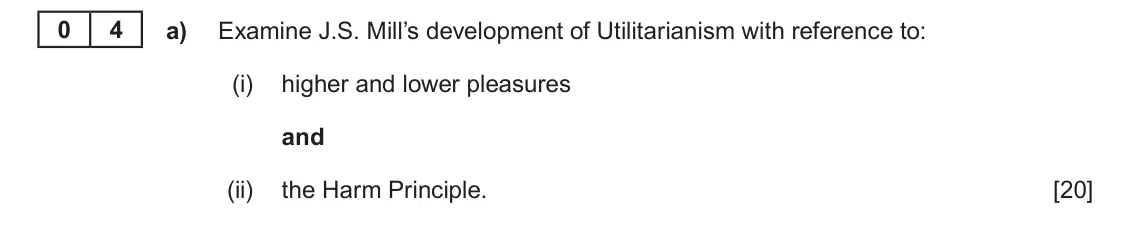
Q2(b)
The whole paper ↗
Q5(a)
The whole paper ↗
Q5(b)
The whole paper ↗
Q1(a)
The whole paper ↗
Q2(a)
The whole paper ↗
All 12 questions on Mill’s Rule Utilitarianism, as a list
- June 2025, Component 3, Q2(a) (20 marks): Examine John Stuart Mill’s development of Utilitarianism.
- June 2025, Component 3, Q2(b) (30 marks): ‘Utilitarianism does not offer a practical basis for making moral decisions.’ Evaluate this view. 3
- June 2024, AS Component 3, Q3(a) (25 marks): Examine Mill’s Utilitarianism as a teleological/deontological hybrid.
- June 2024, AS Component 3, Q3(b) (25 marks): ‘Utilitarianism promotes moral behaviour.’ Evaluate this view.
- June 2023, AS Component 3, Q4(a) (25 marks): Explain John Stuart Mill’s development of Utilitarianism.
- June 2023, AS Component 3, Q4(b) (25 marks): ‘Utilitarianism does not work in contemporary society.’ Evaluate this view.
- June 2022, Component 3, Q4(a) (20 marks): Examine J.S. Mill’s development of Utilitarianism with reference to: (i) higher and lower pleasures and (ii) the Harm Principle.
- Autumn 2020, AS Component 3, Q2(b) (25 marks): ‘Bentham offers a more practical form of Utilitarianism than Mill.’ Evaluate this view. 3
- June 2018, Component 3, Q5(a) (20 marks): Examine both the deontological and teleological features of Rule Utilitarianism.
- June 2018, Component 3, Q5(b) (30 marks): ‘Act Utilitarianism provides a better basis for making moral decisions than Rule Utilitarianism.’ Evaluate this view.
- June 2017, AS Component 3, Q1(a) (25 marks): Explain Mill’s development of Bentham’s Utilitarianism.
- June 2017, AS Component 3, Q2(a) (25 marks): Compare Act and Rule Utilitarianism.
Questions, mark schemes and examiner’s reports are © WJEC Eduqas, from their published past papers. Plumi isn’t affiliated with any exam board. Want whole papers? Full past papers.
Rather write your answers by hand on iPad? Plumi marks them against the same mark schemes.