 plumi
Stefan-Boltzmann and Wien’s laws: Edexcel International A Level Physics questions
Edexcel International A Level Physics past-paper questions on 5.6.2.2 Stefan-Boltzmann and Wien’s laws, 2019–2025, with mark schemes and examiner’s reports where available.
Paper
All papers
Exam
All years
Calculations
- Your answer
Q19(a)(i)
The whole paper ↗
Q19(b)
The whole paper ↗Q19(c)(i)
The whole paper ↗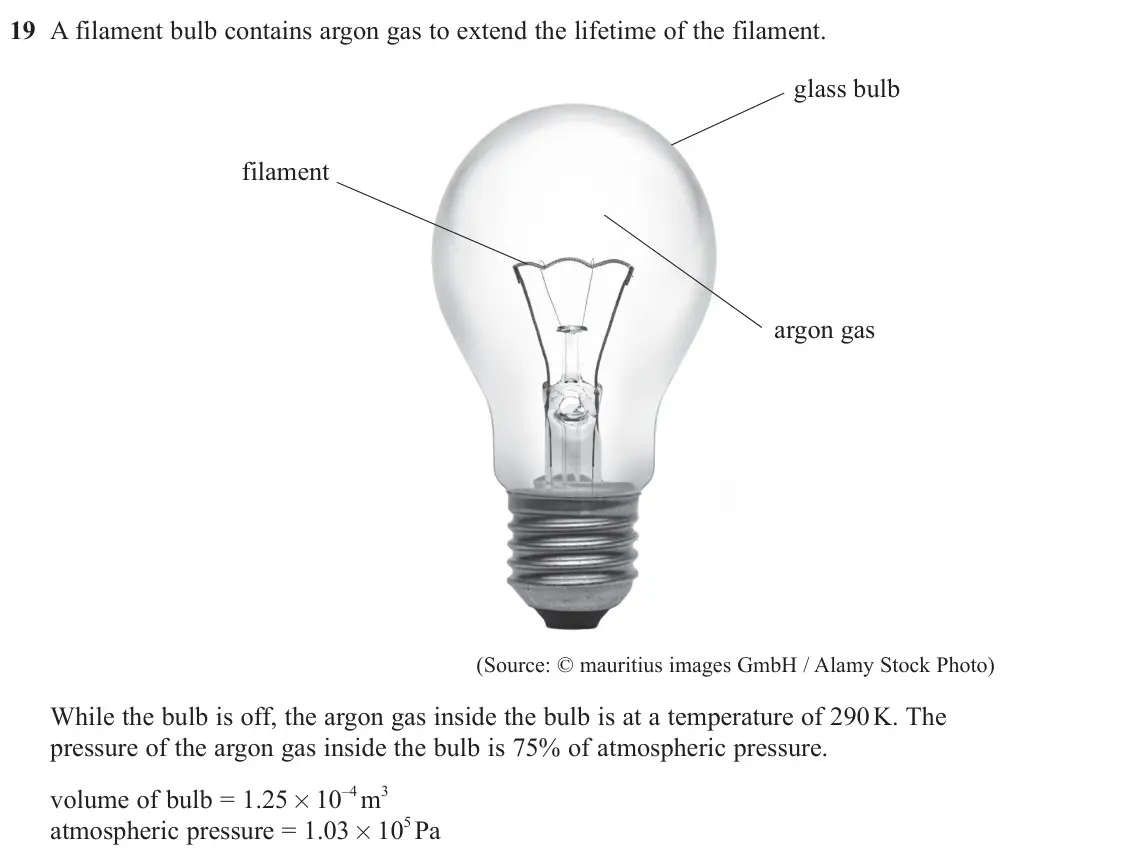
- Your answer
Q15(a)
The whole paper ↗
Q20(a)(i)
The whole paper ↗
Q16(a)
The whole paper ↗
- Your answer
Q16(a)
The whole paper ↗
Q18(a)
The whole paper ↗
Q21(a)(i)
The whole paper ↗
Q21(a)(i)
The whole paper ↗
Q21(a)(ii)
The whole paper ↗Q21(a)(i)
The whole paper ↗
Q16(a)
The whole paper ↗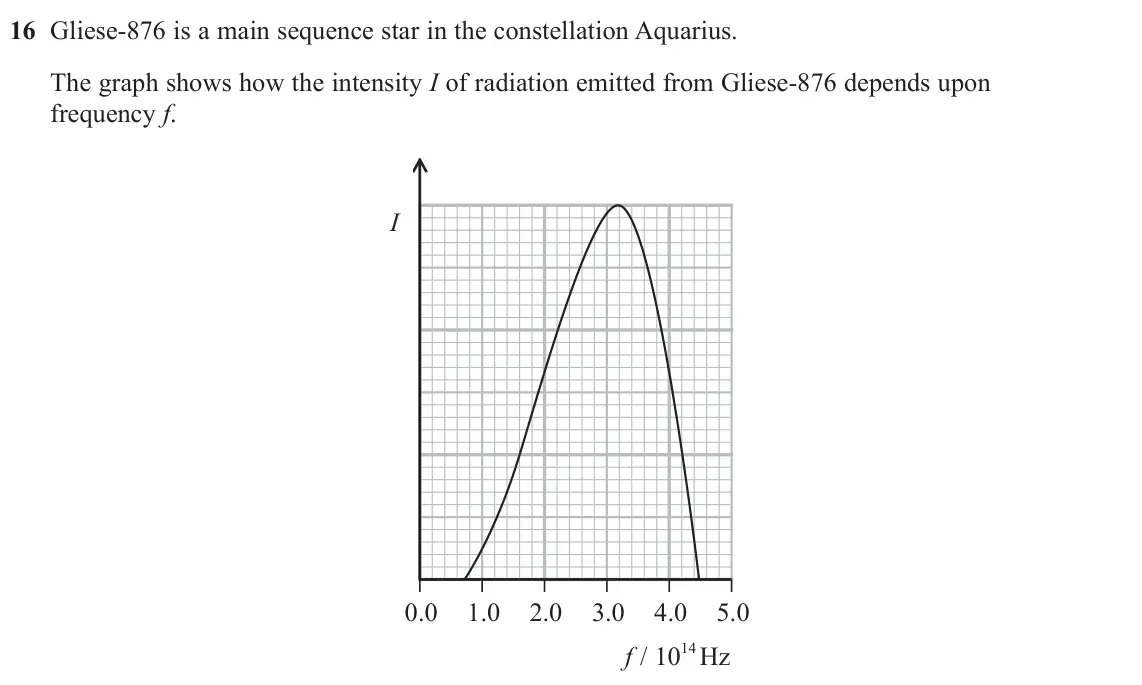
Q16(b)
The whole paper ↗Q18(b)(i)
The whole paper ↗
Q18(b)(ii)
The whole paper ↗Q19(c)
The whole paper ↗
All 31 questions on Stefan-Boltzmann and Wien’s laws, as a list
- June 2025, Unit 5, Q8 (1 mark): Two stars, X and Y, have the same luminosity. The graph shows how the intensity I of radiation received at Earth from star X and star Y varies with wavelength λ
- June 2025, Unit 5, Q19(a)(i) (3 marks): The spectrum of electromagnetic radiation emitted by Tau Ceti has a maximum intensity at a frequency of 5.50 × 10 14 Hz. Show that the surface temperature of Ta
- June 2025, Unit 5, Q19(b) (5 marks): Aita is a planet in orbit around Tau Ceti. A scientist suggests that Aita receives the same intensity of light from Tau Ceti as the Earth receives from the Sun.
- January 2025, Unit 5, Q19(c)(i) (3 marks): While the bulb is on, radiation is emitted by the filament. This radiation has a peak power output at a wavelength, λmax , of 1100 nm. Calculate the power outpu
- October 2024, Unit 5, Q3 (1 mark): The graph shows how intensity of radiation varies with wavelength for two stars, P and Q. Intensity P Q Wavelength Which of the following could be deduced from
- October 2024, Unit 5, Q15(a) (3 marks): Show that the luminosity of Sirius is about 9.7 × 10 27 W. radius of Sirius = 1.18 × 10 9 m surface temperature of Sirius = 9940 K (3)
- October 2024, Unit 5, Q20(a)(i) (3 marks): Show that the surface temperature of the Sun is about 6000 K. (3)
- June 2024, Unit 5, Q16(a) (5 marks): Calculate the wavelength, λmax , corresponding to the peak intensity of emission of radiation from ε-Eridani. distance of ε-Eridani from the Earth = 9.94 × 10 1
- January 2024, Unit 5, Q9 (1 mark): The graphs show how the radiation intensity varies with wavelength for star X and star Y. The surface temperature of star X is TX and the surface temperature of
- January 2024, Unit 5, Q16(a) (4 marks): Calculate the intensity of radiation from the Sun incident on Pluto. radius of Sun = 6.96 × 10 8 m surface temperature of Sun = 5800 K (4) Intensity of radiatio
- January 2024, Unit 5, Q18(a) (3 marks): The wavelength, λmax , at which the intensity of radiation is a maximum is 850 nm for Kruger A and 1500 nm for Kruger B. A website states that the surface tempe
- October 2023, Unit 5, Q21(a)(i) (4 marks): A website claims that the radius of Betelgeuse is 1000 times the radius of the Sun. Assess the accuracy of this claim. surface temperature of Sun = 5800 K 26 W
- June 2023, Unit 5, Q21(a)(i) (3 marks): Show that the surface temperature of Ross-154 is about 3000 K. (3)
- June 2023, Unit 5, Q21(a)(ii) (5 marks): A website states that the luminosity of Ross-154 is less than 0.5% of the luminosity of the Sun, LSun. Evaluate whether this statement is correct. radius of Ros
- January 2023, Unit 5, Q21(a)(i) (2 marks): Show that the surface temperature of Kapteyn’s Star is about 3600 K. (2)
- October 2022, Unit 5, Q16(a) (4 marks): Show that the surface temperature of Gliese-876 is about 3000 K. (4)
- October 2022, Unit 5, Q16(b) (4 marks): As a red dwarf star, the luminosity of Gliese-876 should be less than 10% of the luminosity of the Sun. Evaluate whether the surface temperature of Gliese-876 s
- June 2022, Unit 5, Q18(b)(i) (3 marks): Show that the surface temperature of Wolf 359 is about 2700 K. (3)
- June 2022, Unit 5, Q18(b)(ii) (3 marks): The radius of the Sun is RSun. The radius of Wolf 359 is 0.16 RSun. It is claimed that the luminosity of Wolf 359 is less than 0.1% of the luminosity of the Sun
- June 2022, Unit 5, Q19(c) (1 mark): The surface temperature of Chi Lupi is twice the surface temperature of the Sun. The radius of Chi Lupi is three times the radius of the Sun. State where Chi Lu
- January 2022, Unit 5, Q15 (5 marks): Procyon is the brightest star in the constellation Canis Minor. The graph shows how the radiated intensity from Procyon varies with wavelength. Radiated intensi
- October 2021, Unit 5, Q20(b)(i) (2 marks): Show that the current radius of the Sun is about 7.0 × 10⁸ m. surface temperature of Sun = 5780 K (2)
- October 2021, Unit 5, Q20(b)(ii) (3 marks): As a red giant star, the radius of the Sun will be about 150 times its current radius. Its luminosity will be about 1600 times its current luminosity. λmax is t
- October 2021, Unit 5, Q20(b)(iii) (3 marks): At this stage of its evolution the Sun will be classified as a red giant star. The wavelength of red light is between 6.2 × 10⁻⁷ m and 7.8 × 10⁻⁷ m. Comment on
- June 2021, Unit 5, Q8 (1 mark): Two stars, P and Q, have approximately the same radius. The surface temperature of star P is twice the surface temperature of star Q. Star P has a luminosity LP
- June 2021, Unit 5, Q10 (1 mark): Two stars, X and Y, behave as black body radiators. The graphs show how the intensity I of radiation emitted varies with wavelength λ for the two stars. I X Y λ
- June 2021, Unit 5, Q15(a) (3 marks): Determine the surface temperature of the star. (3) Surface temperature of star =
- January 2021, Unit 5, Q4 (1 mark): A metal bar is heated, then allowed to cool. The wavelength λmax at which peak radiation emission occurs is determined. Which of the following statements is cor
- January 2021, Unit 5, Q8 (1 mark): Two stars, X and Y, have the same surface temperature. X has a radius 25% larger than the radius of Y. The luminosity of X is LX. The luminosity of Y is LY. Whi
- October 2020, Unit 5, Q16(b) (2 marks): Calculate the wavelength at which peak radiation power occurs for Mintaka. (2) Wavelength =
- October 2020, Unit 5, Q16(c) (2 marks): Calculate the radius of Alnilam. (2) Radius of Alnilam =
Questions, mark schemes and examiner’s reports are © Pearson Edexcel, from their published past papers. Plumi isn’t affiliated with any exam board. Want whole papers? Edexcel International A Level Physics past papers.
The Plumi iPad app also offers exam-style questions with AI feedback on your handwritten working.