 plumi
Orbits: Edexcel International A Level Physics questions
Edexcel International A Level Physics past-paper questions on 5.6.1.4 Orbits, 2019–2025, with mark schemes and examiner’s reports where available.
Paper
All papers
Exam
All years
Calculations
Q13(b)
The whole paper ↗
Q14(a)
The whole paper ↗
Q18(a)
The whole paper ↗
- Your answer
Q18(a)
The whole paper ↗
Q18(b)(i)
The whole paper ↗Q18(b)(ii)
The whole paper ↗- Your answer
Q16(b)
The whole paper ↗
Q17(a)
The whole paper ↗
Q17(b)
The whole paper ↗
Q21(b)
The whole paper ↗
Q17(a)(ii)
The whole paper ↗
Q16(a)(i)
The whole paper ↗
Q16(a)(ii)
The whole paper ↗Q16(a)(i)
The whole paper ↗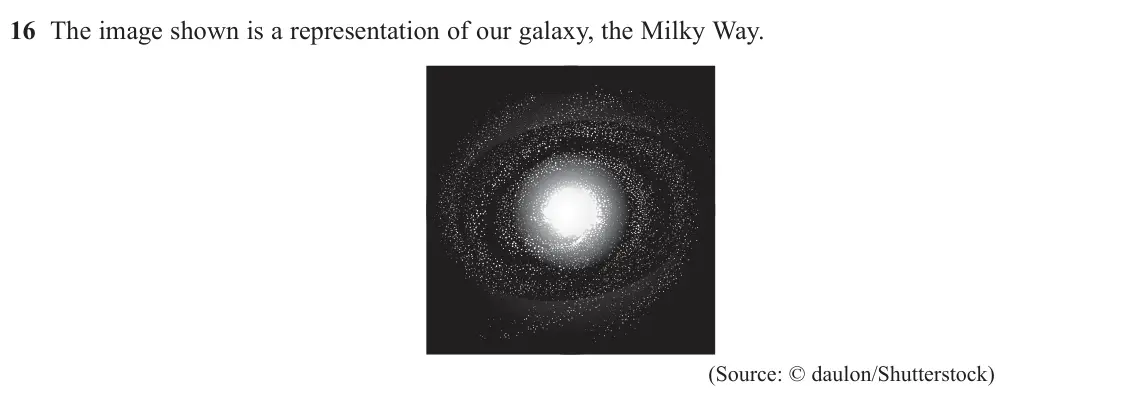
Q18(a)
The whole paper ↗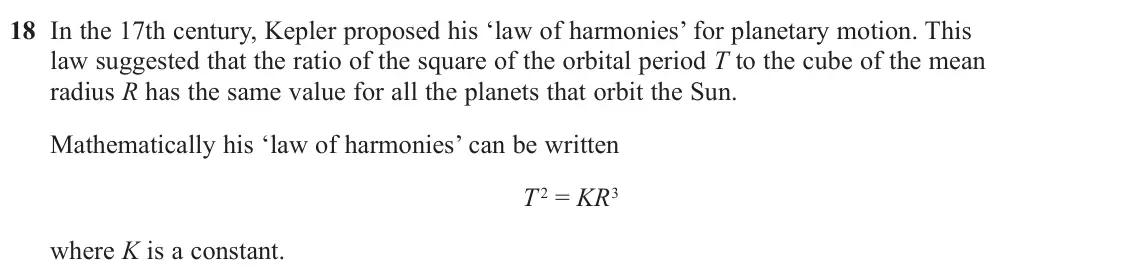
Q18(b)
The whole paper ↗Q18(c)
The whole paper ↗Q20(c)
The whole paper ↗
All 25 questions on Orbits, as a list
- June 2025, Unit 5, Q13(b) (4 marks): The satellite is in orbit above the equator. Deduce whether the satellite would appear to be stationary above the surface of the Earth. period of rotation of Ea
- January 2025, Unit 5, Q14(a) (3 marks): Show that the mass of the Sun is about 2 × 10 30 kg. radius of Earth’s orbit about Sun = 1.49 × 10 11 m 1 year = 3.15 × 10 7 s (3)
- October 2024, Unit 5, Q18(a) (4 marks): Galileo made observations of the movement of these moons for 8 days. The largest moon is Ganymede. Deduce whether 8 days would have been enough time for Galileo
- June 2024, Unit 5, Q6 (1 mark): The dwarf planet Pluto orbits the Sun in an elliptical orbit. The gravitational force of the Sun on Pluto varies as Pluto orbits the Sun. Pluto moves away from
- June 2024, Unit 5, Q18(a) (3 marks): One law related the orbital time T of a planet to its average distance r from the Sun. Show that 2 r 3 4π T 2 GM where M is the solar mass. (3)
- June 2024, Unit 5, Q18(b)(i) (2 marks): A star in one of the outer arms of the galaxy is orbiting the centre of the galaxy. The star is 5.7 × 10 20 m from the centre of the galaxy. Show that the orbit
- June 2024, Unit 5, Q18(b)(ii) (4 marks): The orbital period of the star is actually 6.0 × 10 The two values for the orbital period of the star do not agree. Deduce what this tells us about our galaxy.
- January 2024, Unit 5, Q6 (1 mark): The planet Mercury orbits the Sun in an elliptical orbit. As a result, the speed of Mercury varies as it orbits the Sun. Which row of the table shows how the sp
- January 2024, Unit 5, Q16(b) (4 marks): Calculate the time, in years, that Pluto takes to make one complete orbit of the Sun. 7 s 1 year = 3.15 × 10 30 kg mass of Sun = 1.99 × 10 (4) Time for one orbi
- January 2024, Unit 5, Q17(a) (2 marks): Astronauts in orbit about the Earth are sometimes described as ‘weightless’, although they do experience a weight force. Explain why astronauts may be described
- October 2023, Unit 5, Q17(b) (6 marks): The average distance of Makemake from the Sun is similar to the average distance of the dwarf planet Pluto from the Sun. A website states: “The time taken by Ma
- June 2023, Unit 5, Q21(b) (3 marks): Scientists have observed an Earth-type planet in orbit around Ross-154. The radius of the orbit is 0.096 AU. Calculate the time for this planet to make one orbi
- October 2022, Unit 5, Q17(a)(ii) (4 marks): Determine the time T, in years, for Ceres to make one complete orbit about the Sun. 1 year = 3.15 × 10⁷ s (4) T = years
- June 2022, Unit 5, Q16(a)(i) (3 marks): Show that T is related to r by the expression: T 2 µ r3 (3)
- June 2022, Unit 5, Q16(a)(ii) (5 marks): When planets align as they orbit the Sun they are said to be ‘in opposition’. The diagram shows the Earth and Jupiter in opposition. NOT TO SCALE Sun Earth Jupi
- January 2022, Unit 5, Q16(a)(i) (3 marks): The graph shows how astronomers expect v to vary with r. v r Explain how the expression gives the variation of v with r shown in the graph. (3)
- January 2022, Unit 5, Q18(a) (3 marks): The table shows data for Earth and Mars. Planet T / s R / m Earth 3.16 × 10⁷ 1.50 × 10¹¹ Mars 5.93 × 10⁷ 2.28 × 10¹¹ Show that, for Earth and for Mars, K has a
- January 2022, Unit 5, Q18(b) (3 marks): Kepler’s law of harmonies was derived later by Newton. Newton applied his law of gravitation to a planet moving in an approximately circular orbit around the Su
- January 2022, Unit 5, Q18(c) (2 marks): Jupiter is the most massive planet in the solar system and has many moons. Kepler’s law of harmonies applies to the orbiting moons. However, the value of K for
- October 2021, Unit 5, Q20(c) (3 marks): As the Sun continues its evolution, its mass will decrease. It is estimated that at its largest radius, the mass of the Sun will have decreased significantly. E
- October 2021, Unit 5, Q21(b) (5 marks): It is claimed that a satellite in orbit at a height of 8.50 × 10⁵ m would make 15 orbits of the Earth every 24 hours. Assess the validity of this claim. (5)
- October 2021, Unit 5, Q21(c) (2 marks): It is suggested that the satellite could be placed in an equatorial orbit at a radius of 42 200 km. With this radius the satellite would have an orbital period
- June 2021, Unit 5, Q16(a) (3 marks): Calculate the orbital time of a Starlink satellite. (3) Orbital time of satellite =
- June 2021, Unit 5, Q16(b) (3 marks): Explain why satellites in low Earth orbits have a smaller orbital time than satellites in higher Earth orbits. (3)
- January 2021, Unit 5, Q17(a)(i) (4 marks): A textbook claims that for astronauts in Salyut 1, there would be a sunrise 16 times every day. Assess the validity of this claim. 1 day = 8.64 ´ 104 s (4)
Questions, mark schemes and examiner’s reports are © Pearson Edexcel, from their published past papers. Plumi isn’t affiliated with any exam board. Want whole papers? Edexcel International A Level Physics past papers.
The Plumi iPad app also offers exam-style questions with AI feedback on your handwritten working.