 plumi
Gravitational potential and comparing fields: Edexcel International A Level Physics questions
Edexcel International A Level Physics past-paper questions on 5.6.1.3 Gravitational potential and comparing fields, 2019–2025, with mark schemes and examiner’s reports where available.
Paper
All papers
Exam
All years
Calculations
- Your answer
Q13(a)
The whole paper ↗
- Your answer
- Your answer
- Your answer
- Your answer
- Your answer
Q18(b)
The whole paper ↗
- Your answer
Q12(a)
The whole paper ↗
Q12(b)(i)
The whole paper ↗- Your answer
Q16(b)
The whole paper ↗
- Your answer
Q21(a)(i)
The whole paper ↗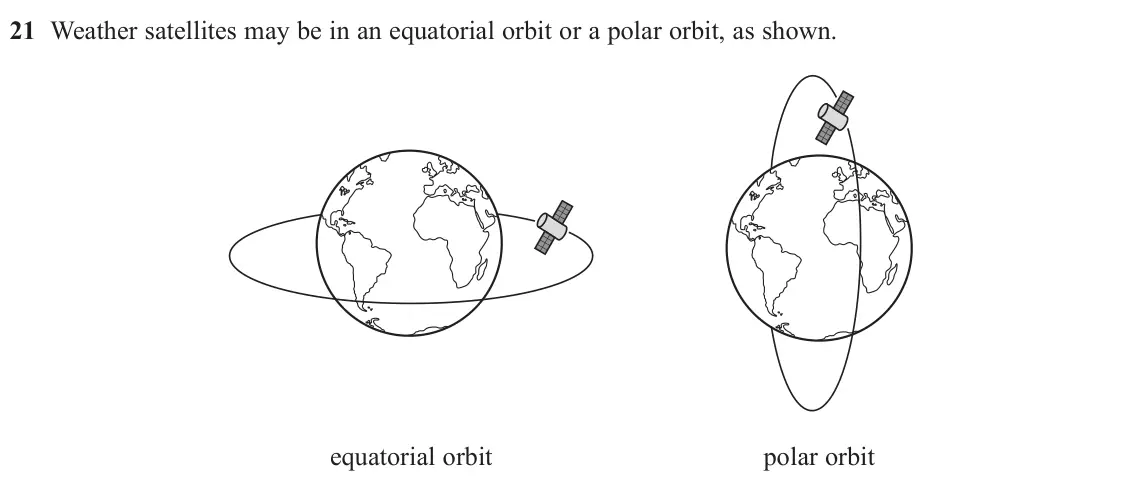
Q21(a)(ii)
The whole paper ↗Q16(c)
The whole paper ↗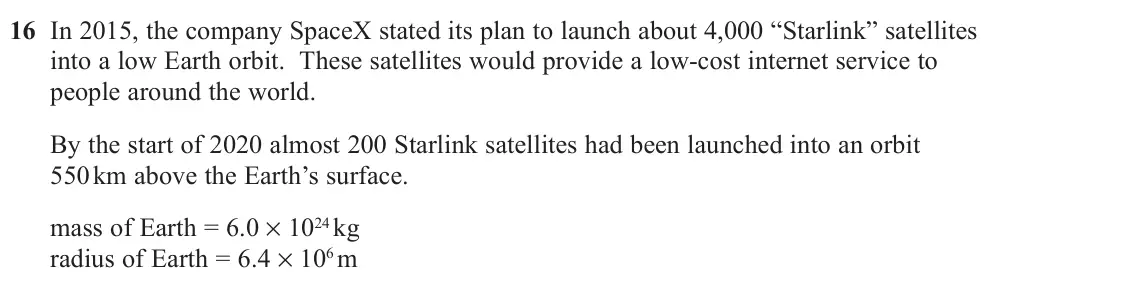
Q17(a)(ii)
The whole paper ↗
All 23 questions on Gravitational potential and comparing fields, as a list
- June 2025, Unit 5, Q1 (1 mark): Which of the following statements applies to both electric fields and gravitational fields? A Each field causes a force on all particles. B Each field can cause
- June 2025, Unit 5, Q13(a) (3 marks): Calculate the change in gravitational potential energy of the satellite. 24 kg mass of Earth = 5.98 × 10 6 m radius of Earth = 6.37 × 10 (3) Change in gravitati
- January 2025, Unit 5, Q3 (1 mark): There is an electric field around a point charge and a gravitational field around a point mass. Which of the following is not correct? A Both fields are radial.
- January 2025, Unit 5, Q9 (1 mark): Due to tidal action, the Moon is slowly moving away from the Earth. As the Moon moves away from the Earth, the gravitational force between the Earth and the Moo
- January 2025, Unit 5, Q12 (3 marks): The graph shows how gravitational potential V varies with distance r from the centre of the Earth. 0 0.2 0.4 0.6 0.8 1.0 r / 108 m 0 –1.0 –2.0 V / 107 J kg–1 –3
- October 2024, Unit 5, Q5 (1 mark): The dashed circles on the diagram represent gravitational equipotentials about the planet Mars. The gravitational potential at X is –5.5 MJ kg –1. The gravitati
- June 2024, Unit 5, Q11 (2 marks): The diagram shows the Earth and some gravitational equipotential surfaces X, Y and Z. The difference in gravitational potential between X and Y is the same as t
- January 2024, Unit 5, Q6 (1 mark): The planet Mercury orbits the Sun in an elliptical orbit. As a result, the speed of Mercury varies as it orbits the Sun. Which row of the table shows how the sp
- October 2023, Unit 5, Q6 (1 mark): The Moon is gradually moving away from the Earth. The gravitational potential at the Earth due to the Moon, and the gravitational force between the Earth and th
- October 2023, Unit 5, Q18(b) (3 marks): Calculate the change in gravitational potential energy of the asteroid if it had fallen to the surface of the Earth from a height of 3590 km. Assume that the ma
- June 2023, Unit 5, Q4 (1 mark): A satellite of mass m is on the Earth’s surface. The satellite is moved into a circular orbit of height h above the Earth. The mass of the Earth is M and the ra
- January 2023, Unit 5, Q12(a) (2 marks): Show that the escape velocity v for a planet of mass M and radius r is given by the expression 2 GM v = r (2)
- January 2023, Unit 5, Q12(b)(i) (2 marks): Show that the escape velocity for a mass at the Earth’s surface is about 1.1 × 10 4 m s –1. mass of Earth = 5.98 × 10 24 kg radius of Earth = 6.36 × 10 6 m (2)
- October 2022, Unit 5, Q7 (1 mark): A space shuttle of mass m is returning to Earth of mass M. The space shuttle falls from a height R above the Earth, where R is equal to the radius of the Earth.
- June 2022, Unit 5, Q16(b) (3 marks): The distance of Jupiter from the Sun varies from 7.4 × 10¹¹ m to 8.2 × 10¹¹ m. Calculate the change in gravitational potential energy of Jupiter as it moves fro
- October 2021, Unit 5, Q2 (1 mark): A helium nucleus approaches a gold nucleus. An electric force and a gravitational force act on each nucleus. Which statement about these forces is not correct?
- October 2021, Unit 5, Q21(a)(i) (2 marks): Show that the gravitational potential at this height is about −5.5 × 10⁷ J kg−1. mass of Earth = 5.98 × 1024 kg radius of Earth = 6360 km (2)
- October 2021, Unit 5, Q21(a)(ii) (2 marks): Hence calculate the increase in gravitational potential energy when the satellite is placed in orbit. satellite mass = 4990 kg gravitational potential at the Ea
- June 2021, Unit 5, Q16(c) (3 marks): The satellites were launched into orbit using rockets able to make multiple space flights. Calculate the minimum kinetic energy required to raise the satellite
- January 2021, Unit 5, Q17(a)(ii) (3 marks): Salyut 1 made almost three thousand orbits before falling back to Earth. Calculate the change in gravitational potential energy of Salyut 1 as it fell back to E
- October 2020, Unit 5, Q11 (2 marks): Electrostatic forces and gravitational forces can both be modelled by the idea of a field. Give one similarity and one difference between electric fields and gr
- October 2020, Unit 5, Q15(b)(i) (1 mark): The change in gravitational potential energy ∆Egrav of a mass m when it experiences a vertical displacement Δh can be calculated using the expression ∆Egrav = m
- October 2020, Unit 5, Q15(b)(ii) (3 marks): Calculate the change in gravitational potential energy of the satellite. mass of the Earth = 6.0 × 1024 kg RE = 6.4 × 10⁶ m mass of satellite = 3.5 × 10³ kg (3)
Questions, mark schemes and examiner’s reports are © Pearson Edexcel, from their published past papers. Plumi isn’t affiliated with any exam board. Want whole papers? Edexcel International A Level Physics past papers.
The Plumi iPad app also offers exam-style questions with AI feedback on your handwritten working.