 plumi
Electric fields and field strength: Edexcel International A Level Physics questions
Edexcel International A Level Physics past-paper questions on 4.4.1.1 Electric fields and field strength, 2019–2025, with mark schemes and examiner’s reports where available.
Paper
All papers
Exam
All years
Calculations
- Your answer
Q19(b)(i)
The whole paper ↗
Q19(b)(ii)
The whole paper ↗Q19(b)(iii)
The whole paper ↗Q19(c)(i)
The whole paper ↗Q19(c)(ii)
The whole paper ↗Q16(b)
The whole paper ↗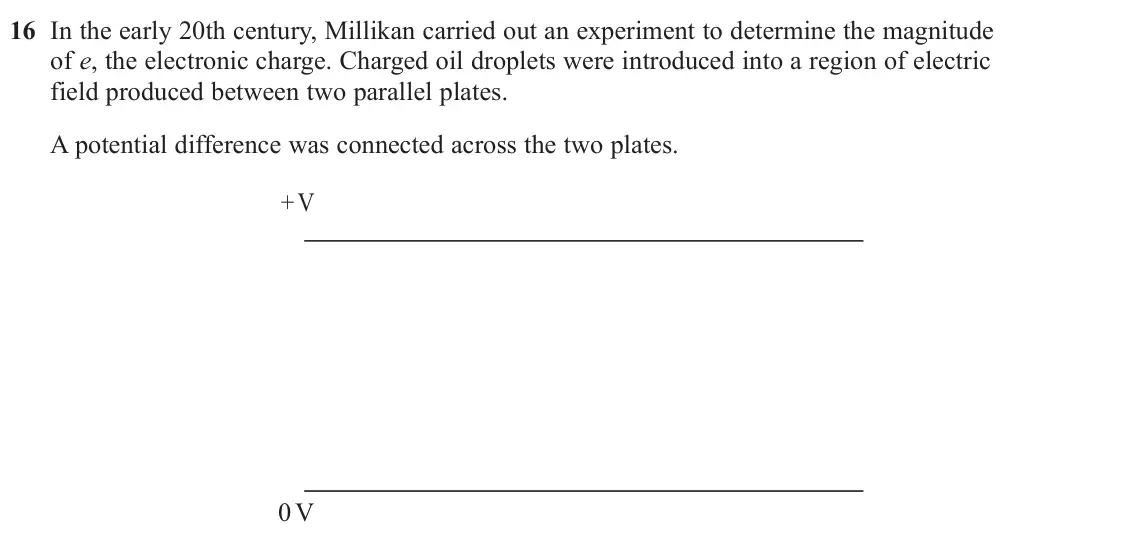
Q16(a)(iii)
The whole paper ↗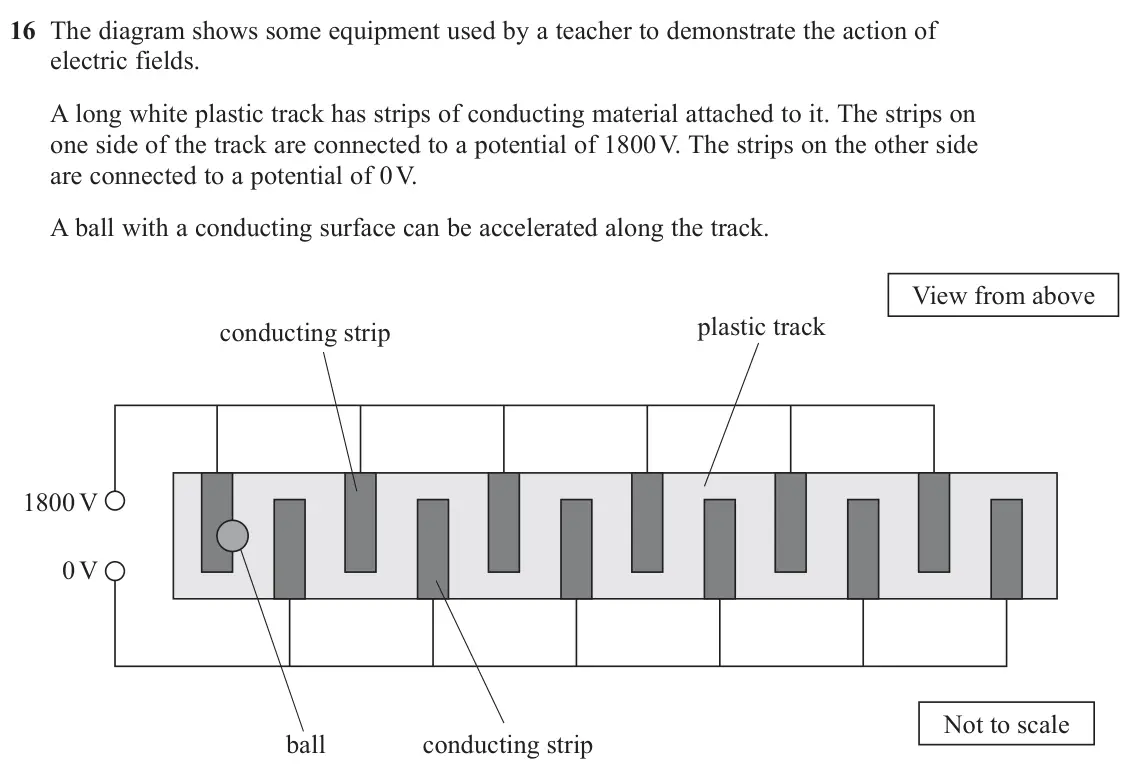
Q17(c)
The whole paper ↗
Q13(b)
The whole paper ↗
Q20(a)
The whole paper ↗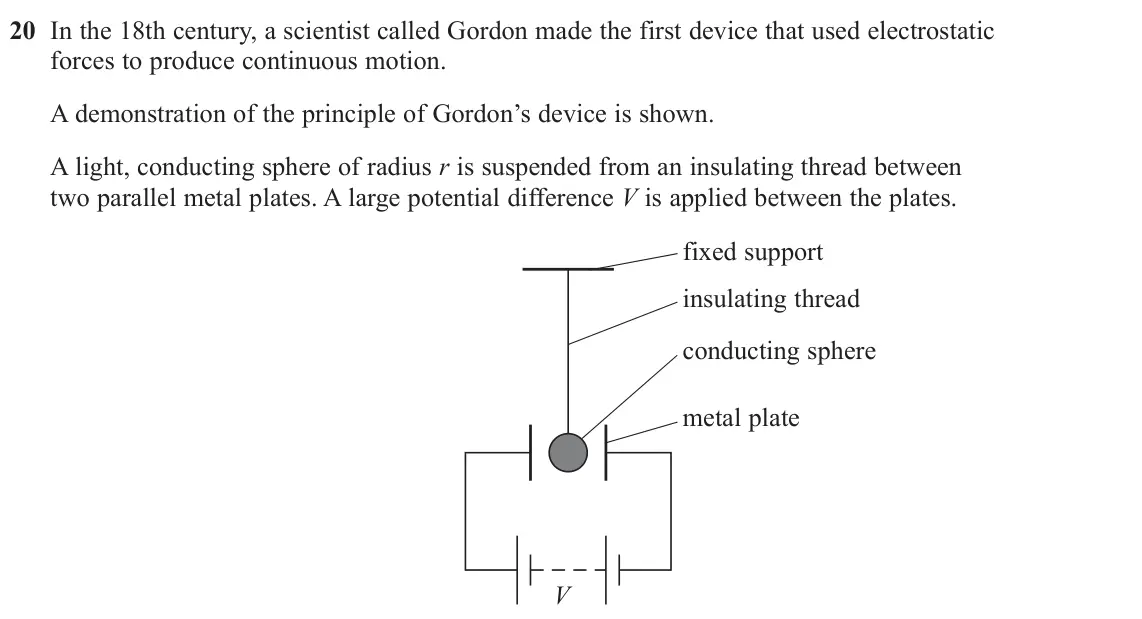
Q20(b)
The whole paper ↗Q20(c)
The whole paper ↗Q22(a)
The whole paper ↗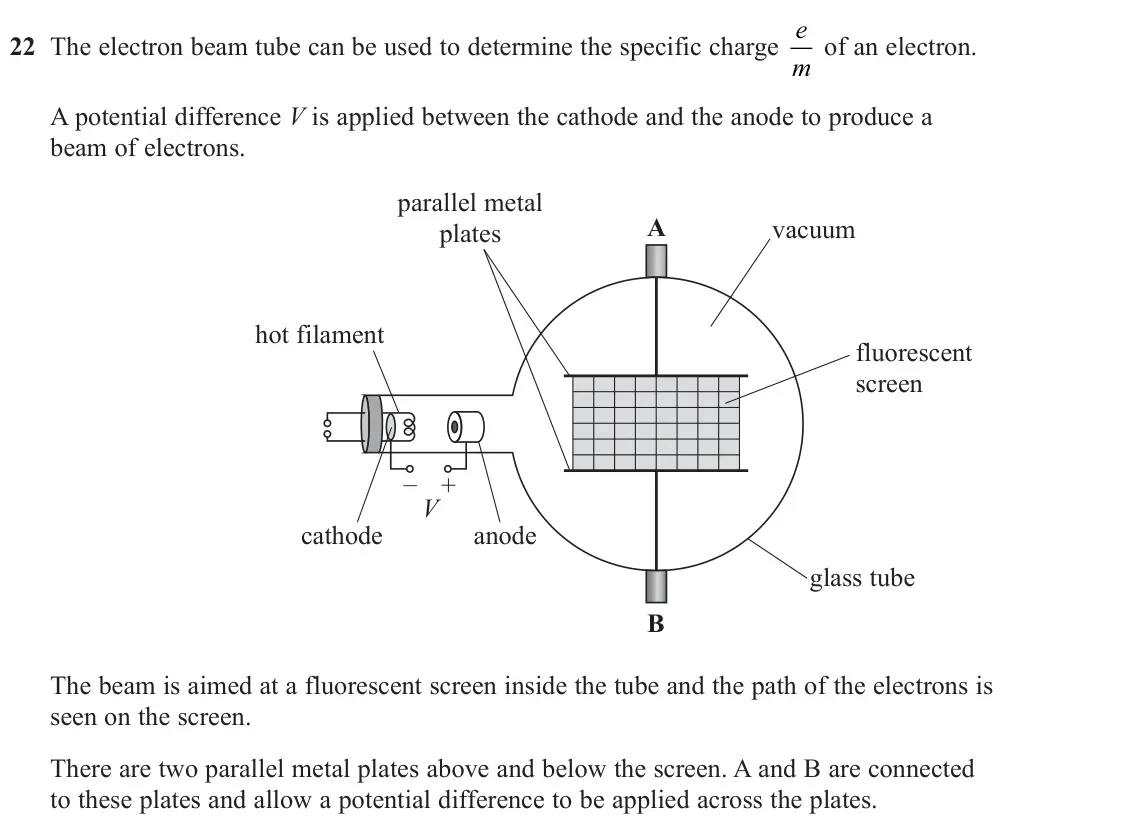
Q22(b)(ii)
The whole paper ↗Q17(b)(ii)
The whole paper ↗
Q17(b)(iii)
The whole paper ↗- Your answer
Q17(a)(i)
The whole paper ↗Q18(b)(i)
The whole paper ↗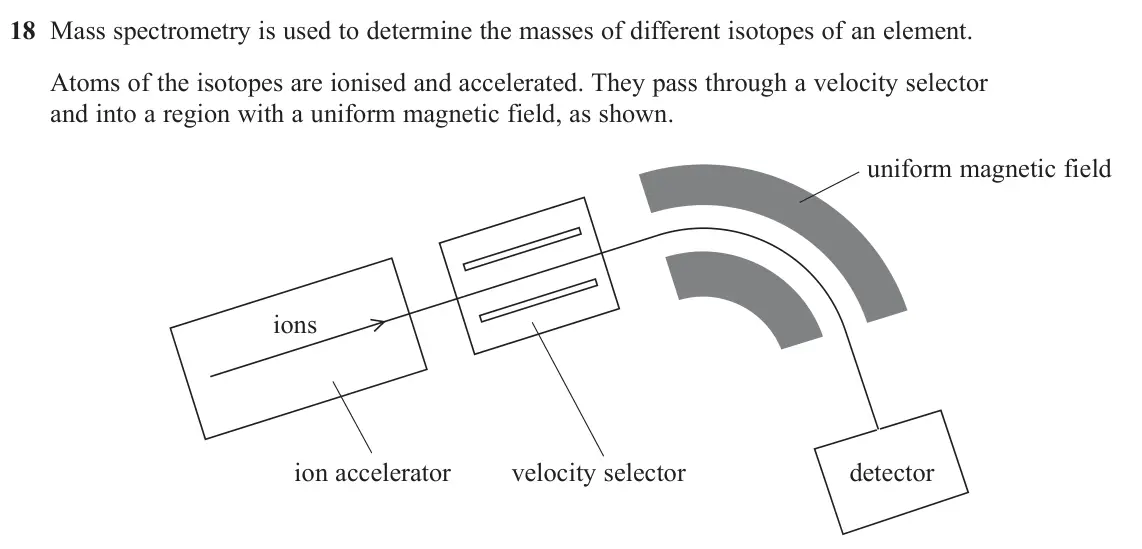
All 33 questions on Electric fields and field strength, as a list
- June 2025, Unit 4, Q3 (1 mark): A proton is in a vacuum. At a distance r from the proton, the electric field strength due to the proton is 0.77 N C –1. Which of the following gives the distanc
- June 2025, Unit 4, Q19(b)(i) (2 marks): Explain why a sand particle moves as shown. (2)
- June 2025, Unit 4, Q19(b)(ii) (2 marks): Show that the electric field strength between the negatively charged plate and the solar panel is about 8.1 × 10 5 V m –1. distance between plate and solar pane
- June 2025, Unit 4, Q19(b)(iii) (6 marks): The maximum positive charge that can be given to the sand particles when the –12 C. solar panel is charged is 4.0 × 10 The table below shows the diameters of so
- June 2025, Unit 4, Q19(c)(i) (2 marks): Add to the diagram below to show the forces acting on a charged sand particle. (2) negatively charged plate + positively charged solar panel θ
- June 2025, Unit 4, Q19(c)(ii) (2 marks): Explain how inclining the solar panel at an angle θ would improve the removal of sand particles from the solar panel. (2)
- January 2025, Unit 4, Q16(b) (5 marks): A charged oil drop entered the region of electric field between the plates. The plates were 1.5 cm apart. A potential difference of 85 V was applied between the
- October 2024, Unit 4, Q16(a)(iii) (4 marks): There is a force on the ball due to the uniform electric field between the strips. Deduce whether this is the only force acting to accelerate the ball at about
- June 2024, Unit 4, Q17(c) (1 mark): In reality, the magnitude of the positive charge on the spacecraft may be greater than the magnitude of the negative charge on the satellite. Suggest why. (1)
- January 2024, Unit 4, Q13(b) (2 marks): Calculate the electric field strength due to the helium ion, at the initial position of the proton. (2) Electric field strength due to helium ion =
- October 2023, Unit 4, Q20(a) (5 marks): There is an electrostatic force on the sphere when the sphere is charged. The capacitance C of the sphere is given by C = 4πε0r where r is the radius of the con
- October 2023, Unit 4, Q20(b) (3 marks): After the sphere has been charged, the sphere starts to oscillate between the plates. The sphere touches each plate alternately. Explain why the conducting sphe
- October 2023, Unit 4, Q20(c) (2 marks): A few years later, another scientist called Franklin adapted Gordon’s device. Franklin suspended a conducting sphere between two metal bells. One metal bell was
- October 2023, Unit 4, Q22(a) (3 marks): Explain why electrons are deflected into a parabolic path when a potential difference is applied between A and B. (3)
- October 2023, Unit 4, Q22(b)(ii) (5 marks): The electric field strength between the parallel metal plates is 1.7 × 10 4 V m –1. The length of each plate is 7.5 cm. The electrons pass through the region be
- June 2023, Unit 4, Q17(b)(ii) (3 marks): The sphere moves away from the positive plate and comes to rest at an angle θ to the vertical. insulating thread θ +5000 V 0 V –4 N. Show that the horizontal fo
- June 2023, Unit 4, Q17(b)(iii) (3 marks): Show that θ is about 1°. mass of sphere = 2.7 g (3)
- January 2023, Unit 4, Q10 (1 mark): A proton is accelerated by a uniform electric field. After time t the speed of the proton has increased by Δv. A helium nucleus 4 2He is accelerated by the same
- January 2023, Unit 4, Q17(a)(i) (3 marks): The plates are separated by a distance d. Show that the speed v of the electrons is given by v = V Bd (3)
- October 2022, Unit 4, Q18(b)(i) (2 marks): A uniform electric field between the plates acts on an oxygen ion. A uniform magnetic field acts so that the magnetic force on the oxygen ion is in the opposite
- October 2021, Unit 4, Q16(b)(i) (3 marks): Show that the force on an ionised atom due to the electric field is about 2.6 × 10⁻¹³ N. charge on ionised atom = 1.60 × 10⁻¹⁹ C distance between plates = 6.40
- October 2021, Unit 4, Q16(b)(ii) (2 marks): The ionised atom travels 0.2 μm in the direction perpendicular to the plates before colliding with another atom. Deduce whether the collision could lead to furt
- June 2021, Unit 4, Q8 (1 mark): The diagram shows two metal plates with a potential difference V across them. The path of an electron travelling between the plates is shown. +V θ electron path
- June 2021, Unit 4, Q12(b) (4 marks): A mercury ion with kinetic energy 6.42 × 10⁻¹⁵ J leaves a drift tube, as shown. drift tube drift tube path of mercury ion Calculate the momentum of the mercury
- January 2021, Unit 4, Q1 (1 mark): Which of the following is not a vector quantity? A electric field strength B impulse C magnetic flux density D work done
- January 2021, Unit 4, Q19(a)(iii) (4 marks): A potential difference (p.d.) was applied across the plates and adjusted until a charged oil droplet was stationary between them. metal plates 9910 V 1.60 cm st
- January 2021, Unit 4, Q19(b) (3 marks): The students repeated the experiment for a large number of oil droplets. The graph shows the number of oil droplets with each measured charge. 20 18 16 14 12 Nu
- January 2021, Unit 4, Q19(c) (3 marks): In 1909 Millikan concluded that the charge on the electron was 1.592 × 10⁻¹⁹ C whereas the accepted value today is 1.602 × 10⁻¹⁹ C. This was because the value f
- October 2020, Unit 4, Q1 (1 mark): Two equal positive charges are placed at Y and Z. Y Z X Point X is equidistant from Y and Z. Which of the following shows the direction of the electric field at
- October 2020, Unit 4, Q6 (1 mark): An oil drop with charge q and mass m remains stationary between two metal plates with a potential difference V across them. The plates are separated by distance
- January 2020, Unit 4, Q5 (1 mark): The diagram shows a potential difference applied across two conducting parallel plates. +10 V X 20 cm 0 V Point X is midway between the plates. Which of the fol
- January 2020, Unit 4, Q16(a) (1 mark): State, with a reason, the polarity of the charge on the strands of web. (1)
- January 2020, Unit 4, Q16(b) (5 marks): A spider moves upwards after letting out a strand of web. Determine the initial upwards acceleration of the spider. mass of spider = 3.00×10⁻⁶ kg total magnitud
Questions, mark schemes and examiner’s reports are © Pearson Edexcel, from their published past papers. Plumi isn’t affiliated with any exam board. Want whole papers? Edexcel International A Level Physics past papers.
The Plumi iPad app also offers exam-style questions with AI feedback on your handwritten working.