 plumi
Diffraction and the diffraction grating (core practical 6): Edexcel International A Level Physics questions
Edexcel International A Level Physics past-paper questions on 2.3.4.2 Diffraction and the diffraction grating (core practical 6), 2019–2025, with mark schemes and examiner’s reports where available.
Paper
All papers
Exam
All years
Calculations
Q15(a)
The whole paper ↗
Q15(b)(ii)
The whole paper ↗Q14(b)(i)
The whole paper ↗
Q14(b)(ii)
The whole paper ↗Q4(b)
The whole paper ↗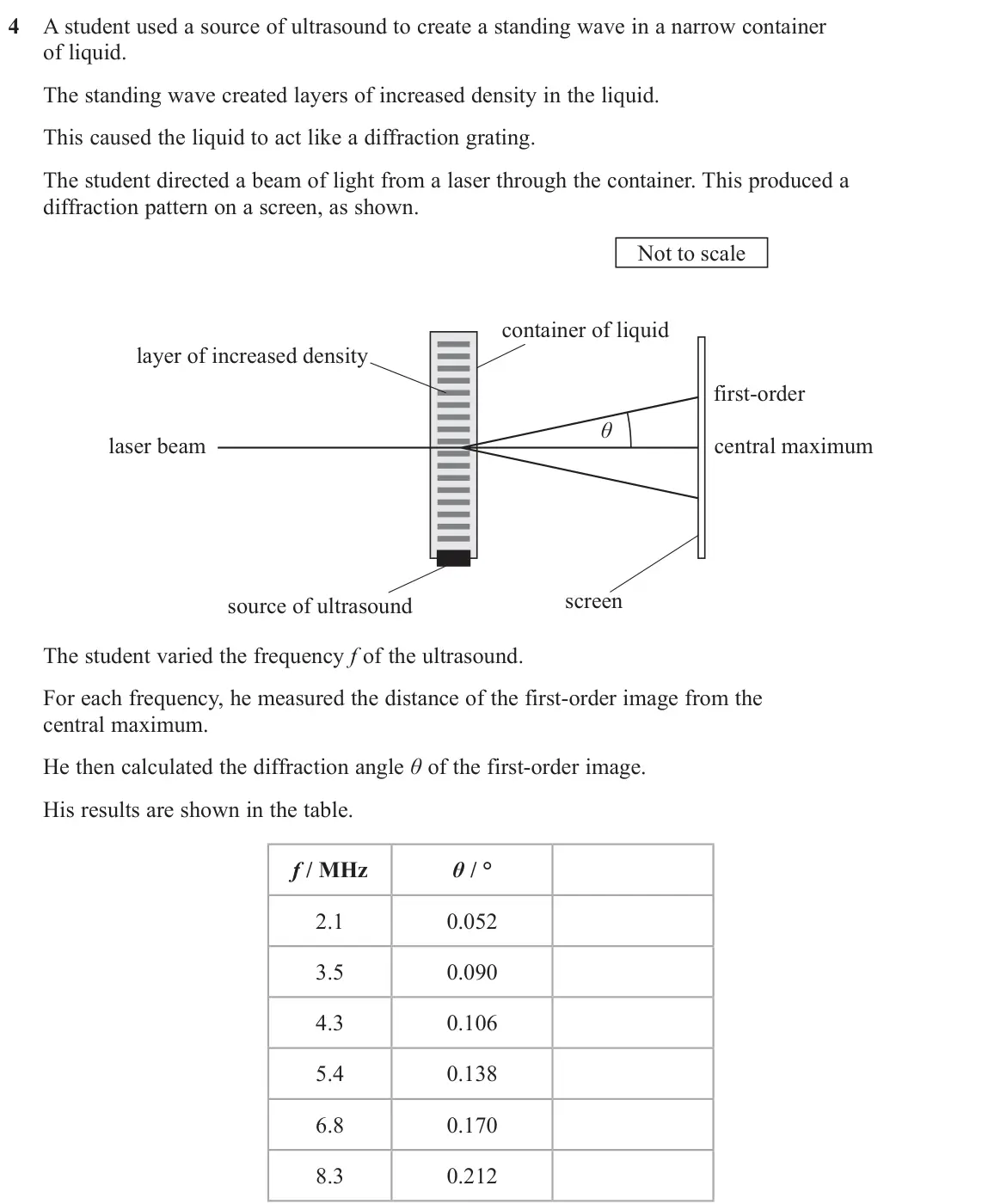
Q4(c)(i)
The whole paper ↗Q16(a)
The whole paper ↗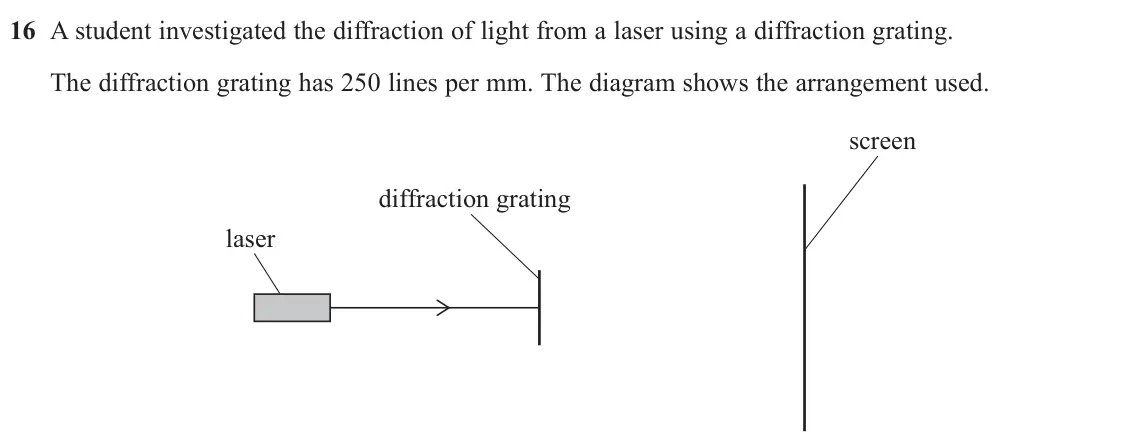
Q16(b)
The whole paper ↗Q16(c)(i)
The whole paper ↗Q16(c)(ii)
The whole paper ↗Q12(a)
The whole paper ↗
Q12(b)
The whole paper ↗Q17(a)
The whole paper ↗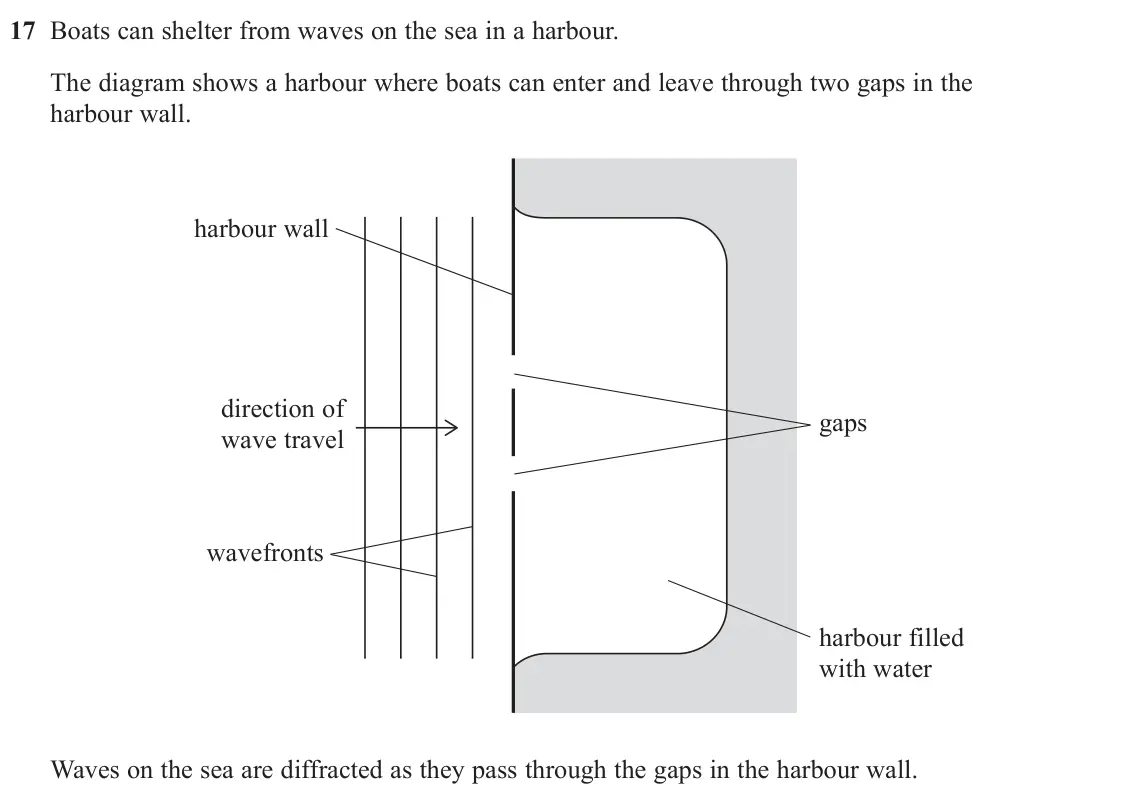
Q17(b)
The whole paper ↗Q3(b)(i)
The whole paper ↗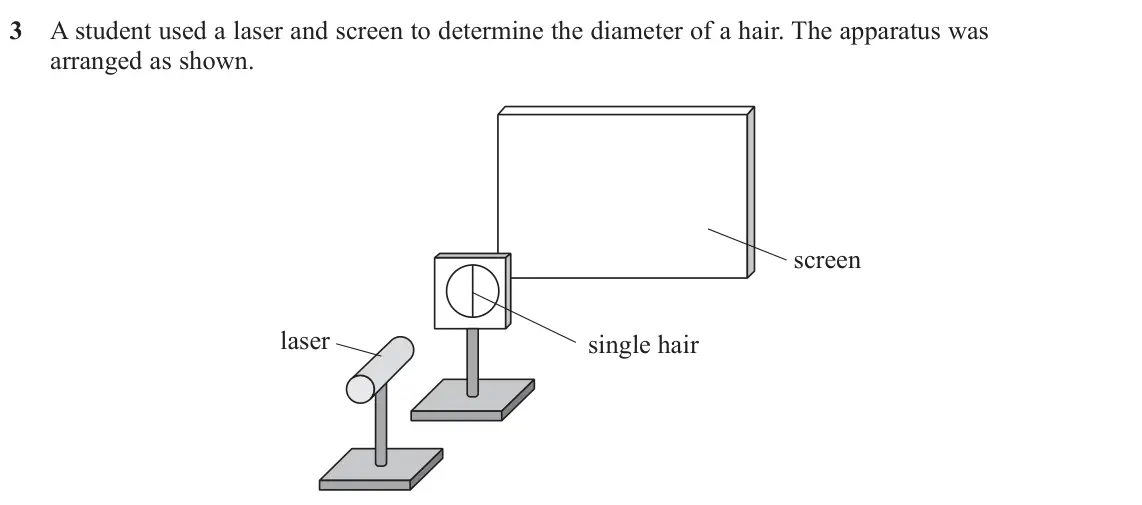
- Your answer
Q15(a)
The whole paper ↗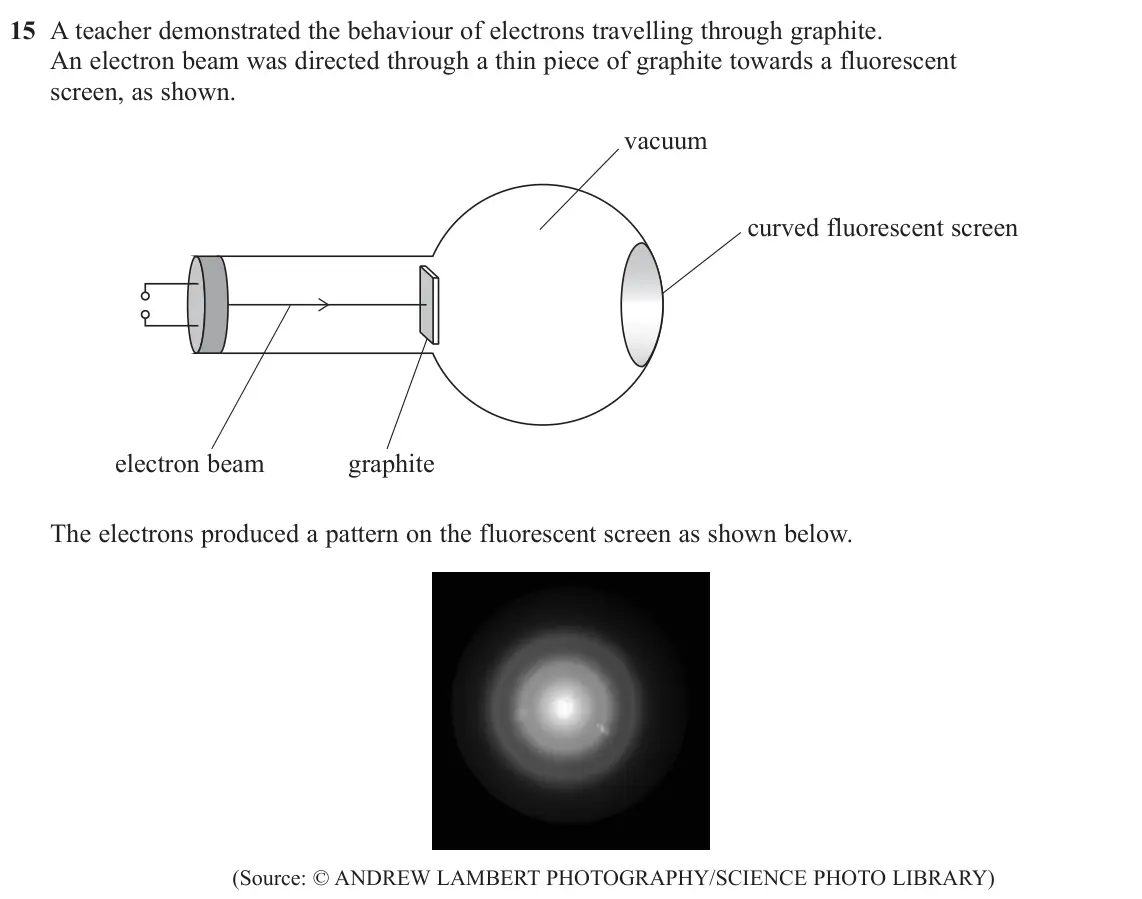
- Your answer
- Your answer
- Your answer
All 38 questions on Diffraction and the diffraction grating (core practical 6), as a list
- June 2025, AS Unit 2, Q15(a) (2 marks): State what is meant by diffraction. (2)
- June 2025, AS Unit 2, Q15(b)(ii) (3 marks): A student suggests that the beam of electrons would produce a diffraction pattern if a diffraction grating with 5000 lines per cm was used. screen electron beam
- January 2025, AS Unit 2, Q14(b)(i) (4 marks): Calculate the number of lines per mm on the diffraction grating. λ = 650 nm L = 1.30 m x = 0.22 m (4) Number of lines per mm =
- January 2025, AS Unit 2, Q14(b)(ii) (3 marks): Explain how a first order maximum is produced on the screen. (3)
- January 2025, AS Unit 3, Q4(b) (2 marks): The student derived the following formula v λ θ sin f where λ is the wavelength of the laser light and v is the speed of sound in the liquid. Explain how a grap
- January 2025, AS Unit 3, Q4(c)(i) (3 marks): Determine the value of v using your graph. λ = 650 nm (3) v =
- October 2024, AS Unit 2, Q16(a) (1 mark): Give one safety precaution the student should take during the experiment. (1)
- October 2024, AS Unit 2, Q16(b) (2 marks): State what measurements the student should make to determine the wavelength of the light from the laser. (2)
- October 2024, AS Unit 2, Q16(c)(i) (4 marks): Show that the wavelength of the light from the laser is about 600 nm. (4)
- October 2024, AS Unit 2, Q16(c)(ii) (2 marks): The student observed maxima beyond the first order. Determine the greatest order of maximum that the student could observe. (2) Greatest order of maximum =
- June 2024, AS Unit 2, Q12(a) (2 marks): In the visible spectrum formed on the screen, violet light is closest to the central maximum and red light is furthest away. Explain why the violet light is clo
- June 2024, AS Unit 2, Q12(b) (2 marks): The diffraction grating has a line spacing of 1.62 × 10 Calculate the wavelength of the violet light. (2) Wavelength of the violet light =
- January 2024, AS Unit 2, Q17(a) (2 marks): Describe how Huygens’ construction can be used to predict the shape of diffracted wavefronts. (2)
- January 2024, AS Unit 2, Q17(b) (6 marks): The wavefronts in the sea arrive parallel to the harbour wall. The wavelength of the waves varies as the weather varies. There are identical boats at two positi
- January 2024, AS Unit 3, Q3(b)(i) (2 marks): The student used a metre rule to measure the distance between adjacent minima. Describe how the student should determine an accurate value for the distance betw
- October 2023, AS Unit 2, Q1 (1 mark): The formula for a diffraction grating in the list of equations is nλ = d sin θ. Which of the following quantities does not have units? A n B λ C d D θ
- October 2023, AS Unit 2, Q15(a) (4 marks): This demonstration can be used to make conclusions about the behaviour of the electrons and the structure of the graphite. State these conclusions. (4)
- June 2023, AS Unit 2, Q1 (1 mark): Waves may spread out as they pass an object. Which of the following is the name of this process? A diffraction B interference C reflection D refraction
- June 2023, AS Unit 2, Q8 (1 mark): Light from a laser is incident on a diffraction grating, causing a series of maxima to be seen on a screen. The positions of the central maximum and first order
- January 2023, AS Unit 2, Q4 (1 mark): The equation nλ = d sin θ can be used to determine the wavelength of laser light that has passed through a diffraction grating. Which of the following is repres
- October 2022, AS Unit 2, Q18(a) (2 marks): Calculate the angle θ2 . (2) θ2 =
- October 2022, AS Unit 2, Q18(b) (3 marks): The student measured θ for values of n from 1 to 4. Describe how a graphical method can be used to determine the wavelength of the light from the laser. Assume
- October 2022, AS Unit 2, Q18(c) (4 marks): In a separate experiment, the student uses a different diffraction grating that has been labelled as “300 lines per mm” by another student. The distance measure
- June 2022, AS Unit 2, Q5 (1 mark): A laser, diffraction grating and screen are set up as shown. The position of the central maximum is O and the position of the first order maximum is X. The diff
- January 2022, AS Unit 2, Q14(a) (4 marks): The diagram below shows the position of the central dot at O. The next bright dot appears at position X. The diffraction grating has 450 lines per mm. X 0.500 m
- January 2022, AS Unit 2, Q14(b) (3 marks): Explain why a series of bright dots is seen on the screen. (3)
- January 2022, AS Unit 2, Q14(c) (2 marks): The laser is replaced by a source producing a parallel beam of bright white light. Suggest what would now be observed on the screen. (2)
- October 2021, AS Unit 2, Q2 (1 mark): A student determines the wavelength of the light emitted by a laser. She uses the laser, a diffraction grating and a screen. Which of the following measurements
- October 2021, AS Unit 2, Q9 (1 mark): The wavefront diagrams show consecutive waves approaching gaps of different sizes. A B C D The wavefronts diffract as they pass through each gap. In which diagr
- January 2021, AS Unit 2, Q18(b)(i) (1 mark): The diffraction grating equation is nλ = d sin θ State the quantity represented by d. (1)
- January 2021, AS Unit 2, Q18(b)(ii) (3 marks): The teacher made the following measurements: distance from central maximum to first order maximum = 1.61m distance from diffraction grating to screen = 2.74 m T
- January 2021, AS Unit 2, Q18(b)(iii) (3 marks): Using this diffraction grating and laser pointer, only the first order maxima and the central maximum are produced. Explain how the teacher, using the same lase
- October 2020, AS Unit 2, Q3 (1 mark): A diffraction grating has 300 lines per mm. When laser light is directed towards the diffraction grating, a diffraction pattern is observed on a screen. The pos
- January 2020, AS Unit 2, Q9 (1 mark): In an experiment, laser light is shone through a diffraction grating so that a series of bright dots appears on a screen. The equation nλ = d sin θ can be used
- January 2020, AS Unit 2, Q16(a) (2 marks): Explain, using Huygens’ construction, how diffraction occurs as waves pass through a gap. (2)
- January 2020, AS Unit 2, Q16(b) (3 marks): The diffraction pattern consists of a central bright spot surrounded by concentric circles of light of decreasing intensity. A close‑up of the pattern is shown
- June 2019, AS Unit 2, Q16(c) (3 marks): Light from the tube was directed through a diffraction grating, labelled as having 300 lines per mm. The diffraction pattern produced was displayed on a flat sc
- June 2019, AS Unit 3, Q3(c)(iv) (2 marks): The diffraction occurs as the electrons pass through the thin slice of graphite. The atoms in the graphite are arranged in layers. The position of the rings in
Questions, mark schemes and examiner’s reports are © Pearson Edexcel, from their published past papers. Plumi isn’t affiliated with any exam board. Want whole papers? Edexcel International A Level Physics past papers.
The Plumi iPad app also offers exam-style questions with AI feedback on your handwritten working.