 plumi
Critical angle and total internal reflection: Edexcel International A Level Physics questions
Edexcel International A Level Physics past-paper questions on 2.3.3.3 Critical angle and total internal reflection, 2019–2025, with mark schemes and examiner’s reports where available.
Paper
All papers
Exam
All years
Calculations
- Your answer
Q18(b)
The whole paper ↗
Q18(c)
The whole paper ↗Q18(d)
The whole paper ↗Q17(b)
The whole paper ↗
Q18(b)
The whole paper ↗
- Your answer
Q13(b)(ii)
The whole paper ↗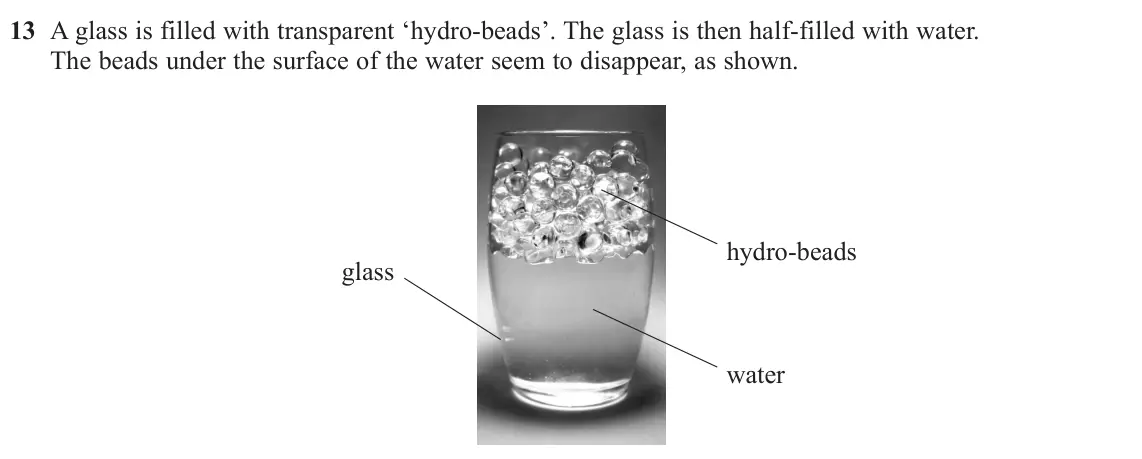
Q18(b)
The whole paper ↗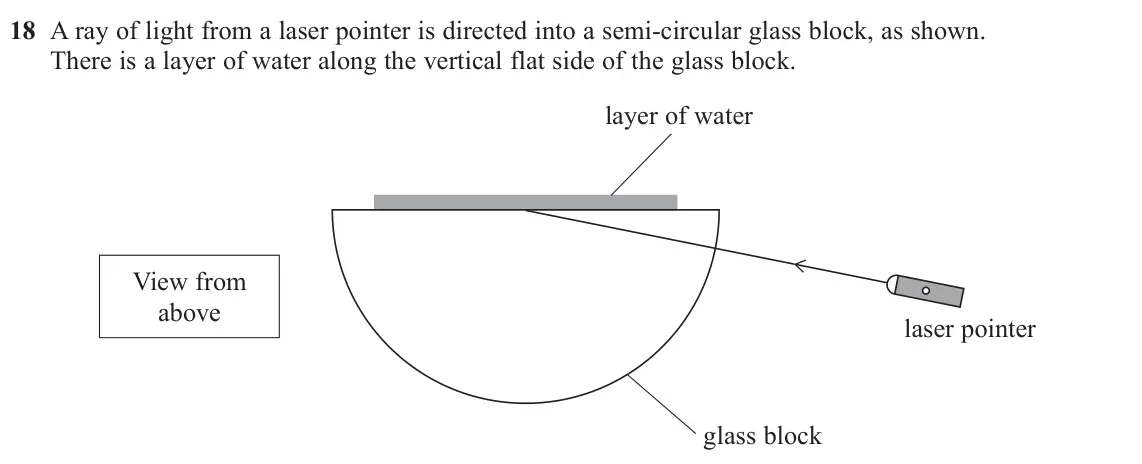
Q18(c)
The whole paper ↗Q18(d)
The whole paper ↗- Your answer
Q16(a)(i)
The whole paper ↗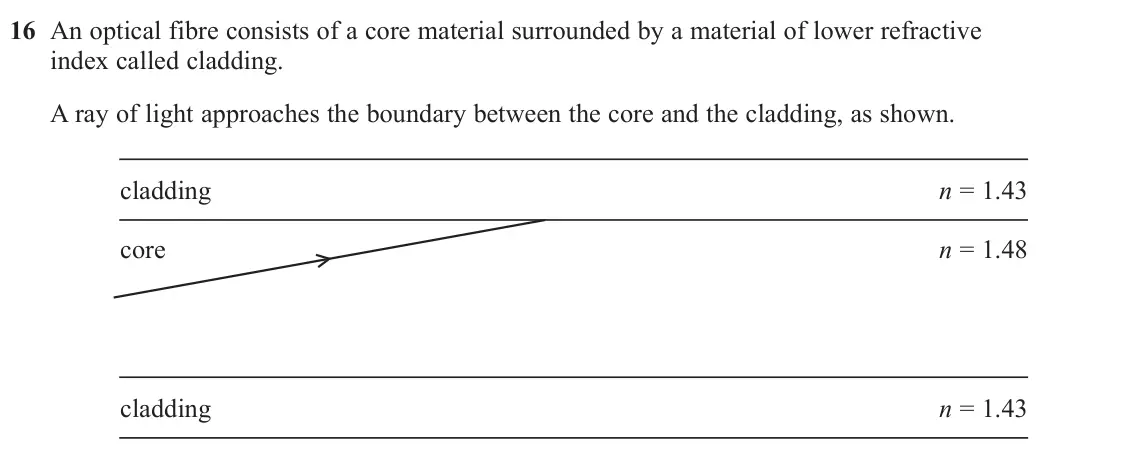
Q16(a)(ii)
The whole paper ↗Q16(b)(ii)
The whole paper ↗Q11(b)
The whole paper ↗
- Your answer
Q16(b)(ii)
The whole paper ↗
Q11(b)(i)
The whole paper ↗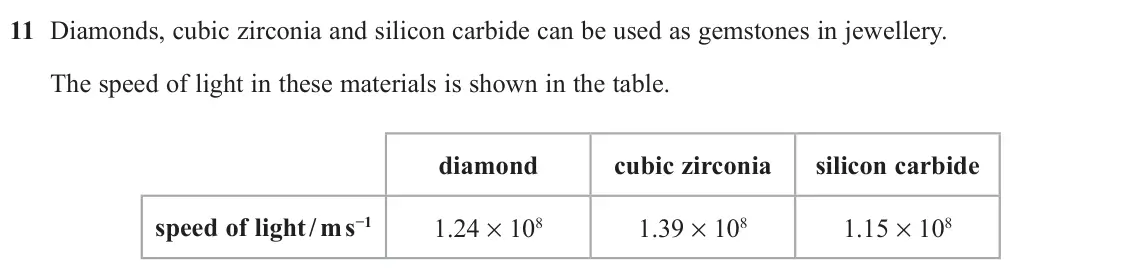
Q11(b)(ii)
The whole paper ↗
All 28 questions on Critical angle and total internal reflection, as a list
- June 2025, AS Unit 2, Q2 (1 mark): A ray of light is incident on the boundary between Perspex and air, as shown. The angle of incidence i is greater than the critical angle for the Perspex-air bo
- January 2025, AS Unit 2, Q18(b) (3 marks): The diagram shows one ray of light inside the optical fibre, incident on a boundary with the air. air glass 45 Not to scale Deduce whether the ray will be total
- January 2025, AS Unit 2, Q18(c) (5 marks): Data is transmitted along the optical fibre by pulses of light. One pulse of light initially has a constant intensity I for a duration T, as shown. Light intens
- January 2025, AS Unit 2, Q18(d) (2 marks): Some optical fibres are surrounded by a thin layer of transparent material called cladding, as shown. cladding glass cladding The transparent material has a low
- October 2024, AS Unit 2, Q17(b) (6 marks): A person is swimming underwater in a lake. The person looks up towards the surface. Three rays of light, A, B and C, are incident on the surface of the water, a
- June 2024, AS Unit 2, Q18(b) (4 marks): At surface Y the ray of light must be reflected. This reflection could be due to total internal reflection. If the ray of light is not totally internally reflec
- January 2024, AS Unit 2, Q1 (1 mark): A ray of light in air is incident on a glass surface. The angle of incidence is less than the critical angle. Which of the following describes what happens to t
- January 2024, AS Unit 2, Q13(b)(ii) (3 marks): Complete the diagram to show what happens to the ray at position X. Your answer should include a calculation. (3)
- October 2023, AS Unit 2, Q18(b) (3 marks): Show that the critical angle between glass and water is about 60°. refractive index of glass = 1.51 refractive index of water = 1.33 (3)
- October 2023, AS Unit 2, Q18(c) (3 marks): Complete the diagram to show the path of the ray of light after meeting the boundary between the glass and water. (3) layer of water laser pointer glass block
- October 2023, AS Unit 2, Q18(d) (4 marks): The photograph shows a hand holding a glass beaker containing water. Fingerprints are a series of ridges and valleys on the surface of fingers. The valleys trap
- January 2023, AS Unit 2, Q3 (1 mark): A ray of light approaches a boundary between air and glass, as shown. The angle of incidence is i. glass i air Which of the following statements about total int
- October 2022, AS Unit 2, Q16(a)(i) (3 marks): Show that the critical angle for light incident on the boundary between the core and cladding is about 75°. (3)
- October 2022, AS Unit 2, Q16(a)(ii) (3 marks): Explain what will happen to the ray of light after it meets the boundary between the core and cladding. The diagram is drawn to scale and you should use a measu
- October 2022, AS Unit 2, Q16(b)(ii) (2 marks): Light may escape from the core into the cladding when the optical fibre is curved. A student suggests that using cladding with a lower refractive index would le
- June 2022, AS Unit 2, Q11(b) (3 marks): The speed of light in a different type of glass is 1.96 × 10⁸ m s–1. Calculate the value of the critical angle at a boundary between this type of glass and air.
- January 2022, AS Unit 2, Q6 (1 mark): Which of the following could result in a ray of light undergoing total internal reflection? A light travelling from L to M B light travelling from L to N C ligh
- January 2022, AS Unit 2, Q16(b)(ii) (4 marks): The refractive index of the glass in prism B is greater than the refractive index of the glass in prism A. When the ray of light reaches the boundary between th
- October 2021, AS Unit 2, Q11(b)(i) (4 marks): Add to the diagram to show the path of the ray of light as it leaves this boundary. Your answer should include a calculation. (4)
- October 2021, AS Unit 2, Q11(b)(ii) (2 marks): Explain what would happen to the ray at this boundary if the material used was silicon carbide instead of diamond. (2)
- June 2021, AS Unit 2, Q13(b) (4 marks): White light is incident on a boundary between glass and air, as shown. air glass 41.00° Explain what happens to the red light and the violet light when meeting
- January 2021, AS Unit 2, Q8 (1 mark): A ray of light travels through glass, towards a boundary between glass and air. The critical angle for this boundary is 42°. Which row of the table is correct?
- January 2021, AS Unit 3, Q2(a)(i) (1 mark): Complete the diagram to show the critical angle. (1)
- January 2021, AS Unit 3, Q2(a)(ii) (2 marks): Determine the refractive index of the transparent material, using measurements from the diagram. (2) Refractive index =
- January 2021, AS Unit 3, Q2(b) (2 marks): The student repeated the process for a second semicircular block of a different transparent material. Her measured value for C was 41 ± 0.5° Calculate the range
- October 2020, AS Unit 2, Q11(b) (2 marks): Determine the critical angle for light at a glass-water boundary. (2) Critical angle =
- June 2019, AS Unit 2, Q18(a) (2 marks): State the conditions required for total internal reflection to occur. (2)
- June 2019, AS Unit 2, Q18(c) (4 marks): The diagram shows a ray of light being totally internally reflected at one side of a glass fibre and then refracting as it leaves the end of the fibre. The angl
Questions, mark schemes and examiner’s reports are © Pearson Edexcel, from their published past papers. Plumi isn’t affiliated with any exam board. Want whole papers? Edexcel International A Level Physics past papers.
The Plumi iPad app also offers exam-style questions with AI feedback on your handwritten working.