 plumi
The structure and stability of benzene: Edexcel International A Level Chemistry questions
Edexcel International A Level Chemistry past-paper questions on 18.1.1 The structure and stability of benzene, 2019–2025, with mark schemes and examiner’s reports where available.
Paper
All papers
Exam
All years
Calculations
Q16(a)(iii)
The whole paper ↗
Q16(b)
The whole paper ↗Q16(c)
The whole paper ↗- Your answer
Q10(a)
The whole paper ↗ Your answer
Q10(b)
The whole paper ↗Your answer- Your answer
Q13(a)
The whole paper ↗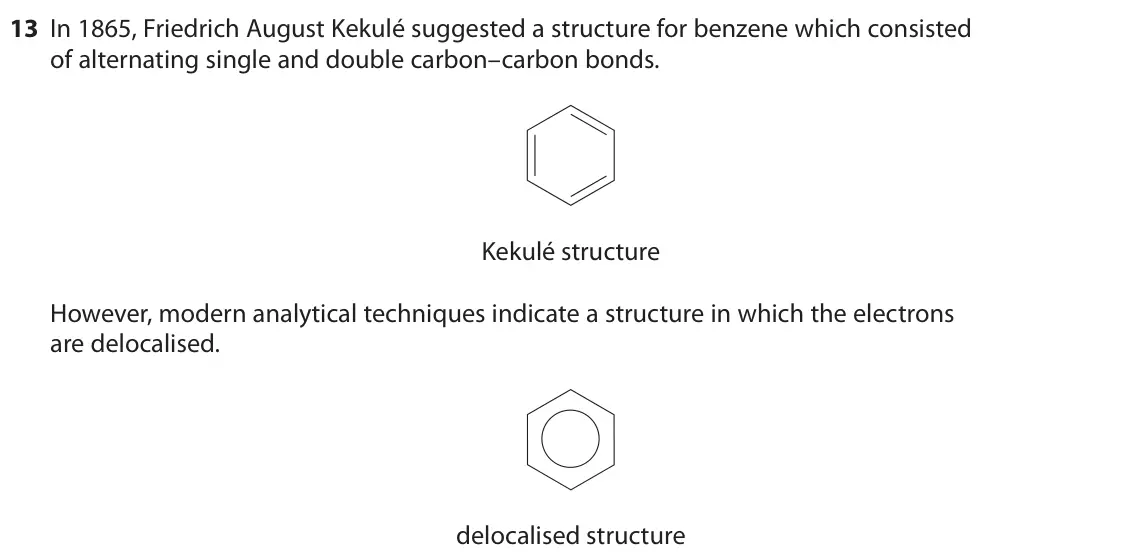
Q13(b)
The whole paper ↗Q13(c)
The whole paper ↗Q13(d)
The whole paper ↗- Your answer
- Your answer
Q19(a)
The whole paper ↗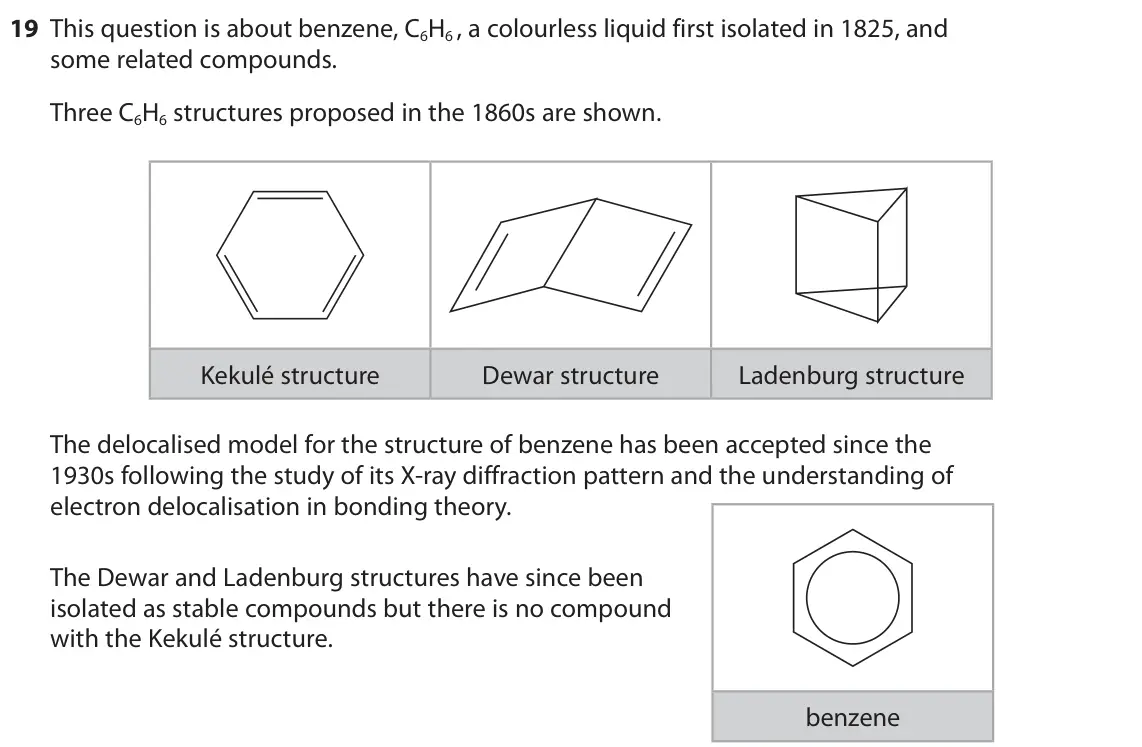
Q19(c)
The whole paper ↗Q19(d)(i)
The whole paper ↗Q19(d)(ii)
The whole paper ↗Q19(e)
The whole paper ↗- Your answer
All 27 questions on The structure and stability of benzene, as a list
- June 2025, Unit 5, Q16(a)(iii) (2 marks): Explain why the bond enthalpy value calculated in (a)(ii) is not the exact mean of the carbon-carbon double bond and carbon-carbon single bond enthalpies that w
- June 2025, Unit 5, Q16(b) (2 marks): Describe how all the carbon-carbon bonds in benzene are formed. (2)
- June 2025, Unit 5, Q16(c) (2 marks): State one chemical property and one physical property of benzene which would not be shown by the compound with the Kekulé structure. (2)
- June 2025 (A), Unit 5, Q11 (1 mark): Which is the best technique to show that the carbon‑carbon bonds in benzene are all the same length? A infrared spectroscopy B mass spectrometry C high resoluti
- October 2024, Unit 5, Q10(a) (1 mark): Evidence for the aromaticity of this compound is that the carbon-carbon bonds in the ten-carbon ring (1) A alternate in length between single and double bonds B
- October 2024, Unit 5, Q10(b) (1 mark): The aromaticity is due to the formation of pi (π) bonds as a result of overlap of (1) A s and p orbitals B p and d orbitals C p orbitals D d orbitals
- June 2024, Unit 5, Q7 (1 mark): Which type of data is not used as evidence for the structure or stability of the benzene ring? A infrared spectroscopy B mass spectrometry C thermochemical D X‑
- January 2024, Unit 5, Q13(a) (2 marks): Explain how the results of X‑ray diffraction experiments on benzene suggest a delocalised structure rather than the Kekulé structure. (2)
- January 2024, Unit 5, Q13(b) (2 marks): The compound 1,2‑dichlorobenzene exists as only one structure. Explain how this supports the delocalised structure of benzene rather than the Kekulé structure.
- January 2024, Unit 5, Q13(c) (1 mark): State how the enthalpy changes of hydrogenation for cyclohexene and benzene provide evidence for the delocalised structure. ΔH = –118 kJ mol–1 + H2 → + 3H2 → ΔH
- January 2024, Unit 5, Q13(d) (3 marks): Describe the structure of benzene in terms of the atomic orbitals involved, the bonds formed and the delocalised electrons. (3)
- June 2023, Unit 5, Q15 (1 mark): What is the total number of delocalised electrons in anthracene? anthracene A 6 B 10 C 14 D 18
- June 2023, Unit 5, Q23 (6 marks): *23 Some thermochemical, X-ray diffraction and bromination information on benzene and cyclohexene is shown. Thermochemical data Compound Enthalpy of hydrogenati
- October 2022, Unit 5, Q10 (1 mark): How many σ bonds and π bonds are there in a molecule of benzene? σ bonds π bonds A 6 3 B 6 6 C 12 3 D 12 6
- October 2021, Unit 5, Q19(a) (2 marks): Describe a chemical test, including the result, that could distinguish the Dewar structure from benzene. (2)
- October 2021, Unit 5, Q19(c) (2 marks): Explain how X‑ray diffraction shows that benzene has a delocalised structure and not a Kekulé structure. (2)
- October 2021, Unit 5, Q19(d)(i) (2 marks): Draw a labelled enthalpy level diagram showing the relative thermodynamic stability of the Ladenburg structure, the Dewar structure and benzene. Include the ent
- October 2021, Unit 5, Q19(d)(ii) (1 mark): Give a possible reason why the isomerisation of the Dewar structure to benzene has a lower activation energy than that of the Ladenburg structure to benzene. (1
- October 2021, Unit 5, Q19(e) (2 marks): The enthalpy change of hydrogenation of hex‑3‑ene is –118 kJ mol–1. + H2 The table shows the enthalpy changes of hydrogenation of two further alkenes containing
- June 2021, Unit 5, Q9 (1 mark): Benzene is sometimes represented by a Kekulé structure. Kekulé structure of benzene If this were the only structure of benzene, what would be the total number o
- June 2021, Unit 5, Q20(a)(i) (2 marks): Using the standard enthalpies of combustion of cyclohexene and cyclohexa-1,4-diene, calculate a value for the enthalpy of combustion of the theoretical compound
- June 2021, Unit 5, Q20(a)(ii) (3 marks): Explain the difference between the enthalpy of combustion of ‘cyclohexa-1,3,5-triene’ calculated in (a)(i) and the enthalpy of combustion of benzene given in th
- January 2021, Unit 5, Q10 (1 mark): The delocalised electrons in benzene result from the overlap of A s orbitals to form σ bonds B s orbitals to form π bonds C p orbitals to form σ bonds D p orbit
- January 2021, Unit 5, Q11 (1 mark): The reaction of ethene with bromine occurs under normal laboratory conditions but the reaction of benzene with bromine to form bromobenzene requires heat and th
- January 2021, Unit 5, Q24(a)(i) (3 marks): The bonding represented by this diagram of caffeine differs from that given in the passage. Explain what this diagram indicates about the bonding in caffeine, s
- October 2020, Unit 5, Q1 (1 mark): The enthalpy change of hydrogenation of cyclohexene is −120 kJ mol−1. + H2 What is the approximate enthalpy change of hydrogenation of benzene, in kJ mol−1? A −
- October 2020, Unit 5, Q2 (1 mark): Which orbitals overlap to form the ring of delocalised electrons in benzene and what type of bond is formed? Orbitals overlapping Type of bond A p π B p σ C s a
Questions, mark schemes and examiner’s reports are © Pearson Edexcel, from their published past papers. Plumi isn’t affiliated with any exam board. Want whole papers? Edexcel International A Level Chemistry past papers.
The Plumi iPad app also offers exam-style questions with AI feedback on your handwritten working.