 plumi
Electrophilic addition mechanisms: Edexcel International A Level Chemistry questions
Edexcel International A Level Chemistry past-paper questions on 5.2.2 Electrophilic addition mechanisms, 2019–2025, with mark schemes and examiner’s reports where available.
Paper
All papers
Exam
All years
Calculations
- Your answer
Q25(b)(ii)
The whole paper ↗
Q19(a)(i)
The whole paper ↗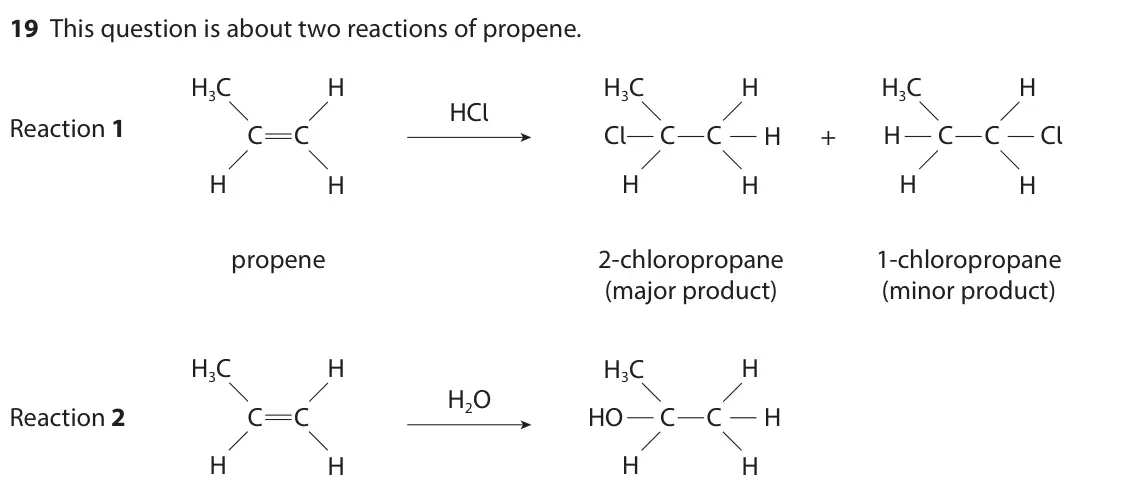
Q19(a)(ii)
The whole paper ↗Q19(b)
The whole paper ↗Q19(c)(i)
The whole paper ↗
Q19(c)(i)
The whole paper ↗
Q19(c)(ii)
The whole paper ↗Q10(a)
The whole paper ↗ Your answer
Q10(b)
The whole paper ↗Your answerQ22(c)(i)
The whole paper ↗
Q22(c)(ii)
The whole paper ↗Q15(c)(i)
The whole paper ↗
Q15(c)(ii)
The whole paper ↗Q22(c)(i)
The whole paper ↗
Q22(c)(ii)
The whole paper ↗Q22(c)(iii)
The whole paper ↗Q21(b)(ii)
The whole paper ↗
Q23(d)
The whole paper ↗
Q20(b)
The whole paper ↗
All 28 questions on Electrophilic addition mechanisms, as a list
- June 2025, AS Unit 1, Q19 (1 mark): Which is the correct mechanism for the electrophilic addition reaction between HBr and pent-1-ene to give the major product? H A CH2 CHCH2CH2CH3 CH3 CCH2CH2CH3
- January 2025, AS Unit 1, Q25(b)(ii) (2 marks): Explain why chlorine reacts with alkenes even though it is not a polar molecule. (2)
- October 2024, AS Unit 1, Q19(a)(i) (1 mark): Name the mechanism and type of reaction for Reaction 1. (1)
- October 2024, AS Unit 1, Q19(a)(ii) (3 marks): Explain why the structures of the intermediates in Reaction 1 mean that 2‑chloropropane is formed in greater yield than 1‑chloropropane. (3)
- October 2024, AS Unit 1, Q19(b) (4 marks): Reaction 2 proceeds in two stages. The equation for the first stage is shown. CH2 + H2SO4 → CH3CH(OSO2OH)CH3 CH3CH The mechanism for this reaction is the same a
- June 2024, AS Unit 1, Q19(c)(i) (4 marks): Using the simplest alkene as an example, draw the mechanism to show the reaction with liquid bromine. (4)
- January 2024, AS Unit 1, Q19(c)(i) (4 marks): Give the mechanism for this reaction. Include curly arrows and relevant dipoles and lone pairs. (4)
- January 2024, AS Unit 1, Q19(c)(ii) (2 marks): Explain why only a small amount of 1‑chloropropane is produced in this reaction. (2)
- October 2023, AS Unit 1, Q10(a) (1 mark): Which of these steps is most likely to occur in the reaction? H H H (1) A H C C C+ :Cl– H H H H H H B H C C C+ :Cl– H H H :Cl– H H + C H C C C H H H H :Cl– H H
- October 2023, AS Unit 1, Q10(b) (1 mark): The reaction of propene with hydrogen chloride is an example of (1) A free radical substitution B free radical addition C electrophilic substitution D electroph
- January 2023, AS Unit 1, Q22(c)(i) (4 marks): Complete the mechanism to show this reaction. Include curly arrows, and any relevant lone pairs and dipoles. (4) H Br H C C C H H H H Br
- January 2023, AS Unit 1, Q22(c)(ii) (2 marks): Explain why 1,2‑dibromopropane is the major product instead of 1,3‑dibromopropane. (2)
- October 2022, AS Unit 1, Q15(c)(i) (4 marks): Draw the mechanism for the formation of the major product of the reaction between 2‑methylpropene and hydrogen bromide, HBr. Include curly arrows, and relevant
- October 2022, AS Unit 1, Q15(c)(ii) (1 mark): Give the reason why your product in (c)(i) is the major product. (1)
- June 2022, AS Unit 1, Q22(c)(i) (1 mark): Name the type and mechanism of the reaction. (1)
- June 2022, AS Unit 1, Q22(c)(ii) (4 marks): The diagram shows a simplified structure of zingiberene, in which part of the molecule is represented by A. Complete the mechanism for the reaction of zingibere
- June 2022, AS Unit 1, Q22(c)(iii) (2 marks): For the reaction in (c)(ii) there are two possible products: A Br A Br I II Explain why I is the major product, by referring to your mechanism. (2)
- January 2022, AS Unit 1, Q21(b)(ii) (3 marks): Propene also reacts with hydrogen bromide, HBr. Give the mechanism for this reaction to form the major product. Include curly arrows, and relevant lone pairs an
- June 2021, AS Unit 1, Q23(d) (4 marks): Iodine monochloride, ICl, reacts with alkenes in a similar way to hydrogen bromide. Complete the mechanism for the reaction of iodine monochloride with propene
- June 2021, Unit 5, Q20(b) (4 marks): Bromine reacts with cyclohexene to form 1,2-dibromocyclohexane, and with benzene to form bromobenzene. Compare and contrast these reactions, considering the typ
- January 2021, AS Unit 1, Q20(d)(ii) (3 marks): Draw the mechanism for the formation of 1-bromo-2-chloropropane in this reaction. Include curly arrows, and relevant lone pairs. (3)
- January 2021, AS Unit 1, Q20(e) (3 marks): Propene reacts with steam in the presence of an acid catalyst to form a mixture of the alcohols propan-1-ol and propan-2-ol. Complete the mechanism for the form
- October 2020, AS Unit 1, Q21(b)(ii) (4 marks): This reaction is very similar to the reaction of ethene with bromine. Draw the mechanism for this reaction of cyclohexene with bromine. Include curly arrows, an
- January 2020, AS Unit 1, Q21(c)(i) (4 marks): Draw the mechanism for the reaction between ethene and chlorine to form 1,2-dichloroethane. Include curly arrows, and relevant lone pairs and dipoles. (4)
- January 2020, AS Unit 2, Q17(c) (2 marks): When dry hydrogen chloride gas reacts with 2-methylbut-2-ene, two isomeric chloroalkanes are formed. Give the structure of the major product and the reason why
- June 2019, AS Unit 1, Q20 (1 mark): Which is the major product of this reaction? H CH2CH3 o H Br + C C H H H H A H3C C C CH3 H Br H H B H C C CH2CH3 Br H H H C H3C C C CH2CH3 Br H H H D H3C C C CH
- January 2019, AS Unit 1, Q23(c) (4 marks): Draw the mechanism for the reaction between 2-methylpropene and bromine, Br2. Include curly arrows, and relevant lone pairs and dipoles. Use formula 1 to repres
- January 2019, AS Unit 1, Q23(d)(iv) (2 marks): Explain why 2-bromo-2-methylpropane is the major organic product in Reaction 2. (2)
Questions, mark schemes and examiner’s reports are © Pearson Edexcel, from their published past papers. Plumi isn’t affiliated with any exam board. Want whole papers? Edexcel International A Level Chemistry past papers.
The Plumi iPad app also offers exam-style questions with AI feedback on your handwritten working.