 plumi
Diazonium ions and azo dyes: Edexcel International A Level Chemistry questions
Edexcel International A Level Chemistry past-paper questions on 19.1.4 Diazonium ions and azo dyes, 2019–2025, with mark schemes and examiner’s reports where available.
Paper
All papers
Exam
All years
Calculations
Q18(a)
The whole paper ↗
Q18(b)
The whole paper ↗Q18(c)
The whole paper ↗Q17(c)(ii)
The whole paper ↗
Q17(d)(i)
The whole paper ↗Q9(a)
The whole paper ↗Your answerQ9(b)
The whole paper ↗Your answerQ2(c)(i)
The whole paper ↗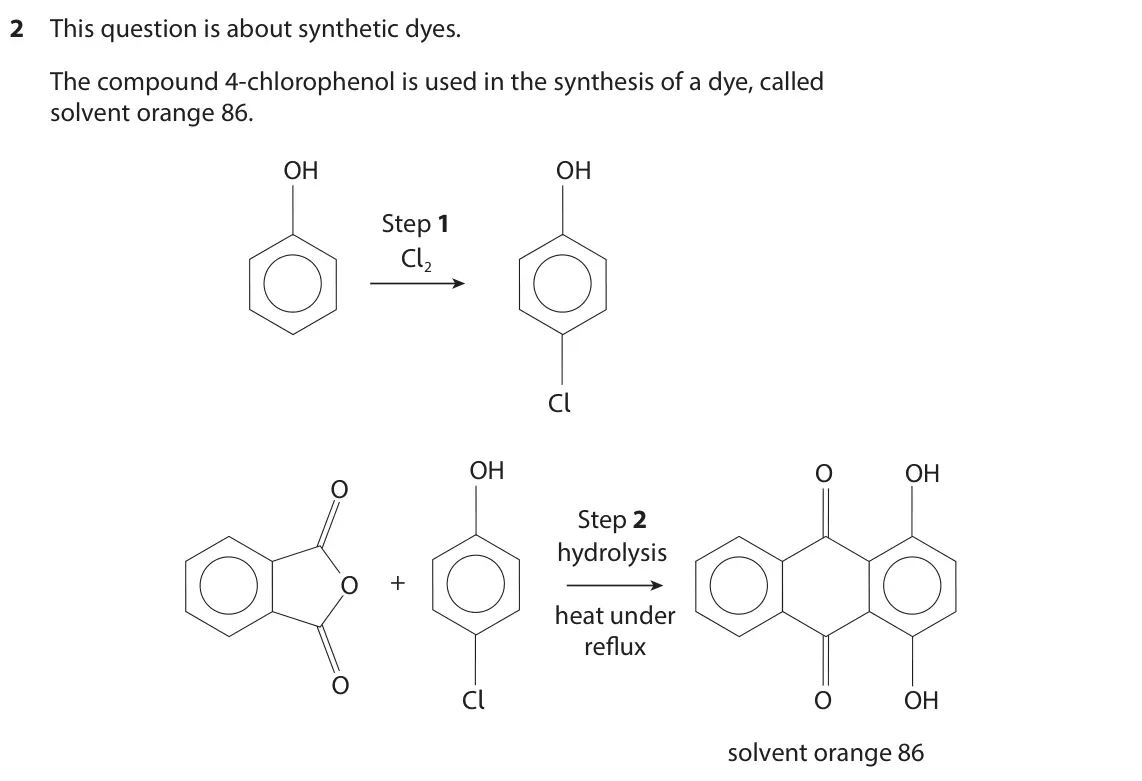
Q2(c)(ii)
The whole paper ↗Q2(c)(iii)
The whole paper ↗Q7(a)
The whole paper ↗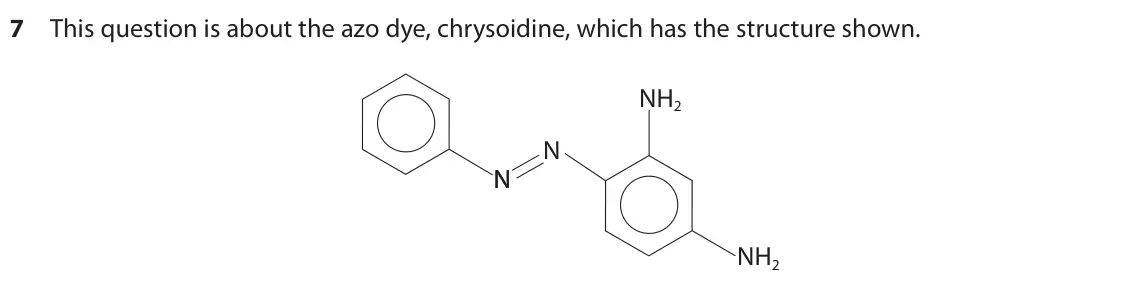 Your answer
Q7(b)
The whole paper ↗Q7(c)
The whole paper ↗Your answerQ4(b)(i)
The whole paper ↗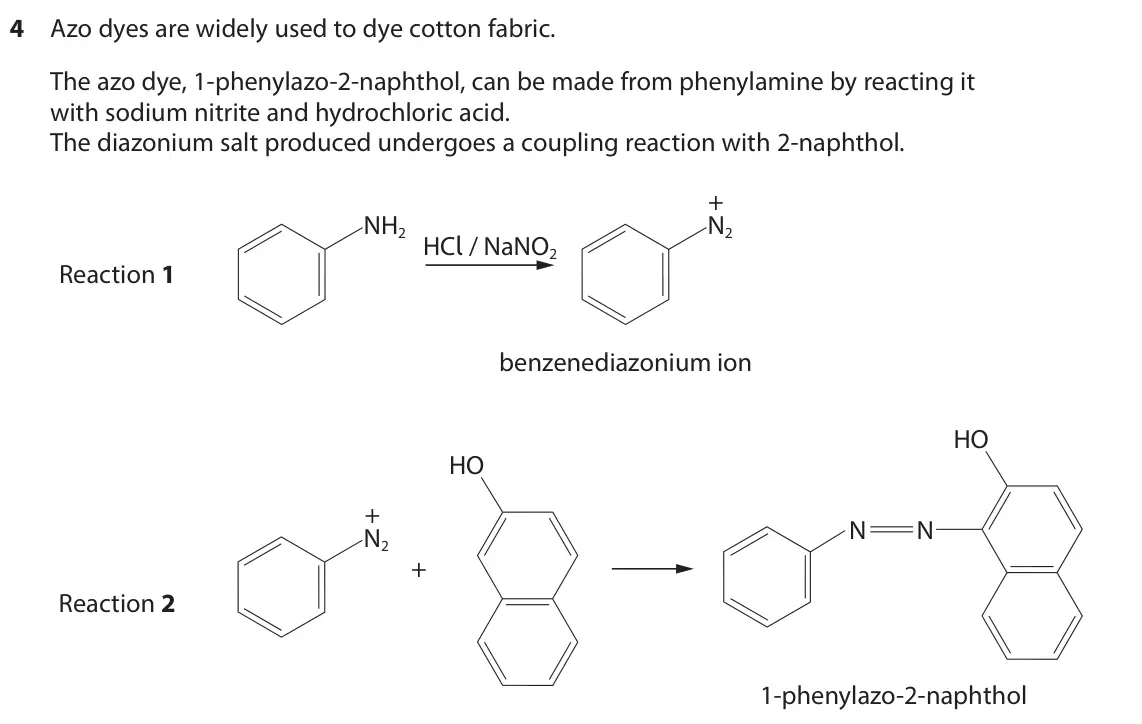
Q4(c)
The whole paper ↗Q15(c)
The whole paper ↗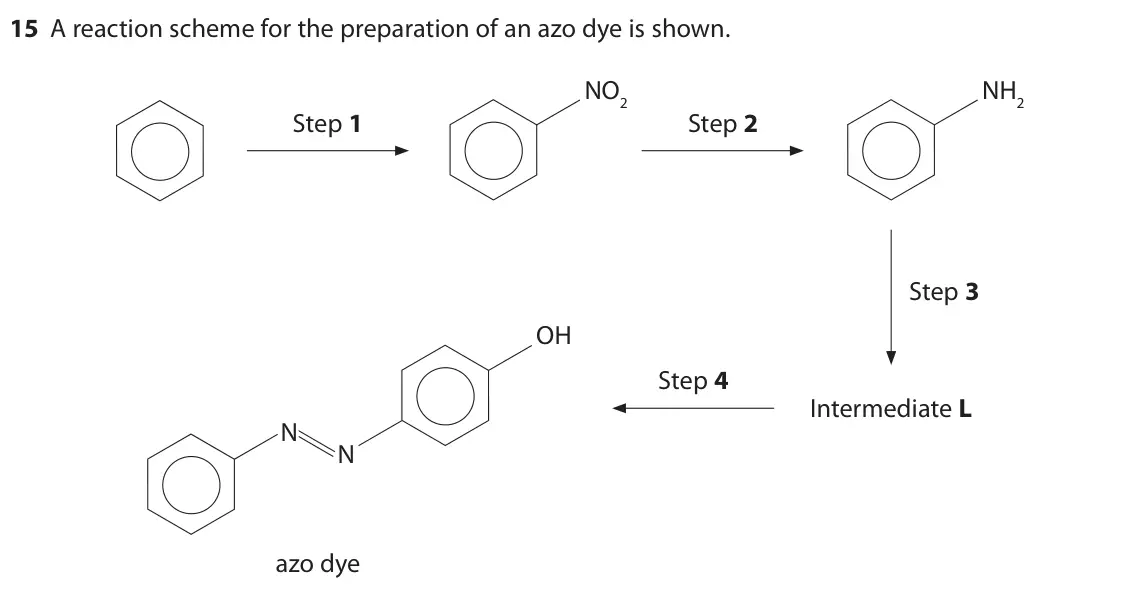
Q15(d)
The whole paper ↗Your answer- Your answer
Q15(a)
The whole paper ↗ Your answer
Q15(b)
The whole paper ↗Your answer
All 30 questions on Diazonium ions and azo dyes, as a list
- June 2025, Unit 5, Q18(a) (2 marks): State the reagents and conditions required for the formation of a diazonium ion from compound A. (2)
- June 2025, Unit 5, Q18(b) (1 mark): Draw the structure of the diazonium ion formed. (1)
- June 2025, Unit 5, Q18(c) (1 mark): The structure of sunset yellow is shown. Use a circle to identify the functional group, other than the diazonium group, that is essential for the coupling react
- June 2025 (A), Unit 5, Q17(c)(ii) (2 marks): State the reagents and conditions for Reaction 2. (2)
- June 2025 (A), Unit 5, Q17(d)(i) (1 mark): Draw the structure of the reagent which is added to the diazonium ion in this reaction. Ignore the conversion to the sodium salt. (1)
- January 2025, Unit 5, Q9(a) (1 mark): Which reagents are mixed with hydrochloric acid to produce the benzenediazonium ion? N+ N benzenediazonium ion (1) A C6H5NH2 and NaNO2 B C6H5NO2 and NaNO2 C C6H
- January 2025, Unit 5, Q9(b) (1 mark): Which reagents and conditions are used to prepare the yellow dye 4‑phenyldiazenylphenol from the benzenediazonium ion? N N N+ N OH benzenediazonium ion 4‑phenyl
- January 2025, Unit 6, Q2(c)(i) (1 mark): Give the systematic name of HNO2 . (1)
- January 2025, Unit 6, Q2(c)(ii) (1 mark): State why the HNO2 is formed when required in test tube A, rather than bought from a chemical supplier. (1)
- January 2025, Unit 6, Q2(c)(iii) (2 marks): Explain why the test tubes in Step 1 are left in an ice-water bath for five minutes. (2)
- October 2024, Unit 5, Q7(a) (1 mark): In the production of chrysoidine, phenylamine is first reacted with nitrous acid. Which equation shows the formation of nitrous acid from sodium nitrite? (1) A
- October 2024, Unit 5, Q7(b) (1 mark): The reaction of phenylamine with nitrous acid produces the benzenediazonium ion. Which is the structure of the benzenediazonium ion? (1) + + :N N: N N A B + + N
- October 2024, Unit 5, Q7(c) (1 mark): Which reactant is required for the coupling reaction with the benzenediazonium ion to form chrysoidine? (1) NH2 A NH2 NH2 HO B NH2 NH2 H2N C NH2 NH2 Cl–N2 + D N
- October 2024, Unit 6, Q4(b)(i) (2 marks): Explain why the temperature for Reaction 1 must be kept between 0 °C and 5 °C. (2)
- October 2024, Unit 6, Q4(c) (1 mark): Azo dyes were developed during the nineteenth century but workers in the industry showed high rates of bladder cancer and the production of some dyes was discon
- October 2023, Unit 5, Q15(c) (1 mark): Step 3 takes place using sodium nitrite and dilute hydrochloric acid at 5°C. Which is the structure of Intermediate L? (1) + N Cl– N N Cl N A B + N Cl– N N Cl N
- October 2023, Unit 5, Q15(d) (1 mark): The reactant in Step 4 is phenol. What condition is needed for this reaction? (1) A acidic B alkaline C ethanolic D neutral Use this space for any rough working
- June 2023, Unit 5, Q18 (1 mark): Compound X reacts with excess nitrous acid, followed by coupling with excess phenol to form an azo dye. OCH3 H2N NH2 H3CO compound X What is the structure of th
- January 2023, Unit 5, Q15(a) (1 mark): What are the reagents and condition for Step 1? (1) A NaNO2 and HCl at 5 °C B NaNO3 and HCl at 5 °C C NaNO2 and HCl at 50 °C D NaNO3 and HCl at 50 °C
- January 2023, Unit 5, Q15(b) (1 mark): Which reagent and condition are used for Step 2? (1) Reagent Condition OH A acidic OH B alkaline OH C acidic OH D alkaline Use this space for any rough working.
- June 2022, Unit 5, Q8 (1 mark): Which ion is formed when a mixture of sodium nitrite, NaNO2 , and dilute hydrochloric acid reacts with phenylamine at a temperature of 5°C? H + A N H H + B N N
- January 2022, Unit 5, Q16(b)(iii) (2 marks): In Step 3, the 3‑aminobenzoic acid reacts with sodium nitrite and dilute hydrochloric acid, forming a diazonium ion. HO O HO O C C NaNO2 HCl(aq) + N N NH2 3‑ami
- January 2022, Unit 5, Q16(b)(iv) (1 mark): Draw the structure of the azo dye formed when the diazonium ion reacts with phenol. (1)
- October 2021, Unit 5, Q21(d)(iii) (1 mark): State the reagents needed in Step Y. (1)
- October 2021, Unit 5, Q21(d)(iv) (1 mark): Draw the structure of compound B. (1)
- October 2021, Unit 5, Q21(d)(v) (2 marks): The temperature used in Steps Y and Z should be kept as close to 5 °C as possible. State why the temperature should be neither higher nor lower than 5 °C. (2)
- January 2021, Unit 6, Q3(c)(i) (1 mark): Nitrous acid is formed in the reaction mixture using sodium nitrite and hydrochloric acid. State why nitrous acid is generated in the reaction mixture instead o
- January 2021, Unit 6, Q3(c)(ii) (2 marks): Explain why the temperature of the reaction between phenylamine and nitrous acid must be neither lower than 0°C nor higher than 10°C. (2)
- October 2020, Unit 5, Q22(c)(i) (2 marks): Give the reagents and condition for Step 1. (2)
- October 2020, Unit 5, Q22(c)(ii) (1 mark): Deduce the structure of the organic compound needed to produce azo violet in Step 2. (1)
Questions, mark schemes and examiner’s reports are © Pearson Edexcel, from their published past papers. Plumi isn’t affiliated with any exam board. Want whole papers? Edexcel International A Level Chemistry past papers.
The Plumi iPad app also offers exam-style questions with AI feedback on your handwritten working.