 plumi
Inheritance and genetic diagrams: Edexcel GCSE Biology questions
Every Edexcel GCSE Biology exam question on Inheritance and genetic diagrams (specification points 3.11–3.18), 2018–2025, with its mark scheme and examiner’s report.
Find questions1,834
Exam
All years
Calculations
Q4(a)(i)
The whole paper ↗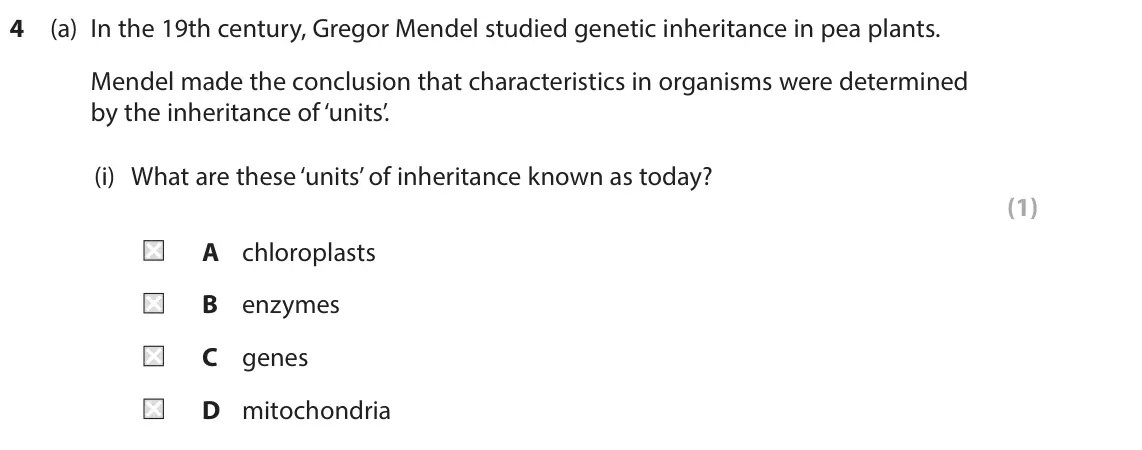
Q4(a)(ii)
The whole paper ↗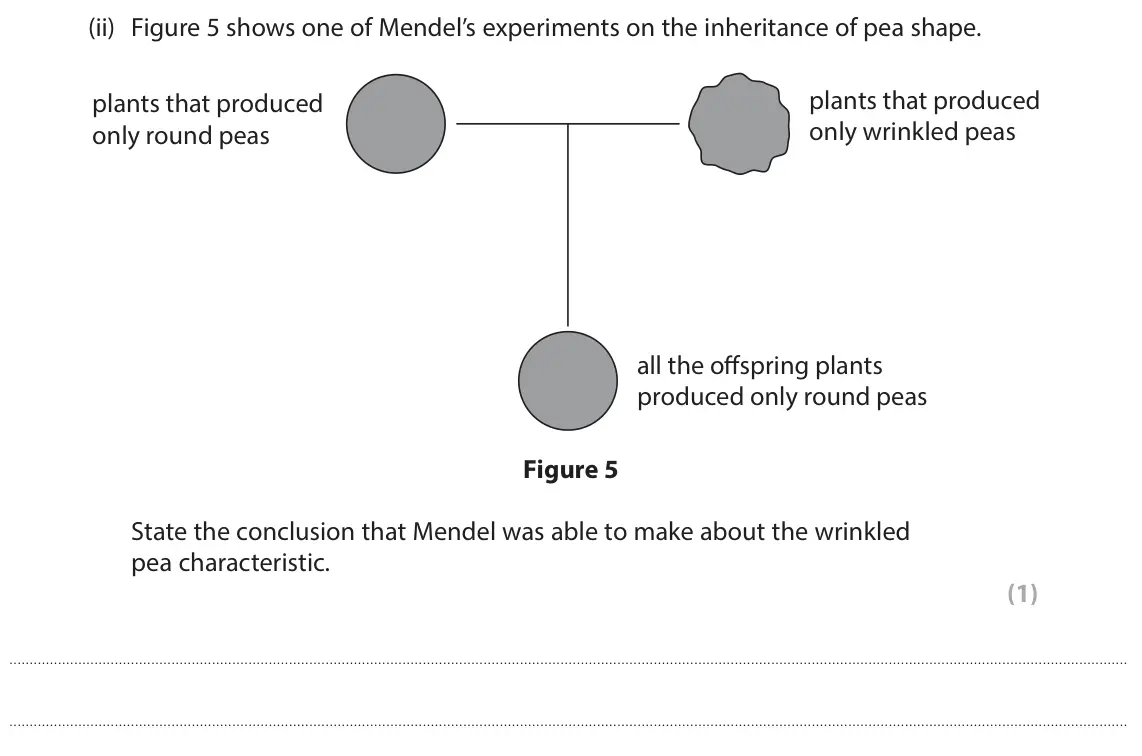
Q4(b)(i)
The whole paper ↗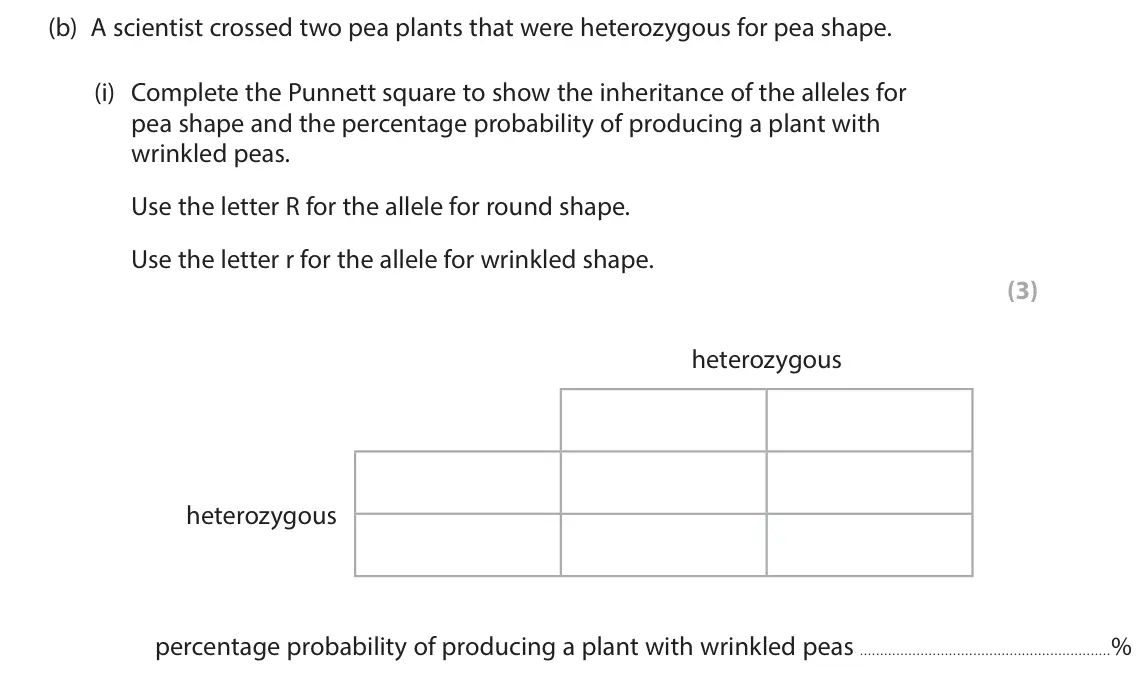
Q4(b)(ii)
The whole paper ↗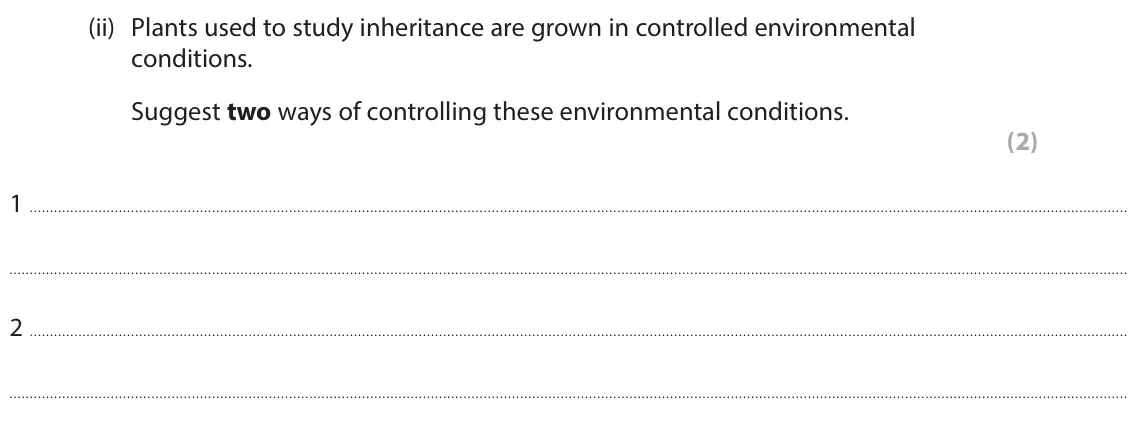
Q9(a)(i)
The whole paper ↗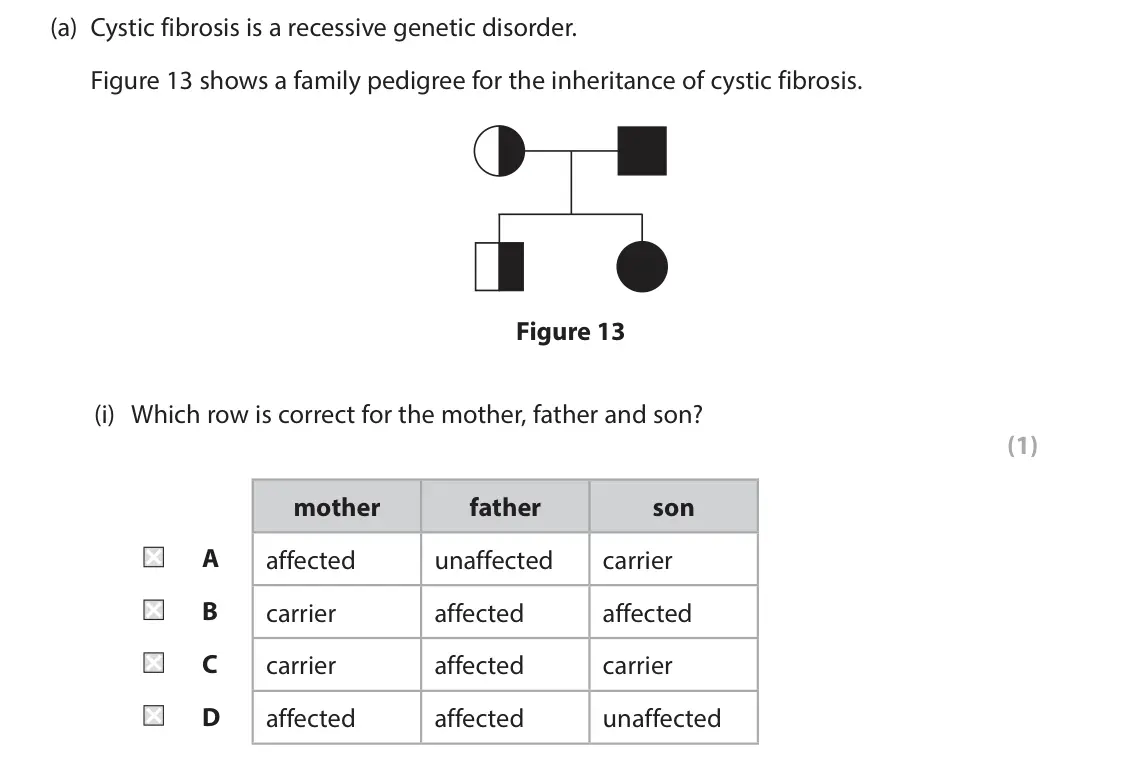
Q9(a)(ii)
The whole paper ↗
Q9(b)
The whole paper ↗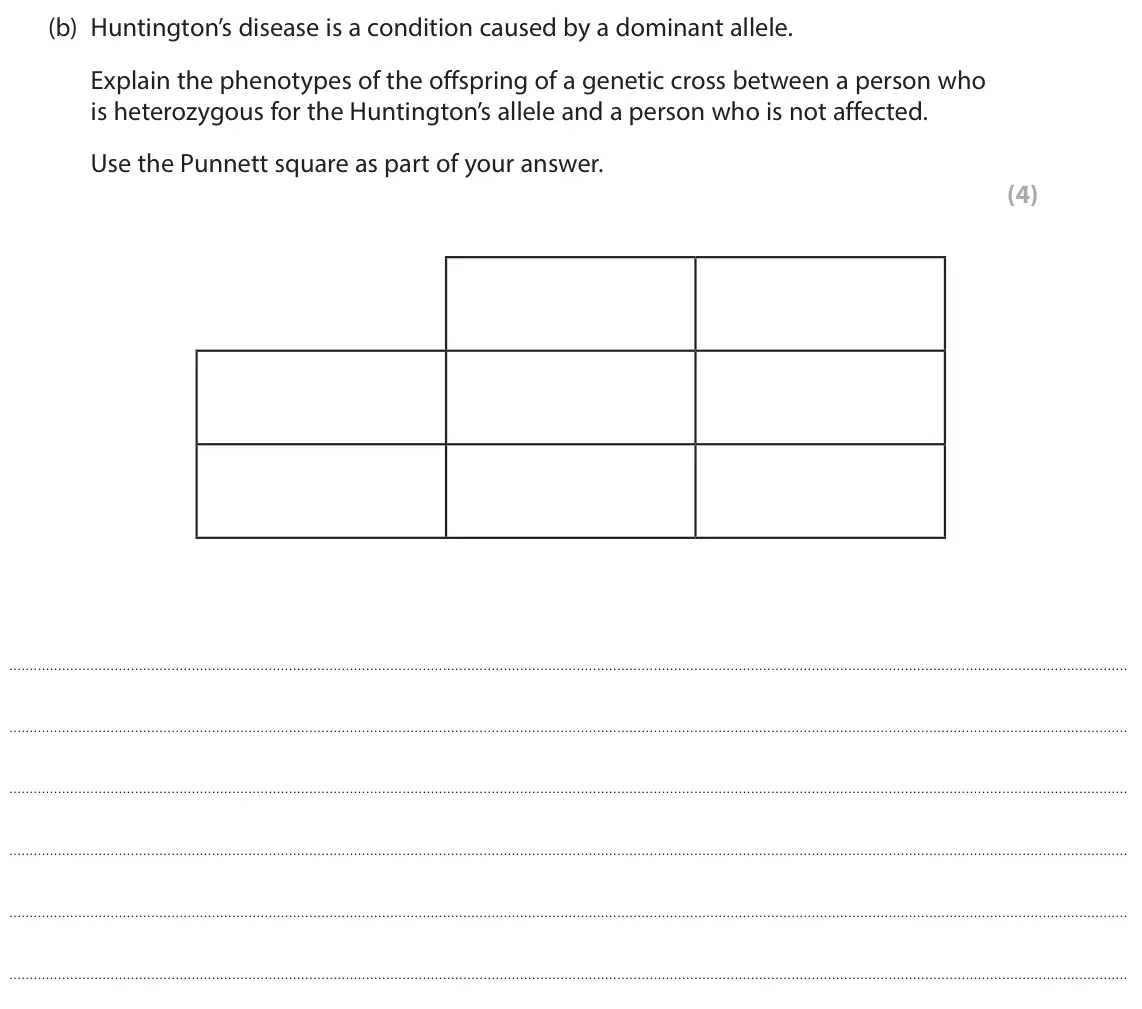
Q10(a)(i)
The whole paper ↗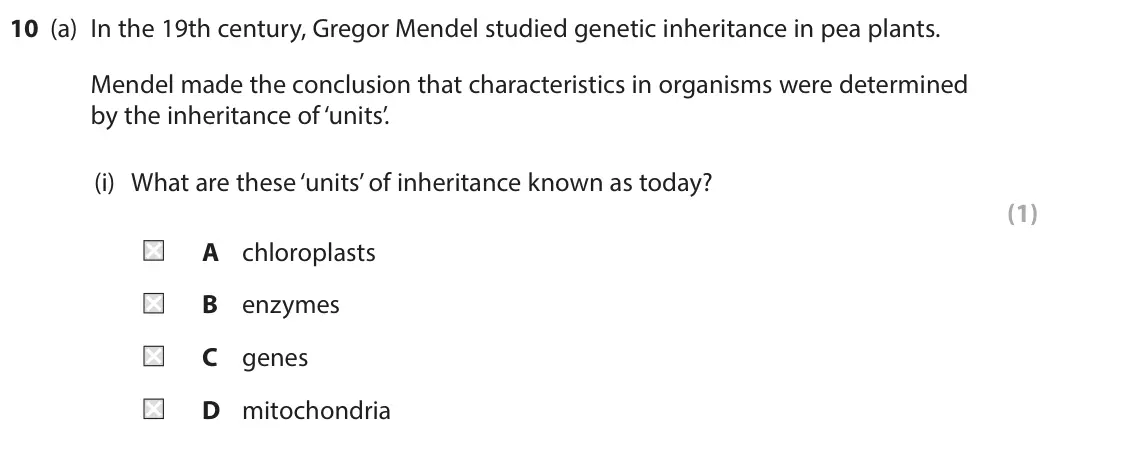
Q10(a)(ii)
The whole paper ↗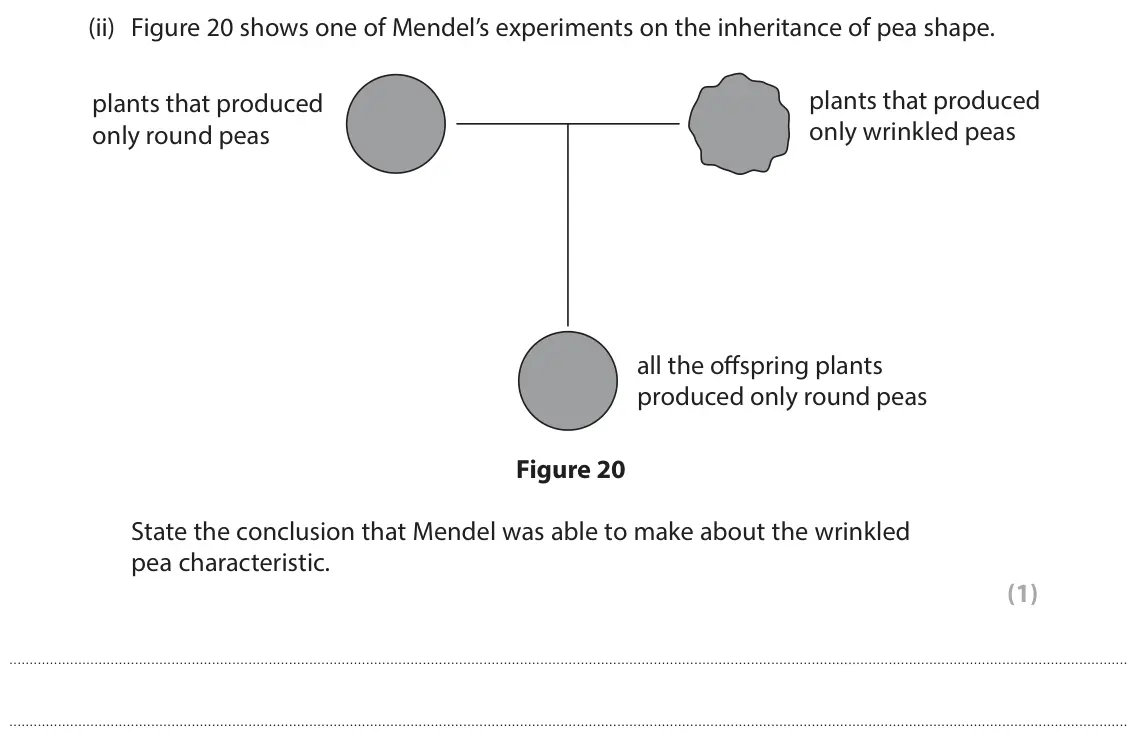
Q10(b)(i)
The whole paper ↗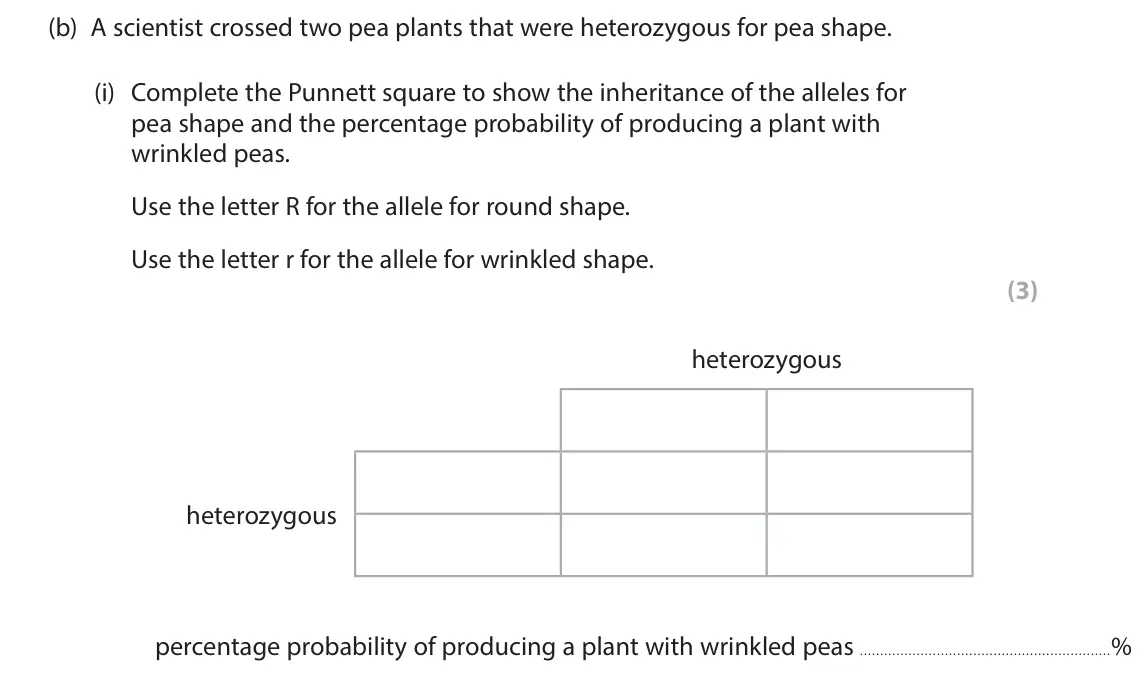
Q10(b)(ii)
The whole paper ↗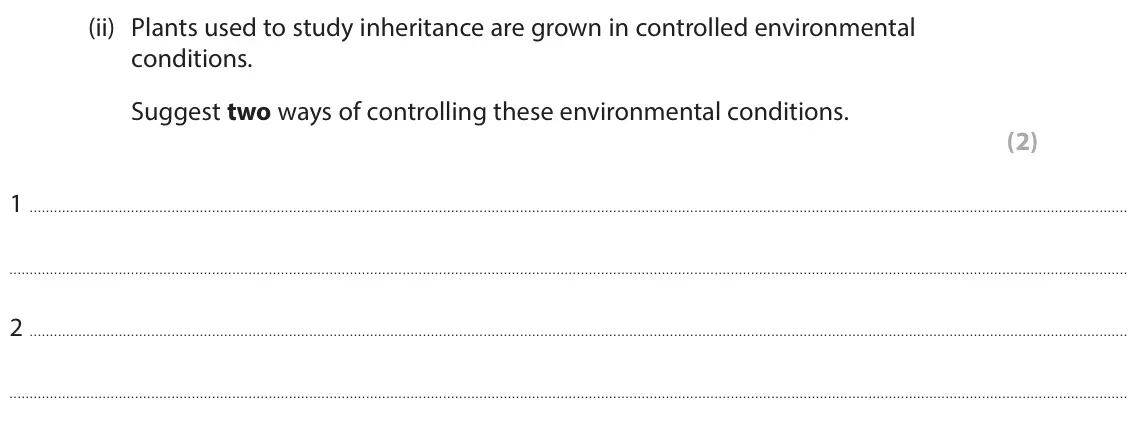
Q4(a)(i)
The whole paper ↗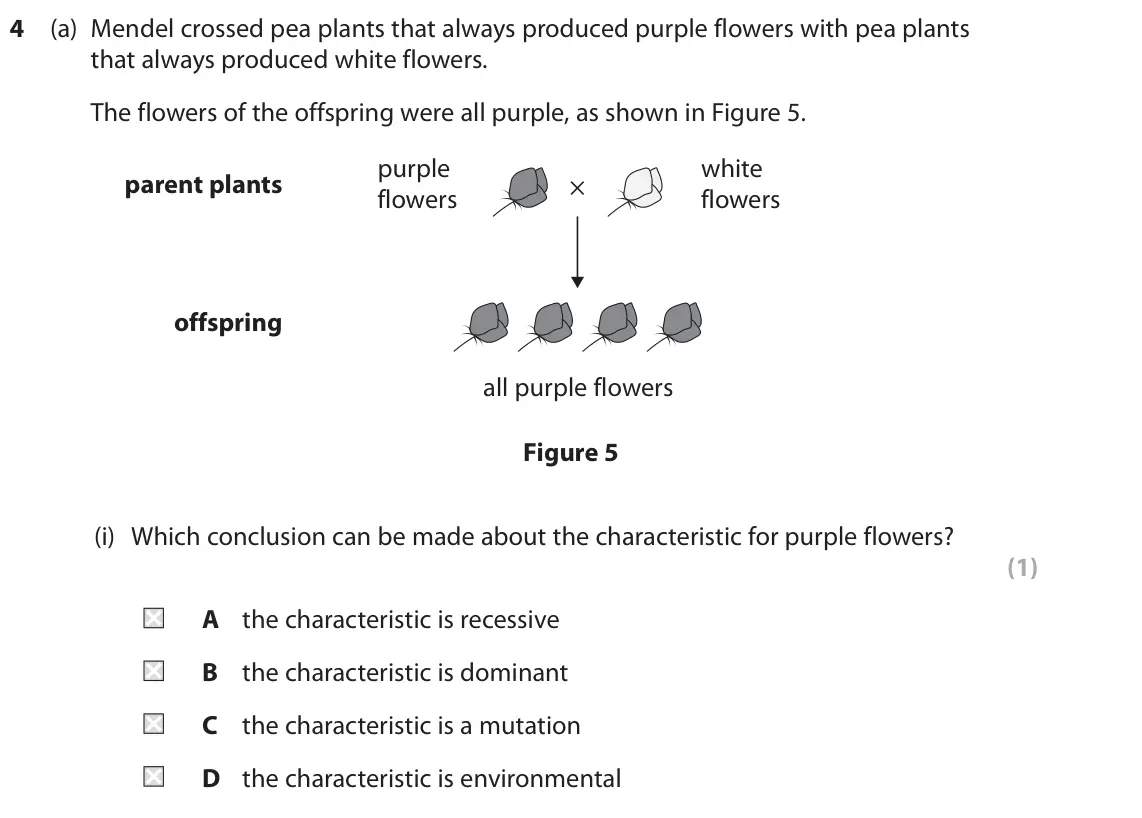
Q4(a)(ii)
The whole paper ↗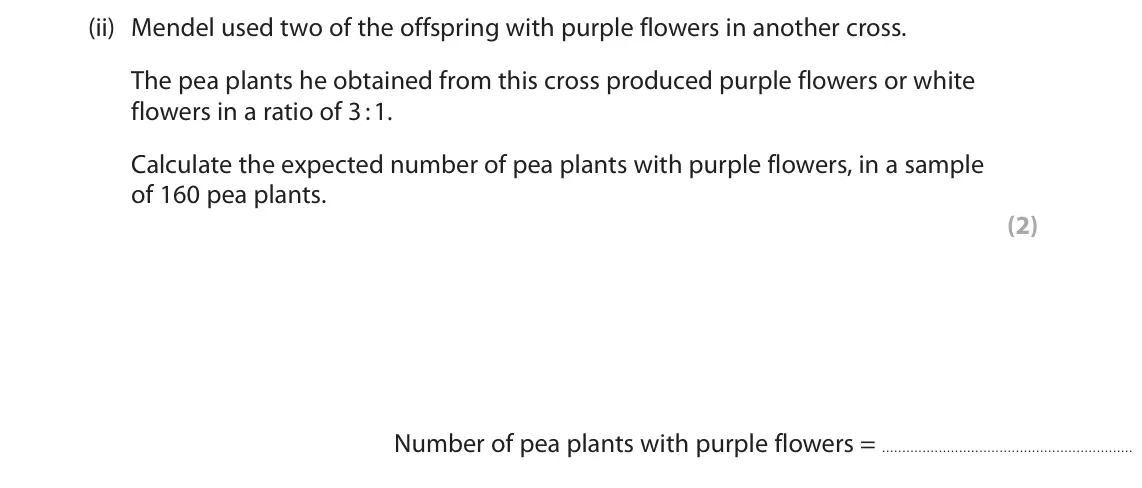
Q4(a)(iii)
The whole paper ↗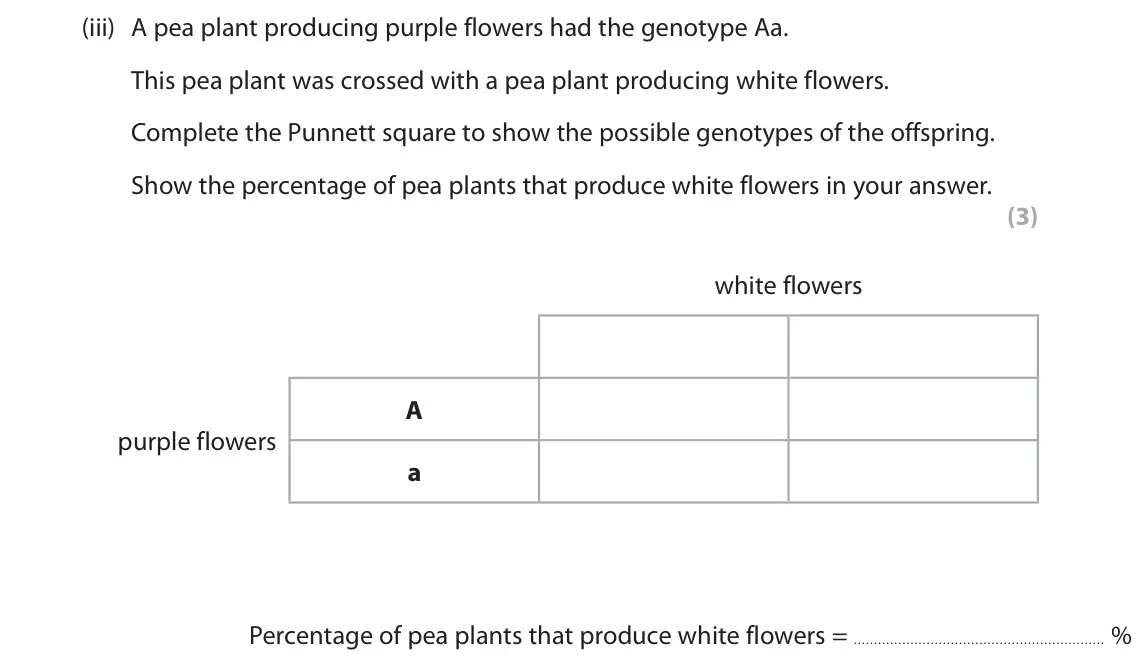
Q10(a)(i)
The whole paper ↗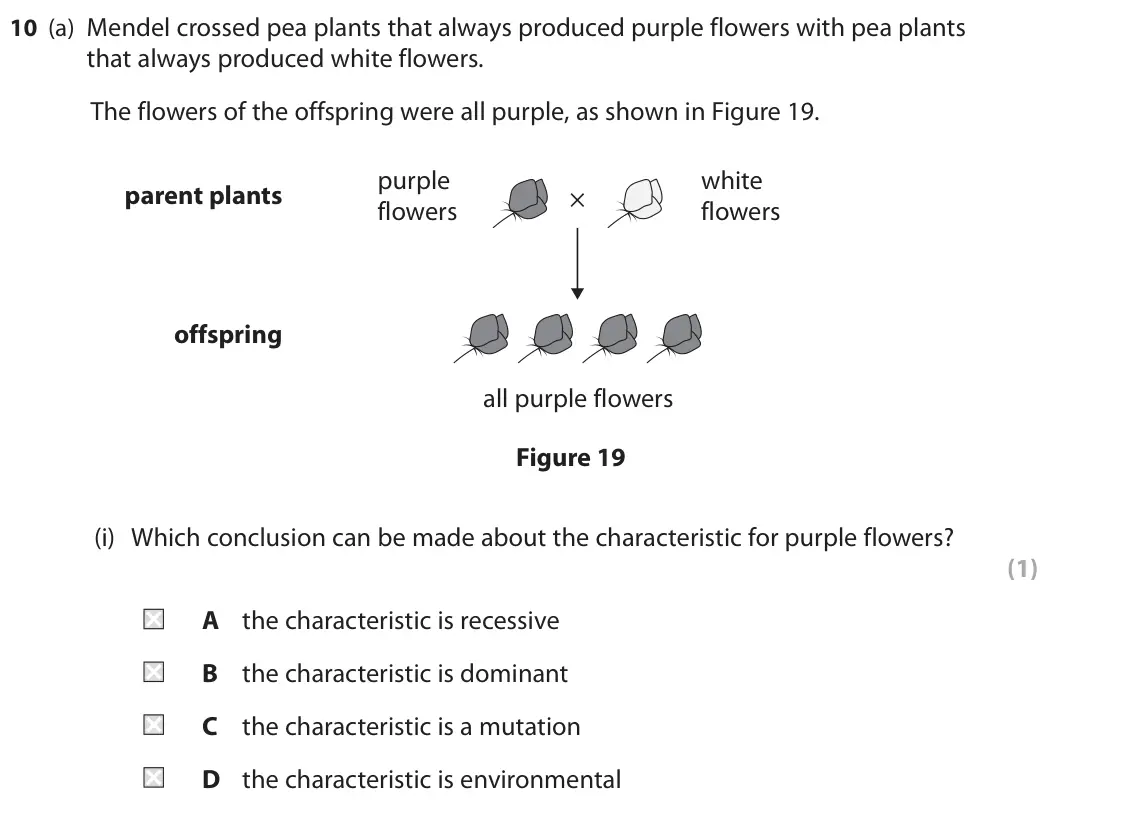
Q10(a)(ii)
The whole paper ↗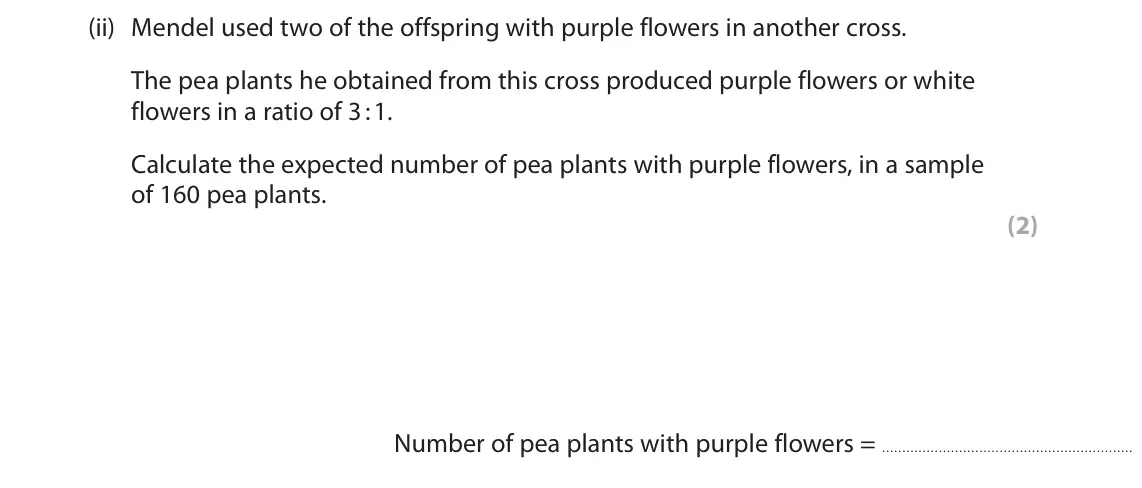
Q10(a)(iii)
The whole paper ↗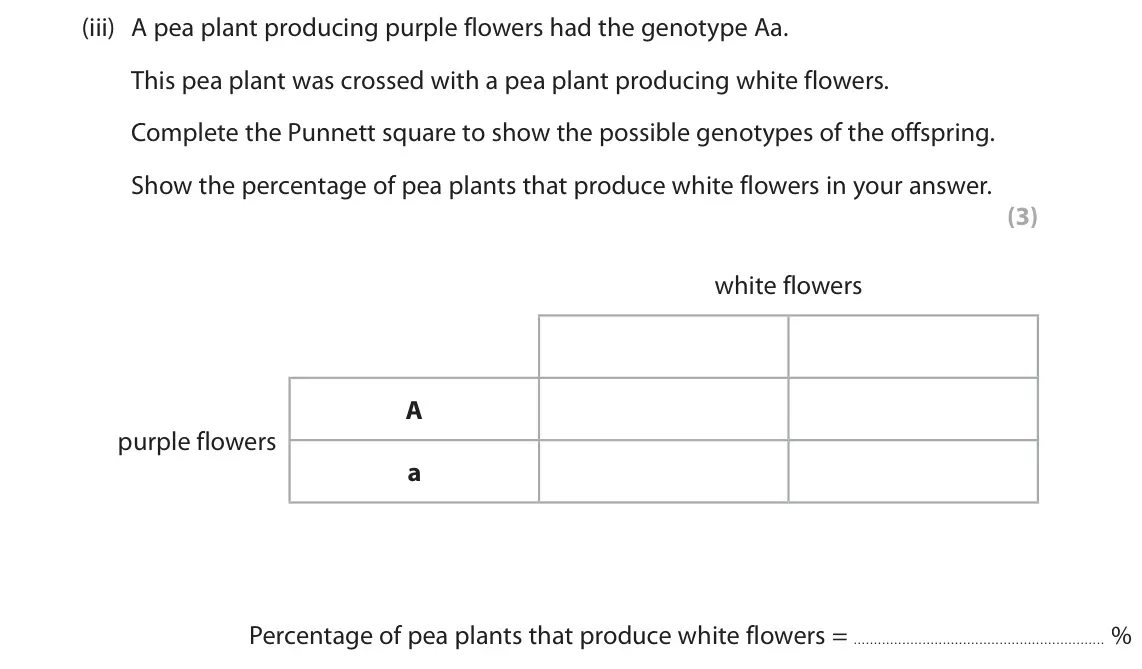
Q6(c)
The whole paper ↗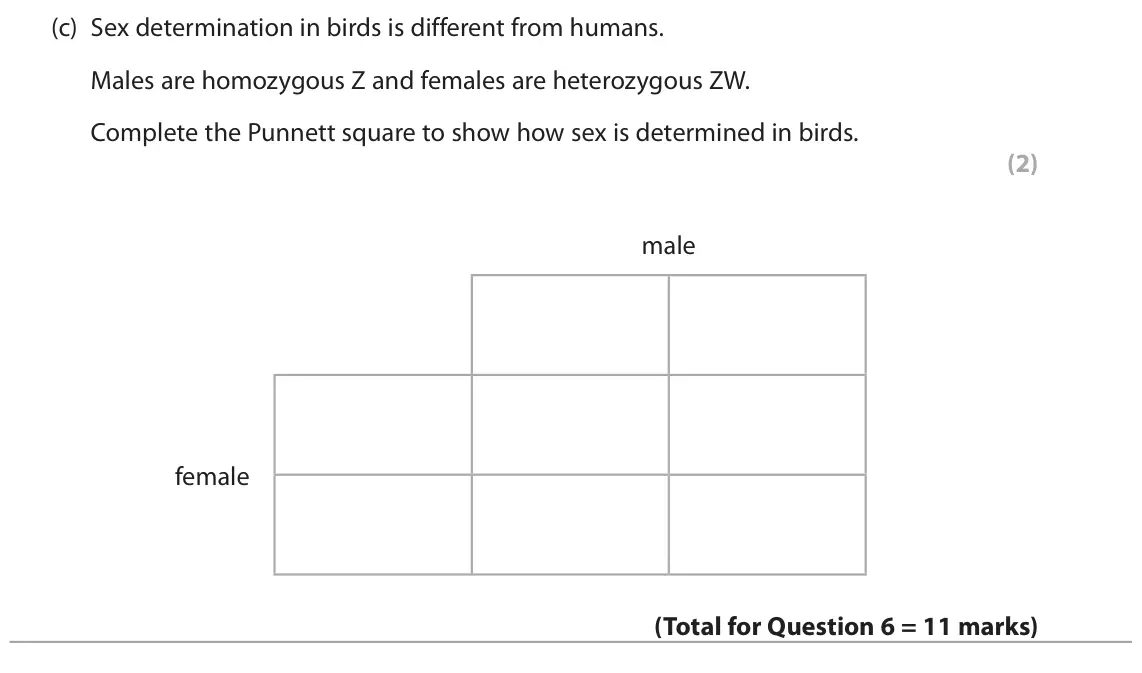
Q10(a)(i)
The whole paper ↗
Q10(a)(ii)
The whole paper ↗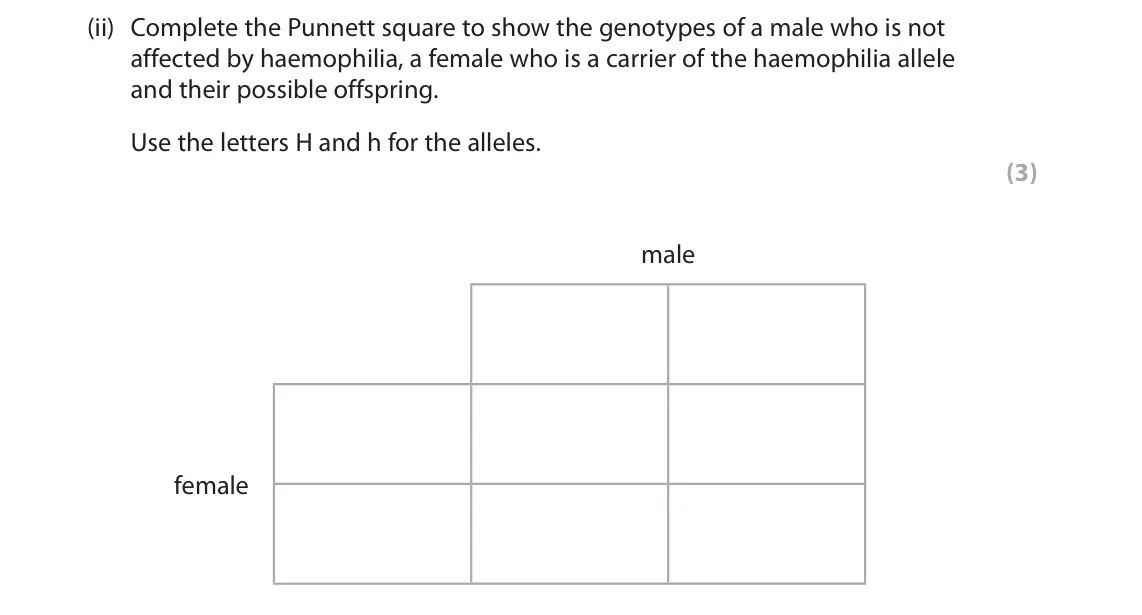
All 71 questions on Inheritance and genetic diagrams, as a list
- June 2025, Paper 1 Higher, Q4(a)(i) (1 mark): What are these ‘units’ of inheritance known as today? (1) A chloroplasts B enzymes C genes D mitochondria
- June 2025, Paper 1 Higher, Q4(a)(ii) (1 mark): Figure 5 shows one of Mendel’s experiments on the inheritance of pea shape. plants that produced plants that produced only wrinkled peas only round peas all the
- June 2025, Paper 1 Higher, Q4(b)(i) (3 marks): Complete the Punnett square to show the inheritance of the alleles for pea shape and the percentage probability of producing a plant with wrinkled peas. Use the
- June 2025, Paper 1 Higher, Q4(b)(ii) (2 marks): Plants used to study inheritance are grown in controlled environmental conditions. Suggest two ways of controlling these environmental conditions. (2) 1 2
- June 2025, Paper 1 Higher, Q9(a)(i) (1 mark): Which row is correct for the mother, father and son? (1) mother father son A affected unaffected carrier B carrier affected affected C carrier affected carrier
- June 2025, Paper 1 Higher, Q9(a)(ii) (2 marks): Cystic fibrosis causes the build‑up of thick, sticky mucus. Describe how the build-up of thick, sticky mucus affects the airways of a person. (2)
- June 2025, Paper 1 Higher, Q9(b) (4 marks): Huntington’s disease is a condition caused by a dominant allele. Explain the phenotypes of the offspring of a genetic cross between a person who is heterozygous
- June 2025, Paper 1 Foundation, Q10(a)(i) (1 mark): What are these ‘units’ of inheritance known as today? (1) A chloroplasts B enzymes C genes D mitochondria
- June 2025, Paper 1 Foundation, Q10(a)(ii) (1 mark): Figure 20 shows one of Mendel’s experiments on the inheritance of pea shape. plants that produced plants that produced only wrinkled peas only round peas all th
- June 2025, Paper 1 Foundation, Q10(b)(i) (3 marks): Complete the Punnett square to show the inheritance of the alleles for pea shape and the percentage probability of producing a plant with wrinkled peas. Use the
- June 2025, Paper 1 Foundation, Q10(b)(ii) (2 marks): Plants used to study inheritance are grown in controlled environmental conditions. Suggest two ways of controlling these environmental conditions. (2) 1 2
- June 2024, Paper 1 Higher, Q4(a)(i) (1 mark): Which conclusion can be made about the characteristic for purple flowers? (1) A the characteristic is recessive B the characteristic is dominant C the character
- June 2024, Paper 1 Higher, Q4(a)(ii) (2 marks): Mendel used two of the offspring with purple flowers in another cross. The pea plants he obtained from this cross produced purple flowers or white flowers in a
- June 2024, Paper 1 Higher, Q4(a)(iii) (3 marks): A pea plant producing purple flowers had the genotype Aa. This pea plant was crossed with a pea plant producing white flowers. Complete the Punnett square to sh
- June 2024, Paper 1 Foundation, Q10(a)(i) (1 mark): Which conclusion can be made about the characteristic for purple flowers? (1) A the characteristic is recessive B the characteristic is dominant C the character
- June 2024, Paper 1 Foundation, Q10(a)(ii) (2 marks): Mendel used two of the offspring with purple flowers in another cross. The pea plants he obtained from this cross produced purple flowers or white flowers in a
- June 2024, Paper 1 Foundation, Q10(a)(iii) (3 marks): A pea plant producing purple flowers had the genotype Aa. This pea plant was crossed with a pea plant producing white flowers. Complete the Punnett square to sh
- June 2023, Paper 1 Higher, Q6(c) (2 marks): Sex determination in birds is different from humans. Males are homozygous Z and females are heterozygous ZW. Complete the Punnett square to show how sex is dete
- June 2023, Paper 1 Higher, Q10(a)(i) (1 mark): Describe the phenotype of a male with the genotype XhY. (1)
- June 2023, Paper 1 Higher, Q10(a)(ii) (3 marks): Complete the Punnett square to show the genotypes of a male who is not affected by haemophilia, a female who is a carrier of the haemophilia allele and their po
- June 2023, Paper 1 Foundation, Q6(a) (1 mark): Which term describes the allele for white flowers? (1) A heterozygous B homozygous C gamete D recessive
- June 2023, Paper 1 Foundation, Q6(b)(i) (2 marks): Complete the Punnett square. (2) wrinkled seeds R round seeds r
- June 2023, Paper 1 Foundation, Q6(b)(ii) (1 mark): State the percentage of the offspring that will produce round seeds. (1) percentage = %
- June 2023, Paper 1 Foundation, Q6(c)(i) (2 marks): Calculate the ratio of offspring with purple flowers to offspring with white flowers. Give your answer to the nearest whole number. (2) ratio : 1
- June 2023, Paper 1 Foundation, Q6(c)(ii) (2 marks): Explain why it was possible for this cross to produce some offspring with white flowers. (2)
- June 2023, Paper 1 Foundation, Q8(a)(ii) (1 mark): The colour of an apple is an observable characteristic. Which is the term for an observable characteristic? (1) A gene B genotype C heterozygous D phenotype
- June 2022, Paper 1 Higher, Q1(a) (1 mark): Which is the genotype of the pea pods produced from this cross? (1) A AA B aa C Aa D YG
- June 2022, Paper 1 Higher, Q1(b)(i) (1 mark): Mendel grew many plants from the seeds in these pea pods. These plants were then crossed with each other. The seeds from this second cross produced 5 496 plants
- June 2022, Paper 1 Higher, Q1(b)(ii) (3 marks): Complete the Punnett square to show the outcome of a cross where both parent pea plants are heterozygous. Show the percentage probability of homozygous recessiv
- June 2022, Paper 1 Foundation, Q4(c)(ii) (2 marks): Figure 8 shows the inheritance of cystic fibrosis in a family. F represents the dominant allele that does not cause cystic fibrosis. f represents the recessive
- June 2022, Paper 1 Foundation, Q4(c)(iii) (1 mark): State the genotype of person C. (1)
- November 2021, Paper 1 Higher, Q6(b)(ii) (3 marks): Haemochromatosis can be inherited. Haemochromatosis occurs when a person inherits two copies of a recessive allele. Figure 9 shows the inheritance of haemochrom
- November 2021, Paper 1 Higher, Q10(c)(i) (1 mark): Give the genotype for a plant producing white flowers. (1)
- November 2021, Paper 1 Higher, Q10(c)(ii) (4 marks): Explain the outcome if two plants that produce pink flowers are crossed. You should complete the Punnett square as part of your answer. (4) (TOTAL FOR PAPER = 1
- November 2021, Paper 1 Foundation, Q3(a)(i) (1 mark): Two parents are heterozygous for sickle cell disease. Complete the Punnett square to show the possible genotypes of their children. (1) D d D d
- November 2021, Paper 1 Foundation, Q3(a)(ii) (1 mark): State the percentage probability that their children could have sickle cell disease. (1) percentage probability = %
- November 2021, Paper 1 Foundation, Q3(a)(iii) (2 marks): A father with the genotype dd and a mother with the genotype DD plan to have several children. Explain why none of their children will have sickle cell disease.
- November 2021, Paper 1 Foundation, Q5(a) (1 mark): Carrots have different physical characteristics such as colour. Which genetic term describes the physical characteristics of a carrot? (1) A genotype B monohybr
- November 2020, Paper 1 Higher, Q4(a)(i) (2 marks): Explain why the offspring are all tall. (2)
- November 2020, Paper 1 Higher, Q4(a)(ii) (2 marks): In this investigation, the parent pea plants were grown in a warm, closed greenhouse. Give two reasons why the parent pea plants were grown in a warm, closed gr
- November 2020, Paper 1 Higher, Q4(b)(i) (3 marks): Predict, using the Punnett square, the percentage probability that this cross will have offspring that produce green‑coloured peas. (3) percentage probability o
- November 2020, Paper 1 Higher, Q10(b)(i) (1 mark): What is the number of men who are colour blind in the city? (1) A 42 500 B 85 000 C 166 666 D 1 020 000
- November 2020, Paper 1 Higher, Q10(b)(ii) (2 marks): Colour blindness is a sex-linked genetic disorder caused by a recessive allele. Colour blindness only affects 1 in 200 women. Explain why more men than women ar
- November 2020, Paper 1 Higher, Q10(b)(iii) (2 marks): A female without the allele for colour blindness has a baby boy. The father is colour blind. Explain the probability of the baby boy being colour blind. (2)
- November 2020, Paper 1 Foundation, Q10(a)(i) (2 marks): Explain why the offspring are all tall. (2)
- November 2020, Paper 1 Foundation, Q10(a)(ii) (2 marks): In this investigation, the parent pea plants were grown in a warm, closed greenhouse. Give two reasons why the parent pea plants were grown in a warm, closed gr
- November 2020, Paper 1 Foundation, Q10(b)(i) (3 marks): Predict, using the Punnett square, the percentage probability that this cross will have offspring that produce green‑coloured peas. (3) percentage probability o
- June 2019, Paper 1 Higher, Q9(c) (6 marks): The inheritance of different alleles affects the phenotype of an individual. A child is blood group O. The child’s mother is blood group A and the child’s fathe
- June 2019, Paper 1 Foundation, Q1(b)(i) (1 mark): A homozygous dominant round seeded plant was crossed with a homozygous recessive wrinkled seeded plant. Complete the Punnett square to show the genotypes of the
- June 2019, Paper 1 Foundation, Q1(b)(ii) (1 mark): State the percentage of the offspring that will produce round seeds. (1) percentage = %
- June 2019, Paper 1 Foundation, Q1(b)(iii) (1 mark): Which scientist discovered the basis of genetic inheritance by crossing pea plants? (1) A Charles Darwin B Alfred Wallace C Louis Leakey D Gregor Mendel
- June 2019, Paper 1 Foundation, Q1(c) (2 marks): The blood group of a person is determined by their genotype. Describe how a person inherits the blood group AB. (2)
- June 2019, Paper 1 Foundation, Q6(a)(ii) (1 mark): State the gender shown by this karyogram. (1)
- June 2019, Paper 1 Foundation, Q6(a)(iii) (2 marks): Complete the Punnett square to show how gender is inherited. (2) male gametes female gametes
- June 2019, Paper 1 Foundation, Q6(a)(iv) (1 mark): State the probability that a child will be male. (1)
- June 2018, Paper 1 Higher, Q7(b)(i) (1 mark): Which term is used to describe the expression of traits in an organism? (1) A genotype B phenotype C allele D gamete
- June 2018, Paper 1 Higher, Q7(b)(ii) (3 marks): Mendel crossed pea plants that produced round seeds with pea plants that produced wrinkled seeds. All the offspring produced round seeds. He then crossed these
- June 2018, Paper 1 Higher, Q7(c) (3 marks): Duchenne muscular dystrophy is a recessive sex-linked genetic disorder. This disorder causes muscle weakness. Figure 14 shows the inheritance of Duchenne muscul
- June 2018, Paper 1 Foundation, Q3(a)(i) (3 marks): Gregor Mendel crossed red-flowered pea plants with white-flowered pea plants. Describe how this equipment could be used to do this cross and discover the flower
- June 2018, Paper 1 Foundation, Q3(a)(ii) (2 marks): Describe how to make sure that the results obtained from this investigation are not anomalous. (2)
- June 2018, Paper 1 Foundation, Q3(b) (2 marks): In a different investigation, Mendel crossed pea plants that produced yellow seeds (AA) with pea plants that produced green seeds (aa). The dominant allele is s
- June 2018, Paper 1 Foundation, Q3(c) (1 mark): Mendel did his investigations in the 19th century. State one reason why Mendel could not fully explain the results of his investigations. (1)
- Specimen, Paper 1 Higher, Q4(a) (2 marks): Explain how Mendel used homozygous tall and homozygous short pea plants to show that the tall allele is dominant to the short allele. (2)
- Specimen, Paper 1 Higher, Q4(c)(i) (1 mark): What is the percentage chance of any child from person A inheriting the mutated allele? (1) A 0% B 25% C 50% D 75%
- Specimen, Paper 1 Higher, Q4(c)(ii) (2 marks): Explain the conclusion that can be made about the genotype of person C. (2)
- Specimen, Paper 1 Higher, Q6(b)(i) (1 mark): State the genotype of Rani. (1)
- Specimen, Paper 1 Higher, Q6(b)(ii) (2 marks): The offspring with normal fur pigmentation was bred with a tiger that was heterozygous. Use A/a to represent the alleles for fur pigmentation. Predict, using th
- Specimen, Paper 1 Higher, Q6(c) (2 marks): Explain how two parents with a dominant phenotype can produce offspring expressing a recessive characteristic. (2)
- Specimen, Paper 1 Foundation, Q1(a) (2 marks): A female with blue eyes and a male with brown eyes are about to have a child. Complete the Punnett square to determine the phenotype of the child. (2) man B B b
- Specimen, Paper 1 Foundation, Q10(a) (2 marks): Explain how Mendel used homozygous tall and homozygous short pea plants to show that the tall allele is dominant to the short allele. (2)
- Specimen, Paper 1 Foundation, Q10(b) (6 marks): Figure 16 shows a drosophila fruit fly. (Source: Science Photo Library) Figure 16 The brown body colour of a drosophila fruit fly is dominant to black body colo
Questions, mark schemes and examiner’s reports are © Pearson Edexcel, from their published past papers. Plumi isn’t affiliated with any exam board. Want whole papers? Every Edexcel GCSE Biology paper.
Rather write your answers by hand on iPad? Plumi marks them against the same mark schemes.