 plumi
Methods: Edexcel A‑Level Psychology questions
Every Edexcel A-Level Psychology exam question on 4.2 Methods, 2016–2025, with its mark scheme and examiner’s report.
Find questions946
Exam
All years
Calculations
Q13(a)
The whole paper ↗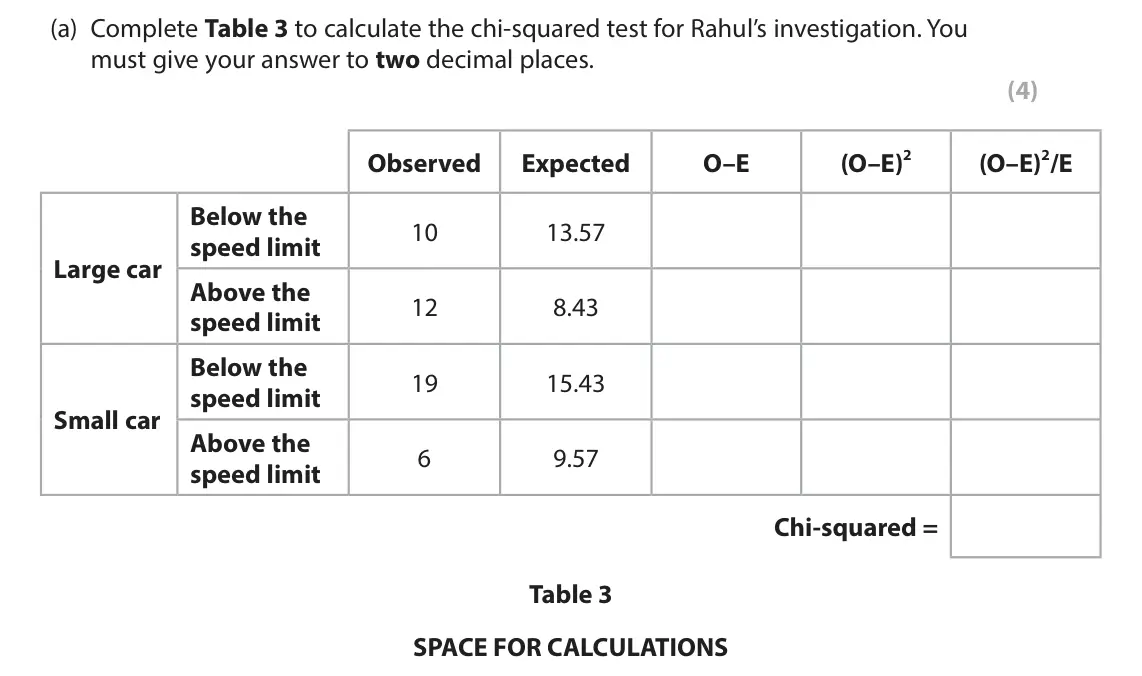
Q13(b)
The whole paper ↗
Q13(a)
The whole paper ↗
Q13(b)
The whole paper ↗
Q13(c)
The whole paper ↗
Q8(a)
The whole paper ↗
Q8(b)
The whole paper ↗
Q9(a)
The whole paper ↗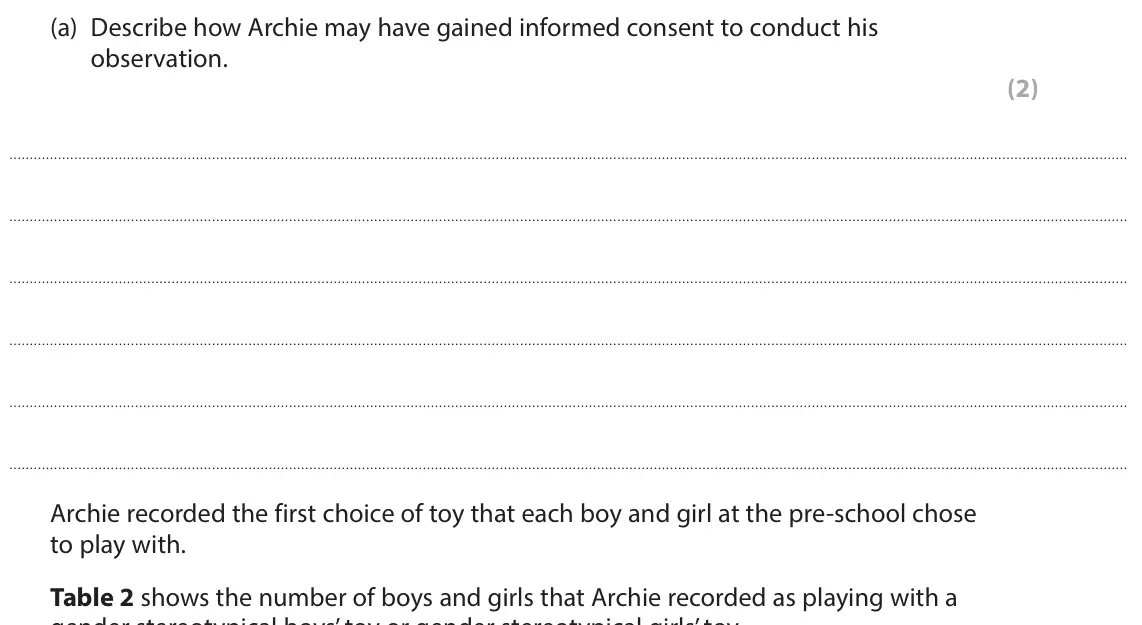
Q9(b)
The whole paper ↗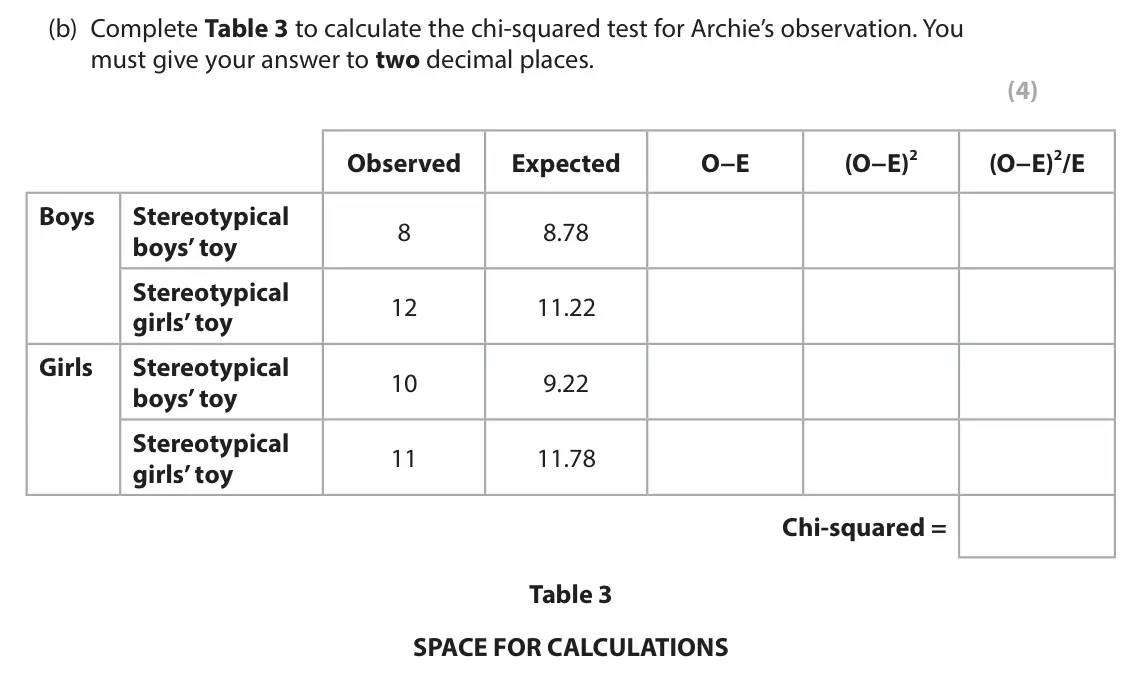
Q9(c)
The whole paper ↗
Q6(a)
The whole paper ↗
Q6(b)
The whole paper ↗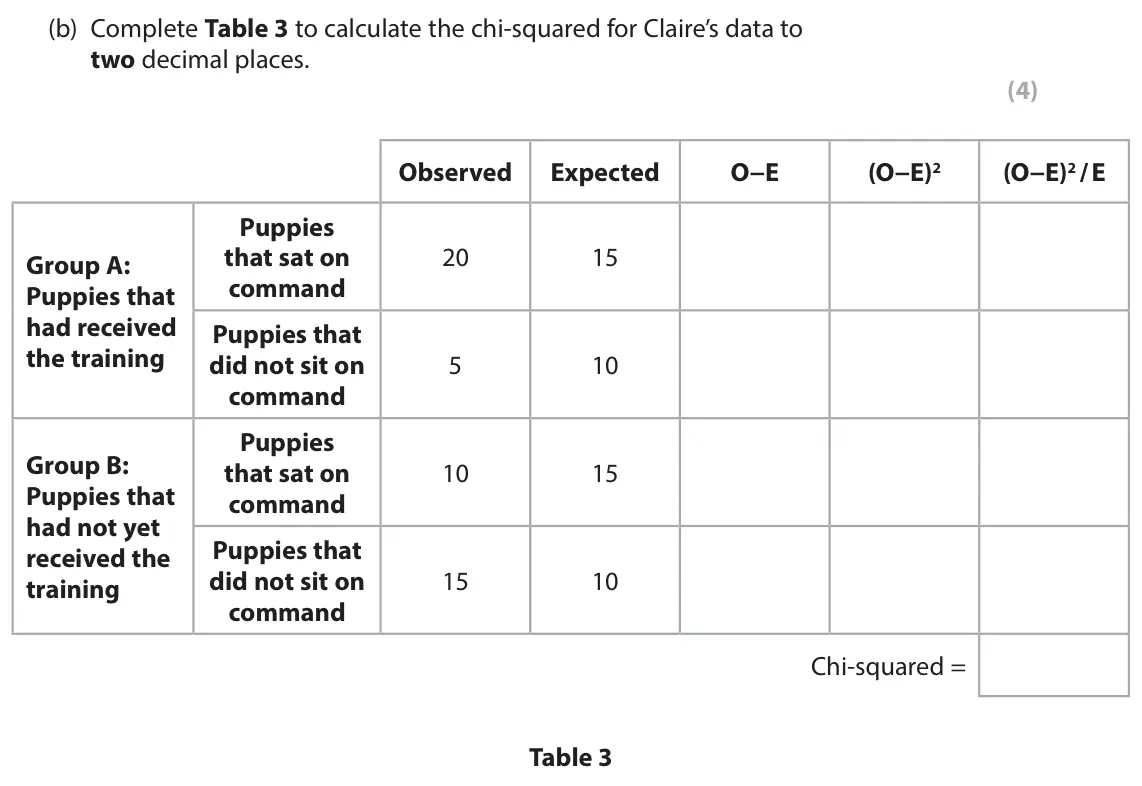
Q6(c)
The whole paper ↗
Q10(a)
The whole paper ↗
Q10(b)
The whole paper ↗
Q10(c)
The whole paper ↗
Q10(d)
The whole paper ↗
Q8(a)
The whole paper ↗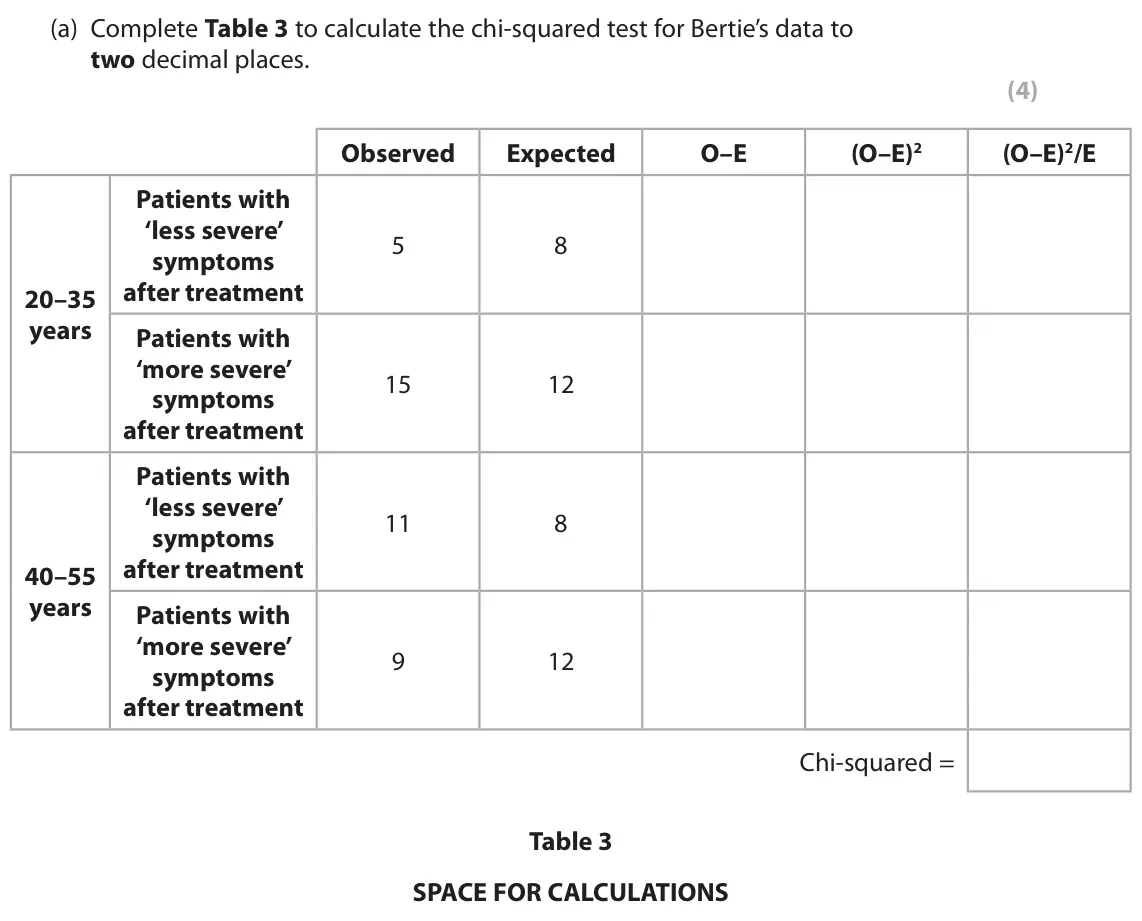
Q8(b)
The whole paper ↗
Q8(c)
The whole paper ↗
All 46 questions on Methods, as a list
- June 2025, Paper 1, Q13(a) (4 marks): Complete Table 3 to calculate the chi-squared test for Rahul’s investigation. You must give your answer to two decimal places. (4) (O–E)2 (O–E)2/E Observed Expe
- June 2025, Paper 1, Q13(b) (1 mark): Rahul had a one-tailed (directional) hypothesis with df = 1 and used p = 0.025 as his level of significance. Determine whether there was a significant differenc
- June 2024, Paper 1, Q13(a) (2 marks): Describe how Mischa could use tallying to gather his quantitative data. (2) 13 Mischa is investigating the healthy and unhealthy food choices made by people and
- June 2024, Paper 1, Q13(b) (2 marks): Describe the sampling technique used by Mischa to gather the participants for his observation. (2) 13 Mischa is investigating the healthy and unhealthy food cho
- June 2024, Paper 1, Q13(c) (4 marks): Explain two improvements Mischa could make to his investigation. (4) 13 Mischa is investigating the healthy and unhealthy food choices made by people and decide
- June 2024, AS Paper 2, Q8(a) (1 mark): Identify the type of observation used by Theresa in her investigation. (1) 8 Theresa wanted to investigate children’s colour preferences. She placed green and o
- June 2024, AS Paper 2, Q8(b) (4 marks): Explain one strength and one weakness of Theresa using an observation for her investigation into children’s colour preferences. (4) 8 Theresa wanted to investig
- June 2023, Paper 1, Q9(a) (2 marks): Describe how Archie may have gained informed consent to conduct his observation. (2) Archie recorded the first choice of toy that each boy and girl at the pre-s
- June 2023, Paper 1, Q9(b) (4 marks): Complete Table 3 to calculate the chi-squared test for Archie’s observation. You must give your answer to two decimal places. (4) (O−E)2 (O−E)2/E Observed Expec
- June 2023, Paper 1, Q9(c) (1 mark): Archie had a one-tailed (directional) hypothesis with df=1 and used p=0.05 as his level of significance. Determine whether there is a significant difference bet
- June 2023, AS Paper 2, Q6(a) (3 marks): Draw a bar chart to display the number of puppies in each group that sat on command using the data from Table 2. (3) 6 Claire recently got a new puppy and it wi
- June 2023, AS Paper 2, Q6(b) (4 marks): Complete Table 3 to calculate the chi-squared for Claire’s data to two decimal places. (4) Observed Expected O−E (O−E)2 (O−E)2 / E Puppies that sat on 20 15 Gro
- June 2023, AS Paper 2, Q6(c) (2 marks): Explain one strength of Claire using quantitative data in her investigation. (2) 6 Claire recently got a new puppy and it will not sit when she commands it to.
- November 2021, Paper 1, Q10(a) (2 marks): Using the Scientific Procedures Act (1986), state two considerations Zoë would have made for her research with squirrels and mice. (2) 10 Zoë investigated the u
- November 2021, Paper 1, Q10(b) (2 marks): State a fully operationalised directional (one-tailed) experimental hypothesis for Zoë’s investigation. (2) 10 Zoë investigated the use of operant conditioning
- November 2021, Paper 1, Q10(c) (2 marks): Explain one strength of Zoë’s research in terms of reliability. (2) 10 Zoë investigated the use of operant conditioning in training two different animals. She t
- November 2021, Paper 1, Q10(d) (2 marks): Explain one improvement that could be made to Zoë’s investigation in terms of validity. (2) 10 Zoë investigated the use of operant conditioning in training two
- October 2020, AS Paper 2, Q8(a) (4 marks): Complete Table 3 to calculate the chi-squared test for Bertie’s data to two decimal places. (4) Observed Expected O–E (O–E)2 (O–E)2/E Patients with ‘less severe
- October 2020, AS Paper 2, Q8(b) (2 marks): Explain one strength of Bertie’s study in terms of reliability. (2) 8 Bertie wanted to investigate the severity of symptoms for older and younger patients after
- October 2020, AS Paper 2, Q8(c) (2 marks): Explain one improvement that Bertie could make to his study in terms of validity. (2) 8 Bertie wanted to investigate the severity of symptoms for older and youn
- October 2020, AS Paper 2, Q9 (3 marks): Bradley decided to use a content analysis to investigate how much violence is shown in children’s television programmes. Describe how Bradley could use a conten
- June 2019, Paper 1, Q9(a) (1 mark): Identify the type of observation that Malik used in this study. (1) 9 Malik carried out an observation in a local cinema to investigate which films males and fe
- June 2019, Paper 1, Q9(b) (3 marks): Table 1 shows the number of males and females who watched either a horror film or a comedy film at the local cinema. Comedy Film Horror Film Males HH HH // Fema
- June 2019, Paper 1, Q9(c) (4 marks): Complete Table 2 to calculate the chi-squared test for Malik's study to two decimal places. (4) Observed Expected (O-E)2 (O-E)≥/E O-E Comedy Films Males 9.5 12
- June 2019, Paper 1, Q9(d) (1 mark): Malik had a two-tailed (non-directional) hypothesis with df = 1 and used p=0.05 as his level of significance. Determine whether there is a significant differenc
- June 2019, Paper 1, Q9(e) (2 marks): Malik used quantitative data for his study into film choice at the local cinema. Explain one weakness of using quantitative data for Malik's study. (2) 9 Malik
- June 2019, AS Paper 2, Q5(a) (1 mark): Define what is meant by a naturalistic observation. (1) 5 When studying learning theories, you will have learned about different types of observations.
- June 2019, AS Paper 2, Q5(b) (4 marks): Explain one strength and one weakness of the naturalistic observation method. (4) 5 When studying learning theories, you will have learned about different types
- June 2019, AS Paper 2, Q7(a) (1 mark): Calculate the mode for the number of anti-social behaviours recorded in programmes filmed in 2000. (1) 7 Brian completed a study that investigated anti-social b
- June 2019, AS Paper 2, Q7(b) (1 mark): Calculate the range for the number of anti-social behaviours recorded in programmes filmed in 2016. (1) 7 Brian completed a study that investigated anti-social
- June 2019, AS Paper 2, Q7(c) (4 marks): Explain one strength and one weakness of Brian using thematic analysis to analyse the television programmes. (4) 7 Brian completed a study that investigated ant
- June 2018, Paper 1, Q11(a) (3 marks): Draw a bar chart to show the total number of sporty males and sporty females shown in Table 3. (3) 11 Mandeep and Priya used a content analysis to investigate h
- June 2018, Paper 1, Q11(b) (2 marks): Explain one conclusion that could be drawn from Mandeep and Priya’s investigation. (2) 11 Mandeep and Priya used a content analysis to investigate how gender is
- June 2018, Paper 1, Q11(c) (2 marks): Explain one methodological issue there may have been with Mandeep and Priya’s content analysis. (2) 11 Mandeep and Priya used a content analysis to investigate
- June 2018, Paper 1, Q13 (8 marks): When studying learning theories you will have covered the observational research method for human research. Evaluate the usefulness of observational methods for
- June 2018, AS Paper 2, Q5(a) (3 marks): Describe non-participant observation as a human research method. (3) 5 Malcolm carried out a non-participant observation in a local nursery to find out whether
- June 2018, AS Paper 2, Q5(b) (2 marks): Describe how Malcolm could use event sampling in his non-participant observation at the local nursery. (2) 5 Malcolm carried out a non-participant observation i
- June 2018, AS Paper 2, Q5(c) (1 mark): Calculate the median number of aggressive acts observed for children aged one to two years old (Group A). (1) 5 Malcolm carried out a non-participant observatio
- June 2018, AS Paper 2, Q5(d) (3 marks): Draw a bar chart to display the mean number of aggressive acts for children aged one to two years old (Group A) and for children aged three to four years old (G
- June 2018, AS Paper 2, Q5(e) (2 marks): Explain one participant variable that Malcolm could have controlled for when planning his observation at the local nursery. (2) 5 Malcolm carried out a non-part
- June 2018, AS Paper 2, Q7(a) (4 marks): Describe content analysis as a research method used in psychology. (4)
- June 2018, AS Paper 2, Q7(b) (2 marks): Explain one weakness of content analysis as a research method used in psychology. (2)
- June 2017, Paper 1, Q13 (3 marks): You and a friend are undertaking an observation to see how many people in a supermarket help you to reach something on the top shelf. Describe how you would car
- June 2016, AS Paper 2, Q5(a) (2 marks): State the independent variable (IV) and dependent variable (DV) for Zaid’s study. (2) 5 Zaid conducted an animal study investigating the influence of different
- June 2016, AS Paper 2, Q5(b) (2 marks): Describe one ethical issue that Zaid needed to consider before conducting his study, which would have helped him gain a Home Office licence. (2) 5 Zaid conducte
- June 2016, AS Paper 2, Q5(c) (4 marks): Explain two weaknesses of using animals in psychological research. (4) 5 Zaid conducted an animal study investigating the influence of different schedules of re
Questions, mark schemes and examiner’s reports are © Pearson Edexcel, from their published past papers. Plumi isn’t affiliated with any exam board. Want whole papers? Full past papers.
Rather write your answers by hand on iPad? Plumi marks them against the same mark schemes.