 plumi
Content: Edexcel A‑Level Psychology questions
Every Edexcel A-Level Psychology exam question on 4.1 Content, 2016–2025, with its mark scheme and examiner’s report.
Find questions946
Exam
All years
Calculations

Q3(b)
The whole paper ↗

Q3(b)
The whole paper ↗
Q5(a)
The whole paper ↗
Q5(b)
The whole paper ↗


Q3(b)
The whole paper ↗
All 65 questions on Content, as a list
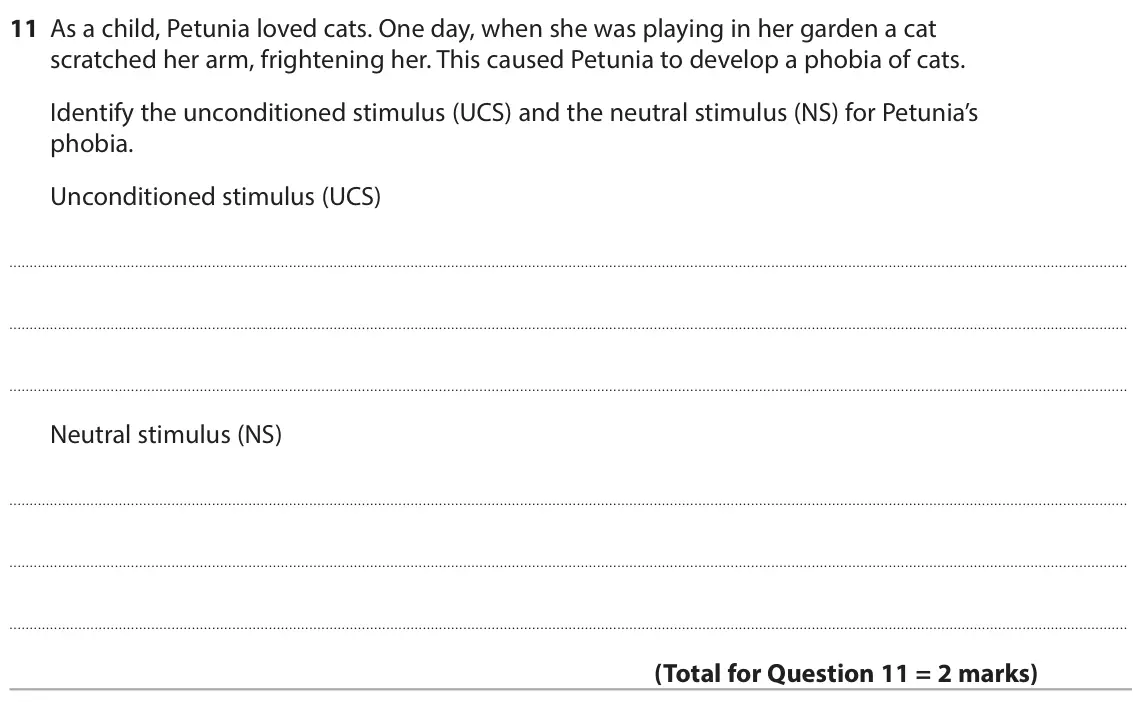
- June 2025, Paper 1, Q11 (2 marks): As a child, Petunia loved cats. One day, when she was playing in her garden a cat scratched her arm, frightening her. This caused Petunia to develop a phobia of
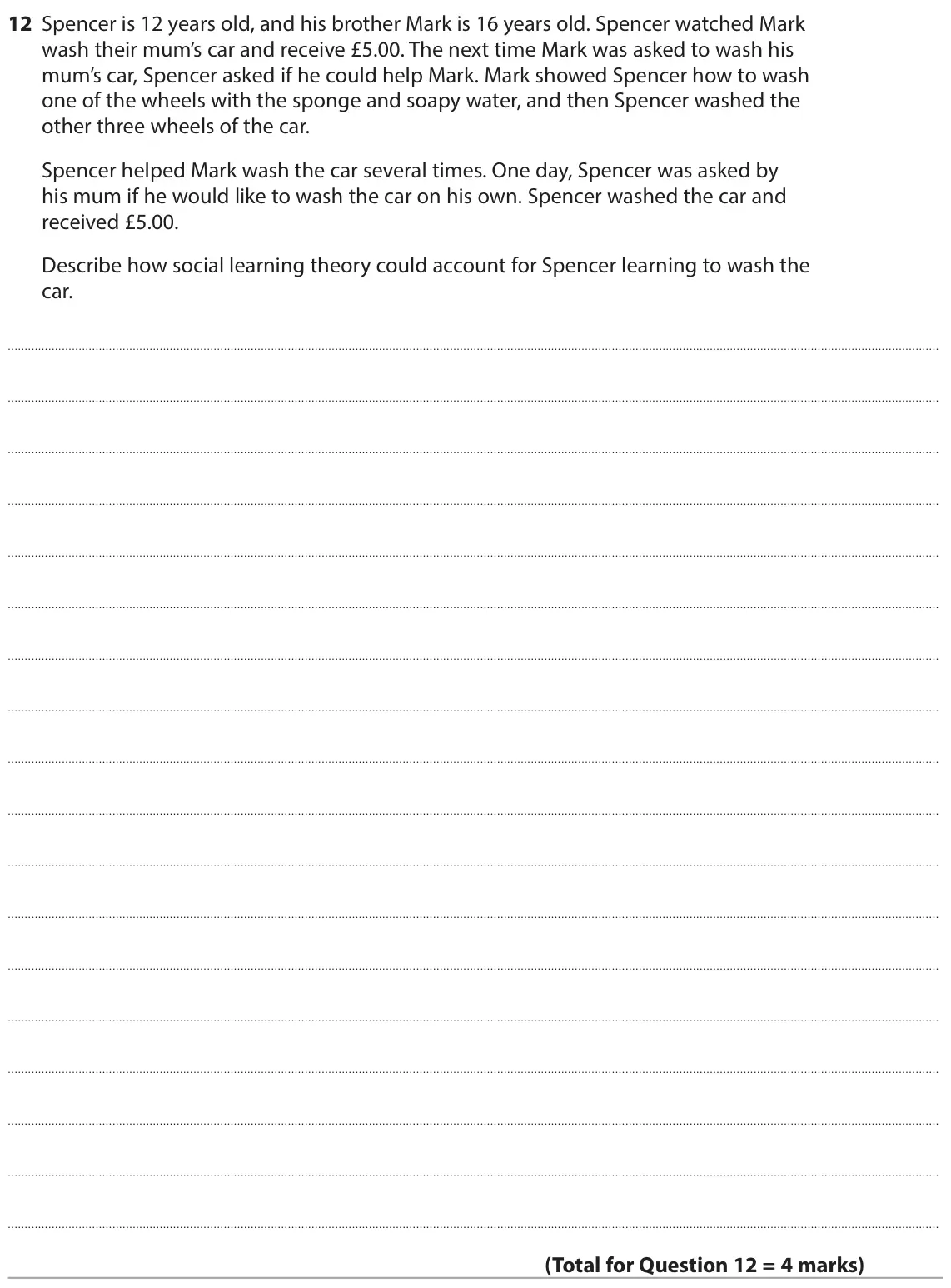
- June 2025, Paper 1, Q12 (4 marks): Spencer is 12 years old, and his brother Mark is 16 years old. Spencer watched Mark wash their mum’s car and receive £5.00. The next time Mark was asked to wash
- June 2025, Paper 1, Q14 (8 marks): Assess whether systematic desensitisation is an effective treatment for phobias. (8)
- June 2025, Paper 3, Q3(b) (6 marks): Using research evidence, explain how far social learning theory can account for the findings of the preschool children and PE study. (6) 3 Preschool children an
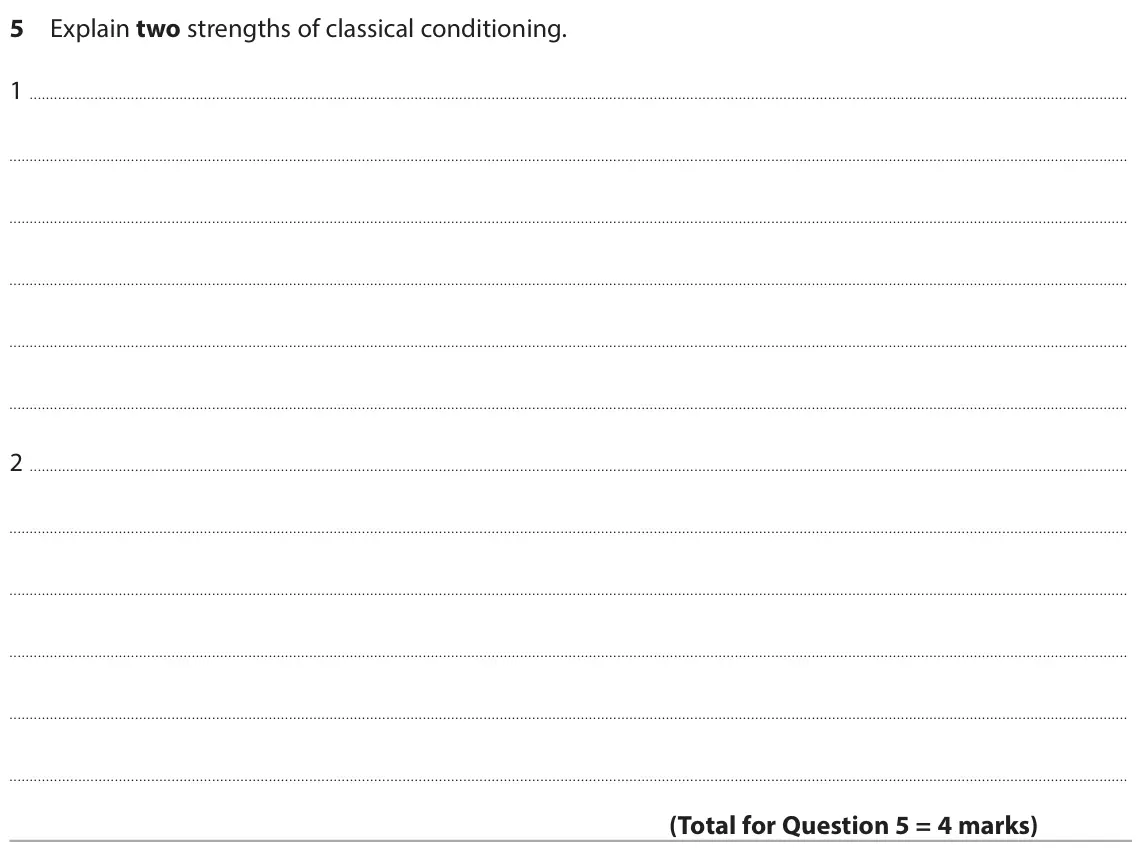
- June 2025, AS Paper 2, Q5 (4 marks): Explain two strengths of classical conditioning. 1 2
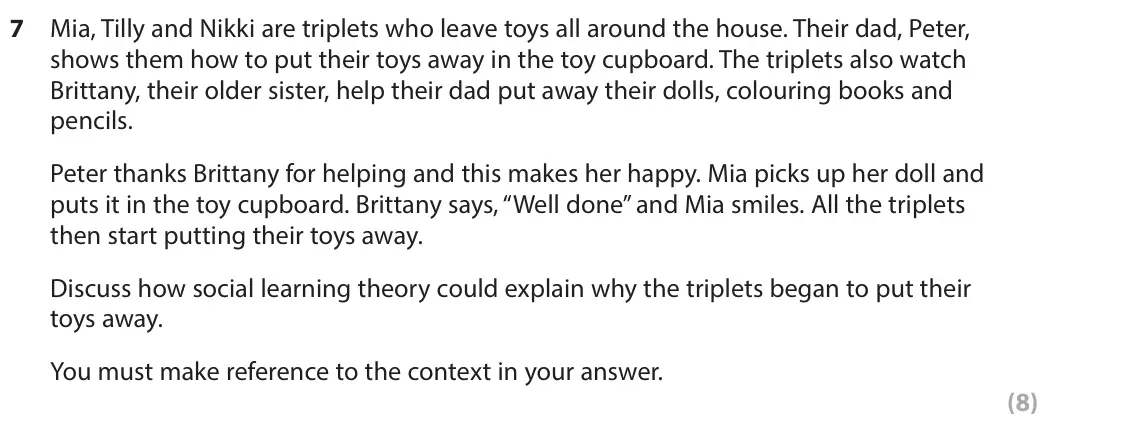
- June 2025, AS Paper 2, Q7 (8 marks): Mia, Tilly and Nikki are triplets who leave toys all around the house. Their dad, Peter, shows them how to put their toys away in the toy cupboard. The triplets
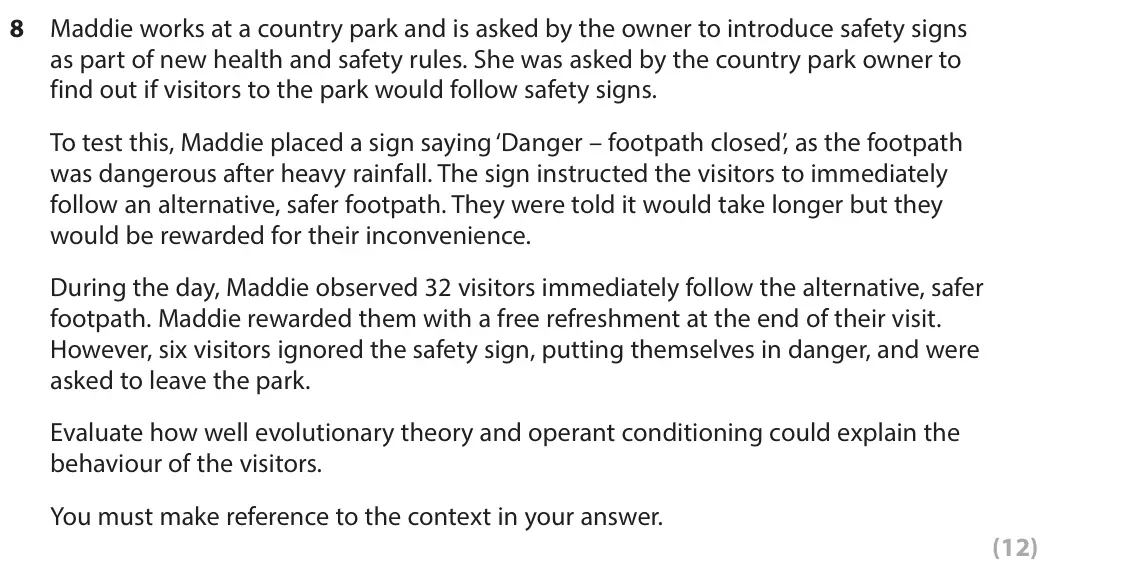
- June 2025, AS Paper 2, Q8 (12 marks): Maddie works at a country park and is asked by the owner to introduce safety signs as part of new health and safety rules. She was asked by the country park own
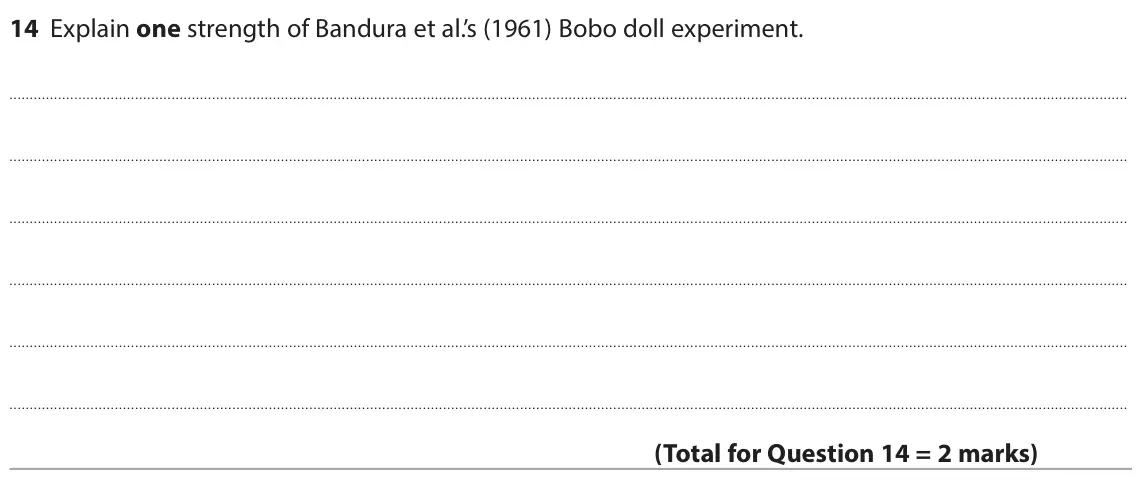
- June 2024, Paper 1, Q14 (2 marks): Explain one strength of Bandura et al.’s (1961) Bobo doll experiment.
- June 2024, Paper 1, Q15 (8 marks): Evaluate Pavlov’s (1927) experiment with salivation in dogs. (8)
- June 2024, Paper 3, Q3(b) (6 marks): Using research evidence, explain how far learning theories can account for the findings of the screen advertising and children study. (6) 3 Screen advertising a
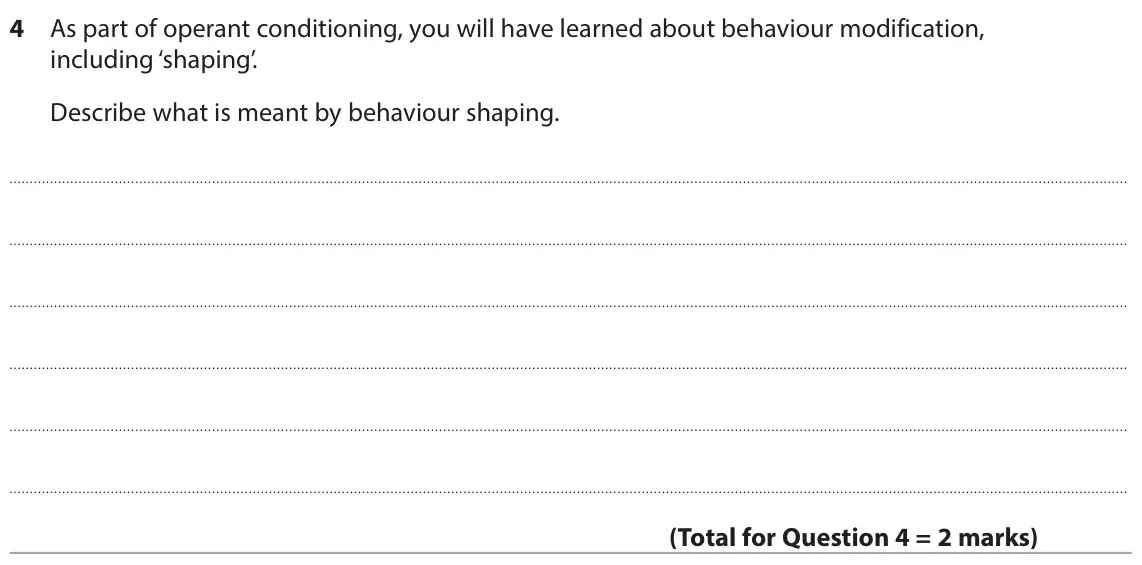
- June 2024, AS Paper 2, Q4 (2 marks): As part of operant conditioning, you will have learned about behaviour modification, including ‘shaping’. Describe what is meant by behaviour shaping.
- June 2024, AS Paper 2, Q5(a) (4 marks): Using classical conditioning, describe how Winston developed a phobia of flying. (4) 5 Winston is afraid of storms. During a recent work trip, Winston experienc
- June 2024, AS Paper 2, Q5(b) (4 marks): Explain two weaknesses of classical conditioning. (4) 5 Winston is afraid of storms. During a recent work trip, Winston experienced several hours of turbulence
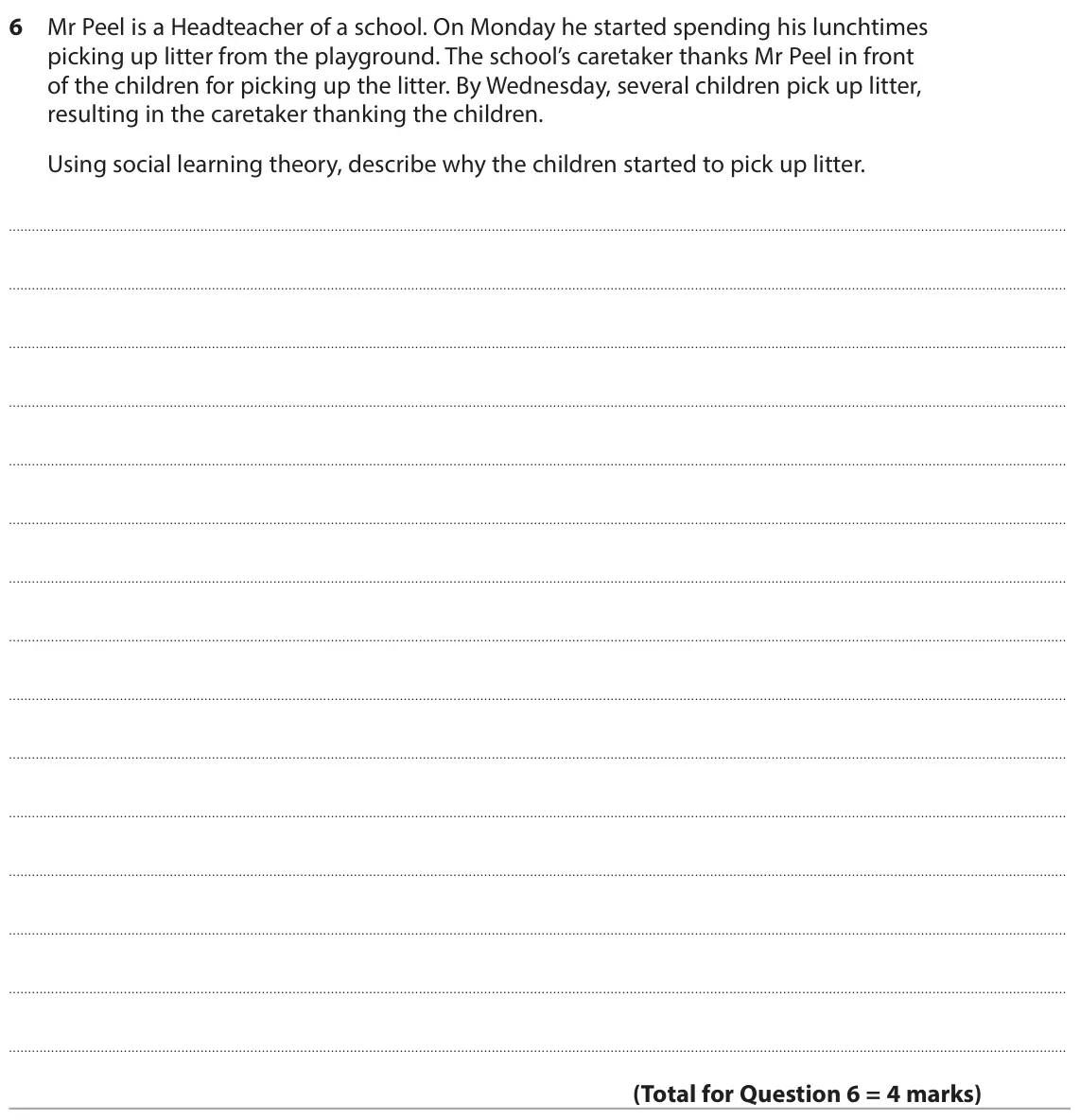
- June 2024, AS Paper 2, Q6 (4 marks): Mr Peel is a Headteacher of a school. On Monday he started spending his lunchtimes picking up litter from the playground. The school’s caretaker thanks Mr Peel
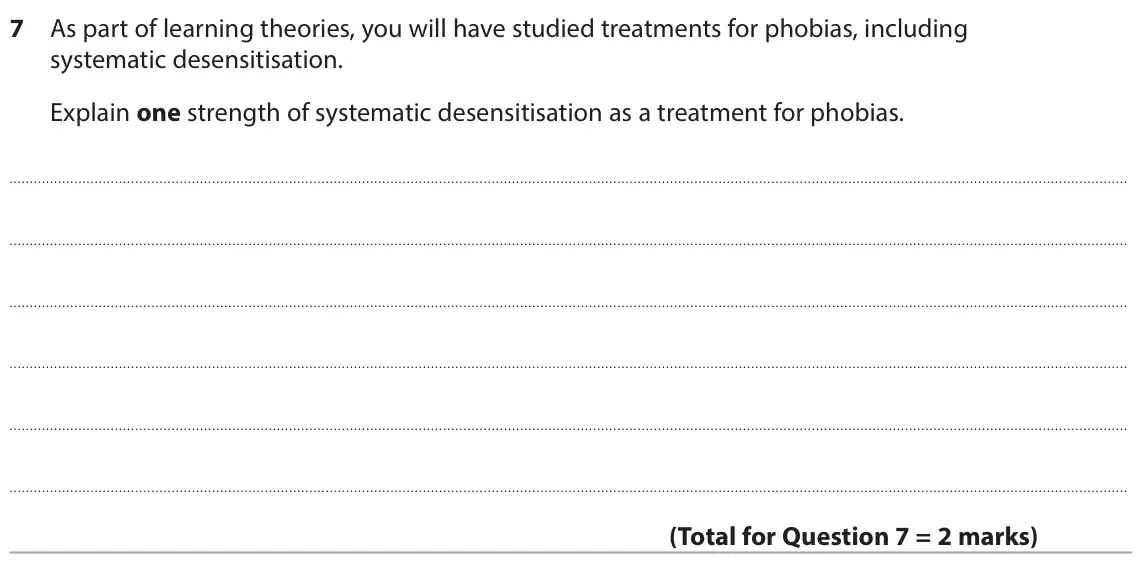
- June 2024, AS Paper 2, Q7 (2 marks): As part of learning theories, you will have studied treatments for phobias, including systematic desensitisation. Explain one strength of systematic desensitisa
- June 2024, AS Paper 2, Q9 (8 marks): Evaluate Bandura’s (1965) Bobo doll experiment with vicarious reinforcement. (8)
- June 2024, AS Paper 2, Q10 (12 marks): To what extent do operant conditioning and hormones explain human behaviour? (12)
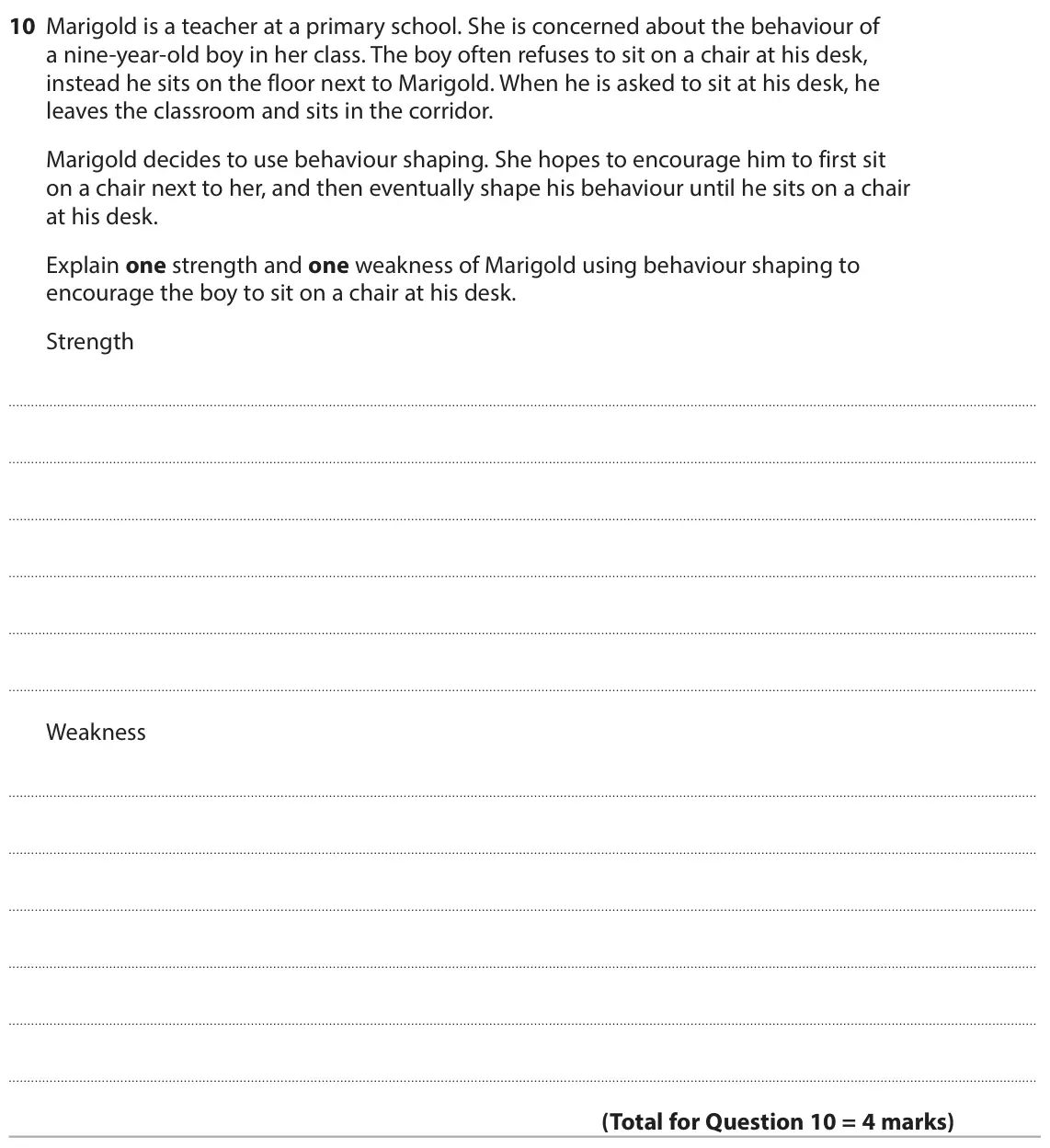
- June 2023, Paper 1, Q10 (4 marks): Marigold is a teacher at a primary school. She is concerned about the behaviour of a nine-year-old boy in her class. The boy often refuses to sit on a chair at
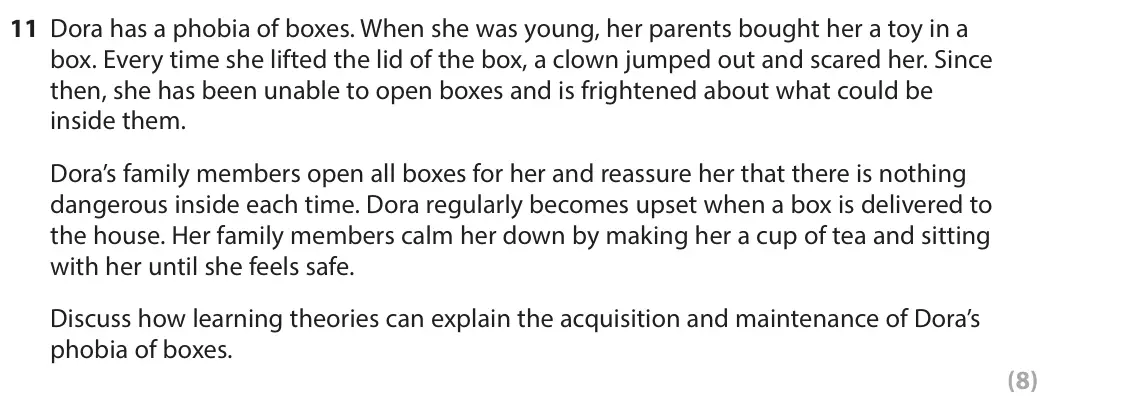
- June 2023, Paper 1, Q11 (8 marks): Dora has a phobia of boxes. When she was young, her parents bought her a toy in a box. Every time she lifted the lid of the box, a clown jumped out and scared h
- June 2023, Paper 3, Q3(b) (6 marks): Using research evidence, explain how far learning theories could account for the findings of the anti-littering study. (6) 3 Anti-littering study Researchers wa
- June 2023, AS Paper 2, Q5(a) (1 mark): Define what is meant by ‘retention’ as used in social learning theory. (1) 5 As part of your psychology course you will have covered social learning theory.
- June 2023, AS Paper 2, Q5(b) (1 mark): Define what is meant by ‘reproduction’ as used in social learning theory. (1) 5 As part of your psychology course you will have covered social learning theory.
- June 2023, AS Paper 2, Q5(c) (2 marks): Explain one strength of social learning theory. (2) 5 As part of your psychology course you will have covered social learning theory.
- June 2023, AS Paper 2, Q5(d) (4 marks): Explain two weaknesses of social learning theory. (4) 5 As part of your psychology course you will have covered social learning theory.
- June 2023, AS Paper 2, Q7 (4 marks): In learning theories you will have studied operant conditioning. Explain one strength and one weakness of operant conditioning. Strength Weakness
- June 2023, AS Paper 2, Q8 (8 marks): Evaluate one treatment for phobias based on theories of learning, other than systematic desensitisation. (8)
- June 2022, Paper 1, Q9 (2 marks): Ruhee receives reward points at school when she behaves extremely well, helps other students, and does extra research for her homework tasks. When she has 25 po
- June 2022, Paper 1, Q10(a) (4 marks): Using classical conditioning, describe why Victor may no longer want to go to the restaurant. (4) 10 Victor went to a local restaurant for a meal with friends.
- June 2022, Paper 1, Q10(b) (4 marks): Explain two weaknesses of classical conditioning as an explanation of human behaviour. (4) 10 Victor went to a local restaurant for a meal with friends. He ate
- June 2022, Paper 1, Q11 (8 marks): Evaluate Bandura’s (1965) Bobo doll experiment with vicarious reinforcement. (8)
- June 2022, Paper 3, Q3(b) (6 marks): Using research evidence, explain how far social learning theory could account for the findings of the reconciliation after romantic conflict study. (6) 3 Reconc
- June 2022, AS Paper 2, Q5(a) (1 mark): State one aim of Bandura’s (1961) Bobo doll experiment. (1) 5 You will have learned about Bandura’s (1961) Bobo doll experiment.
- June 2022, AS Paper 2, Q5(b) (2 marks): Explain one strength of Bandura’s (1961) Bobo doll experiment. (2) 5 You will have learned about Bandura’s (1961) Bobo doll experiment.
- June 2022, AS Paper 2, Q5(c) (2 marks): Explain one improvement you could make to Bandura’s (1961) Bobo doll experiment. (2) 5 You will have learned about Bandura’s (1961) Bobo doll experiment.
- June 2022, AS Paper 2, Q6(a) (2 marks): Using an example, define ‘extinction’ as a feature of classical conditioning. (2) 6 In learning theories you will have studied classical conditioning.
- June 2022, AS Paper 2, Q6(b) (4 marks): Explain one strength and one weakness of classical conditioning. (4) 6 In learning theories you will have studied classical conditioning.
- June 2022, AS Paper 2, Q8 (12 marks): Alik and Joshua are competitive teenage brothers. When preparing for tests in school, they revise extra hard to try and achieve higher marks than each other. Th
- October 2020, Paper 1, Q12 (2 marks): When Arthur was three years old a chicken chased him and pecked at him. This frightened Arthur and made him cry, resulting in alektorophobia (a fear of chickens
- October 2020, Paper 1, Q14 (8 marks): Astrid has a fear of flying. She experienced a flight with heavy turbulence when returning from a holiday and since then has been unable to board a plane. Astri
- October 2020, AS Paper 2, Q10 (8 marks): Evaluate social learning theory as an explanation of human behaviour. (8)
- October 2020, AS Paper 2, Q11 (12 marks): To what extent do classical conditioning, the process of synaptic transmission and neurotransmitter functioning explain human behaviour? (12)
- June 2019, Paper 1, Q10 (8 marks): Tom has a daughter called Holly who is 18 months old. Tom is trying to teach Holly how to use a fork by demonstrating to her how he holds it. He also shows Holl
- June 2019, Paper 3, Q3(b) (6 marks): Using research evidence, explain how operant conditioning could support the findings of the monkeying around study. (6) 3 Monkeying around Researchers wanted to
- June 2019, AS Paper 2, Q6(a) (2 marks): Describe ‘spontaneous recovery’ as a feature of classical conditioning. (2) 6 In learning theories you will have studied classical conditioning.
- June 2019, AS Paper 2, Q6(b) (4 marks): Anastasia fell off her bike several times whilst listening to her favourite band, Camban. Every time Anastasia now listens to the music of her favourite band Ca
- June 2019, AS Paper 2, Q9 (8 marks): Evaluate operant conditioning as a way of explaining human behaviour. (8)
- June 2019, AS Paper 2, Q10 (12 marks): Melissa is a 16-year-old girl who has started to wear make-up like her favourite celebrity. She went shopping and bought new clothes like the ones she had seen
- June 2018, Paper 1, Q12 (4 marks): Jodi attended a number of birthday parties when she was younger. At all of the parties there was a clown who burst a balloon which scared Jodi. Jodi is now fear
- June 2018, Paper 3, Q5 (12 marks): When commuting to college Sam notices that whichever form of public transport he uses strangers rarely communicate with each other. He notices that people tend
- June 2018, AS Paper 2, Q6 (4 marks): Matilda has been diagnosed with a phobia of buttons. She has been undergoing systematic desensitisation therapy for three months, which has been unsuccessful. H
- June 2018, AS Paper 2, Q9 (12 marks): Harrison and two of his friends were arrested for fighting whilst watching their local football club play against a rival team. During the fight Harrison’s frie
- June 2017, Paper 1, Q11 (2 marks): Classical conditioning uses many terms to explain the acquisition of behaviour. Define the terms ‘unconditioned response (UCR)’ and ‘extinction’. (2)
- June 2017, Paper 3, Q3(b) (6 marks): Explain how useful social learning theory could be in accounting for the findings of the Superman vs The Joker study. (6) 3 Superman vs The Joker Playing comput
- June 2017, AS Paper 2, Q5(a) (2 marks): Identify the primary reinforcer and secondary reinforcer in this scenario. (2) 5 Jayne owns a cafe called Rainfall and wants to encourage people to continue to
- June 2017, AS Paper 2, Q5(b) (4 marks): Describe how Jayne could use two schedules of reinforcement to encourage her customers to buy hot drinks from her cafe. (4) 5 Jayne owns a cafe called Rainfall
- June 2017, AS Paper 2, Q7(a) (4 marks): Using your knowledge of social learning theory, explain why Hugo may have driven in excess of the speed limit. (4) 7 Hugo passed his driving test one year ago.
- June 2017, AS Paper 2, Q7(b) (2 marks): Explain one weakness of social learning theory. (2) 7 Hugo passed his driving test one year ago. Recently, he received three penalty points for driving in exces
- June 2017, AS Paper 2, Q8 (8 marks): Evaluate classical conditioning as a theory to explain human behaviour. (8)
- June 2017, AS Paper 2, Q9 (12 marks): As part of your AS Psychology specification you were required to learn about the classic study Raine et al. (1997) and research carried out by Bandura (1961, 19
- June 2016, AS Paper 2, Q4(b) (4 marks): Explain whether Pavlov’s (1927) experiment with salivation in dogs could be considered scientific. (4)
- June 2016, AS Paper 2, Q4(c) (2 marks): Suggest one way in which Pavlov’s (1927) experiment with salivation in dogs could have been improved. (2)
- June 2016, AS Paper 2, Q6(a) (4 marks): Describe how Jack’s parents could use operant conditioning to encourage him to use the potty/toilet. (4) 6 Jack is two years of age and is learning to use the p
- June 2016, AS Paper 2, Q6(b) (2 marks): Bandura’s (1961, 1963) original Bobo Doll experiments investigated the influence of social learning theory. Using your knowledge of Bandura’s (1961, 1963) origi
- June 2016, AS Paper 2, Q7 (8 marks): Evaluate systematic desensitisation as a treatment for phobias. (8)
- June 2016, AS Paper 2, Q8 (12 marks): ‘Taking recreational drugs is purely a choice and to stop using drugs is easy.’ To what extent do the learning and biological approaches agree with the above st
Questions, mark schemes and examiner’s reports are © Pearson Edexcel, from their published past papers. Plumi isn’t affiliated with any exam board. Want whole papers? Full past papers.
Rather write your answers by hand on iPad? Plumi marks them against the same mark schemes.