 plumi
Methods: Edexcel A‑Level Psychology questions
Every Edexcel A-Level Psychology exam question on 2.2 Methods, 2016–2025, with its mark scheme and examiner’s report.
Find questions946
Exam
All years
Calculations
Q5(a)
The whole paper ↗
Q5(b)
The whole paper ↗
Q9(a)
The whole paper ↗
Q9(b)
The whole paper ↗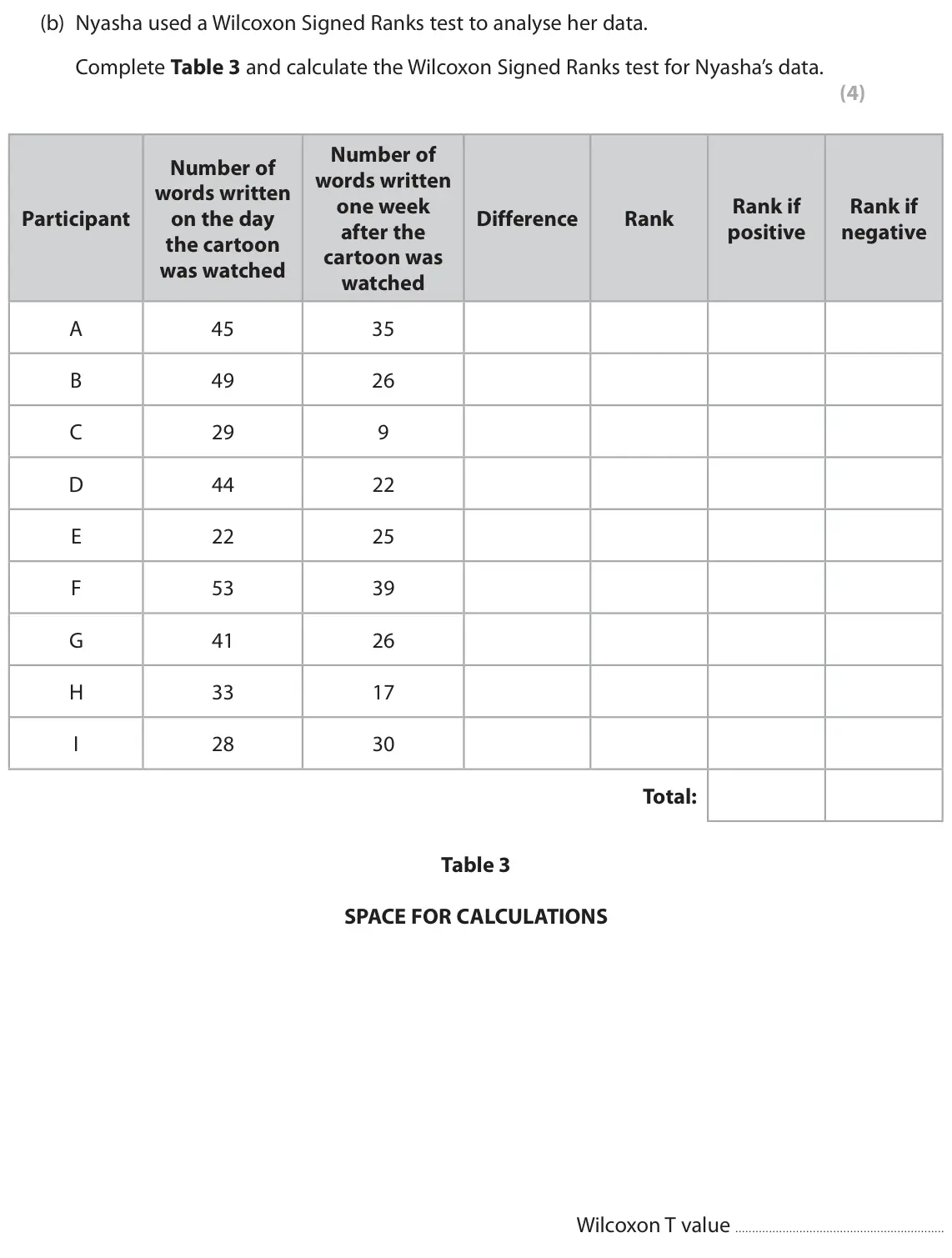
Q9(c)
The whole paper ↗

Q6(a)
The whole paper ↗
Q6(b)
The whole paper ↗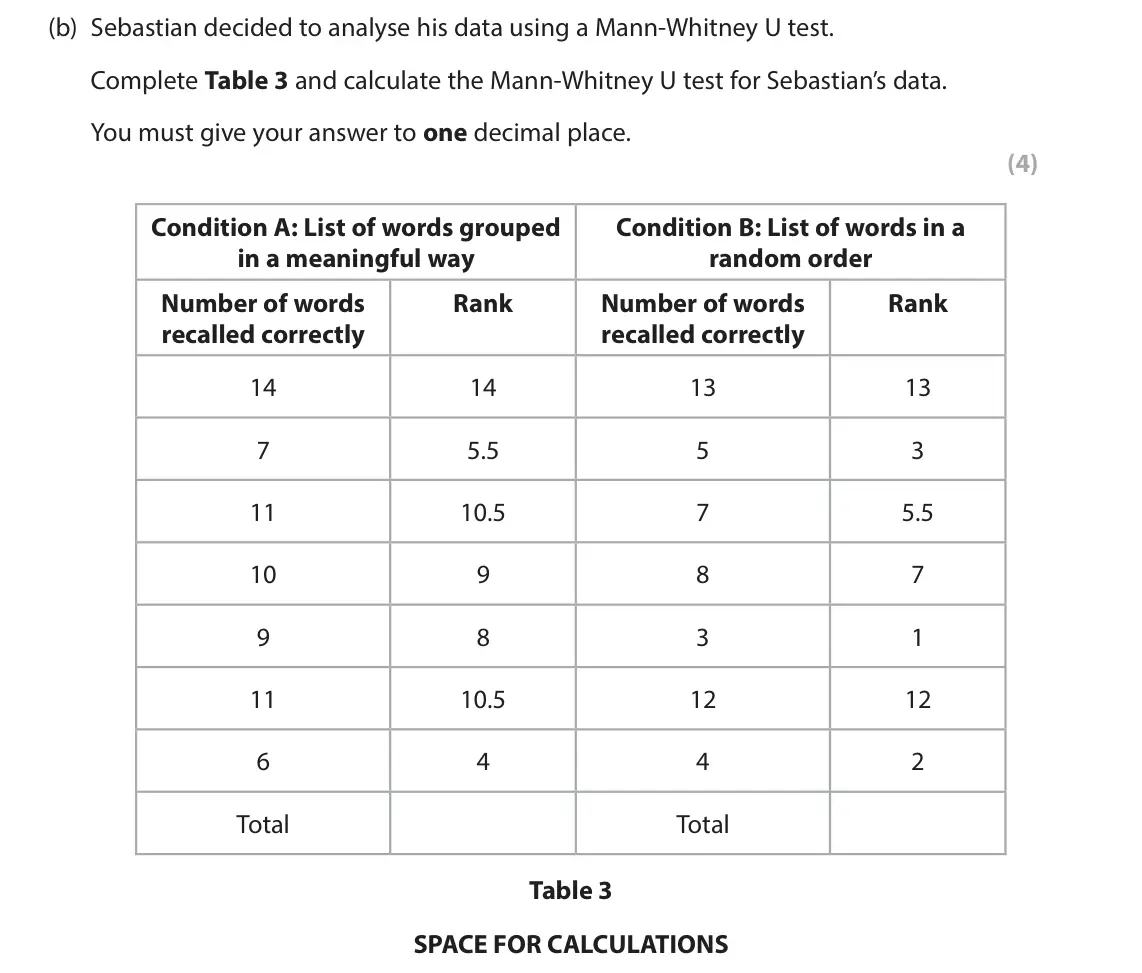
Q6(c)
The whole paper ↗

Q9(a)
The whole paper ↗
Q9(b)
The whole paper ↗
Q9(c)
The whole paper ↗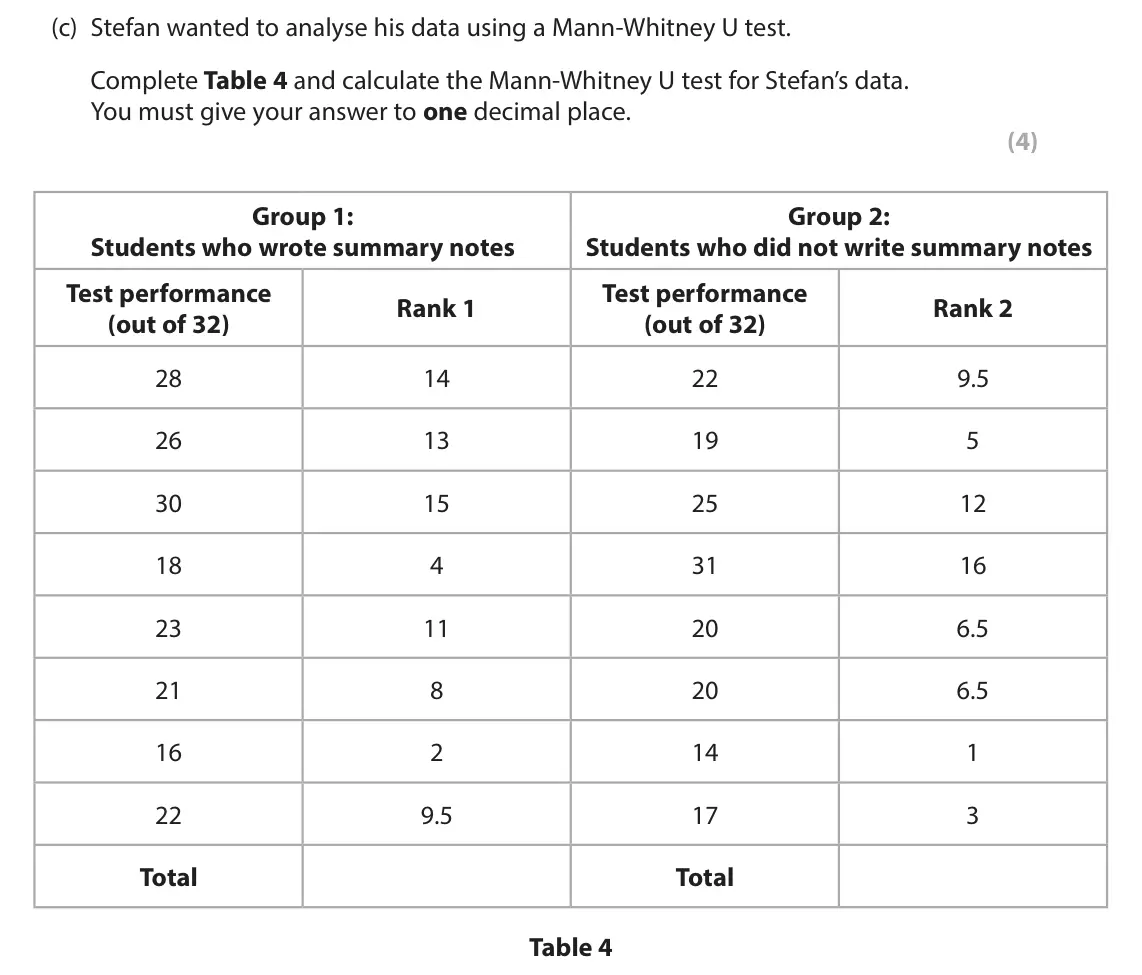
Q9(d)
The whole paper ↗
Q9(e)
The whole paper ↗

Q4(a)
The whole paper ↗
All 60 questions on Methods, as a list
- June 2025, Paper 1, Q5(a) (1 mark): State the fully operationalised dependent variable (DV) from Jenny’s experiment. (1) 5 Jenny investigated the influence of semantic similarity on the accuracy o
- June 2025, Paper 1, Q5(b) (3 marks): Using the data in Table 1, draw a bar chart to represent the data from Jenny’s experiment. (3) 5 Jenny investigated the influence of semantic similarity on the
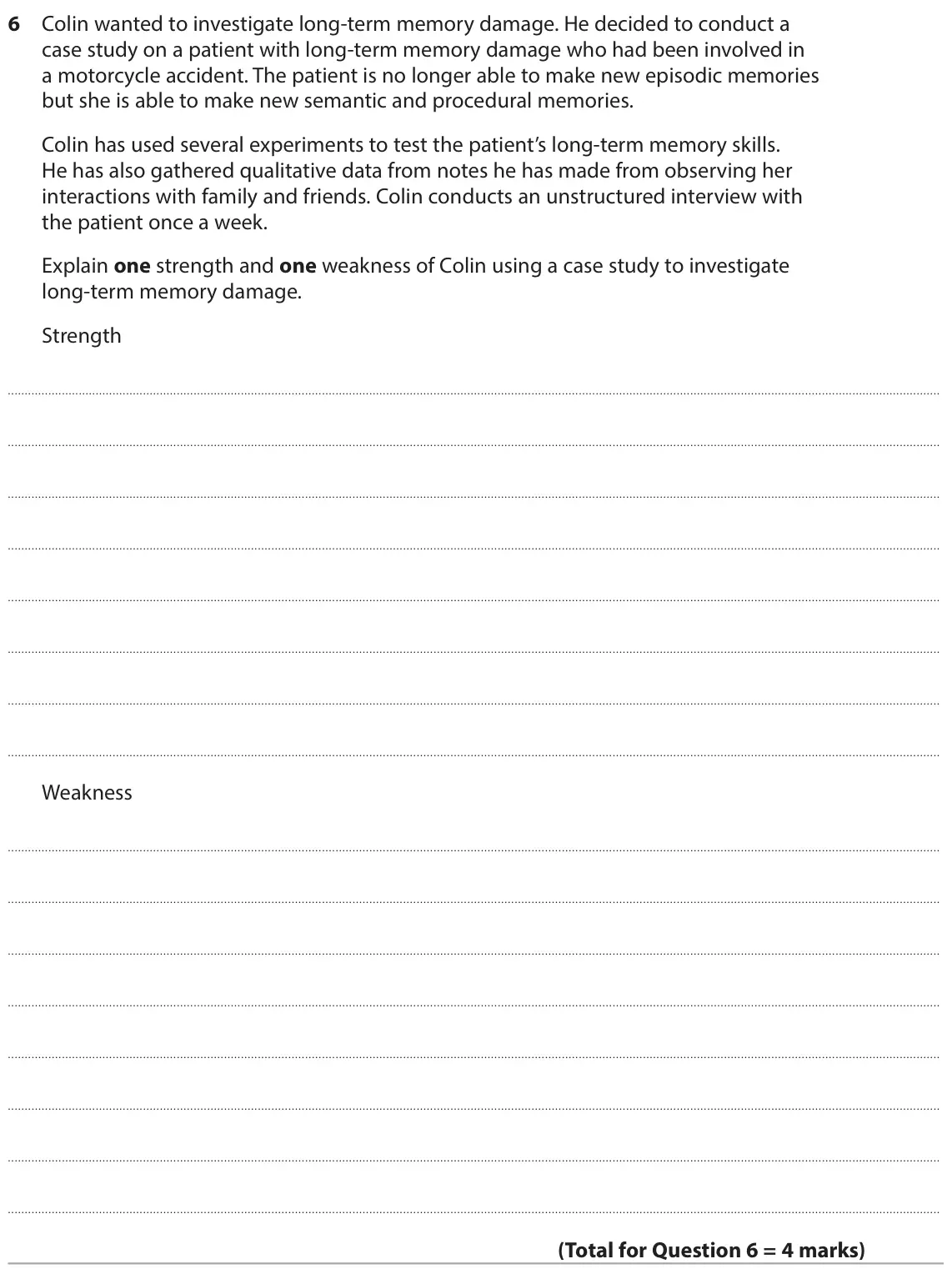
- June 2025, Paper 1, Q6 (4 marks): Colin wanted to investigate long-term memory damage. He decided to conduct a case study on a patient with long-term memory damage who had been involved in a mot
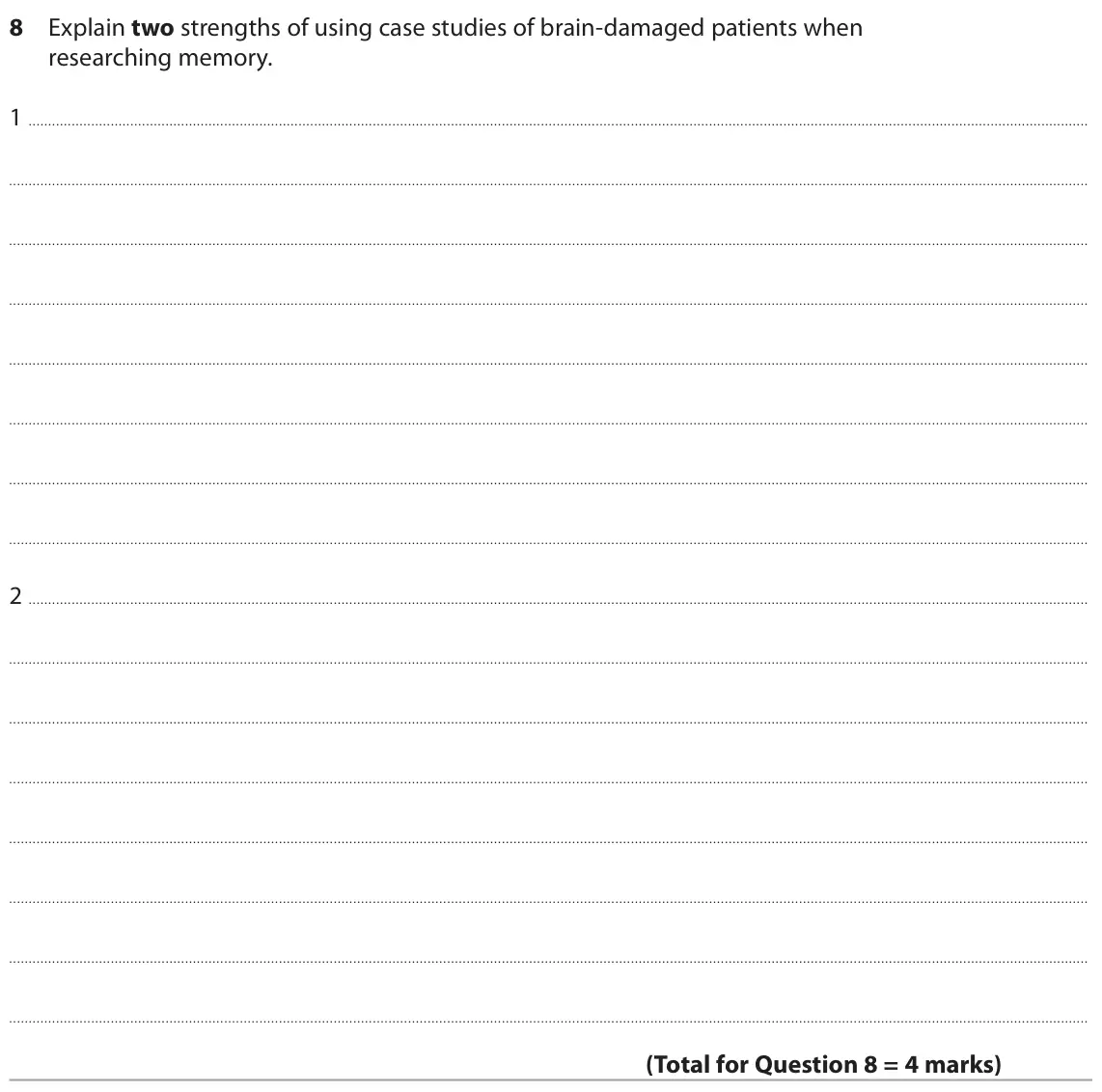
- June 2025, AS Paper 1, Q8 (4 marks): Explain two strengths of using case studies of brain-damaged patients when researching memory. 1 2
- June 2025, AS Paper 1, Q9(a) (1 mark): Calculate the median number of words written in the description of the cartoon on the day the cartoon was watched. (1) 9 Nyasha recruited British children to ta
- June 2025, AS Paper 1, Q9(b) (4 marks): Nyasha used a Wilcoxon Signed Ranks test to analyse her data. Complete Table 3 and calculate the Wilcoxon Signed Ranks test for Nyasha’s data. (4) Number of Num
- June 2025, AS Paper 1, Q9(c) (2 marks): Explain one improvement Nyasha could make to her experiment. (2) 9 Nyasha recruited British children to take part in a memory experiment. She showed the childre
- June 2024, Paper 1, Q8 (8 marks): Evaluate the use of experimental methods when researching memory. (8)
- June 2024, AS Paper 1, Q6(a) (1 mark): Calculate the range for the list of words grouped in a meaningful way (condition A). (1) 6 Sebastian conducted an experiment to see whether information being or
- June 2024, AS Paper 1, Q6(b) (4 marks): Sebastian decided to analyse his data using a Mann‑Whitney U test. Complete Table 3 and calculate the Mann‑Whitney U test for Sebastian’s data. You must give yo
- June 2024, AS Paper 1, Q6(c) (2 marks): Explain one improvement Sebastian could make to his experiment. (2) 6 Sebastian conducted an experiment to see whether information being organised in a meaningf
- June 2024, AS Paper 1, Q8 (8 marks): Evaluate laboratory experiments as they are used in cognitive psychology. (8)
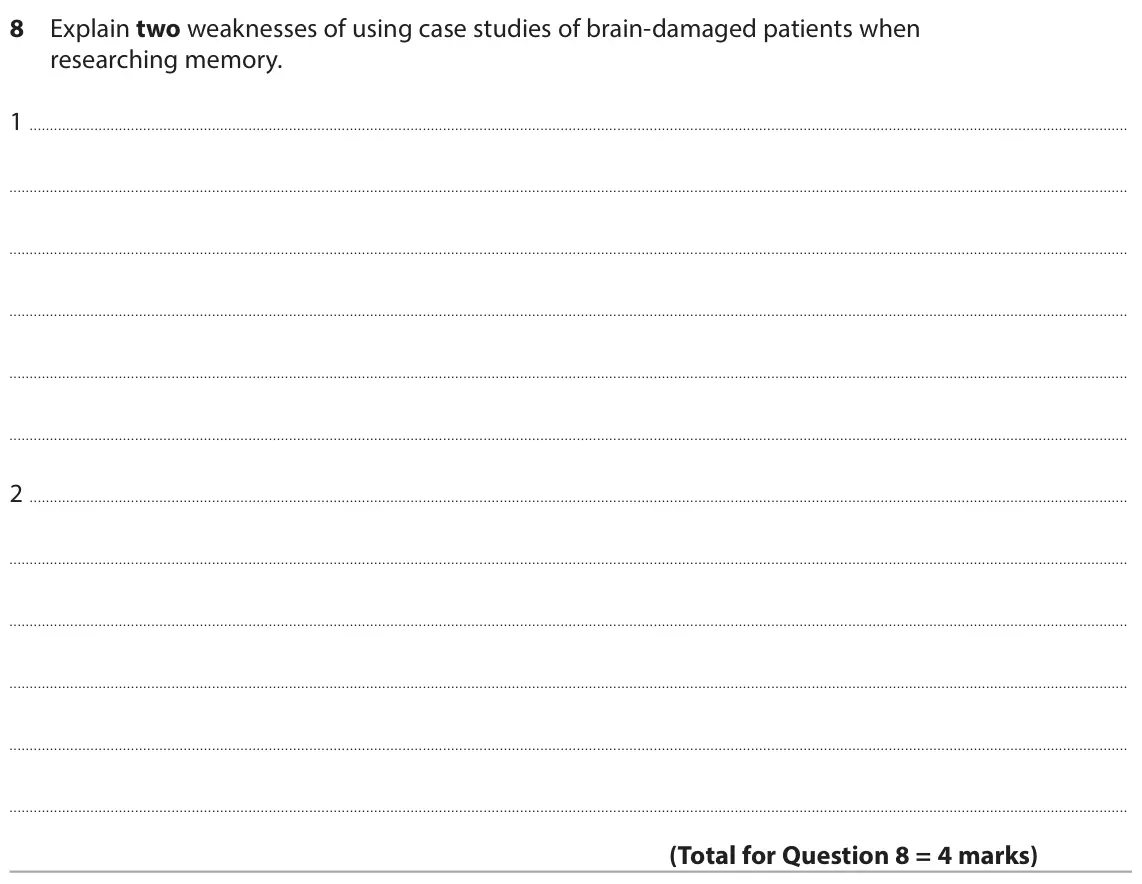
- June 2023, AS Paper 1, Q8 (4 marks): Explain two weaknesses of using case studies of brain‑damaged patients when researching memory. 1 2
- June 2023, AS Paper 1, Q9(a) (1 mark): From the total number of students in group 1, calculate the percentage of students who scored higher than 20 in the test. (1) 9 Stefan is a psychology teacher w
- June 2023, AS Paper 1, Q9(b) (1 mark): The student participants in Stefan’s sample consisted of twelve females and four males. Calculate what fraction of Stefan’s sample were female. You must express
- June 2023, AS Paper 1, Q9(c) (4 marks): Stefan wanted to analyse his data using a Mann‑Whitney U test. Complete Table 4 and calculate the Mann‑Whitney U test for Stefan’s data. You must give your answ
- June 2023, AS Paper 1, Q9(d) (1 mark): Stefan was concerned about making a Type I error when analysing the results of his investigation. Define what is meant by a Type I error. (1) 9 Stefan is a psyc
- June 2023, AS Paper 1, Q9(e) (2 marks): Explain one improvement Stefan could have made to his investigation. (2) 9 Stefan is a psychology teacher who is investigating the influence of note‑taking on t
- June 2023, AS Paper 1, Q12 (12 marks): Evaluate the use of interviews and field experiments when conducting research in psychology. (12)
- June 2022, Paper 1, Q4(a) (2 marks): State the fully operationalised independent variable (IV) and dependent variable (DV) in Lei’s investigation. (2) 4 Lei investigated the effect of word length o
- June 2022, Paper 1, Q4(b) (4 marks): Complete Table 2 and calculate the Mann-Whitney U for the results of Lei’s investigation. (4) Condition A: monosyllabic words Condition B: polysyllabic words Nu
- June 2022, Paper 1, Q4(c) (1 mark): Using the Mann-Whitney U value that you calculated for 4(b), determine whether Lei’s data were significant at p ≤ 0.05 for a directional (one-tailed) hypothesis
- June 2022, AS Paper 1, Q7(a) (1 mark): Calculate the mean number of country names recalled correctly from list 2. You must give your answer to one decimal place. (1) 7 Gwen conducted an experiment to
- June 2022, AS Paper 1, Q7(b) (1 mark): Calculate the mode for the number of country names recalled correctly from list 2. (1) 7 Gwen conducted an experiment to investigate whether the length of words
- June 2022, AS Paper 1, Q7(c) (3 marks): Gwen decided to use the standard deviation as a measure of dispersion for her data. Calculate the standard deviation for the number of country names recalled co
- June 2022, AS Paper 1, Q7(d) (2 marks): Explain one improvement that could be made to Gwen’s experiment. (2) 7 Gwen conducted an experiment to investigate whether the length of words influences the nu
- June 2022, AS Paper 1, Q8 (4 marks): Jane has asked for your help to design a laboratory experiment to find out if listening to music whilst revising affects people’s ability to recall facts. Descr
- November 2021, Paper 1, Q5(a) (2 marks): Describe how Ken would gather a stratified sample for his research. (2) 5 Ken is planning to research whether the time of day has an impact on working memory pr
- November 2021, Paper 1, Q5(b) (2 marks): To test working memory processing speed, Ken intends to ask his participants to complete a series of mathematical calculations in the morning. They will then re
- October 2020, Paper 1, Q7(a) (4 marks): Complete Table 1 and calculate the Wilcoxon Signed Ranks test for Charles’s study. (4) Participant Recall Recall Difference Rank Rank if Rank if after an with n
- October 2020, Paper 1, Q7(b) (1 mark): Using the Wilcoxon T value that you calculated for 7(a), determine whether Charles’s data were significant at p≤0.025 for a directional (one-tailed) hypothesis.
- October 2020, Paper 1, Q8 (8 marks): Assess whether case studies of brain-damaged patients are an effective method for investigating human memory. (8)
- October 2020, AS Paper 1, Q6(a) (1 mark): Identify the independent variable (IV) in the experiment conducted by Bernadette. (1) 6 Bernadette carried out an experiment to investigate whether noise affect
- October 2020, AS Paper 1, Q6(b) (4 marks): Bernadette used a repeated measures design in her experiment. Explain one strength and one weakness of using a repeated measures design. (4) 6 Bernadette carrie
- October 2020, AS Paper 1, Q6(c) (4 marks): Bernadette decided to carry out a statistical test on her data. She used a Wilcoxon Signed Ranks test. Complete Table 1 and calculate the Wilcoxon Signed Ranks
- October 2020, AS Paper 1, Q6(d) (2 marks): Explain one improvement Bernadette could have made to her experiment. (2) 6 Bernadette carried out an experiment to investigate whether noise affects concentrat
- June 2019, AS Paper 1, Q5(c) (2 marks): Case studies of brain-damaged patients have been used when researching memory. Explain one strength of using case studies of brain-damaged patients when researc
- June 2019, AS Paper 1, Q7(a) (1 mark): Calculate the percentage of landmarks correctly recalled by Participant C. (1) 7 Elizabeth conducted a laboratory experiment to investigate the impact of brain
- June 2019, AS Paper 1, Q7(b) (2 marks): Elizabeth repeated her experiment with a second group of participants who did not have brain damage. She compared the results from the two experiments. Explain
- June 2019, AS Paper 1, Q8 (4 marks): Ricky is planning to conduct a field experiment to test recall accuracy of a story. He wants to find out if accuracy decreases over time. Ricky has asked for yo
- June 2018, Paper 1, Q5(a) (1 mark): Calculate the mean number of words retrieved by the mathematics and geography students and complete Table 1 with your answers. You must give your answers to one
- June 2018, Paper 1, Q5(b) (2 marks): Explain which statistical (inferential) test Mr Robinson would have used to analyse the data. (2) 5 Mr Robinson has asked geography students and mathematics stu
- June 2018, Paper 1, Q5(c) (2 marks): Explain one strength of Mr Robinson using quantitative data in his experiment. (2) 5 Mr Robinson has asked geography students and mathematics students to take p
- June 2018, AS Paper 1, Q8(b) (1 mark): Calculate the range for the number of recall errors made by female participants. (1) 8 George tested the accuracy of memory using a fairy tale story about a pri
- June 2018, AS Paper 1, Q8(c) (1 mark): Calculate the ratio of male to female participants in George’s study. (1) 8 George tested the accuracy of memory using a fairy tale story about a princess. He r
- June 2018, AS Paper 1, Q8(d) (2 marks): Explain one improvement that could be made to George’s study. (2) The mean number of errors in recall by males and females are shown in Table 4. Mean number of
- June 2018, AS Paper 1, Q8(e) (2 marks): Explain one conclusion that George could make from the data in Table 4. (2) 8 George tested the accuracy of memory using a fairy tale story about a princess. He
- June 2018, AS Paper 1, Q9(a) (1 mark): Define what is meant by ‘objectivity’. (1) 9 You have been asked to design a field experiment to investigate whether poor working memory in children affects the
- June 2018, AS Paper 1, Q9(b) (4 marks): Describe the procedure you could use in your field experiment. (4) 9 You have been asked to design a field experiment to investigate whether poor working memory
- June 2017, Paper 1, Q5(a) (2 marks): Calculate the range of scores Louise gathered in both conditions of her study and complete Table 2 above. (2) 5 Louise is interested to see whether there is a d
- June 2017, Paper 1, Q5(b) (4 marks): Calculate the standard deviation for the number of pictures recalled by children with dyslexia. Show your working and give your answer to two decimal places. (4
- June 2017, Paper 1, Q6 (8 marks): Experiments within psychology, such as that carried out by Baddeley (1966b), have aided our understanding of cognitive functions. Assess the usefulness of using
- June 2017, AS Paper 1, Q6(a) (4 marks): Explain the terms ‘independent variable’ and ‘dependent variable’, using Sarah’s research as an example. (4) 6 Sarah would like to research whether 15 acoustica
- June 2017, AS Paper 1, Q6(b) (3 marks): The mean results of Sarah’s experiment are shown in Table 2. Mean number of acoustically Mean number of acoustically similar words recalled dissimilar words rec
- June 2017, AS Paper 1, Q6(c) (1 mark): State one conclusion from Sarah’s results. (1) 6 Sarah would like to research whether 15 acoustically similar words will be easier to recall than 15 acousticall
- June 2017, AS Paper 1, Q7 (8 marks): Henry Molaison (HM) was a patient who had a brain injury as a result of a surgical procedure to help him with epileptic seizures. As a result he suffered with s
- June 2016, AS Paper 1, Q6(a) (3 marks): State a fully operationalised directional (one-tailed) hypothesis for Jared’s experiment. (3) 6 Jared decided to investigate how many household objects could be
- June 2016, AS Paper 1, Q6(b) (3 marks): Describe an appropriate participant design that Jared could use for this experiment. (3) 6 Jared decided to investigate how many household objects could be reca
- June 2016, AS Paper 1, Q6(c) (3 marks): Table 1 shows the results of Jared’s experiment. Condition 1 Condition 2 Number of items recalled Number of items recalled when rehearsal is not when rehearsal
- June 2016, AS Paper 1, Q9 (12 marks): Ed and Najeeb are researching the effects of individual tutorials on student wellbeing. Ed wants to carry out a laboratory experiment and collect quantitative d
Questions, mark schemes and examiner’s reports are © Pearson Edexcel, from their published past papers. Plumi isn’t affiliated with any exam board. Want whole papers? Full past papers.
Rather write your answers by hand on iPad? Plumi marks them against the same mark schemes.