 plumi
Redshift and cosmology: Edexcel A‑Level Physics questions
Every Edexcel A-Level Physics exam question on Redshift and cosmology (specification points 161–163), 2016–2025, with its mark scheme and examiner’s report.
Find questions1,540
Calculations
Q15(b)
The whole paper ↗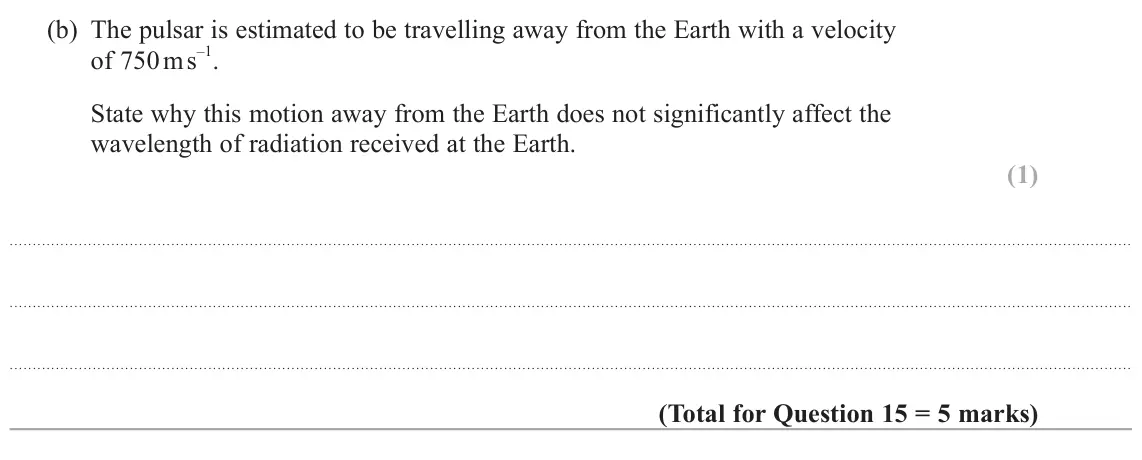
Q18(c)(i)
The whole paper ↗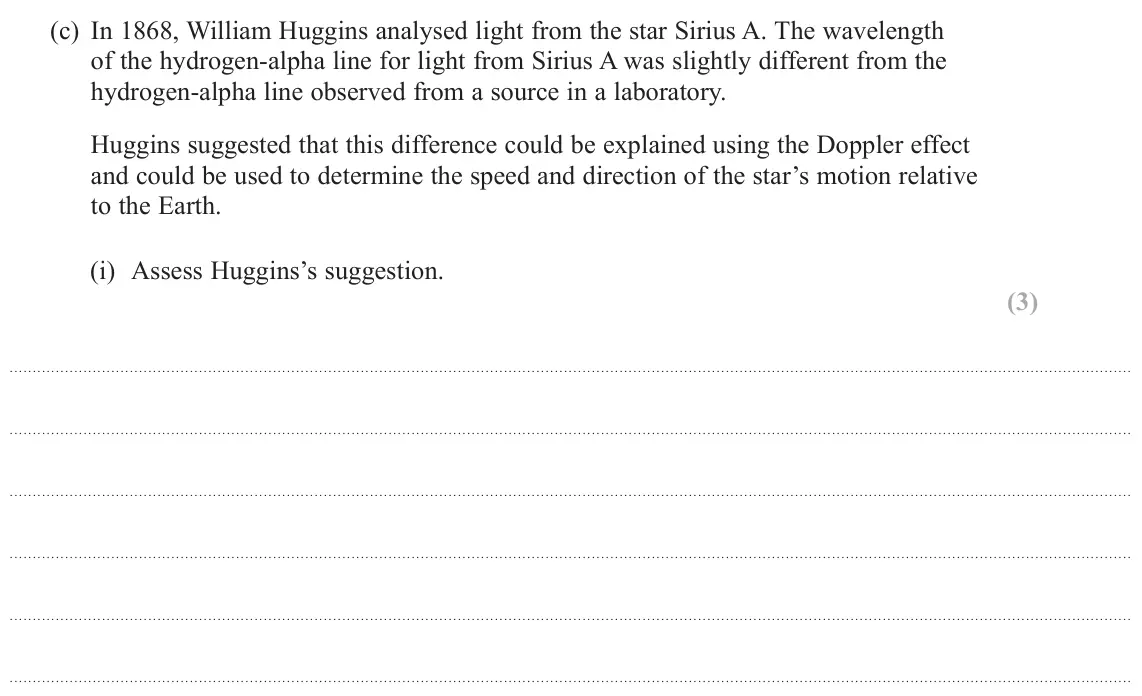
Q18(c)(ii)
The whole paper ↗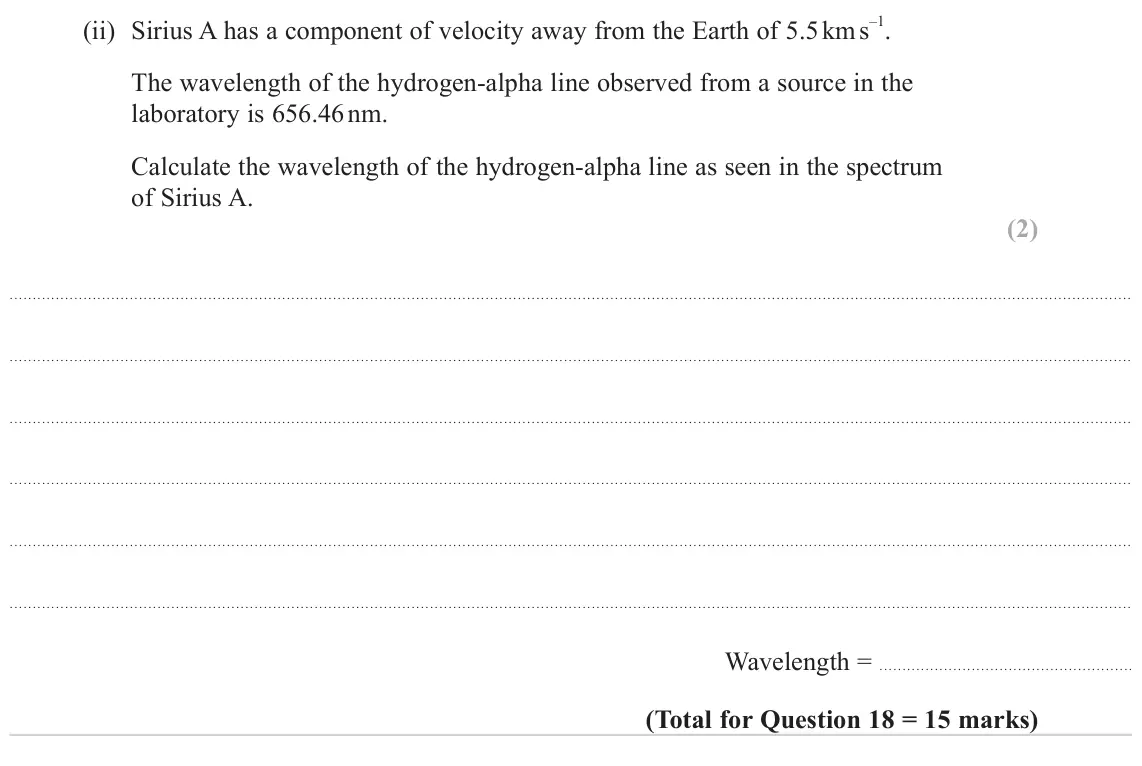
Q15(a)(i)
The whole paper ↗
Q15(a)(ii)
The whole paper ↗
Q15(a)(iii)
The whole paper ↗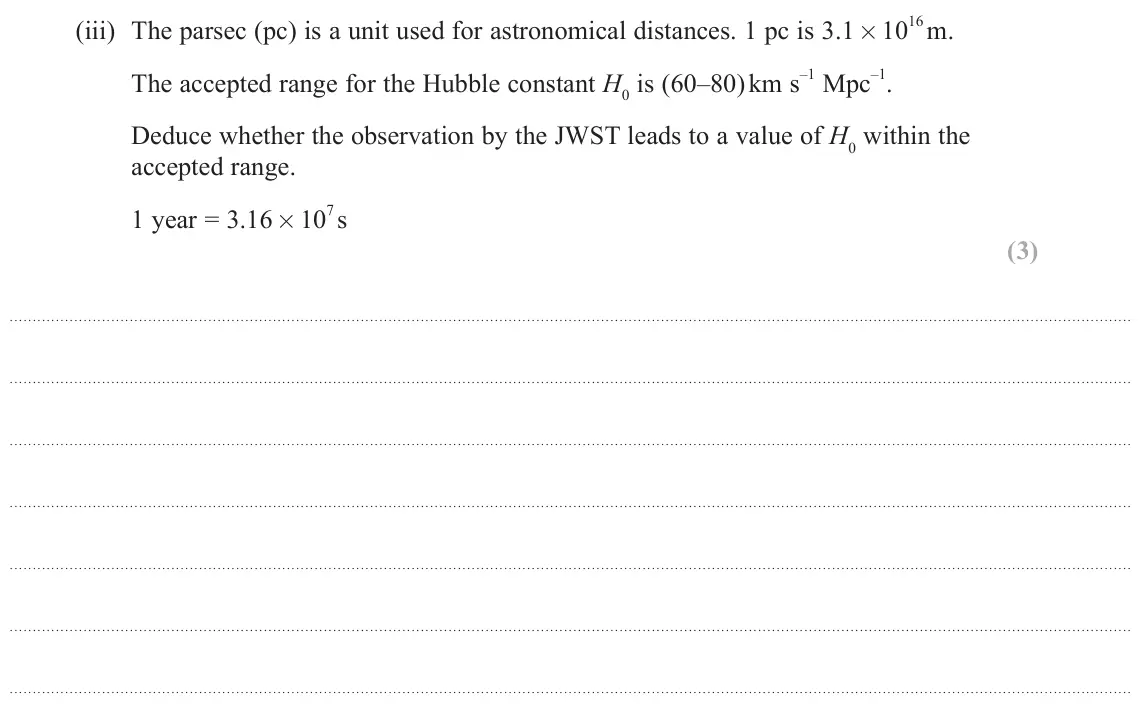
Q15(b)(i)
The whole paper ↗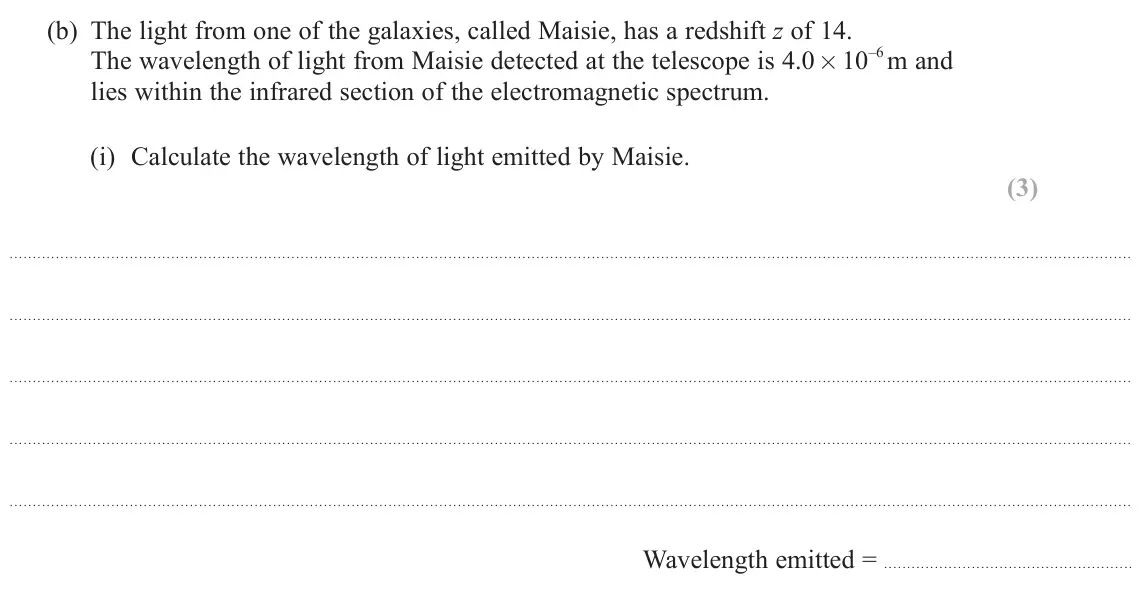
Q15(b)(ii)
The whole paper ↗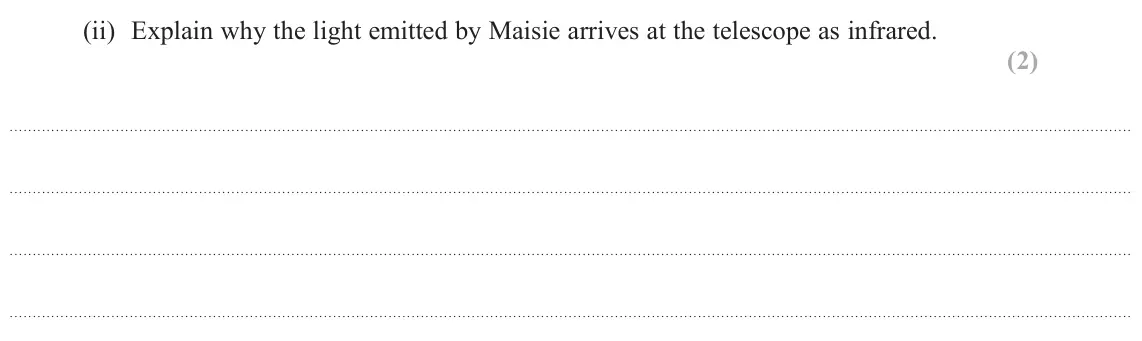
Q14(a)
The whole paper ↗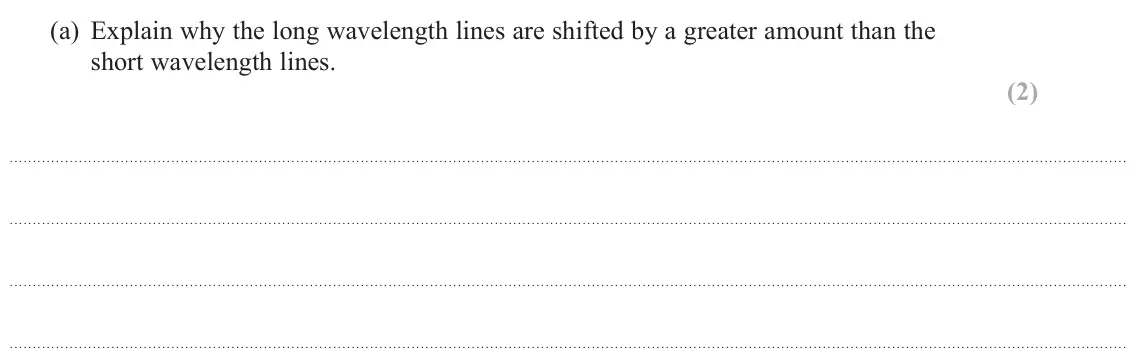
Q14(b)
The whole paper ↗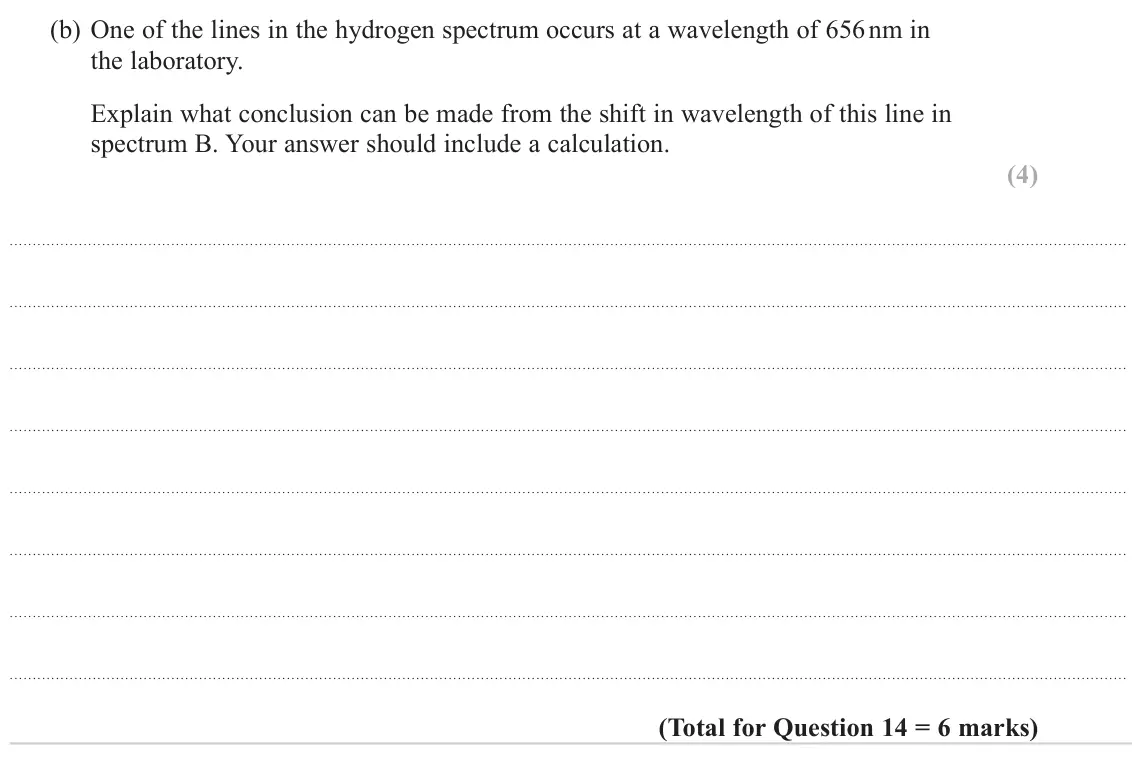
Q17(c)
The whole paper ↗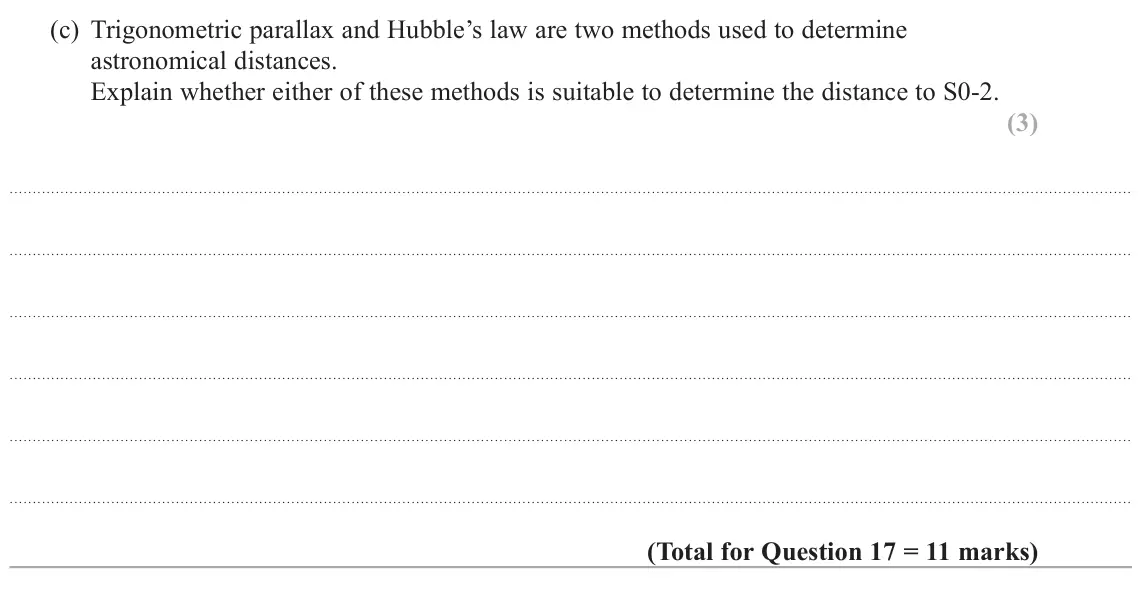
Q18(c)(iii)
The whole paper ↗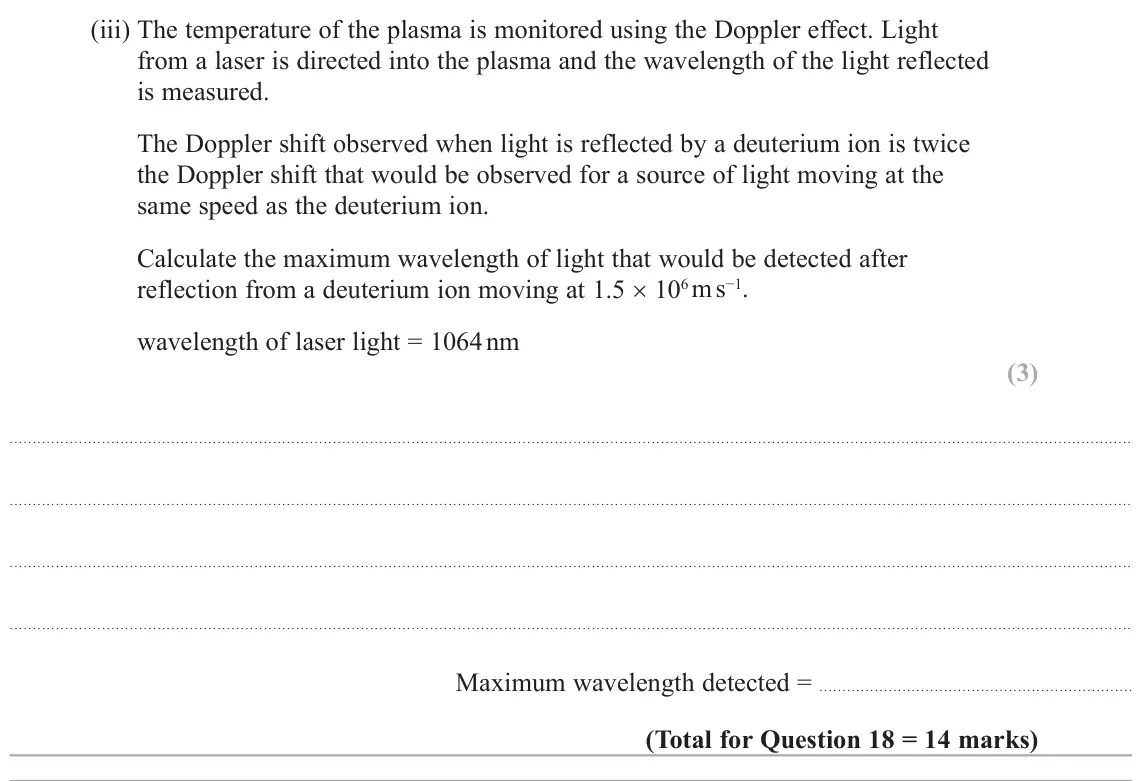
Q14(a)
The whole paper ↗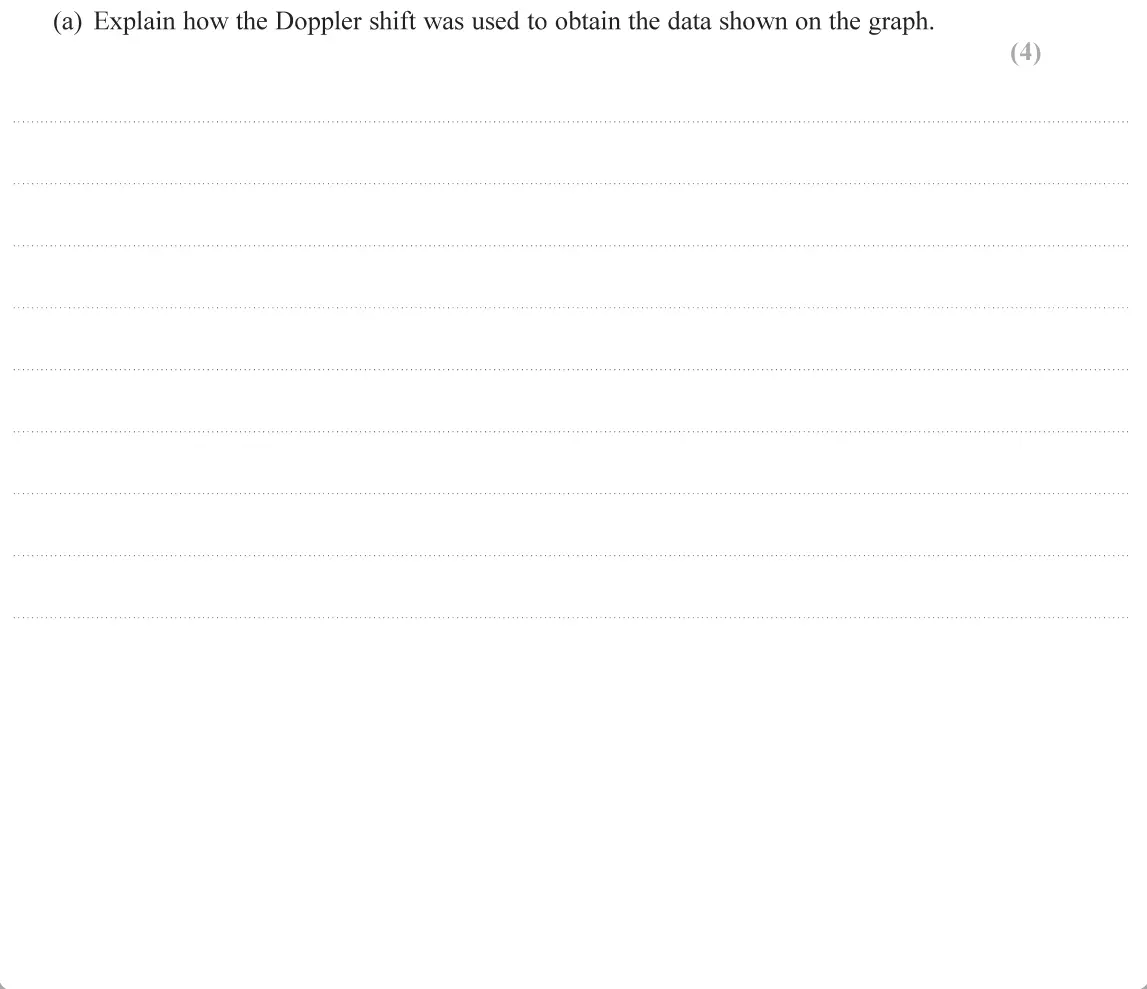
Q6(c)
The whole paper ↗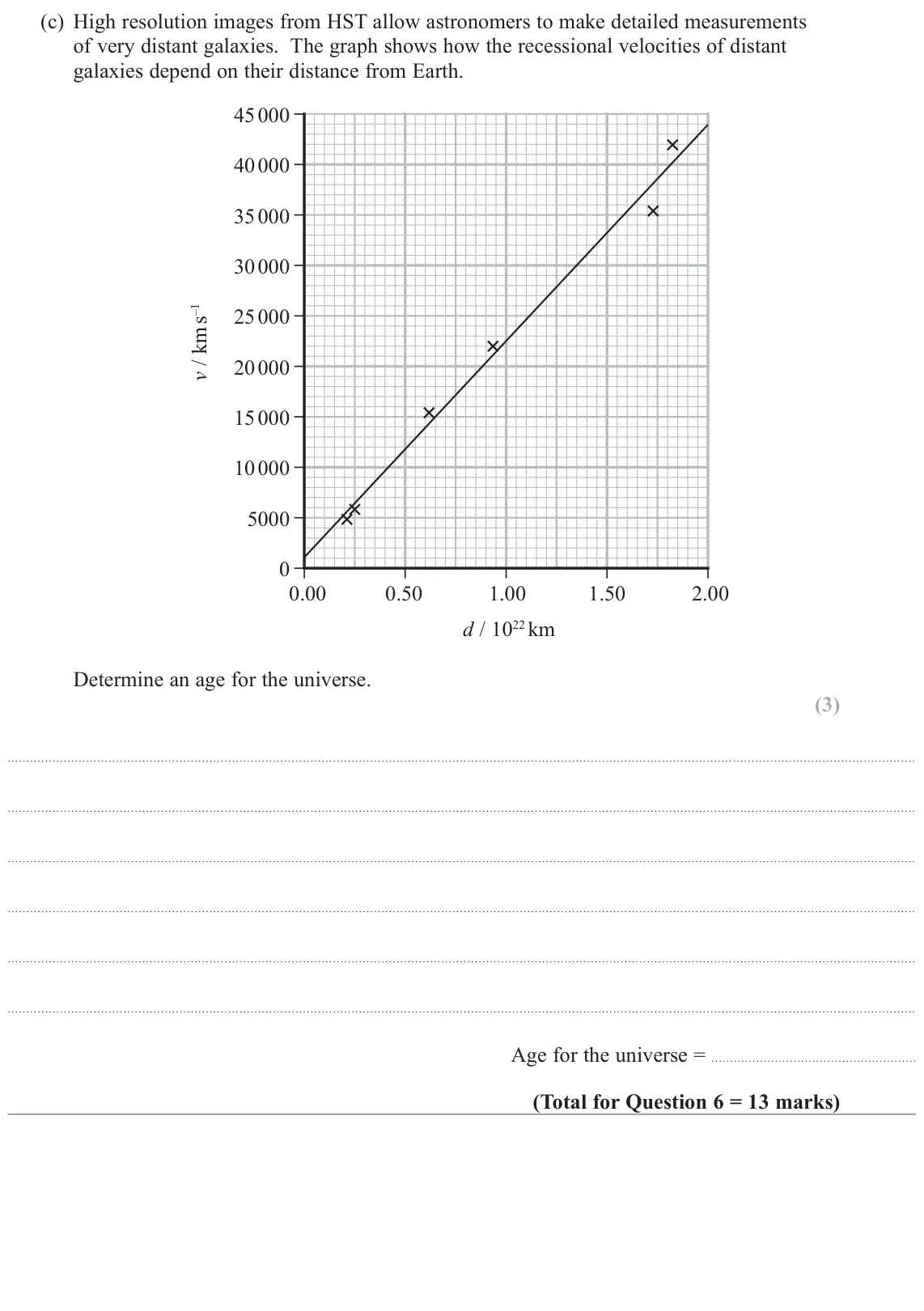
Q13(c)
The whole paper ↗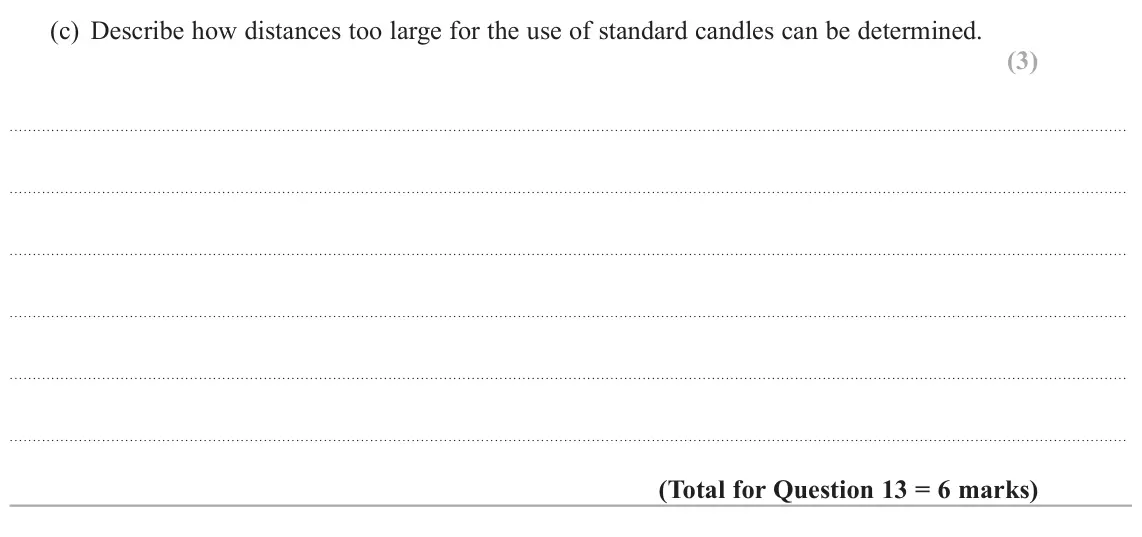
All 21 questions on Redshift and cosmology, as a list
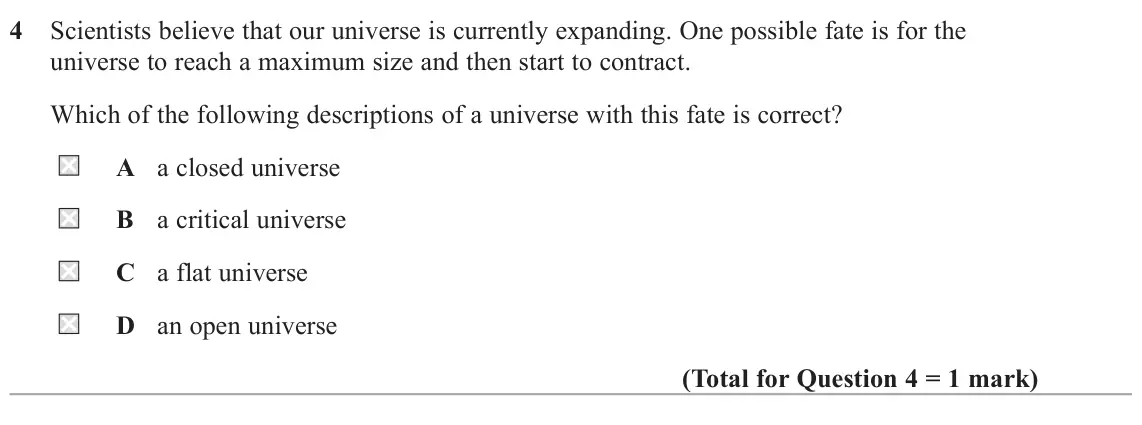
- June 2025, Paper 2, Q4 (1 mark): Scientists believe that our universe is currently expanding. One possible fate is for the universe to reach a maximum size and then start to contract. Which of
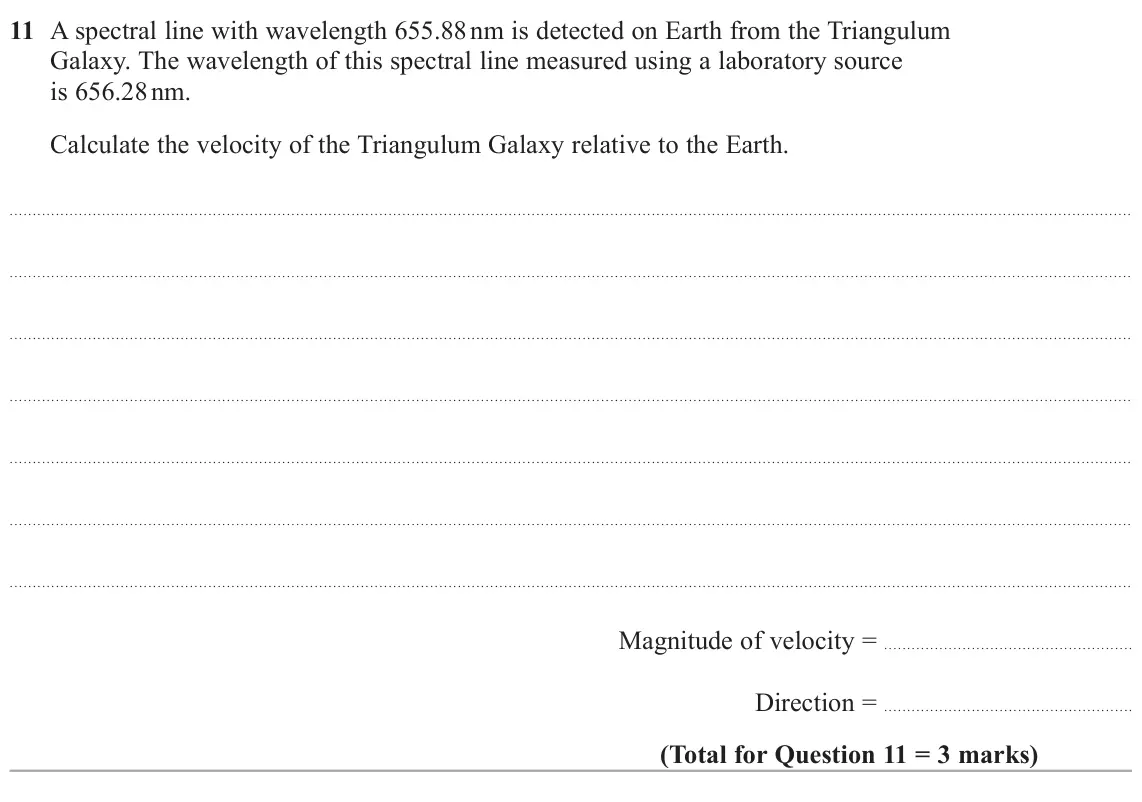
- June 2025, Paper 2, Q11 (3 marks): A spectral line with wavelength 655.88 nm is detected on Earth from the Triangulum Galaxy. The wavelength of this spectral line measured using a laboratory sour
- June 2025, Paper 2, Q15(b) (1 mark): The pulsar is estimated to be travelling away from the Earth with a velocity –1. of 750 m s State why this motion away from the Earth does not significantly aff
- June 2024, Paper 2, Q18(c)(i) (3 marks): Assess Huggins’s suggestion. (3)
- June 2024, Paper 2, Q18(c)(ii) (2 marks): Sirius A has a component of velocity away from the Earth of 5.5 km s –1. The wavelength of the hydrogen-alpha line observed from a source in the laboratory is 6
- June 2023, Paper 2, Q15(a)(i) (1 mark): Derive the equation T = 1/H0 where T is the age of the universe. (1)
- June 2023, Paper 2, Q15(a)(ii) (1 mark): State one assumption made in your derivation. (1)
- June 2023, Paper 2, Q15(a)(iii) (3 marks): The parsec (pc) is a unit used for astronomical distances. 1 pc is 3.1 × 10 –1 Mpc –1. The accepted range for the Hubble constant H0 is (60–80) km s Deduce whet
- June 2023, Paper 2, Q15(b)(i) (3 marks): Calculate the wavelength of light emitted by Maisie. (3) Wavelength emitted =
- June 2023, Paper 2, Q15(b)(ii) (2 marks): Explain why the light emitted by Maisie arrives at the telescope as infrared. (2)
- June 2022, Paper 2, Q14(a) (2 marks): Explain why the long wavelength lines are shifted by a greater amount than the short wavelength lines. (2)
- June 2022, Paper 2, Q14(b) (4 marks): One of the lines in the hydrogen spectrum occurs at a wavelength of 656 nm in the laboratory. Explain what conclusion can be made from the shift in wavelength o
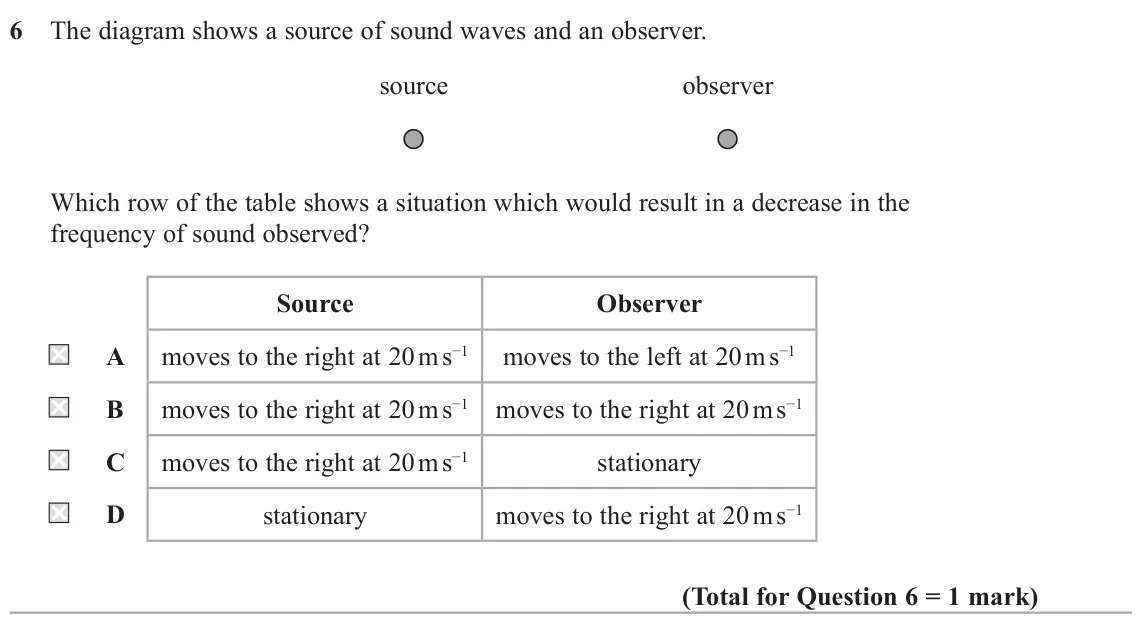
- November 2021, Paper 2, Q6 (1 mark): The diagram shows a source of sound waves and an observer. source observer Which row of the table shows a situation which would result in a decrease in the freq
- November 2021, Paper 2, Q17(c) (3 marks): Trigonometric parallax and Hubble’s law are two methods used to determine astronomical distances. Explain whether either of these methods is suitable to determi
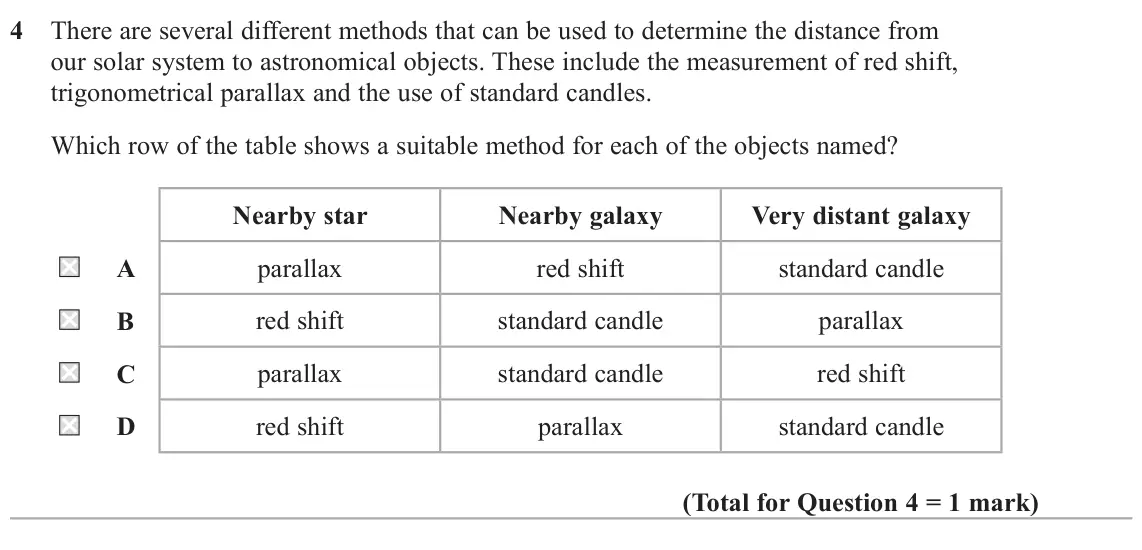
- October 2020, Paper 2, Q4 (1 mark): There are several different methods that can be used to determine the distance from our solar system to astronomical objects. These include the measurement of r
- October 2020, Paper 2, Q18(c)(iii) (3 marks): The temperature of the plasma is monitored using the Doppler effect. Light from a laser is directed into the plasma and the wavelength of the light reflected is
- June 2019, Paper 2, Q14(a) (4 marks): Explain how the Doppler shift was used to obtain the data shown on the graph. (4)
- June 2019, Paper 3, Q6(c) (3 marks): High resolution images from HST allow astronomers to make detailed measurements of very distant galaxies. The graph shows how the recessional velocities of dist
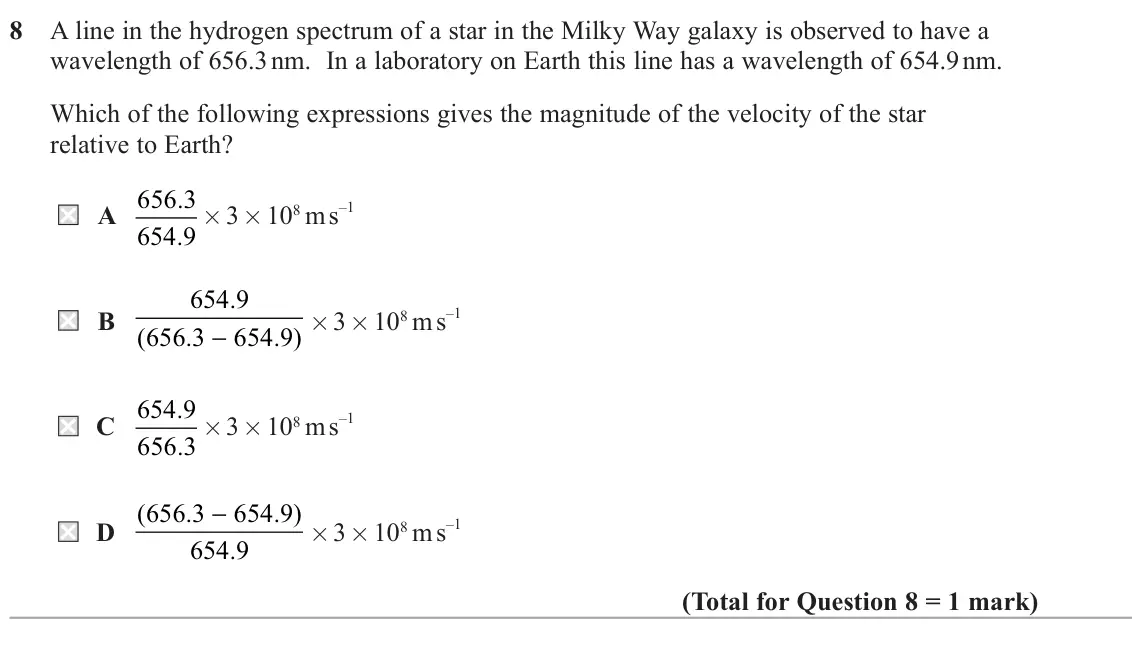
- June 2017, Paper 2, Q8 (1 mark): A line in the hydrogen spectrum of a star in the Milky Way galaxy is observed to have a wavelength of 656.3 nm. In a laboratory on Earth this line has a wavelen
- June 2017, Paper 2, Q13(c) (3 marks): Describe how distances too large for the use of standard candles can be determined. (3)
- June 2017, Paper 3, Q12(a) (3 marks): Calculate the velocity of Barnard’s star relative to the Earth. (3) Velocity =
Questions, mark schemes and examiner’s reports are © Pearson Edexcel, from their published past papers. Plumi isn’t affiliated with any exam board. Want whole papers? Every Edexcel A-Level Physics paper.
Rather write your answers by hand on iPad? Plumi marks them against the same mark schemes.