Skip to content

Algorithms and sorting: Edexcel A‑Level Further Maths questions

Every Edexcel A-Level Further Maths exam question on D.1 Algorithms and sorting, 2018–2025, with its mark scheme and examiner’s report.

Find questions824
824 questions

  1. Q1

    June 2025 · Decision 1

    The whole paper ↗
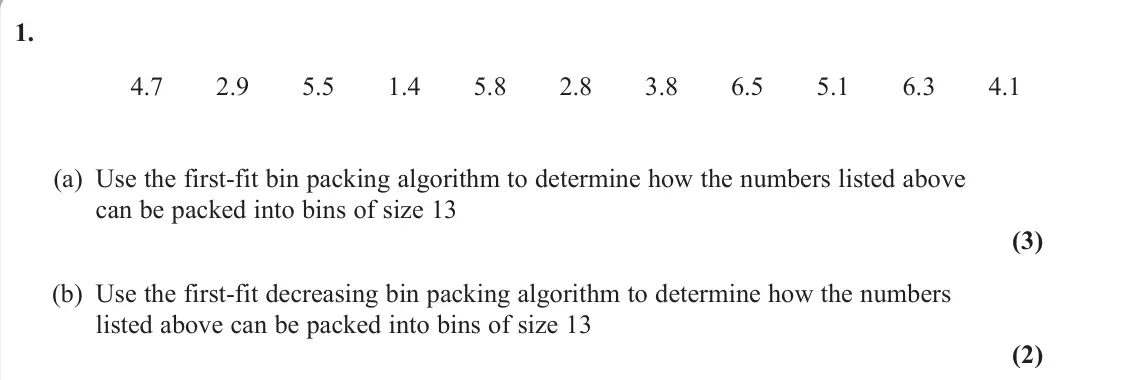
    June 2025 Decision 1, question 1: 4.7 2.9 5.5 1.4 5.8 2.8 3.8 6.5 5.1 6.3 4.1 (a) Use the first-fit bin packing algorithm to determine how the numbers listed above can be packed into bins of siz
  2. Q2

    June 2025 · Decision 1

    The whole paper ↗
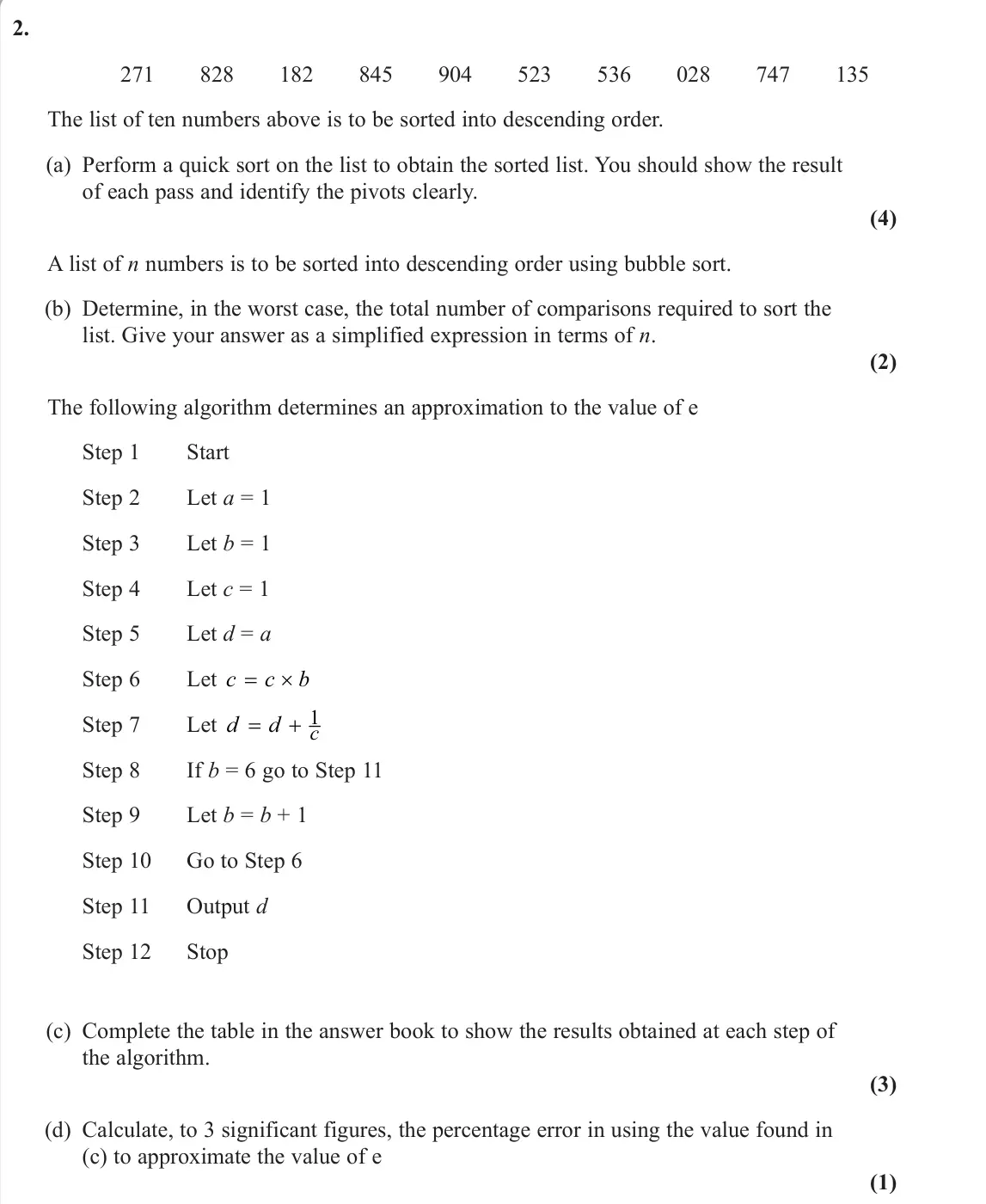
    June 2025 Decision 1, question 2: 271 828 182 845 904 523 536 028 747 135 The list of ten numbers above is to be sorted into descending order. (a) Perform a quick sort on the list to obtain the
  3. Q1

    June 2025 · AS Decision 1

    The whole paper ↗
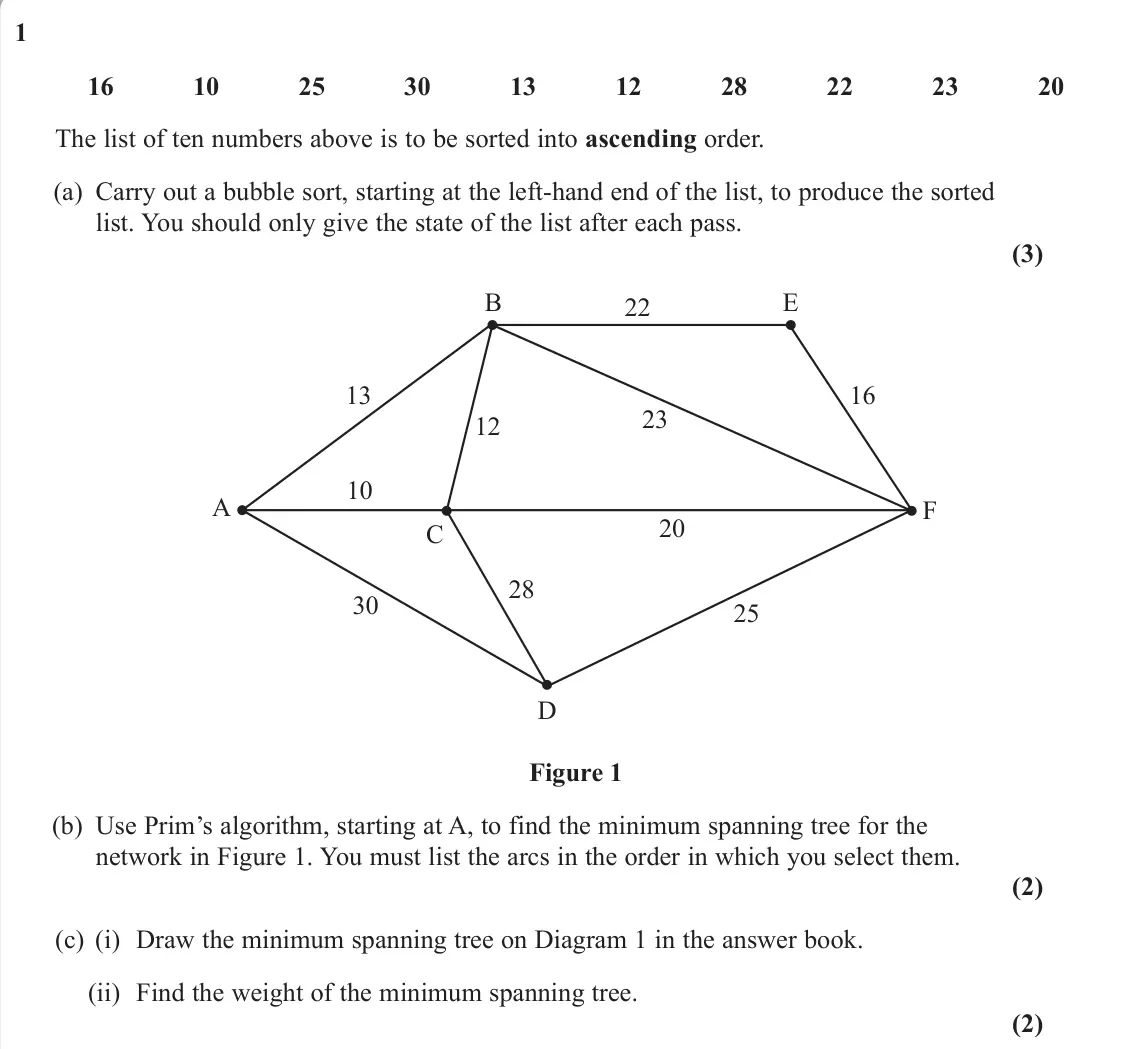
    June 2025 AS Decision 1, question 1: 1 16 10 25 30 13 12 28 22 23 20 The list of ten numbers above is to be sorted into ascending order. (a) Carry out a bubble sort, starting at the left-hand end o
  4. Q1

    June 2024 · Decision 1

    The whole paper ↗
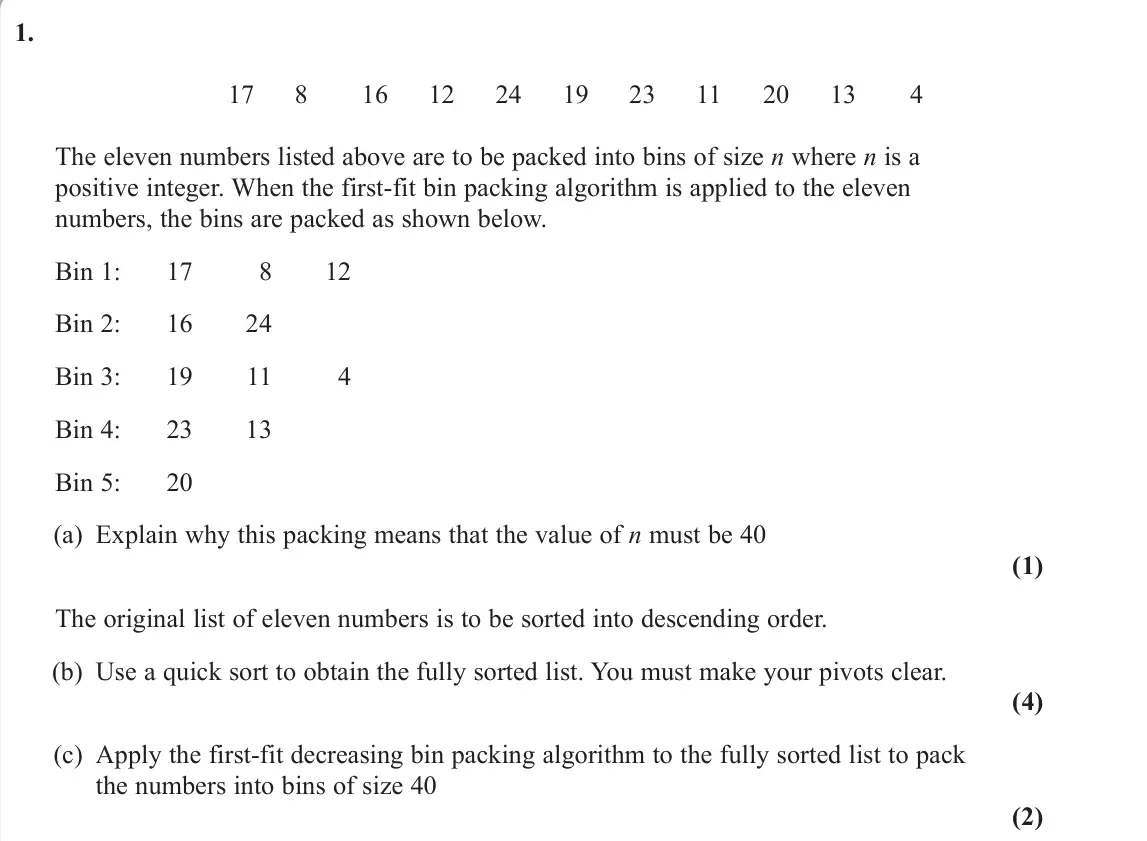
    June 2024 Decision 1, question 1: 17 8 16 12 24 19 23 11 20 13 4 The eleven numbers listed above are to be packed into bins of size n where n is a positive integer. When the first-fit bin packin
  5. Q1

    June 2024 · AS Decision 1

    No published mark scheme
    The whole paper ↗
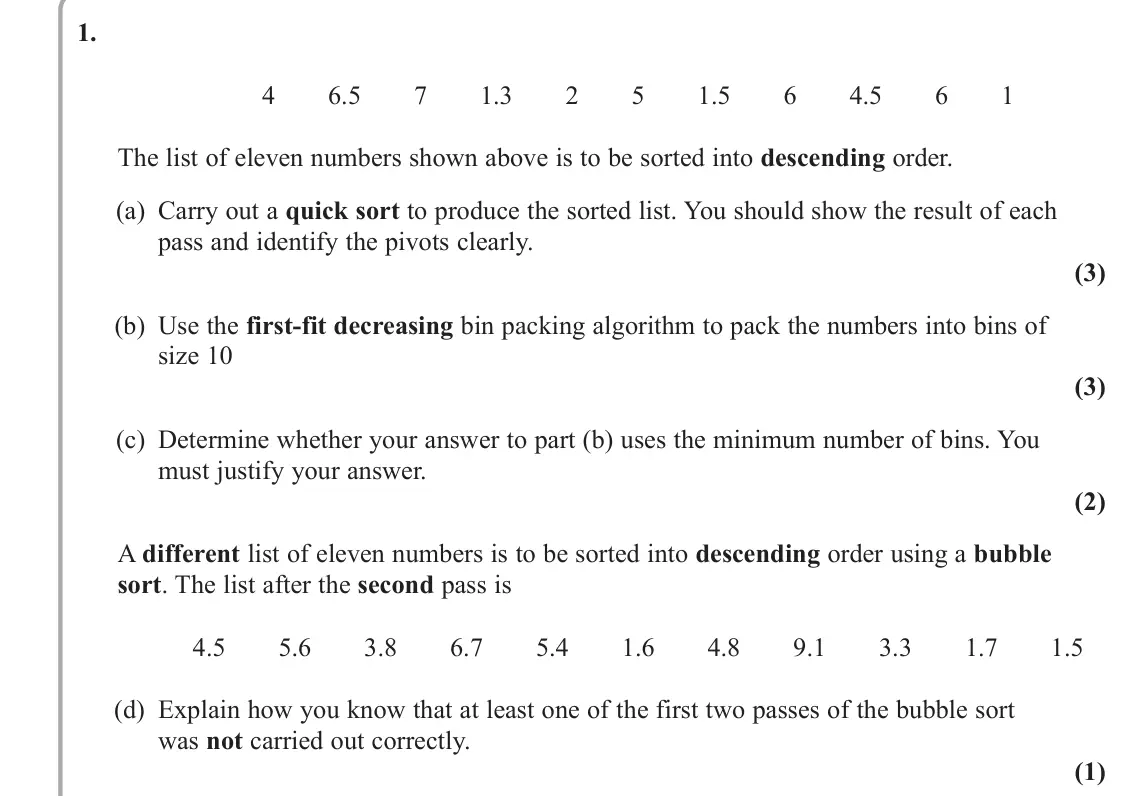
    June 2024 AS Decision 1, question 1: 4 6.5 7 1.3 2 5 1.5 6 4.5 6 1 The list of eleven numbers shown above is to be sorted into descending order. (a) Carry out a quick sort to produce the sorted lis
  6. Q4

    June 2023 · Decision 1

    The whole paper ↗
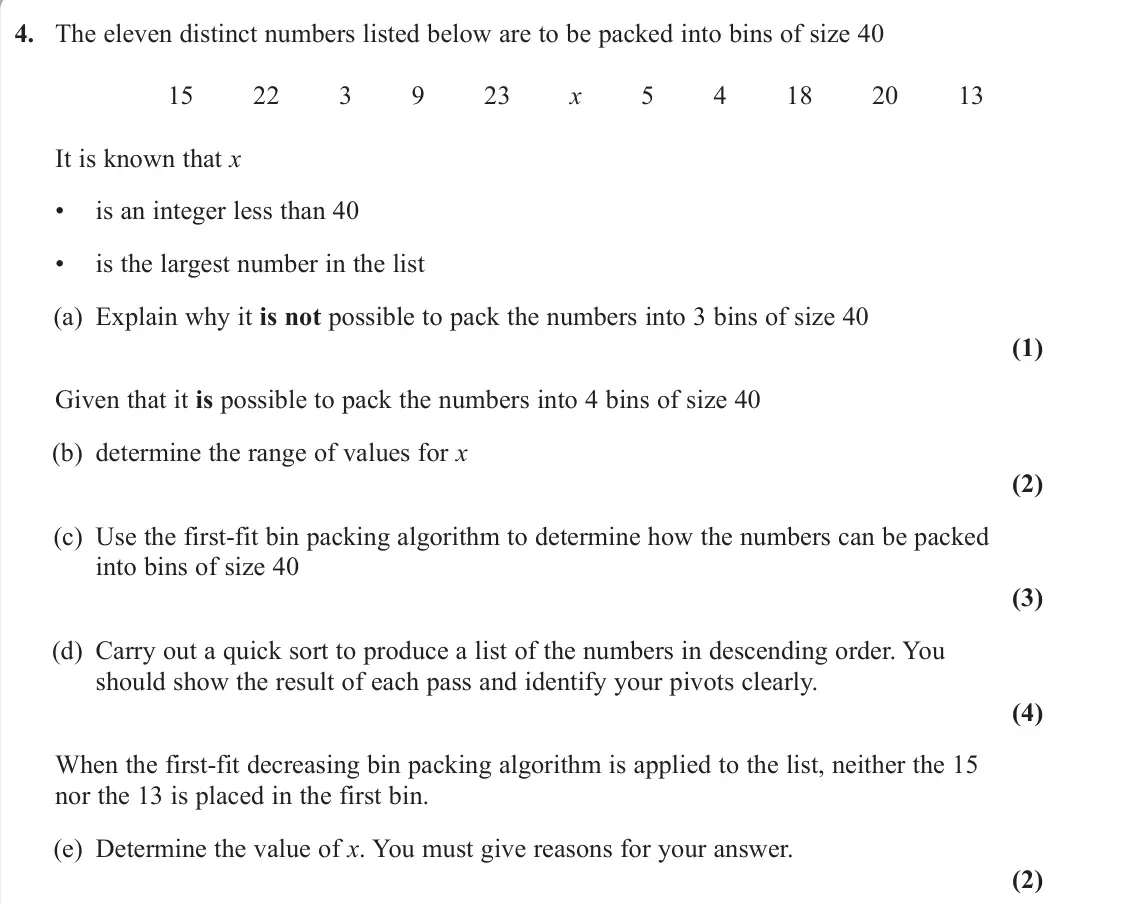
    June 2023 Decision 1, question 4: The eleven distinct numbers listed below are to be packed into bins of size 40 15 22 3 9 23 x 5 4 18 20 13 It is known that x • is an integer less than 40 • is
  7. Q1

    June 2023 · AS Decision 1

    The whole paper ↗
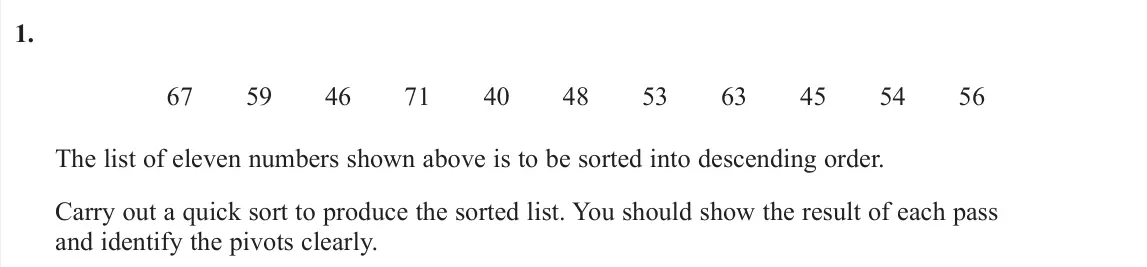
    June 2023 AS Decision 1, question 1: 67 59 46 71 40 48 53 63 45 54 56 The list of eleven numbers shown above is to be sorted into descending order. Carry out a quick sort to produce the sorted list
  8. Q1

    June 2022 · Decision 1

    The whole paper ↗
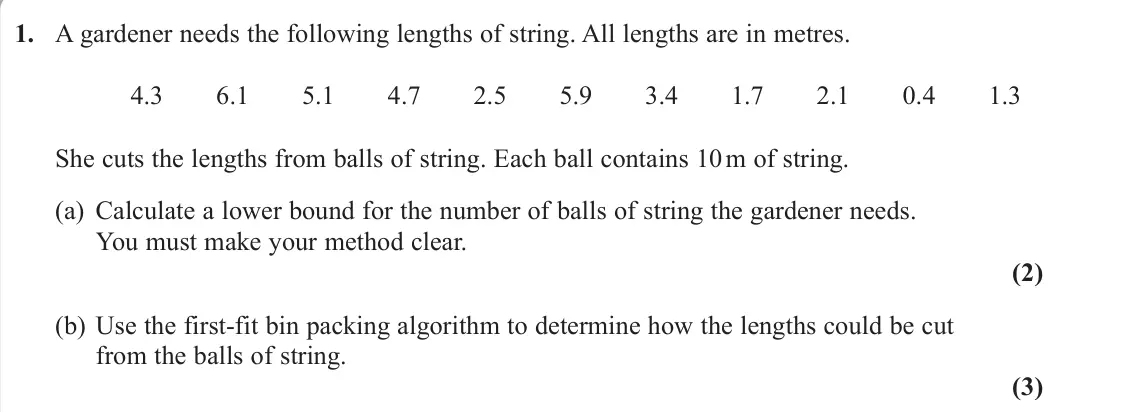
    June 2022 Decision 1, question 1: A gardener needs the following lengths of string. All lengths are in metres. 4.3 6.1 5.1 4.7 2.5 5.9 3.4 1.7 2.1 0.4 1.3 She cuts the lengths from balls of stri
  9. Q6

    June 2022 · Decision 1

    The whole paper ↗
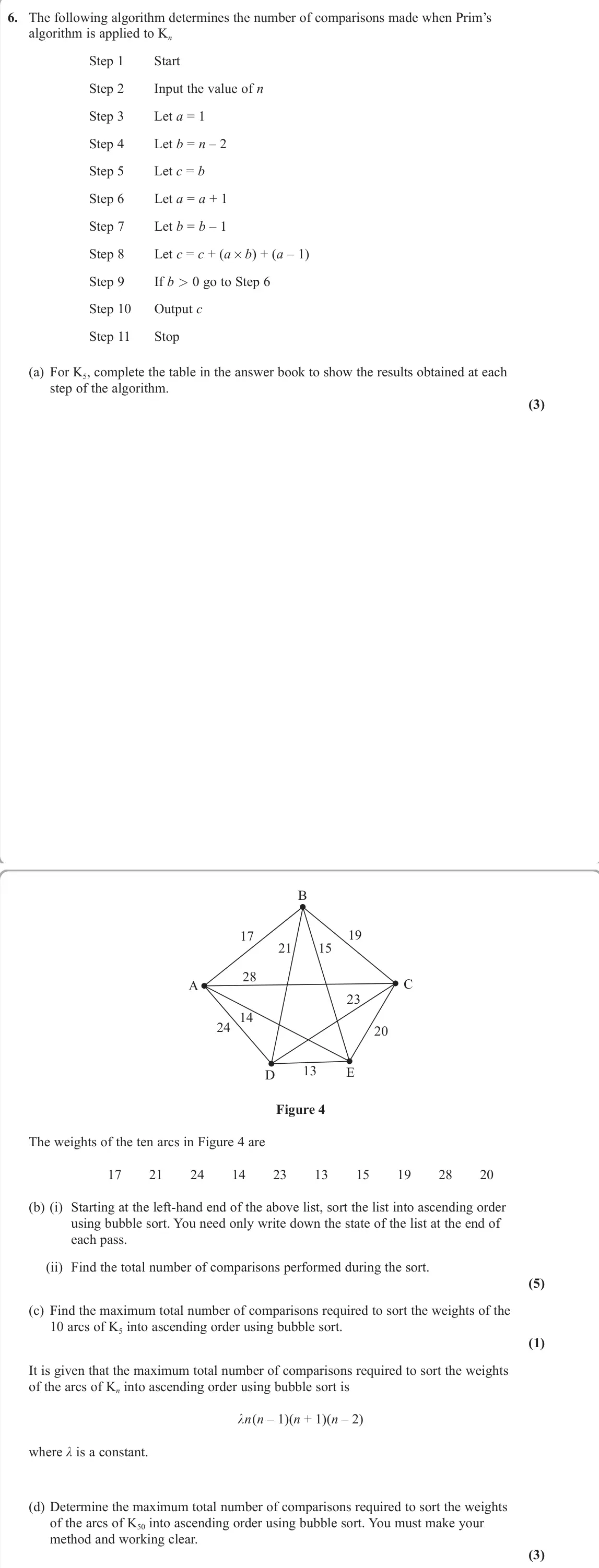
    June 2022 Decision 1, question 6: The following algorithm determines the number of comparisons made when Prim’s algorithm is applied to Kn Step 1 Start Step 2 Input the value of n Step 3 Let a =
  10. Q1

    June 2022 · AS Decision 1

    The whole paper ↗
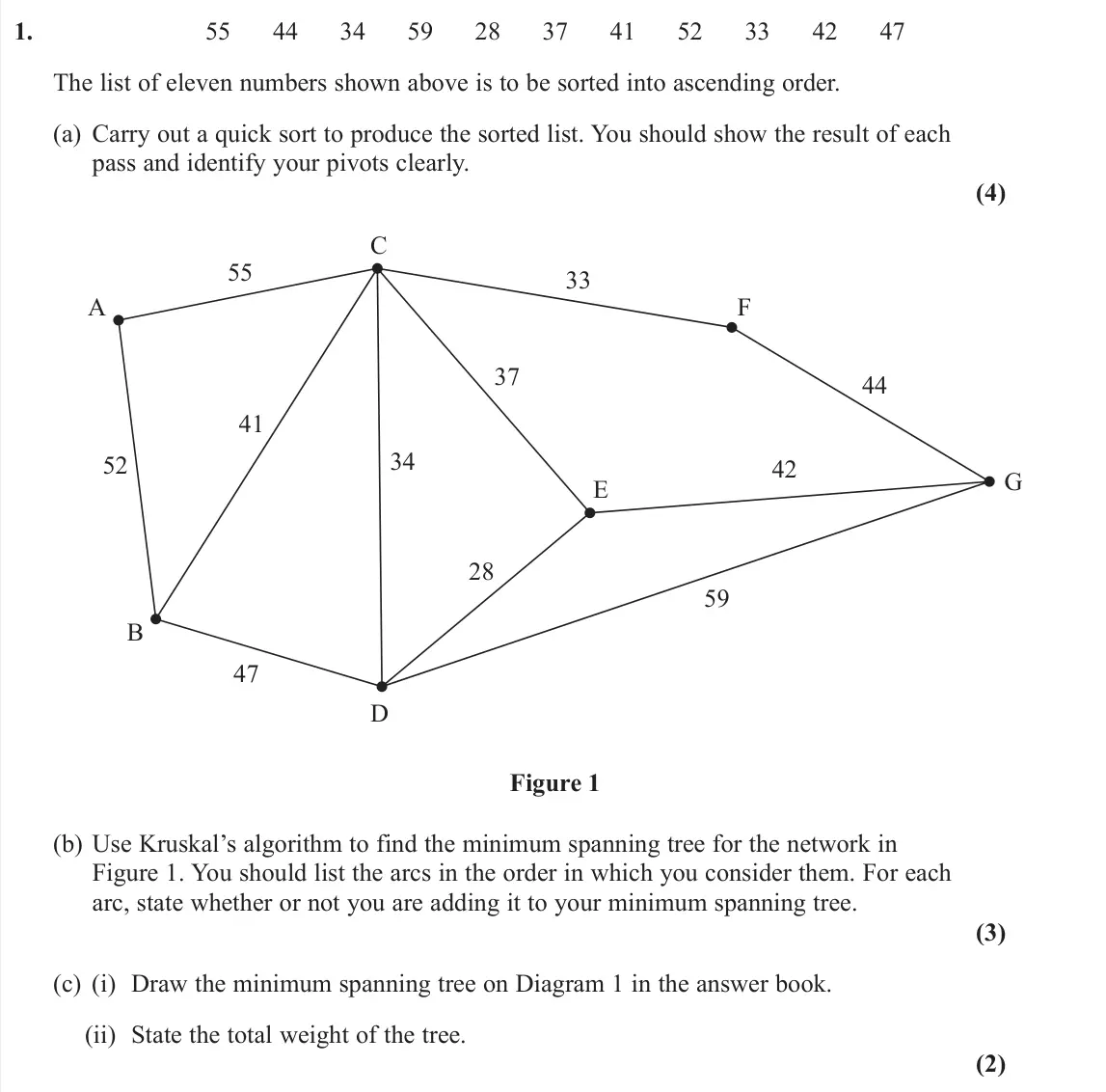
    June 2022 AS Decision 1, question 1: 55 44 34 59 28 37 41 52 33 42 47 The list of eleven numbers shown above is to be sorted into ascending order. (a) Carry out a quick sort to produce the sorted l
  11. Q5

    November 2021 · Decision 1

    The whole paper ↗
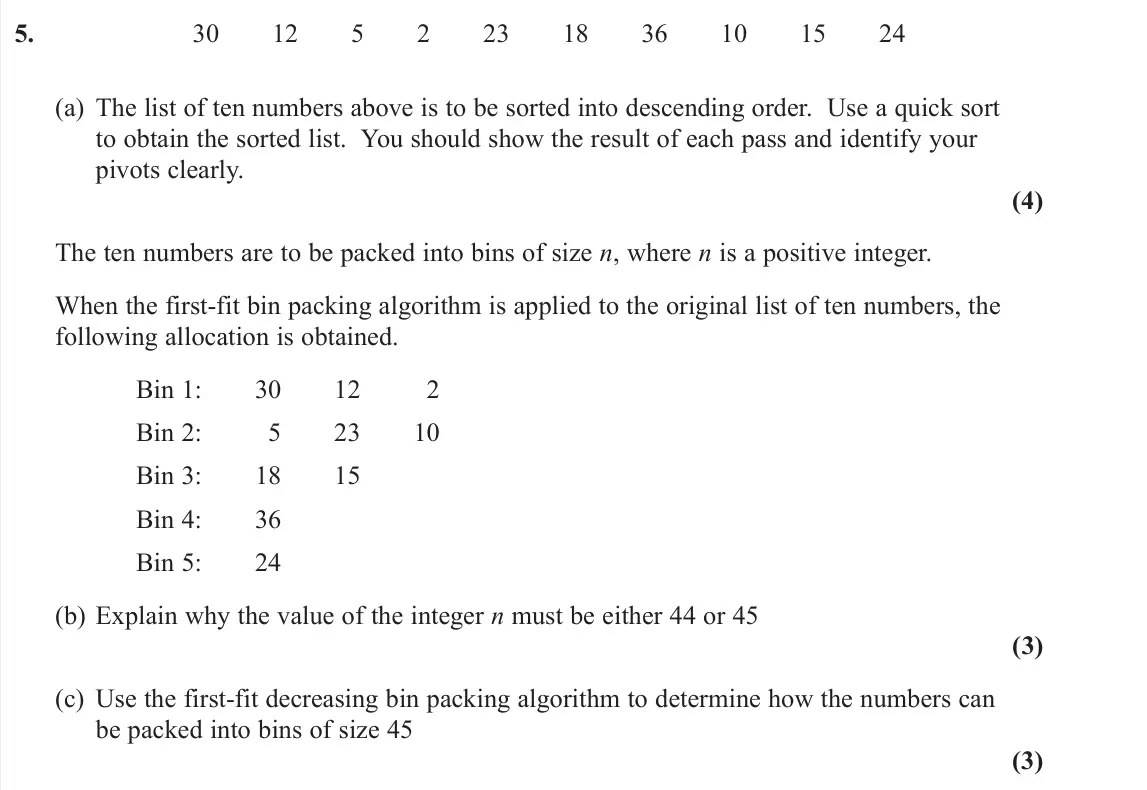
    November 2021 Decision 1, question 5: 30 12 5 2 23 18 36 10 15 24 (a) The list of ten numbers above is to be sorted into descending order. Use a quick sort to obtain the sorted list. You should show
  12. Q5

    November 2020 · Decision 1

    The whole paper ↗
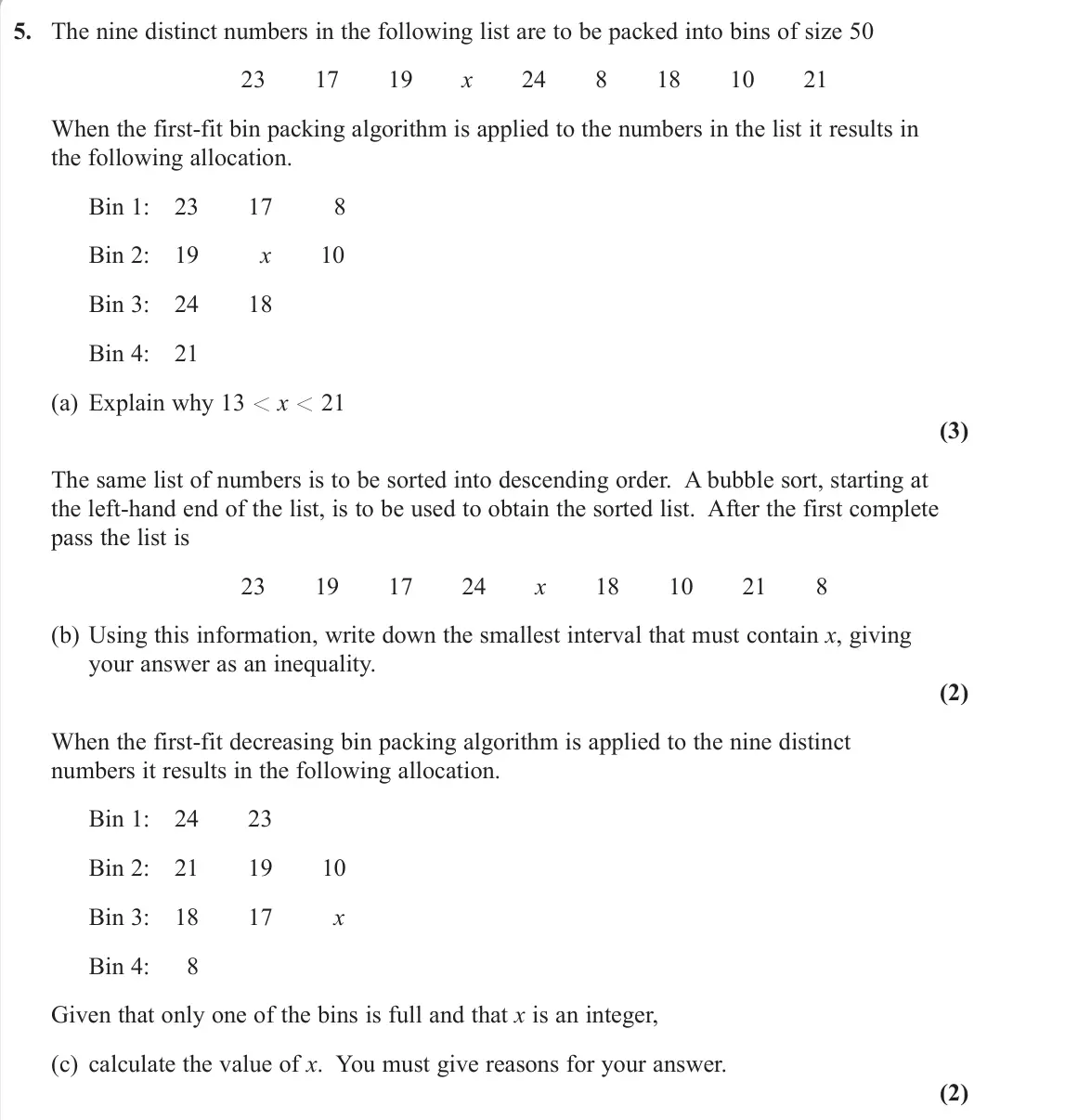
    November 2020 Decision 1, question 5: The nine distinct numbers in the following list are to be packed into bins of size 50 23 17 19 x 24 8 18 10 21 When the first-fit bin packing algorithm is appli
  13. Q1

    November 2020 · AS Decision 1

    The whole paper ↗
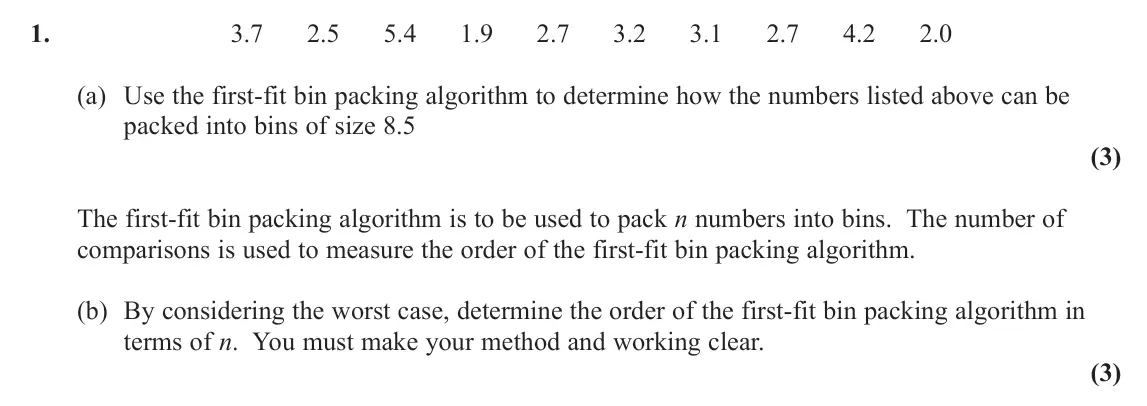
    November 2020 AS Decision 1, question 1: 3.7 2.5 5.4 1.9 2.7 3.2 3.1 2.7 4.2 2.0 (a) Use the first‑fit bin packing algorithm to determine how the numbers listed above can be packed into bins of size 8.
  14. Q1

    June 2019 · Decision 1

    The whole paper ↗
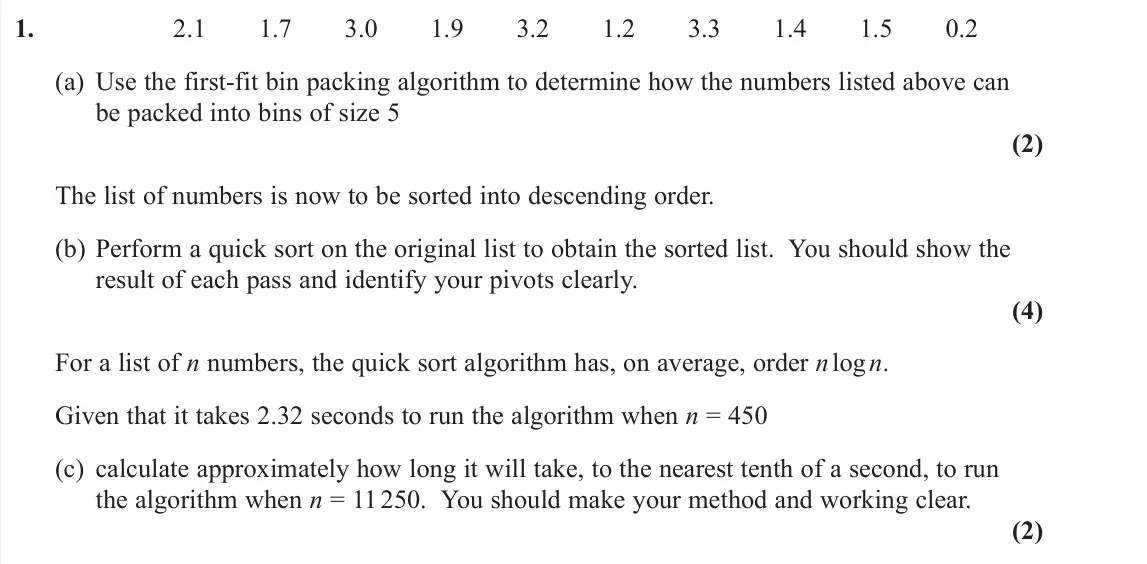
    June 2019 Decision 1, question 1: 2.1 1.7 3.0 1.9 3.2 1.2 3.3 1.4 1.5 0.2 (a) Use the first-fit bin packing algorithm to determine how the numbers listed above can be packed into bins of size 5
  15. Q2

    June 2019 · AS Decision 1

    The whole paper ↗
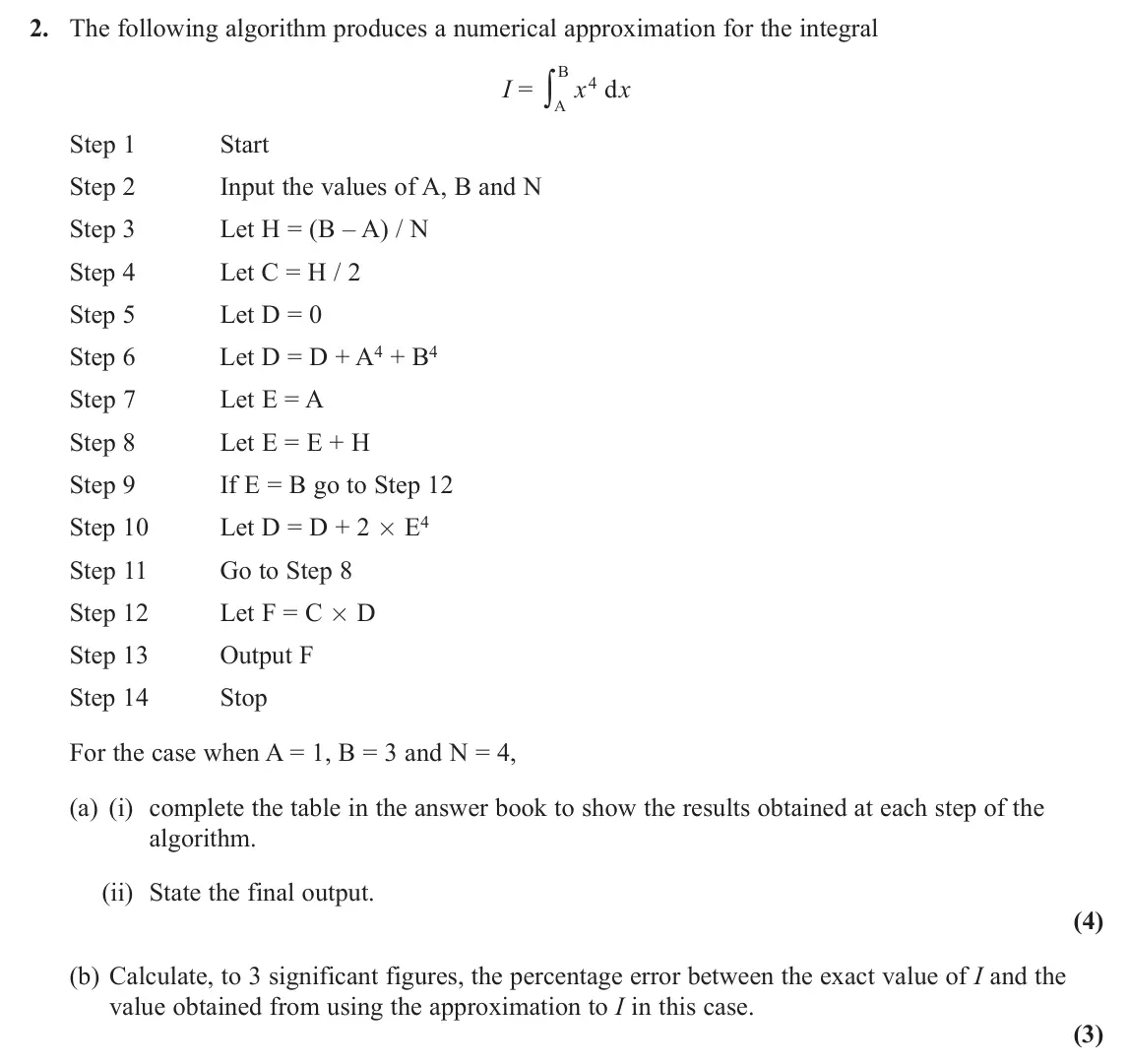
    June 2019 AS Decision 1, question 2: The following algorithm produces a numerical approximation for the integral I = A B∫ x4 dx Step 1 Start Step 2 Input the values of A, B and N Step 3 Let H = (B
All 15 questions on Algorithms and sorting, as a list
  1. June 2025, Decision 1, Q1 (5 marks): 4.7 2.9 5.5 1.4 5.8 2.8 3.8 6.5 5.1 6.3 4.1 (a) Use the first-fit bin packing algorithm to determine how the numbers listed above can be packed into bins of siz
  2. June 2025, Decision 1, Q2 (10 marks): 271 828 182 845 904 523 536 028 747 135 The list of ten numbers above is to be sorted into descending order. (a) Perform a quick sort on the list to obtain the
  3. June 2025, AS Decision 1, Q1 (7 marks): 1 16 10 25 30 13 12 28 22 23 20 The list of ten numbers above is to be sorted into ascending order. (a) Carry out a bubble sort, starting at the left-hand end o
  4. June 2024, Decision 1, Q1 (7 marks): 17 8 16 12 24 19 23 11 20 13 4 The eleven numbers listed above are to be packed into bins of size n where n is a positive integer. When the first-fit bin packin
  5. June 2024, AS Decision 1, Q1 (9 marks): 4 6.5 7 1.3 2 5 1.5 6 4.5 6 1 The list of eleven numbers shown above is to be sorted into descending order. (a) Carry out a quick sort to produce the sorted lis
  6. June 2023, Decision 1, Q4 (12 marks): The eleven distinct numbers listed below are to be packed into bins of size 40 15 22 3 9 23 x 5 4 18 20 13 It is known that x • is an integer less than 40 • is
  7. June 2023, AS Decision 1, Q1 (4 marks): 67 59 46 71 40 48 53 63 45 54 56 The list of eleven numbers shown above is to be sorted into descending order. Carry out a quick sort to produce the sorted list
  8. June 2022, Decision 1, Q1 (5 marks): A gardener needs the following lengths of string. All lengths are in metres. 4.3 6.1 5.1 4.7 2.5 5.9 3.4 1.7 2.1 0.4 1.3 She cuts the lengths from balls of stri
  9. June 2022, Decision 1, Q6 (12 marks): The following algorithm determines the number of comparisons made when Prim’s algorithm is applied to Kn Step 1 Start Step 2 Input the value of n Step 3 Let a =
  10. June 2022, AS Decision 1, Q1 (9 marks): 55 44 34 59 28 37 41 52 33 42 47 The list of eleven numbers shown above is to be sorted into ascending order. (a) Carry out a quick sort to produce the sorted l
  11. November 2021, Decision 1, Q5 (10 marks): 30 12 5 2 23 18 36 10 15 24 (a) The list of ten numbers above is to be sorted into descending order. Use a quick sort to obtain the sorted list. You should show
  12. November 2020, Decision 1, Q5 (7 marks): The nine distinct numbers in the following list are to be packed into bins of size 50 23 17 19 x 24 8 18 10 21 When the first-fit bin packing algorithm is appli
  13. November 2020, AS Decision 1, Q1 (6 marks): 3.7 2.5 5.4 1.9 2.7 3.2 3.1 2.7 4.2 2.0 (a) Use the first‑fit bin packing algorithm to determine how the numbers listed above can be packed into bins of size 8.
  14. June 2019, Decision 1, Q1 (8 marks): 2.1 1.7 3.0 1.9 3.2 1.2 3.3 1.4 1.5 0.2 (a) Use the first-fit bin packing algorithm to determine how the numbers listed above can be packed into bins of size 5
  15. June 2019, AS Decision 1, Q2 (7 marks): The following algorithm produces a numerical approximation for the integral I = A B∫ x4 dx Step 1 Start Step 2 Input the values of A, B and N Step 3 Let H = (B

Questions, mark schemes and examiner’s reports are © Pearson Edexcel, from their published past papers. Plumi isn’t affiliated with any exam board. Want whole papers? Every Edexcel A-Level Further Maths paper.

Rather write your answers by hand on iPad? Plumi marks them against the same mark schemes.